9 Best Identity Verification Solutions for Secure Digital Onboarding
9 Best Identity Verification Solutions for Secure Digital Onboarding
9 Best Identity Verification Solutions for Secure Digital Onboarding
Compare the best identity verification solutions for KYC, fraud prevention, and onboarding. Evaluate features, pricing, and top IDV providers.
Author
Team Bureau


See how Bureau has helped industry leaders defend against networked Industrial-scale frauds →
Schedule a Demo
TABLE OF CONTENTS
See Less
Passing an identity check no longer means you can trust the person behind it. Someone can use synthetic identities, AI-generated documents, deepfakes, and stolen credentials to slip through verification while appearing like a legitimate customer.
Beyond identity verification, the strongest platforms combine document authentication, biometric verification, liveness detection, and fraud intelligence to help stop sophisticated onboarding fraud without creating unnecessary friction for genuine users.
In this guide, we'll compare the top identity verification solutions, examine their strengths and trade-offs, and show you how to evaluate identity verification providers based on fraud prevention, compliance, user experience, and scalability.
Capabilities We Evaluated While Shortlisting Identity Verification Solutions
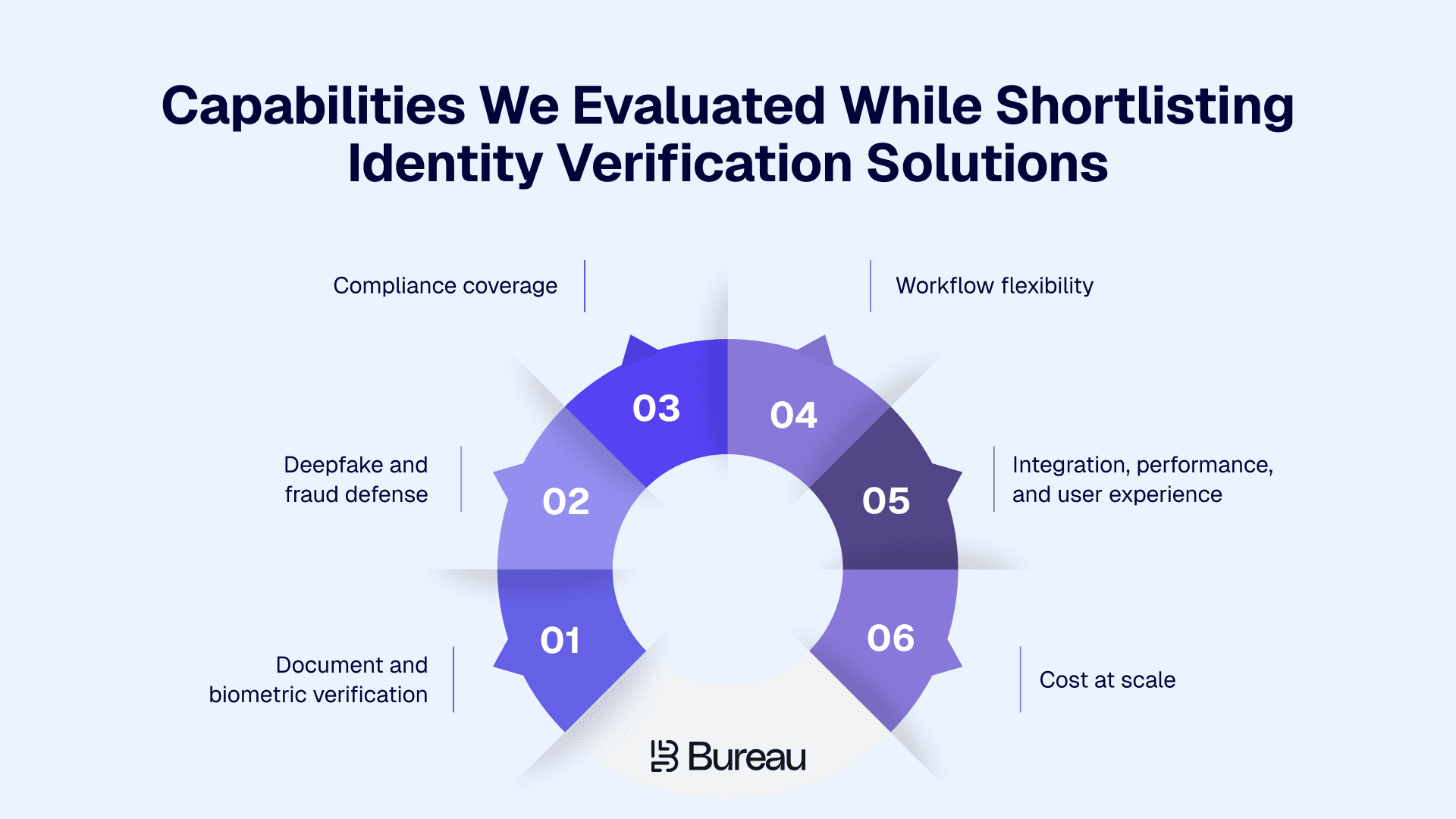
To make this comparison practical, we evaluated each vendor using the capabilities that matter most when shortlisting identity verification solutions:
Document and biometric verification: Ability to authenticate identity documents, support regional IDs, perform selfie matching, and use passive or active liveness detection to prevent spoofing.
Deepfake and fraud defense: Coverage for detecting deepfakes, injection and replay attacks, synthetic identities, risky devices, bots, and other fraud signals.
Compliance coverage: Support for KYC, KYB, AML, sanctions screening, audit trails, and region-specific regulatory requirements.
Workflow flexibility: Ease of configuring verification flows based on geography, product, user type, or risk level without heavy engineering effort.
Integration, performance, and user experience: Availability of APIs and SDKs, mobile support, low-latency verification, and strong completion rates.
Cost at scale: Pricing structure across verifications, retries, manual reviews, and add-on services to reflect long-term operating costs.
A 2025 systematic review covering 43 peer-reviewed studies concluded that AI-generated identities and deepfakes are significantly increasing the complexity of identity fraud detection, requiring multiple verification layers rather than document checks alone.
Together, these criteria provide a more complete way to compare identity verification solutions than feature lists alone, making it easier to shortlist the platforms that best fit your fraud, compliance, and growth objectives.
Top 9 Identity Verification Solutions in 2026
If you're building an initial shortlist, start with the comparison below. It highlights where each platform fits best, its core strength, and what to evaluate before making a decision.
Identity Verification Solution | Best For | Key Strength | What to Validate | Pricing Model |
Bureau ID | Risk-based onboarding and fraud decisioning | Combines identity, device, behavioral, network, and transaction intelligence in one platform | Best suited for organizations that need identity verification connected to broader risk decisioning | Usage-based, custom enterprise pricing |
IDVerse | AI-led digital identity verification | Automated document authentication and biometric verification | Validate regional document coverage and workflow flexibility | Per verification, tiered pricing |
Incode | Enterprise biometric identity verification | Strong face verification and biometric onboarding | Review implementation effort and workflow customization | Custom enterprise pricing |
Entrust | Enterprise identity and security programs | Mature identity proofing within a broader security ecosystem | Assess whether the broader platform aligns with your IDV requirements | Subscription + usage-based |
Persona | Configurable identity verification workflows | Flexible verification journeys and case management | Evaluate setup complexity and ongoing workflow management | Usage-based, modular pricing |
Jumio | Document and biometric verification | Mature document verification and selfie matching | Review manual review workflows and fallback options | Per verification, volume-based |
Veriff | Global digital onboarding | Fast document verification with biometric checks | Test verification accuracy across your priority markets | Per verification, volume discounts |
Proof | High-assurance identity verification | Identity evidence for legally sensitive transactions | Best suited for regulated or high-trust transaction workflows | Per transaction, premium pricing |
Ondato | KYC and AML onboarding | Strong compliance workflows and AML screening | Evaluate fraud detection capabilities beyond compliance requirements | Subscription + usage-based |
The comparison table provides a high-level overview, but each platform approaches identity verification differently. Here's a closer look at what each solution offers and where it fits best.
1. Bureau ID
Bureau ID is built for businesses that need more than identity verification. Instead of treating document authentication as a standalone checkpoint, it combines identity, device, behavioral, network, and transaction signals to help businesses make real-time trust decisions across onboarding, authentication, and ongoing account activity.
This makes Bureau ID a strong choice for organizations that want to reduce onboarding fraud without stitching together separate tools for identity verification, fraud detection, device intelligence, and compliance.
Key benefits:
All-in-one protection: Manage identity verification, fraud prevention, and risk decisioning in one place so you can reduce complexity and make faster, more confident decisions.
Stronger onboarding accuracy: Combine document checks, biometric verification, liveness detection, and device intelligence to verify users more reliably and reduce fake account creation.
Smarter fraud detection: Use behavioral biometrics and graph-based identity intelligence to uncover synthetic identities, repeat fraudsters, and hidden fraud networks before they cause losses.
End-to-end compliance coverage: Handle KYC, KYB, AML, onboarding, authentication, and transaction monitoring from a single platform to simplify compliance and reduce operational overhead.
Faster workflow control: Configure approval, review, and step-up verification flows without engineering support, helping your team respond quickly to changing risk patterns.
Clear, actionable decisions: Get explainable risk scores that show why a user is flagged, so your team can make informed decisions instead of relying on basic pass/fail outcomes.
While the platform is strong in unified identity verification and fraud decisioning, there are a few considerations to keep in mind:
Best suited for organizations that want identity verification integrated with broader fraud and risk workflows.
Businesses looking only for basic document capture or OCR may not require the platform's full capabilities.
Best for: Banks, fintechs, NBFCs, marketplaces, gaming platforms, eCommerce businesses, and other high-volume digital businesses that need to verify users while detecting synthetic identities, account farms, mule accounts, device spoofing, and repeat fraud.
Related Read: How Businesses Can Stop AI Identity Fraud With Connected Risk Intelligence
2. IDVerse
IDVerse is an AI-powered identity verification platform designed for businesses that want fast, automated digital onboarding. It combines document authentication, biometric verification, and liveness detection to help organizations verify users remotely while reducing manual review and improving fraud detection across KYC workflows.
Key benefits:
Accelerate digital onboarding: Automate document and biometric verification to reduce manual intervention and shorten verification times.
Improve verification accuracy: Use AI-powered document authentication and facial matching to verify legitimate users with confidence.
Reduce impersonation risk: Leverage passive liveness detection to help defend against presentation attacks during onboarding.
Scale across digital channels: Support remote identity verification for web and mobile onboarding journeys.
Strengthen compliance: Integrate identity proofing into KYC workflows without creating unnecessary friction for genuine users.
IDVerse delivers a streamlined AI-led verification experience, but buyers should validate a few areas before making a decision.
Confirm document coverage and verification accuracy for the countries and ID types most relevant to your business.
Businesses with highly customized onboarding journeys should test workflow flexibility and reporting capabilities during the evaluation process.
Best for: Financial institutions, fintechs, and digital businesses looking for AI-led identity verification with fast, remote onboarding.
3. Incode
Incode is an enterprise identity verification platform that combines biometric authentication, document verification, and AI-powered fraud detection into a single onboarding experience. It is commonly shortlisted by organizations looking for high-assurance identity verification across customer onboarding, workforce identity, and regulated digital services.
Key benefits:
Strengthen biometric security: Combine facial recognition, document verification, and liveness detection to improve identity assurance.
Increase onboarding success rates: Deliver fast, AI-driven verification while minimizing friction for legitimate users.
Support enterprise deployments: Scale identity verification across customer, employee, and partner onboarding workflows.
Defend against advanced fraud: Detect spoofing attempts and AI-generated identity attacks with built-in fraud detection.
Integrate with existing systems: Connect identity verification into enterprise workflows through APIs and SDKs.
While Incode offers a mature enterprise platform, a few considerations are worth evaluating.
Review implementation effort and internal technical resources required for enterprise deployments.
Some reviewers mention that implementation and advanced customization can require additional effort, particularly for teams deploying identity verification for the first time.
Best for: Enterprises that need biometric-first identity verification for customer onboarding, workforce identity, and regulated digital services.
4. Entrust

Entrust offers identity verification as part of its broader digital security and identity portfolio. Following its acquisition of Onfido, the platform combines document verification, biometric authentication, and identity proofing with enterprise-grade security capabilities, making it well-suited for regulated organizations with complex identity requirements.
Key benefits:
Extend enterprise security: Connect identity verification with broader identity and access management initiatives.
Strengthen digital trust: Combine document authentication and biometric verification for high-assurance onboarding.
Support regulated industries: Meet identity proofing requirements across financial services, government, and other regulated sectors.
Simplify compliance: Integrate identity verification into enterprise governance and compliance workflows.
Scale globally: Deploy identity verification across multiple markets through an enterprise-ready platform.
Entrust is a strong choice for enterprise security programs. However, buyers should consider how well it aligns with their onboarding requirements.
Some reviewers note that new users may need time to become familiar with the dashboard and locate certain features during the initial rollout.
Evaluate how flexible onboarding workflows are for customer-facing digital products compared with dedicated IDV providers.
Best for: Enterprises, financial institutions, and security-focused organizations that want identity verification integrated into a broader identity security strategy.
5. Persona
Persona is an identity verification platform built around highly configurable verification workflows. It enables businesses to customize identity checks based on geography, user type, product, or risk level, making it a popular choice for organizations that need flexibility across multiple onboarding journeys.
Key benefits:
Build tailored verification flows: Configure onboarding journeys for different products, regions, and customer segments.
Adapt to changing risk: Route users through different verification steps based on risk signals and business rules.
Improve operational efficiency: Manage manual reviews and verification cases from a centralized workflow.
Support multiple verification methods: Combine document verification, biometrics, database checks, and business rules.
Scale across teams: Give product, operations, and compliance teams greater control over identity verification processes.
While Persona offers exceptional workflow flexibility, there are a few factors buyers should evaluate.
Teams should plan for additional configuration time to fully customize verification workflows.
Buyers should assess whether additional fraud intelligence capabilities are needed beyond workflow orchestration and identity verification.
Best for: Fintechs, marketplaces, and digital businesses that need highly configurable identity verification workflows across multiple products or regions.
6. Jumio

Jumio is one of the most established identity verification providers, offering document verification, biometric authentication, liveness detection, and KYC onboarding. It is widely used by banks, fintechs, and regulated businesses that need a mature identity verification platform with broad global document support.
Key benefits:
Verify identities with confidence: Authenticate government-issued IDs using AI-powered document verification and authenticity checks.
Strengthen fraud prevention: Combine selfie matching and liveness detection to reduce impersonation and presentation attacks.
Support compliance at scale: Integrate identity verification into KYC and AML onboarding workflows for regulated industries.
Expand globally: Verify users across multiple countries with support for a wide range of identity documents.
Reduce operational effort: Automate verification while routing only higher-risk cases for manual review.
Jumio is a mature identity verification platform, but before shortlisting, buyers should evaluate how well it fits their operational requirements.
Review workflow customization options and fallback verification paths for edge cases.
Some users report that low-quality or damaged ID documents can require additional manual review.
Best for: Banks, fintechs, and regulated digital businesses that need mature document and biometric verification for KYC onboarding.
7. Veriff
Veriff is a digital identity verification platform built for businesses that need fast document verification, biometric authentication, and fraud prevention across global onboarding journeys. It is commonly used by fintechs, marketplaces, mobility platforms, gaming companies, and other digital businesses operating across multiple markets.
Key benefits:
Speed up onboarding: Verify users quickly with automated document and biometric verification.
Strengthen fraud defenses: Combine liveness detection and AI-powered fraud checks to reduce identity fraud.
Support global expansion: Verify users across multiple countries and document types from a single platform.
Handle edge cases efficiently: Route complex verification attempts to manual review without disrupting the overall onboarding experience.
Scale with growing businesses: Support high-volume digital onboarding through API-first integrations.
While Veriff performs well across global onboarding use cases, a few areas should be evaluated during vendor selection.
Validate document coverage and verification performance in your highest-volume markets.
Reviewers also recommend evaluating pricing carefully as verification volumes increase.
Best for: Fintechs, marketplaces, gaming companies, and digital businesses that need fast, automated identity verification across multiple markets.
8. Proof

Proof is an identity verification platform designed for high-trust digital transactions where identity must be verified, documented, and legally defensible. It is widely used for notarization, financial agreements, and other regulated workflows where auditability is just as important as identity verification itself.
Key benefits:
Increase trust in critical transactions: Verify identities for legally binding and high-value digital interactions.
Create auditable verification records: Link identity evidence directly to transaction history for stronger compliance.
Support regulated workflows: Enable secure identity verification for notarization, financial services, and legal processes.
Balance automation with assurance: Combine automated verification with human review for higher-risk cases.
Integrate into existing systems: Deploy identity verification through APIs that fit enterprise workflows.
Proof excels in high-assurance identity verification, but it may not be the ideal fit for every onboarding use case.
Organizations focused on high-volume consumer onboarding should evaluate whether the platform aligns with their operational goals.
Human review can increase verification time for certain workflows, depending on the level of assurance required.
Best for: Legal, financial, real estate, and other regulated organizations that require auditable, transaction-linked identity verification.
9. Ondato
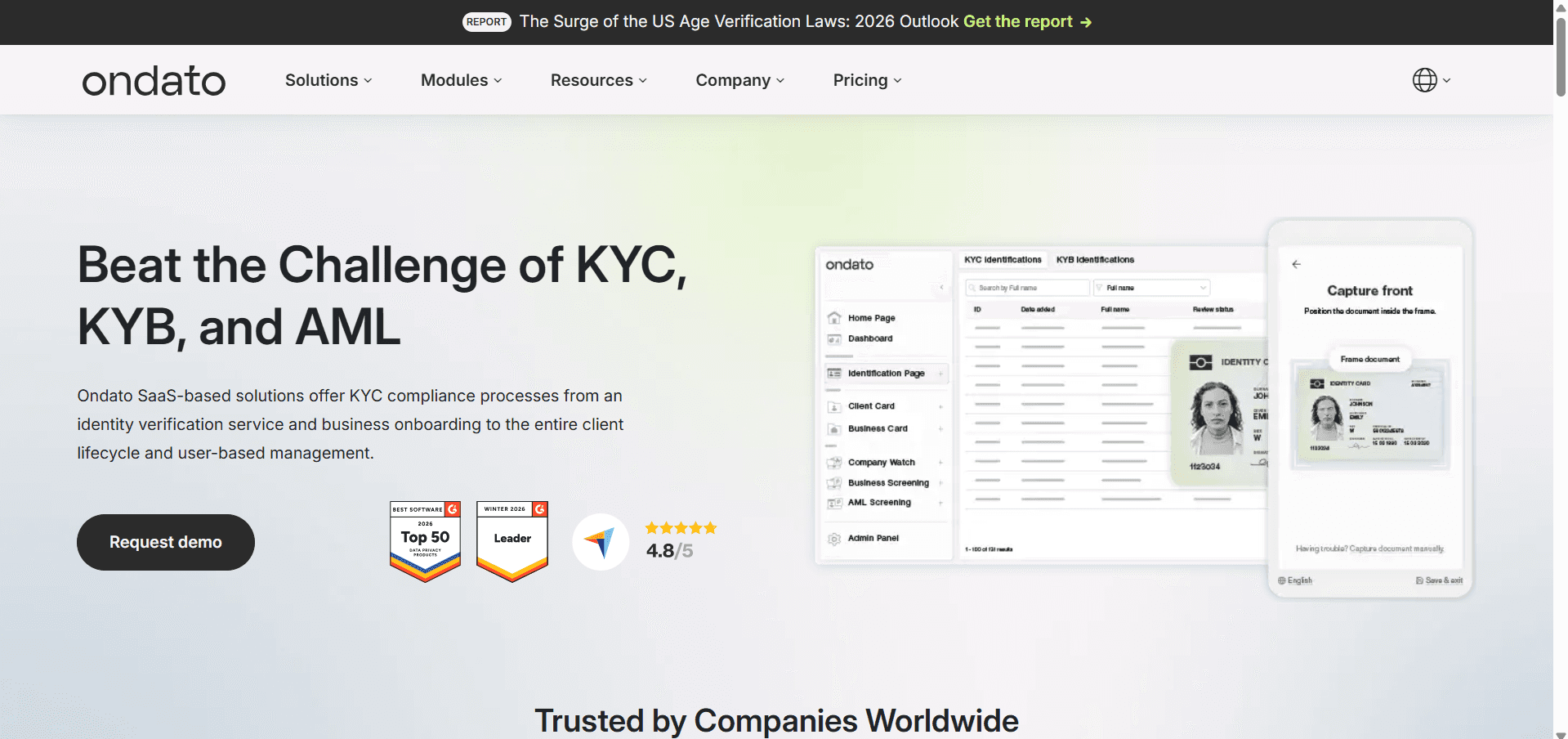
Ondato is an identity verification and compliance platform that combines KYC, AML, document verification, and biometric authentication into a single onboarding workflow. It is commonly used by fintechs, crypto businesses, and financial institutions looking to simplify compliance while automating customer onboarding.
Key benefits:
Simplify compliance: Automate KYC, AML, and customer due diligence within a unified onboarding process.
Verify users accurately: Combine document verification, biometric authentication, and liveness detection to reduce onboarding fraud.
Improve audit readiness: Maintain detailed verification records and compliance documentation for regulated industries.
Accelerate onboarding: Reduce manual verification effort while maintaining regulatory compliance.
Support financial services growth: Scale onboarding across fintech, crypto, and other regulated digital businesses.
While Ondato delivers strong compliance capabilities, buyers should evaluate whether it meets broader fraud prevention requirements.
Some reviewers mention a learning curve when navigating certain workflows and platform features during initial adoption.
Validate country-specific document coverage and regulatory support for your target markets.
Best for: Fintechs, crypto businesses, banks, and regulated organizations that need identity verification integrated with KYC and AML compliance.
Which Identity Verification Solutions Should You Shortlist?
A 2025 study published on arXiv about real-world deepfakes found that the performance of leading open-source deepfake detectors dropped by 50% for video, 48% for audio, and 45% for images compared to older benchmark datasets, underscoring the need to evaluate vendors against modern attack techniques rather than legacy test sets.
Different identity verification solutions are built for different onboarding challenges. Instead of comparing every feature, start by shortlisting the platforms that best match your fraud, compliance, and operational requirements.
If you need... | Shortlist... |
Identity verification combined with fraud prevention and risk decisioning | Bureau ID |
AI-led document authentication, facial verification, and liveness detection | Bureau ID, IDVerse, Incode |
Flexible identity verification workflows that adapt to different products, user types, or geographies | Bureau ID, Persona |
Enterprise identity verification within a broader security ecosystem | Entrust |
Global document verification and KYC onboarding across multiple markets | Jumio, Veriff |
High-assurance identity verification for legally sensitive transactions | Proof |
Compliance-focused onboarding with KYC and AML workflows | Bureau ID, Ondato |
Identity verification for high-volume fintechs, banks, and digital businesses | Bureau ID, Jumio, Veriff |
This should help narrow your evaluation to the platforms that best fit your use case. From there, compare implementation effort, fraud detection depth, compliance capabilities, and user experience to identify the right long-term fit.
Related Read: 8 Best IDfy Competitors for KYC and Fraud Prevention, and Risk Decisioning
How Bureau ID Goes Beyond Identity Verification
Most identity verification solutions answer one question: “Is this person who they claim to be?”
Bureau ID answers a second, equally important question: “Can this person be trusted?”
Instead of treating identity verification as a standalone check, Bureau ID combines identity, device, behavioral, network, and transaction intelligence to help businesses make real-time risk decisions throughout the customer lifecycle.
This enables fraud teams to approve genuine users faster while identifying high-risk applicants before they reach production systems.
Identity verification: Supports document authentication, facial recognition, biometric matching, and liveness detection to verify users during KYC onboarding.
Device intelligence: Creates persistent Device IDs to detect repeat devices, emulators, VPN usage, incognito browsing, and other evasion tactics.
Behavioral biometrics: Analyzes typing patterns, touchscreen interactions, and user behavior to identify bots, fraud farms, scripted attacks, and account takeover attempts.
Graph identity intelligence: Maps connections between identities, devices, phone numbers, emails, and accounts to uncover linked fraud activity.
Risk scoring and workflows: Delivers explainable risk scores using multiple signals and enables teams to automate approve, reject, review, or step-up decisions through configurable workflows.
Compliance support: Helps regulated businesses manage KYC, KYB, AML, and ongoing monitoring from a single platform.
Together, these capabilities allow businesses to move beyond isolated checks and make smarter, faster decisions across the entire onboarding journey.
The impact becomes especially clear when identity verification and risk decisioning work in tandem, as seen in the example below.
Case Study: How Bureau ID Helped a Leading Insurer Cut Fraud and Accelerate Onboarding
A leading private insurer was struggling with fraudulent applications driven by internal agent abuse. Fake and unauthorized applications were increasing customer complaints, slowing onboarding, and creating unnecessary friction for genuine applicants.
The company implemented Bureau ID's identity verification and real-time risk decisioning capabilities to verify applicants, detect suspicious agent activity, and streamline onboarding without adding friction for legitimate customers.
Results achieved:
100+ fake applications were identified and stopped within the first week.
30% faster onboarding, helping genuine customers complete verification more quickly.
Users experienced a seamless, low-friction onboarding journey.
Significant reduction in customer complaints related to unauthorized applications and identity misuse.
Read the full case study here → Insurer Cuts Fraud for 30% Faster Onboarding
The outcome demonstrates why identity verification works best when it's paired with real-time risk intelligence. Instead of treating every applicant the same, Bureau ID helps businesses identify high-risk users early while giving legitimate customers a faster path through onboarding.
If you want to see how unified identity verification and risk decisioning can help your business reduce fraud while accelerating digital onboarding, book a demo with Bureau ID.
Move Beyond Basic Identity Checks
Choosing an identity verification solution is ultimately about finding the right fit for your business. Your decision should reflect the fraud risks you face, the onboarding experience you want to deliver, and the level of trust your business needs to establish.
If you're operating in a high-risk, high-volume environment, identity verification needs to work alongside device intelligence, behavioral biometrics, and real-time risk signals to stop sophisticated attacks without slowing down genuine users.
That's where Bureau ID stands apart. By bringing identity verification, fraud prevention, and risk decisioning together in a single platform, it helps businesses verify users with confidence, reduce false declines, and make faster, more informed onboarding decisions.
Schedule a demo with Bureau ID today and see how a unified risk decisioning approach can strengthen security while improving the customer onboarding experience.
FAQs
1. What is an identity verification solution?
An identity verification solution helps businesses confirm that a user is who they claim to be using methods such as document authentication, biometric verification, facial matching, and liveness detection. Many modern platforms also include fraud detection and risk scoring to improve onboarding decisions.
2. What are the best identity verification solution providers?
Some of the best identity verification providers include Bureau ID, Onfido, Jumio, Trulioo, Persona, and Veriff. Each offers different strengths in document verification, biometrics, fraud detection, and global coverage, depending on business needs.
3. How do I choose the best identity verification solution?
Start by evaluating your fraud risks, compliance requirements, onboarding volume, and customer experience goals. Compare vendors based on document verification accuracy, liveness detection, workflow flexibility, fraud intelligence, integrations, and the ability to scale with your business.
4. What features should an identity verification platform include?
Look for document authentication, biometric verification, liveness detection, deepfake detection, KYC and AML support, workflow customization, API integrations, fraud intelligence, and explainable risk scoring. These capabilities help improve verification accuracy while reducing fraud and manual reviews.
5. Can Bureau ID detect AI-generated identities and deepfakes?
Yes. Bureau ID uses liveness detection and AI-powered fraud detection to identify deepfakes, replay attacks, and manipulated media. It also combines device intelligence and behavioral signals to detect sophisticated identity fraud beyond document verification.
6. What's the difference between identity verification and identity proofing?
Identity verification confirms that a person matches the identity they present. Identity proofing goes further by validating whether that identity can be trusted using additional signals such as device intelligence, behavioral patterns, fraud history, and risk analysis.
Passing an identity check no longer means you can trust the person behind it. Someone can use synthetic identities, AI-generated documents, deepfakes, and stolen credentials to slip through verification while appearing like a legitimate customer.
Beyond identity verification, the strongest platforms combine document authentication, biometric verification, liveness detection, and fraud intelligence to help stop sophisticated onboarding fraud without creating unnecessary friction for genuine users.
In this guide, we'll compare the top identity verification solutions, examine their strengths and trade-offs, and show you how to evaluate identity verification providers based on fraud prevention, compliance, user experience, and scalability.
Capabilities We Evaluated While Shortlisting Identity Verification Solutions
To make this comparison practical, we evaluated each vendor using the capabilities that matter most when shortlisting identity verification solutions:
Document and biometric verification: Ability to authenticate identity documents, support regional IDs, perform selfie matching, and use passive or active liveness detection to prevent spoofing.
Deepfake and fraud defense: Coverage for detecting deepfakes, injection and replay attacks, synthetic identities, risky devices, bots, and other fraud signals.
Compliance coverage: Support for KYC, KYB, AML, sanctions screening, audit trails, and region-specific regulatory requirements.
Workflow flexibility: Ease of configuring verification flows based on geography, product, user type, or risk level without heavy engineering effort.
Integration, performance, and user experience: Availability of APIs and SDKs, mobile support, low-latency verification, and strong completion rates.
Cost at scale: Pricing structure across verifications, retries, manual reviews, and add-on services to reflect long-term operating costs.
A 2025 systematic review covering 43 peer-reviewed studies concluded that AI-generated identities and deepfakes are significantly increasing the complexity of identity fraud detection, requiring multiple verification layers rather than document checks alone.
Together, these criteria provide a more complete way to compare identity verification solutions than feature lists alone, making it easier to shortlist the platforms that best fit your fraud, compliance, and growth objectives.
Top 9 Identity Verification Solutions in 2026
If you're building an initial shortlist, start with the comparison below. It highlights where each platform fits best, its core strength, and what to evaluate before making a decision.
Identity Verification Solution | Best For | Key Strength | What to Validate | Pricing Model |
Bureau ID | Risk-based onboarding and fraud decisioning | Combines identity, device, behavioral, network, and transaction intelligence in one platform | Best suited for organizations that need identity verification connected to broader risk decisioning | Usage-based, custom enterprise pricing |
IDVerse | AI-led digital identity verification | Automated document authentication and biometric verification | Validate regional document coverage and workflow flexibility | Per verification, tiered pricing |
Incode | Enterprise biometric identity verification | Strong face verification and biometric onboarding | Review implementation effort and workflow customization | Custom enterprise pricing |
Entrust | Enterprise identity and security programs | Mature identity proofing within a broader security ecosystem | Assess whether the broader platform aligns with your IDV requirements | Subscription + usage-based |
Persona | Configurable identity verification workflows | Flexible verification journeys and case management | Evaluate setup complexity and ongoing workflow management | Usage-based, modular pricing |
Jumio | Document and biometric verification | Mature document verification and selfie matching | Review manual review workflows and fallback options | Per verification, volume-based |
Veriff | Global digital onboarding | Fast document verification with biometric checks | Test verification accuracy across your priority markets | Per verification, volume discounts |
Proof | High-assurance identity verification | Identity evidence for legally sensitive transactions | Best suited for regulated or high-trust transaction workflows | Per transaction, premium pricing |
Ondato | KYC and AML onboarding | Strong compliance workflows and AML screening | Evaluate fraud detection capabilities beyond compliance requirements | Subscription + usage-based |
The comparison table provides a high-level overview, but each platform approaches identity verification differently. Here's a closer look at what each solution offers and where it fits best.
1. Bureau ID
Bureau ID is built for businesses that need more than identity verification. Instead of treating document authentication as a standalone checkpoint, it combines identity, device, behavioral, network, and transaction signals to help businesses make real-time trust decisions across onboarding, authentication, and ongoing account activity.
This makes Bureau ID a strong choice for organizations that want to reduce onboarding fraud without stitching together separate tools for identity verification, fraud detection, device intelligence, and compliance.
Key benefits:
All-in-one protection: Manage identity verification, fraud prevention, and risk decisioning in one place so you can reduce complexity and make faster, more confident decisions.
Stronger onboarding accuracy: Combine document checks, biometric verification, liveness detection, and device intelligence to verify users more reliably and reduce fake account creation.
Smarter fraud detection: Use behavioral biometrics and graph-based identity intelligence to uncover synthetic identities, repeat fraudsters, and hidden fraud networks before they cause losses.
End-to-end compliance coverage: Handle KYC, KYB, AML, onboarding, authentication, and transaction monitoring from a single platform to simplify compliance and reduce operational overhead.
Faster workflow control: Configure approval, review, and step-up verification flows without engineering support, helping your team respond quickly to changing risk patterns.
Clear, actionable decisions: Get explainable risk scores that show why a user is flagged, so your team can make informed decisions instead of relying on basic pass/fail outcomes.
While the platform is strong in unified identity verification and fraud decisioning, there are a few considerations to keep in mind:
Best suited for organizations that want identity verification integrated with broader fraud and risk workflows.
Businesses looking only for basic document capture or OCR may not require the platform's full capabilities.
Best for: Banks, fintechs, NBFCs, marketplaces, gaming platforms, eCommerce businesses, and other high-volume digital businesses that need to verify users while detecting synthetic identities, account farms, mule accounts, device spoofing, and repeat fraud.
Related Read: How Businesses Can Stop AI Identity Fraud With Connected Risk Intelligence
2. IDVerse
IDVerse is an AI-powered identity verification platform designed for businesses that want fast, automated digital onboarding. It combines document authentication, biometric verification, and liveness detection to help organizations verify users remotely while reducing manual review and improving fraud detection across KYC workflows.
Key benefits:
Accelerate digital onboarding: Automate document and biometric verification to reduce manual intervention and shorten verification times.
Improve verification accuracy: Use AI-powered document authentication and facial matching to verify legitimate users with confidence.
Reduce impersonation risk: Leverage passive liveness detection to help defend against presentation attacks during onboarding.
Scale across digital channels: Support remote identity verification for web and mobile onboarding journeys.
Strengthen compliance: Integrate identity proofing into KYC workflows without creating unnecessary friction for genuine users.
IDVerse delivers a streamlined AI-led verification experience, but buyers should validate a few areas before making a decision.
Confirm document coverage and verification accuracy for the countries and ID types most relevant to your business.
Businesses with highly customized onboarding journeys should test workflow flexibility and reporting capabilities during the evaluation process.
Best for: Financial institutions, fintechs, and digital businesses looking for AI-led identity verification with fast, remote onboarding.
3. Incode
Incode is an enterprise identity verification platform that combines biometric authentication, document verification, and AI-powered fraud detection into a single onboarding experience. It is commonly shortlisted by organizations looking for high-assurance identity verification across customer onboarding, workforce identity, and regulated digital services.
Key benefits:
Strengthen biometric security: Combine facial recognition, document verification, and liveness detection to improve identity assurance.
Increase onboarding success rates: Deliver fast, AI-driven verification while minimizing friction for legitimate users.
Support enterprise deployments: Scale identity verification across customer, employee, and partner onboarding workflows.
Defend against advanced fraud: Detect spoofing attempts and AI-generated identity attacks with built-in fraud detection.
Integrate with existing systems: Connect identity verification into enterprise workflows through APIs and SDKs.
While Incode offers a mature enterprise platform, a few considerations are worth evaluating.
Review implementation effort and internal technical resources required for enterprise deployments.
Some reviewers mention that implementation and advanced customization can require additional effort, particularly for teams deploying identity verification for the first time.
Best for: Enterprises that need biometric-first identity verification for customer onboarding, workforce identity, and regulated digital services.
4. Entrust
Entrust offers identity verification as part of its broader digital security and identity portfolio. Following its acquisition of Onfido, the platform combines document verification, biometric authentication, and identity proofing with enterprise-grade security capabilities, making it well-suited for regulated organizations with complex identity requirements.
Key benefits:
Extend enterprise security: Connect identity verification with broader identity and access management initiatives.
Strengthen digital trust: Combine document authentication and biometric verification for high-assurance onboarding.
Support regulated industries: Meet identity proofing requirements across financial services, government, and other regulated sectors.
Simplify compliance: Integrate identity verification into enterprise governance and compliance workflows.
Scale globally: Deploy identity verification across multiple markets through an enterprise-ready platform.
Entrust is a strong choice for enterprise security programs. However, buyers should consider how well it aligns with their onboarding requirements.
Some reviewers note that new users may need time to become familiar with the dashboard and locate certain features during the initial rollout.
Evaluate how flexible onboarding workflows are for customer-facing digital products compared with dedicated IDV providers.
Best for: Enterprises, financial institutions, and security-focused organizations that want identity verification integrated into a broader identity security strategy.
5. Persona
Persona is an identity verification platform built around highly configurable verification workflows. It enables businesses to customize identity checks based on geography, user type, product, or risk level, making it a popular choice for organizations that need flexibility across multiple onboarding journeys.
Key benefits:
Build tailored verification flows: Configure onboarding journeys for different products, regions, and customer segments.
Adapt to changing risk: Route users through different verification steps based on risk signals and business rules.
Improve operational efficiency: Manage manual reviews and verification cases from a centralized workflow.
Support multiple verification methods: Combine document verification, biometrics, database checks, and business rules.
Scale across teams: Give product, operations, and compliance teams greater control over identity verification processes.
While Persona offers exceptional workflow flexibility, there are a few factors buyers should evaluate.
Teams should plan for additional configuration time to fully customize verification workflows.
Buyers should assess whether additional fraud intelligence capabilities are needed beyond workflow orchestration and identity verification.
Best for: Fintechs, marketplaces, and digital businesses that need highly configurable identity verification workflows across multiple products or regions.
6. Jumio
Jumio is one of the most established identity verification providers, offering document verification, biometric authentication, liveness detection, and KYC onboarding. It is widely used by banks, fintechs, and regulated businesses that need a mature identity verification platform with broad global document support.
Key benefits:
Verify identities with confidence: Authenticate government-issued IDs using AI-powered document verification and authenticity checks.
Strengthen fraud prevention: Combine selfie matching and liveness detection to reduce impersonation and presentation attacks.
Support compliance at scale: Integrate identity verification into KYC and AML onboarding workflows for regulated industries.
Expand globally: Verify users across multiple countries with support for a wide range of identity documents.
Reduce operational effort: Automate verification while routing only higher-risk cases for manual review.
Jumio is a mature identity verification platform, but before shortlisting, buyers should evaluate how well it fits their operational requirements.
Review workflow customization options and fallback verification paths for edge cases.
Some users report that low-quality or damaged ID documents can require additional manual review.
Best for: Banks, fintechs, and regulated digital businesses that need mature document and biometric verification for KYC onboarding.
7. Veriff
Veriff is a digital identity verification platform built for businesses that need fast document verification, biometric authentication, and fraud prevention across global onboarding journeys. It is commonly used by fintechs, marketplaces, mobility platforms, gaming companies, and other digital businesses operating across multiple markets.
Key benefits:
Speed up onboarding: Verify users quickly with automated document and biometric verification.
Strengthen fraud defenses: Combine liveness detection and AI-powered fraud checks to reduce identity fraud.
Support global expansion: Verify users across multiple countries and document types from a single platform.
Handle edge cases efficiently: Route complex verification attempts to manual review without disrupting the overall onboarding experience.
Scale with growing businesses: Support high-volume digital onboarding through API-first integrations.
While Veriff performs well across global onboarding use cases, a few areas should be evaluated during vendor selection.
Validate document coverage and verification performance in your highest-volume markets.
Reviewers also recommend evaluating pricing carefully as verification volumes increase.
Best for: Fintechs, marketplaces, gaming companies, and digital businesses that need fast, automated identity verification across multiple markets.
8. Proof
Proof is an identity verification platform designed for high-trust digital transactions where identity must be verified, documented, and legally defensible. It is widely used for notarization, financial agreements, and other regulated workflows where auditability is just as important as identity verification itself.
Key benefits:
Increase trust in critical transactions: Verify identities for legally binding and high-value digital interactions.
Create auditable verification records: Link identity evidence directly to transaction history for stronger compliance.
Support regulated workflows: Enable secure identity verification for notarization, financial services, and legal processes.
Balance automation with assurance: Combine automated verification with human review for higher-risk cases.
Integrate into existing systems: Deploy identity verification through APIs that fit enterprise workflows.
Proof excels in high-assurance identity verification, but it may not be the ideal fit for every onboarding use case.
Organizations focused on high-volume consumer onboarding should evaluate whether the platform aligns with their operational goals.
Human review can increase verification time for certain workflows, depending on the level of assurance required.
Best for: Legal, financial, real estate, and other regulated organizations that require auditable, transaction-linked identity verification.
9. Ondato
Ondato is an identity verification and compliance platform that combines KYC, AML, document verification, and biometric authentication into a single onboarding workflow. It is commonly used by fintechs, crypto businesses, and financial institutions looking to simplify compliance while automating customer onboarding.
Key benefits:
Simplify compliance: Automate KYC, AML, and customer due diligence within a unified onboarding process.
Verify users accurately: Combine document verification, biometric authentication, and liveness detection to reduce onboarding fraud.
Improve audit readiness: Maintain detailed verification records and compliance documentation for regulated industries.
Accelerate onboarding: Reduce manual verification effort while maintaining regulatory compliance.
Support financial services growth: Scale onboarding across fintech, crypto, and other regulated digital businesses.
While Ondato delivers strong compliance capabilities, buyers should evaluate whether it meets broader fraud prevention requirements.
Some reviewers mention a learning curve when navigating certain workflows and platform features during initial adoption.
Validate country-specific document coverage and regulatory support for your target markets.
Best for: Fintechs, crypto businesses, banks, and regulated organizations that need identity verification integrated with KYC and AML compliance.
Which Identity Verification Solutions Should You Shortlist?
A 2025 study published on arXiv about real-world deepfakes found that the performance of leading open-source deepfake detectors dropped by 50% for video, 48% for audio, and 45% for images compared to older benchmark datasets, underscoring the need to evaluate vendors against modern attack techniques rather than legacy test sets.
Different identity verification solutions are built for different onboarding challenges. Instead of comparing every feature, start by shortlisting the platforms that best match your fraud, compliance, and operational requirements.
If you need... | Shortlist... |
Identity verification combined with fraud prevention and risk decisioning | Bureau ID |
AI-led document authentication, facial verification, and liveness detection | Bureau ID, IDVerse, Incode |
Flexible identity verification workflows that adapt to different products, user types, or geographies | Bureau ID, Persona |
Enterprise identity verification within a broader security ecosystem | Entrust |
Global document verification and KYC onboarding across multiple markets | Jumio, Veriff |
High-assurance identity verification for legally sensitive transactions | Proof |
Compliance-focused onboarding with KYC and AML workflows | Bureau ID, Ondato |
Identity verification for high-volume fintechs, banks, and digital businesses | Bureau ID, Jumio, Veriff |
This should help narrow your evaluation to the platforms that best fit your use case. From there, compare implementation effort, fraud detection depth, compliance capabilities, and user experience to identify the right long-term fit.
Related Read: 8 Best IDfy Competitors for KYC and Fraud Prevention, and Risk Decisioning
How Bureau ID Goes Beyond Identity Verification
Most identity verification solutions answer one question: “Is this person who they claim to be?”
Bureau ID answers a second, equally important question: “Can this person be trusted?”
Instead of treating identity verification as a standalone check, Bureau ID combines identity, device, behavioral, network, and transaction intelligence to help businesses make real-time risk decisions throughout the customer lifecycle.
This enables fraud teams to approve genuine users faster while identifying high-risk applicants before they reach production systems.
Identity verification: Supports document authentication, facial recognition, biometric matching, and liveness detection to verify users during KYC onboarding.
Device intelligence: Creates persistent Device IDs to detect repeat devices, emulators, VPN usage, incognito browsing, and other evasion tactics.
Behavioral biometrics: Analyzes typing patterns, touchscreen interactions, and user behavior to identify bots, fraud farms, scripted attacks, and account takeover attempts.
Graph identity intelligence: Maps connections between identities, devices, phone numbers, emails, and accounts to uncover linked fraud activity.
Risk scoring and workflows: Delivers explainable risk scores using multiple signals and enables teams to automate approve, reject, review, or step-up decisions through configurable workflows.
Compliance support: Helps regulated businesses manage KYC, KYB, AML, and ongoing monitoring from a single platform.
Together, these capabilities allow businesses to move beyond isolated checks and make smarter, faster decisions across the entire onboarding journey.
The impact becomes especially clear when identity verification and risk decisioning work in tandem, as seen in the example below.
Case Study: How Bureau ID Helped a Leading Insurer Cut Fraud and Accelerate Onboarding
A leading private insurer was struggling with fraudulent applications driven by internal agent abuse. Fake and unauthorized applications were increasing customer complaints, slowing onboarding, and creating unnecessary friction for genuine applicants.
The company implemented Bureau ID's identity verification and real-time risk decisioning capabilities to verify applicants, detect suspicious agent activity, and streamline onboarding without adding friction for legitimate customers.
Results achieved:
100+ fake applications were identified and stopped within the first week.
30% faster onboarding, helping genuine customers complete verification more quickly.
Users experienced a seamless, low-friction onboarding journey.
Significant reduction in customer complaints related to unauthorized applications and identity misuse.
Read the full case study here → Insurer Cuts Fraud for 30% Faster Onboarding
The outcome demonstrates why identity verification works best when it's paired with real-time risk intelligence. Instead of treating every applicant the same, Bureau ID helps businesses identify high-risk users early while giving legitimate customers a faster path through onboarding.
If you want to see how unified identity verification and risk decisioning can help your business reduce fraud while accelerating digital onboarding, book a demo with Bureau ID.
Move Beyond Basic Identity Checks
Choosing an identity verification solution is ultimately about finding the right fit for your business. Your decision should reflect the fraud risks you face, the onboarding experience you want to deliver, and the level of trust your business needs to establish.
If you're operating in a high-risk, high-volume environment, identity verification needs to work alongside device intelligence, behavioral biometrics, and real-time risk signals to stop sophisticated attacks without slowing down genuine users.
That's where Bureau ID stands apart. By bringing identity verification, fraud prevention, and risk decisioning together in a single platform, it helps businesses verify users with confidence, reduce false declines, and make faster, more informed onboarding decisions.
Schedule a demo with Bureau ID today and see how a unified risk decisioning approach can strengthen security while improving the customer onboarding experience.
FAQs
1. What is an identity verification solution?
An identity verification solution helps businesses confirm that a user is who they claim to be using methods such as document authentication, biometric verification, facial matching, and liveness detection. Many modern platforms also include fraud detection and risk scoring to improve onboarding decisions.
2. What are the best identity verification solution providers?
Some of the best identity verification providers include Bureau ID, Onfido, Jumio, Trulioo, Persona, and Veriff. Each offers different strengths in document verification, biometrics, fraud detection, and global coverage, depending on business needs.
3. How do I choose the best identity verification solution?
Start by evaluating your fraud risks, compliance requirements, onboarding volume, and customer experience goals. Compare vendors based on document verification accuracy, liveness detection, workflow flexibility, fraud intelligence, integrations, and the ability to scale with your business.
4. What features should an identity verification platform include?
Look for document authentication, biometric verification, liveness detection, deepfake detection, KYC and AML support, workflow customization, API integrations, fraud intelligence, and explainable risk scoring. These capabilities help improve verification accuracy while reducing fraud and manual reviews.
5. Can Bureau ID detect AI-generated identities and deepfakes?
Yes. Bureau ID uses liveness detection and AI-powered fraud detection to identify deepfakes, replay attacks, and manipulated media. It also combines device intelligence and behavioral signals to detect sophisticated identity fraud beyond document verification.
6. What's the difference between identity verification and identity proofing?
Identity verification confirms that a person matches the identity they present. Identity proofing goes further by validating whether that identity can be trusted using additional signals such as device intelligence, behavioral patterns, fraud history, and risk analysis.
TABLE OF CONTENTS
See More
Recommended Blogs

Landing Page.
Simple, bold.
Sign Up
Download

Products
Solutions


© 2026 Bureau . All rights reserved.
Solutions
Industries
Resources
Company
Solutions
Industries
Resources
Company
© 2026 Bureau . All rights reserved.
Follow Us
Leave behind fragmented tools. Stop fraud rings, cut false declines, and deliver secure digital journeys at scale
Our Presence








Leave behind fragmented tools. Stop fraud rings, cut false declines, and deliver secure digital journeys at scale
Our Presence
© 2026 Bureau . All rights reserved.