How Device Intelligence Detects Fraud Across the User Lifecycle
How Device Intelligence Detects Fraud Across the User Lifecycle
How Device Intelligence Detects Fraud Across the User Lifecycle
See how device intelligence differs from device fingerprinting and helps detect ATO, multi-accounting, bots, and synthetic identity fraud.
Author
Team Bureau


See how Bureau has helped industry leaders defend against networked Industrial-scale frauds →
Schedule a Demo
TABLE OF CONTENTS
See Less
Fraudsters can change credentials, identities, IP addresses, and account details, but their devices often leave consistent signals behind.
Device intelligence helps fraud teams use those signals to detect suspicious activity across onboarding, login, account recovery, and transactions, helping them connect activity that may otherwise appear unrelated.
Learn what device intelligence is, how it differs from device fingerprinting, and how businesses use it to make more accurate fraud decisions across the customer lifecycle.
What Is Device Intelligence?
Device intelligence is the process of collecting and analyzing hardware, software, browser, network, integrity, behavioral, and historical signals from a device to assess the risk behind a digital interaction. It helps businesses recognize returning devices, identify manipulated environments, connect activity across accounts, and make risk-based decisions during onboarding, login, and transactions.
In practice, device intelligence helps risk teams answer four questions:
Has this device been seen before?
Is the device environment genuine or manipulated?
Is the device behaving as expected?
Is it connected to suspicious accounts, identities, or transactions?
It goes beyond recording an IP address or creating a device hash. For example, a new device using an emulator may seem risky, but the concern becomes stronger when that same device is also linked to multiple accounts and behaves differently from the legitimate user.
This is why no single signal proves fraud. Device intelligence becomes valuable when several indicators are evaluated together and interpreted in context.
Device Intelligence vs. Device Fingerprinting
Device fingerprinting creates an identifier for a browser or device using a combination of technical attributes. Device intelligence uses that identifier alongside network, integrity, behavioral, historical, and relationship signals to evaluate risk and support a fraud decision.
The distinction is primarily about purpose.
Device fingerprinting answers, “Which device is this?”
Device intelligence asks, “Can this device and the current interaction be trusted?”
Factor | Device Fingerprinting | Device Intelligence |
Primary question | Which device or browser is this? | Can this device and interaction be trusted? |
Main purpose | Device recognition | Device and session risk assessment |
Typical output | Device ID, visitor ID, or device hash | Device profile, risk signals, score, or recommended action |
Data analyzed | Hardware, software, and browser attributes | Device, network, integrity, behavior, history, and relationships |
Historical context | Recognizes repeat appearances | Evaluates device reputation and activity over time |
Relationship analysis | May link one device to several accounts | Connects devices with accounts, identities, and coordinated fraud |
Fraud coverage | Repeat-device identification | ATO, multi-accounting, bots, spoofing, promo abuse, and fraud rings |
Decision support | Usually feeds another risk system | Supports real-time rules, scoring, and orchestration |
Device fingerprinting is not necessarily static or outdated. Modern methods may combine deterministic and probabilistic techniques across client-side, server-side, and historical data. It remains the identification layer, while device intelligence adds the context needed to assess risk and decide what should happen next.
A peer-reviewed study shows how device fingerprinting can strengthen risk assessment without serving as a standalone fraud verdict. Involving approximately 205,000 browser fingerprints, sessions flagged by Browser Polygraph were about 4.7 times more likely to carry an account takeover indicator than the overall traffic baseline.
For example, persistent device identification may recognize a returning device after cookies are cleared. Device intelligence then evaluates whether that device is trusted, linked to suspicious accounts, or operating in a manipulated environment.
How Does Device Intelligence Work?
Device intelligence collects signals from a user’s device and digital environment, resolves them into a device profile, compares that profile with historical activity, and translates the findings into a risk score or action.
Collect signals: Capture relevant device, browser, application, network, location, integrity, and interaction data.
Create a device profile: Combine stable and changing attributes to recognize a browser or physical device without relying only on cookies, IP addresses, or a resettable identifier.
Analyze the environment: Check for emulators, rooted devices, automation, app cloning, location spoofing, VPNs, proxies, and other signs of manipulation.
Compare with history: Determine whether the device is familiar to the account, connected to multiple accounts, or behaving differently from previous sessions.
Evaluate relationships: Link the device with relevant accounts, identities, contact details, payment methods, and transactions.
Generate a decision: Allow the interaction, monitor it, request additional verification, route it for review, restrict the action, or block it.
Device identification varies across web and mobile environments. Mobile SDKs can typically access deeper device-integrity signals, while browser-based systems rely on the attributes available through the browser. In either case, risk teams should receive explainable indicators alongside the final score.
What Device Risk Signals Does Device Intelligence Analyze?
Device intelligence evaluates several categories of device telemetry to understand whether an interaction is genuine, manipulated, or connected to known fraud:
Hardware and browser signals: Device model, operating system, browser configuration, screen properties, and software inconsistencies can indicate spoofing or anti-detect tools.
Network and location signals: IP address, VPN, proxy, TOR, GPS, and time-zone data can reveal masked infrastructure or location mismatches.
Device integrity signals: Rooting, jailbreaking, debugging, app cloning, and hooking can point to a compromised environment.
Automation signals: Emulators, virtual machines, headless browsers, and scripted input can expose bots or device farms.
Behavioral and historical signals: Typing, swiping, navigation patterns, previous activity, and account relationships can surface ATO, multi-accounting, and coordinated fraud.
Network reputation also needs context. Cloudflare reported that AWS and Google infrastructure generated 12.7% and 7.8% of the global bot traffic it observed. Since legitimate cloud infrastructure can also distribute automated attacks, an IP address alone cannot reliably establish whether an interaction is trustworthy.
Risk becomes meaningful when these indicators are assessed alongside velocity, account history, identity consistency, transaction value, and links to confirmed fraud.
Related Read: How Device Signals Help Detect Fraud Rings and Spoofed Devices
How Does Device Intelligence Detect Fraud Across the User Lifecycle?
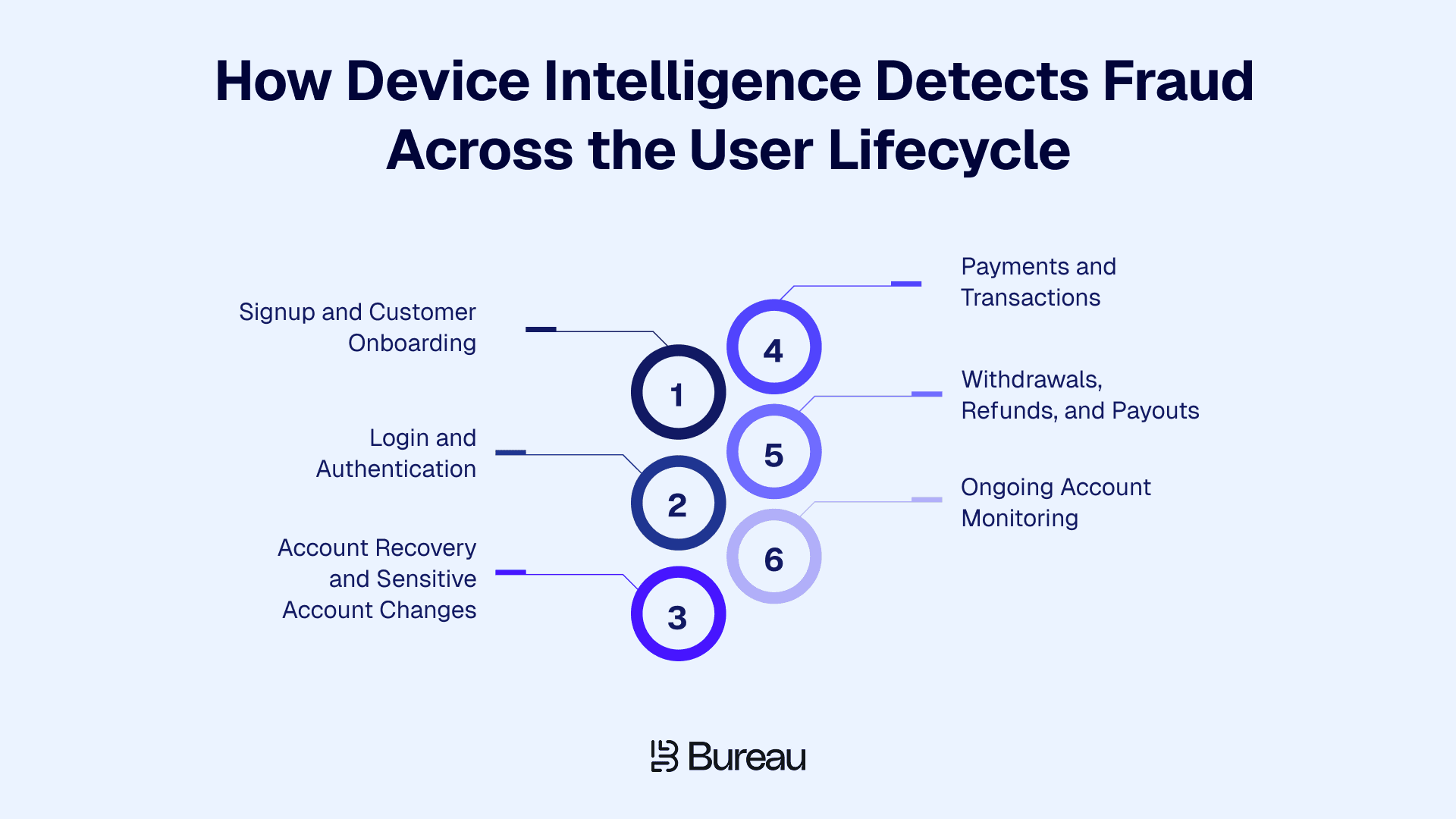
Device intelligence is most effective when it follows the user across the entire digital journey. A device that appears legitimate during signup may become risky during account recovery, payment, withdrawal, or ongoing activity.
Lifecycle stage | Common fraud risks | Relevant device evidence | Possible action |
Signup | Fake accounts, synthetic identities, promo abuse | Device reuse, emulators, signup velocity | Verify, review, or reject |
Login | ATO, credential stuffing, bots | New device, automation, behavioral change | Allow, monitor, or step up |
Account recovery | Social engineering, reset abuse | Device change, risky network, repeated attempts | Add verification or restrict |
Transactions | Payment fraud, card testing, compromised accounts | Device reputation, account history, automation | Approve, hold, or review |
Withdrawals | Mule activity, cash-out after ATO | New payout device, linked accounts, location shift | Delay, verify, or investigate |
Monitoring | Fraud rings, account sharing, repeat abuse | Device-account links and reputation changes | Monitor, restrict, or escalate |
1. Signup and Customer Onboarding
During onboarding, device intelligence for fraud can identify repeated applications, bot-driven registrations, device farms, multi-accounting, and promo abuse. It can also support synthetic identity detection by revealing connections that identity checks may miss.
In fact, Gartner predicted that by 2026, 30% of enterprises would no longer trust identity verification and authentication in isolation, recommending device identification and behavioral analytics as additional risk signals.
For example, a digital lender may receive several applications under different names and phone numbers. Each applicant passes basic document checks, but device intelligence shows that they originate from the same persistent device and follow similar interaction patterns.
This does not prove that the identities are synthetic, but it gives the lender a strong reason to combine the device evidence with identity verification and additional review.
2. Login and Authentication
Valid credentials do not automatically make a login safe. Passwords, OTPs, and authentication prompts can be stolen, intercepted, or approved through social engineering.
Verizon’s 2025 DBIR analysis found that credential stuffing represented a median 19% of daily authentication attempts, rising to 25% at enterprise-sized organizations. Device, browser, network, and behavioral signals help determine which of those attempts pose genuine account takeover risk.
Device intelligence can identify:
An unseen device
Emulator use
Browser automation
Sudden location changes
One device accessing several accounts
Combined with behavioral biometrics, these signals can reveal activity that does not match the account holder’s established behavior.
Risk teams can then allow familiar sessions, monitor uncertain ones, or trigger additional authentication when the likelihood of account takeover increases.
3. Account Recovery and Sensitive Account Changes
Account recovery is often more exposed than standard login because the customer may no longer have access to their usual credentials or device. Fraudsters exploit this gap through:
Password resets
Contact-detail changes
Beneficiary additions
Customer-support manipulation
Device intelligence helps determine whether recovery started from a familiar device with a legitimate account history. A known device showing expected behavior may proceed normally, while a new device in an unusual location may require additional verification.
Recovery attempts made through an emulator or repeated across several accounts can be restricted and investigated.
4. Payments and Transactions
Device-based fraud detection adds context to transaction monitoring. It can show whether the device has completed legitimate payments before, has been connected to disputes, or is testing several payment instruments in quick succession.
The surrounding journey also matters. A high-value payment may require closer review when it follows an unfamiliar login, password reset, or beneficiary change. Device intelligence should strengthen transaction monitoring by adding device history and session context rather than replacing payment-level risk controls.
5. Withdrawals, Refunds, and Payouts
Fraudsters often try to cash out quickly after taking over an account or gaining control of a mule network. Warning signs may include:
A first withdrawal from an unfamiliar device
Several accounts controlled through one device
Shared infrastructure between sending and receiving accounts
Relationship analysis becomes particularly useful here. Graph-based intelligence can connect devices with accounts, identities, transactions, and payout destinations, helping teams investigate coordinated activity instead of reviewing each withdrawal in isolation.
6. Ongoing Account Monitoring
Device risk can change over time. A previously trusted device may become compromised, begin accessing several accounts, move across risky networks, or become connected to a newly identified fraud cluster.
Continuous monitoring helps risk teams track changes in device reputation, account relationships, established behavior, and transaction activity. This makes device intelligence more effective as an ongoing risk layer evaluated at important lifecycle events, rather than a one-time check completed during onboarding.
Where Does Device Intelligence Have the Most Impact?
Device intelligence has the greatest impact when fraudsters change account or identity details but continue using the same devices, infrastructure, or behavioral patterns. This helps teams identify repeat activity without adding unnecessary friction for genuine users.
The MRC’s 2025 Global eCommerce Payments and Fraud survey of 1,000+ payment and fraud professionals found that merchants lost an average of 3.2% of annual e-commerce revenue to payment fraud globally, highlighting the necessity of device intelligence.
Some benefits include:
Stopping account takeover: Device history and behavioral context can flag suspicious sessions even when credentials appear valid.
Detecting synthetic identities: Shared devices, signup velocity, and identity inconsistencies can expose applications that appear legitimate when reviewed separately.
Reducing multi-accounting and collusion: Device-to-account links can reveal several accounts controlled through the same infrastructure.
Improving onboarding speed: Trusted-device recognition allows low-risk users to proceed with fewer verification steps.
Reducing fraud operations workload: Connected device evidence helps analysts prioritize the cases most likely to require investigation.
Uncovering fraud rings: Relationships between devices, accounts, identities, and transactions can expose coordinated activity that account-level checks miss.
The business impact comes from turning device data into precise, explainable actions that stop repeat fraud while allowing trusted users to continue.
Related Read: Compare the 9 Best Device Intelligence Platform Vendors in 2026
Key Technologies Bureau Uses for Device Intelligence
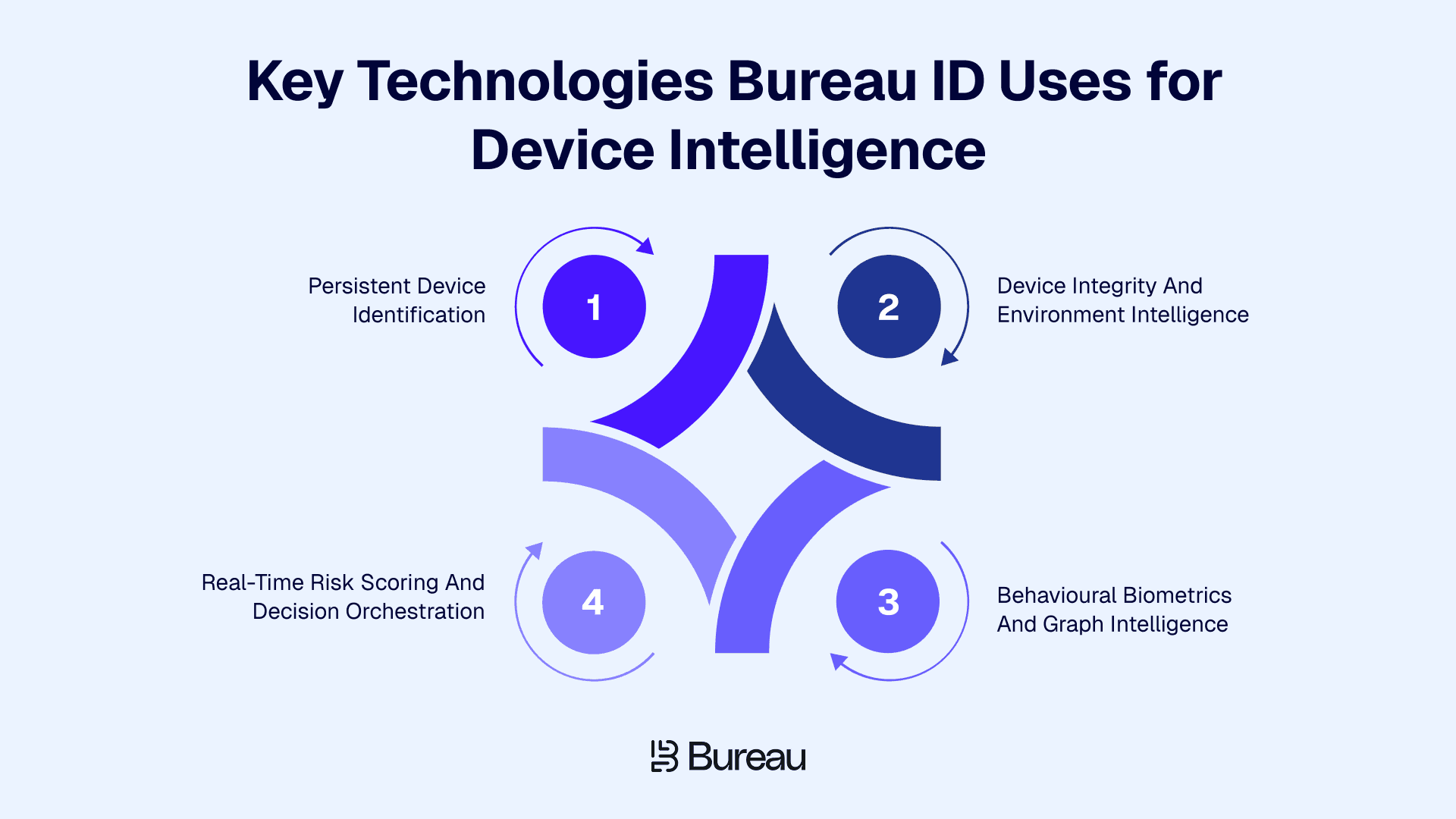
Bureau combines persistent device recognition with integrity checks, behavioral analysis, graph intelligence, and real-time decisioning. Together, these technologies turn device telemetry into context that risk teams can act on.
Persistent Device Identification
Bureau’s persistent Device ID is designed to recognize returning devices despite common evasion attempts such as factory resets, app reinstalls, firmware changes, incognito sessions, VPN use, spoofing, and emulators.
The current device intelligence platform evaluates more than 200 attributes with 99.97% persistence. This gives risk teams continuity when a fraudster returns with new credentials, accounts, or identity details. It also helps recognize genuine returning users so they are not repeatedly asked to verify themselves.
Device Integrity and Environment Intelligence
Recognizing a device is only one part of the decision. A familiar device may still be compromised, remotely controlled, or running in a manipulated environment.
Collecting a fingerprint alone may not expose these manipulated environments. In a study involving approximately 500,000 requests from 20 commercial bot services, adding rules that checked for inconsistencies between browser-fingerprint attributes reduced bot evasion by 48.11% and 44.95% against two detection systems.
This shows why risk systems need to evaluate whether device signals remain consistent, rather than simply recording them.
Bureau device intelligence checks for indicators such as:
Rooted or jailbroken devices
Emulators
App cloning
Spoofed applications
Botnets
TOR usage
Location manipulation
Inconsistent hardware or software configurations
These signals help identify device farms, automated account creation, app tampering, and high-risk login or transaction environments.
Behavioral Biometrics and Graph Intelligence
Bureau adds behavioral biometrics to evaluate how a user interacts with the device. Typing rhythm, touchscreen gestures, pointer movement, and navigation patterns can reveal bots, scripted activity, or changes that may indicate account takeover, even when the credentials and device appear legitimate.
Its Graph Identity Network then maps relationships among devices, accounts, identities, contact details, IP addresses, behaviors, and transactions. This relationship context helps uncover multi-accounting, collusion, mule activity, synthetic identity networks, and coordinated fraud rings that may remain hidden when accounts are reviewed individually.
Real-Time Risk Scoring and Decision Orchestration
Bureau’s unified risk decisioning layer brings device, integrity, behavioral, identity, network, graph, and transaction signals into one workflow. It converts those signals into explainable risk scores and actions rather than leaving teams to interpret separate alerts from multiple systems.
Teams can configure thresholds and adaptive workflows according to product, geography, customer segment, or transaction value:
Low risk: Approve the interaction
Medium risk: Monitor or trigger step-up verification
High risk: Restrict the action or route it for review
Critical risk: Block, freeze, or escalate
No-code orchestration allows risk teams to adjust these workflows without relying on engineering for every rule change. Feedback from confirmed fraud and review outcomes can then be used to refine future decisions.
Together, these technologies give Bureau a connected view of device risk and the controls to act on it in real time. The result is clearer, faster, and more consistent fraud decisions that help businesses transition from account-based defense to network-level intelligence.
Turn Device Signals Into Better Risk Decisions
The value of device intelligence increases when risk teams apply it continuously across onboarding, authentication, account recovery, transactions, and ongoing monitoring. Fraudsters may change credentials, identities, phone numbers, and accounts, but their devices and infrastructure often leave connected patterns behind.
Bureau helps analyze those patterns across the customer lifecycle. It brings persistent device recognition, behavioral biometrics, graph intelligence, and real-time decisioning into one platform.
With Bureau, teams can:
Identify repeat abuse earlier
Apply friction only when risk increases
Make more accurate fraud decisions
Schedule a demo with Bureau and see how connected device intelligence can strengthen fraud decisions.
FAQs
1. What is device intelligence in fraud prevention?
Device intelligence analyzes device, browser, network, integrity, behavioral, and historical signals to assess whether a digital interaction can be trusted. Fraud teams use it across onboarding, login, account recovery, payments, and monitoring to detect suspicious activity and guide risk decisions.
2. What is the difference between device intelligence and device fingerprinting?
Device fingerprinting identifies a browser or device using technical attributes. Device intelligence builds on that identifier with network, behavioral, integrity, historical, and relationship context, helping teams determine whether the device and its current activity present a meaningful fraud risk.
3. Can device intelligence detect VPNs, proxies, and emulators?
Advanced device intelligence can identify indicators associated with VPNs, proxies, TOR, emulators, virtual machines, rooting, jailbreaking, and automation. These indicators should inform a wider risk assessment because legitimate users and internal testing environments may produce some of the same signals.
4. Does device intelligence work in incognito mode?
Some device intelligence solutions can recognize returning devices in incognito mode by analyzing multiple attributes beyond cookies. Recognition accuracy varies by browser, operating system, permissions, and implementation, so incognito detection should be treated as a risk input rather than a guaranteed result.
5. How does Bureau use device intelligence for fraud prevention?
Bureau combines persistent device recognition with behavioral biometrics, graph intelligence, and real-time risk decisioning. This helps teams identify repeat offenders, connect suspicious activity across accounts, and apply the right action during onboarding, login, account recovery, and transactions.
6. Can device intelligence detect multi-accounting and synthetic identities?
Device intelligence can reveal accounts or applications connected through the same devices, infrastructure, and behavioral patterns. It supports multi-accounting and synthetic identity detection, but teams should combine it with identity, network, payment, and relationship evidence before making a final decision.
Fraudsters can change credentials, identities, IP addresses, and account details, but their devices often leave consistent signals behind.
Device intelligence helps fraud teams use those signals to detect suspicious activity across onboarding, login, account recovery, and transactions, helping them connect activity that may otherwise appear unrelated.
Learn what device intelligence is, how it differs from device fingerprinting, and how businesses use it to make more accurate fraud decisions across the customer lifecycle.
What Is Device Intelligence?
Device intelligence is the process of collecting and analyzing hardware, software, browser, network, integrity, behavioral, and historical signals from a device to assess the risk behind a digital interaction. It helps businesses recognize returning devices, identify manipulated environments, connect activity across accounts, and make risk-based decisions during onboarding, login, and transactions.
In practice, device intelligence helps risk teams answer four questions:
Has this device been seen before?
Is the device environment genuine or manipulated?
Is the device behaving as expected?
Is it connected to suspicious accounts, identities, or transactions?
It goes beyond recording an IP address or creating a device hash. For example, a new device using an emulator may seem risky, but the concern becomes stronger when that same device is also linked to multiple accounts and behaves differently from the legitimate user.
This is why no single signal proves fraud. Device intelligence becomes valuable when several indicators are evaluated together and interpreted in context.
Device Intelligence vs. Device Fingerprinting
Device fingerprinting creates an identifier for a browser or device using a combination of technical attributes. Device intelligence uses that identifier alongside network, integrity, behavioral, historical, and relationship signals to evaluate risk and support a fraud decision.
The distinction is primarily about purpose.
Device fingerprinting answers, “Which device is this?”
Device intelligence asks, “Can this device and the current interaction be trusted?”
Factor | Device Fingerprinting | Device Intelligence |
Primary question | Which device or browser is this? | Can this device and interaction be trusted? |
Main purpose | Device recognition | Device and session risk assessment |
Typical output | Device ID, visitor ID, or device hash | Device profile, risk signals, score, or recommended action |
Data analyzed | Hardware, software, and browser attributes | Device, network, integrity, behavior, history, and relationships |
Historical context | Recognizes repeat appearances | Evaluates device reputation and activity over time |
Relationship analysis | May link one device to several accounts | Connects devices with accounts, identities, and coordinated fraud |
Fraud coverage | Repeat-device identification | ATO, multi-accounting, bots, spoofing, promo abuse, and fraud rings |
Decision support | Usually feeds another risk system | Supports real-time rules, scoring, and orchestration |
Device fingerprinting is not necessarily static or outdated. Modern methods may combine deterministic and probabilistic techniques across client-side, server-side, and historical data. It remains the identification layer, while device intelligence adds the context needed to assess risk and decide what should happen next.
A peer-reviewed study shows how device fingerprinting can strengthen risk assessment without serving as a standalone fraud verdict. Involving approximately 205,000 browser fingerprints, sessions flagged by Browser Polygraph were about 4.7 times more likely to carry an account takeover indicator than the overall traffic baseline.
For example, persistent device identification may recognize a returning device after cookies are cleared. Device intelligence then evaluates whether that device is trusted, linked to suspicious accounts, or operating in a manipulated environment.
How Does Device Intelligence Work?
Device intelligence collects signals from a user’s device and digital environment, resolves them into a device profile, compares that profile with historical activity, and translates the findings into a risk score or action.
Collect signals: Capture relevant device, browser, application, network, location, integrity, and interaction data.
Create a device profile: Combine stable and changing attributes to recognize a browser or physical device without relying only on cookies, IP addresses, or a resettable identifier.
Analyze the environment: Check for emulators, rooted devices, automation, app cloning, location spoofing, VPNs, proxies, and other signs of manipulation.
Compare with history: Determine whether the device is familiar to the account, connected to multiple accounts, or behaving differently from previous sessions.
Evaluate relationships: Link the device with relevant accounts, identities, contact details, payment methods, and transactions.
Generate a decision: Allow the interaction, monitor it, request additional verification, route it for review, restrict the action, or block it.
Device identification varies across web and mobile environments. Mobile SDKs can typically access deeper device-integrity signals, while browser-based systems rely on the attributes available through the browser. In either case, risk teams should receive explainable indicators alongside the final score.
What Device Risk Signals Does Device Intelligence Analyze?
Device intelligence evaluates several categories of device telemetry to understand whether an interaction is genuine, manipulated, or connected to known fraud:
Hardware and browser signals: Device model, operating system, browser configuration, screen properties, and software inconsistencies can indicate spoofing or anti-detect tools.
Network and location signals: IP address, VPN, proxy, TOR, GPS, and time-zone data can reveal masked infrastructure or location mismatches.
Device integrity signals: Rooting, jailbreaking, debugging, app cloning, and hooking can point to a compromised environment.
Automation signals: Emulators, virtual machines, headless browsers, and scripted input can expose bots or device farms.
Behavioral and historical signals: Typing, swiping, navigation patterns, previous activity, and account relationships can surface ATO, multi-accounting, and coordinated fraud.
Network reputation also needs context. Cloudflare reported that AWS and Google infrastructure generated 12.7% and 7.8% of the global bot traffic it observed. Since legitimate cloud infrastructure can also distribute automated attacks, an IP address alone cannot reliably establish whether an interaction is trustworthy.
Risk becomes meaningful when these indicators are assessed alongside velocity, account history, identity consistency, transaction value, and links to confirmed fraud.
Related Read: How Device Signals Help Detect Fraud Rings and Spoofed Devices
How Does Device Intelligence Detect Fraud Across the User Lifecycle?
Device intelligence is most effective when it follows the user across the entire digital journey. A device that appears legitimate during signup may become risky during account recovery, payment, withdrawal, or ongoing activity.
Lifecycle stage | Common fraud risks | Relevant device evidence | Possible action |
Signup | Fake accounts, synthetic identities, promo abuse | Device reuse, emulators, signup velocity | Verify, review, or reject |
Login | ATO, credential stuffing, bots | New device, automation, behavioral change | Allow, monitor, or step up |
Account recovery | Social engineering, reset abuse | Device change, risky network, repeated attempts | Add verification or restrict |
Transactions | Payment fraud, card testing, compromised accounts | Device reputation, account history, automation | Approve, hold, or review |
Withdrawals | Mule activity, cash-out after ATO | New payout device, linked accounts, location shift | Delay, verify, or investigate |
Monitoring | Fraud rings, account sharing, repeat abuse | Device-account links and reputation changes | Monitor, restrict, or escalate |
1. Signup and Customer Onboarding
During onboarding, device intelligence for fraud can identify repeated applications, bot-driven registrations, device farms, multi-accounting, and promo abuse. It can also support synthetic identity detection by revealing connections that identity checks may miss.
In fact, Gartner predicted that by 2026, 30% of enterprises would no longer trust identity verification and authentication in isolation, recommending device identification and behavioral analytics as additional risk signals.
For example, a digital lender may receive several applications under different names and phone numbers. Each applicant passes basic document checks, but device intelligence shows that they originate from the same persistent device and follow similar interaction patterns.
This does not prove that the identities are synthetic, but it gives the lender a strong reason to combine the device evidence with identity verification and additional review.
2. Login and Authentication
Valid credentials do not automatically make a login safe. Passwords, OTPs, and authentication prompts can be stolen, intercepted, or approved through social engineering.
Verizon’s 2025 DBIR analysis found that credential stuffing represented a median 19% of daily authentication attempts, rising to 25% at enterprise-sized organizations. Device, browser, network, and behavioral signals help determine which of those attempts pose genuine account takeover risk.
Device intelligence can identify:
An unseen device
Emulator use
Browser automation
Sudden location changes
One device accessing several accounts
Combined with behavioral biometrics, these signals can reveal activity that does not match the account holder’s established behavior.
Risk teams can then allow familiar sessions, monitor uncertain ones, or trigger additional authentication when the likelihood of account takeover increases.
3. Account Recovery and Sensitive Account Changes
Account recovery is often more exposed than standard login because the customer may no longer have access to their usual credentials or device. Fraudsters exploit this gap through:
Password resets
Contact-detail changes
Beneficiary additions
Customer-support manipulation
Device intelligence helps determine whether recovery started from a familiar device with a legitimate account history. A known device showing expected behavior may proceed normally, while a new device in an unusual location may require additional verification.
Recovery attempts made through an emulator or repeated across several accounts can be restricted and investigated.
4. Payments and Transactions
Device-based fraud detection adds context to transaction monitoring. It can show whether the device has completed legitimate payments before, has been connected to disputes, or is testing several payment instruments in quick succession.
The surrounding journey also matters. A high-value payment may require closer review when it follows an unfamiliar login, password reset, or beneficiary change. Device intelligence should strengthen transaction monitoring by adding device history and session context rather than replacing payment-level risk controls.
5. Withdrawals, Refunds, and Payouts
Fraudsters often try to cash out quickly after taking over an account or gaining control of a mule network. Warning signs may include:
A first withdrawal from an unfamiliar device
Several accounts controlled through one device
Shared infrastructure between sending and receiving accounts
Relationship analysis becomes particularly useful here. Graph-based intelligence can connect devices with accounts, identities, transactions, and payout destinations, helping teams investigate coordinated activity instead of reviewing each withdrawal in isolation.
6. Ongoing Account Monitoring
Device risk can change over time. A previously trusted device may become compromised, begin accessing several accounts, move across risky networks, or become connected to a newly identified fraud cluster.
Continuous monitoring helps risk teams track changes in device reputation, account relationships, established behavior, and transaction activity. This makes device intelligence more effective as an ongoing risk layer evaluated at important lifecycle events, rather than a one-time check completed during onboarding.
Where Does Device Intelligence Have the Most Impact?
Device intelligence has the greatest impact when fraudsters change account or identity details but continue using the same devices, infrastructure, or behavioral patterns. This helps teams identify repeat activity without adding unnecessary friction for genuine users.
The MRC’s 2025 Global eCommerce Payments and Fraud survey of 1,000+ payment and fraud professionals found that merchants lost an average of 3.2% of annual e-commerce revenue to payment fraud globally, highlighting the necessity of device intelligence.
Some benefits include:
Stopping account takeover: Device history and behavioral context can flag suspicious sessions even when credentials appear valid.
Detecting synthetic identities: Shared devices, signup velocity, and identity inconsistencies can expose applications that appear legitimate when reviewed separately.
Reducing multi-accounting and collusion: Device-to-account links can reveal several accounts controlled through the same infrastructure.
Improving onboarding speed: Trusted-device recognition allows low-risk users to proceed with fewer verification steps.
Reducing fraud operations workload: Connected device evidence helps analysts prioritize the cases most likely to require investigation.
Uncovering fraud rings: Relationships between devices, accounts, identities, and transactions can expose coordinated activity that account-level checks miss.
The business impact comes from turning device data into precise, explainable actions that stop repeat fraud while allowing trusted users to continue.
Related Read: Compare the 9 Best Device Intelligence Platform Vendors in 2026
Key Technologies Bureau Uses for Device Intelligence
Bureau combines persistent device recognition with integrity checks, behavioral analysis, graph intelligence, and real-time decisioning. Together, these technologies turn device telemetry into context that risk teams can act on.
Persistent Device Identification
Bureau’s persistent Device ID is designed to recognize returning devices despite common evasion attempts such as factory resets, app reinstalls, firmware changes, incognito sessions, VPN use, spoofing, and emulators.
The current device intelligence platform evaluates more than 200 attributes with 99.97% persistence. This gives risk teams continuity when a fraudster returns with new credentials, accounts, or identity details. It also helps recognize genuine returning users so they are not repeatedly asked to verify themselves.
Device Integrity and Environment Intelligence
Recognizing a device is only one part of the decision. A familiar device may still be compromised, remotely controlled, or running in a manipulated environment.
Collecting a fingerprint alone may not expose these manipulated environments. In a study involving approximately 500,000 requests from 20 commercial bot services, adding rules that checked for inconsistencies between browser-fingerprint attributes reduced bot evasion by 48.11% and 44.95% against two detection systems.
This shows why risk systems need to evaluate whether device signals remain consistent, rather than simply recording them.
Bureau device intelligence checks for indicators such as:
Rooted or jailbroken devices
Emulators
App cloning
Spoofed applications
Botnets
TOR usage
Location manipulation
Inconsistent hardware or software configurations
These signals help identify device farms, automated account creation, app tampering, and high-risk login or transaction environments.
Behavioral Biometrics and Graph Intelligence
Bureau adds behavioral biometrics to evaluate how a user interacts with the device. Typing rhythm, touchscreen gestures, pointer movement, and navigation patterns can reveal bots, scripted activity, or changes that may indicate account takeover, even when the credentials and device appear legitimate.
Its Graph Identity Network then maps relationships among devices, accounts, identities, contact details, IP addresses, behaviors, and transactions. This relationship context helps uncover multi-accounting, collusion, mule activity, synthetic identity networks, and coordinated fraud rings that may remain hidden when accounts are reviewed individually.
Real-Time Risk Scoring and Decision Orchestration
Bureau’s unified risk decisioning layer brings device, integrity, behavioral, identity, network, graph, and transaction signals into one workflow. It converts those signals into explainable risk scores and actions rather than leaving teams to interpret separate alerts from multiple systems.
Teams can configure thresholds and adaptive workflows according to product, geography, customer segment, or transaction value:
Low risk: Approve the interaction
Medium risk: Monitor or trigger step-up verification
High risk: Restrict the action or route it for review
Critical risk: Block, freeze, or escalate
No-code orchestration allows risk teams to adjust these workflows without relying on engineering for every rule change. Feedback from confirmed fraud and review outcomes can then be used to refine future decisions.
Together, these technologies give Bureau a connected view of device risk and the controls to act on it in real time. The result is clearer, faster, and more consistent fraud decisions that help businesses transition from account-based defense to network-level intelligence.
Turn Device Signals Into Better Risk Decisions
The value of device intelligence increases when risk teams apply it continuously across onboarding, authentication, account recovery, transactions, and ongoing monitoring. Fraudsters may change credentials, identities, phone numbers, and accounts, but their devices and infrastructure often leave connected patterns behind.
Bureau helps analyze those patterns across the customer lifecycle. It brings persistent device recognition, behavioral biometrics, graph intelligence, and real-time decisioning into one platform.
With Bureau, teams can:
Identify repeat abuse earlier
Apply friction only when risk increases
Make more accurate fraud decisions
Schedule a demo with Bureau and see how connected device intelligence can strengthen fraud decisions.
FAQs
1. What is device intelligence in fraud prevention?
Device intelligence analyzes device, browser, network, integrity, behavioral, and historical signals to assess whether a digital interaction can be trusted. Fraud teams use it across onboarding, login, account recovery, payments, and monitoring to detect suspicious activity and guide risk decisions.
2. What is the difference between device intelligence and device fingerprinting?
Device fingerprinting identifies a browser or device using technical attributes. Device intelligence builds on that identifier with network, behavioral, integrity, historical, and relationship context, helping teams determine whether the device and its current activity present a meaningful fraud risk.
3. Can device intelligence detect VPNs, proxies, and emulators?
Advanced device intelligence can identify indicators associated with VPNs, proxies, TOR, emulators, virtual machines, rooting, jailbreaking, and automation. These indicators should inform a wider risk assessment because legitimate users and internal testing environments may produce some of the same signals.
4. Does device intelligence work in incognito mode?
Some device intelligence solutions can recognize returning devices in incognito mode by analyzing multiple attributes beyond cookies. Recognition accuracy varies by browser, operating system, permissions, and implementation, so incognito detection should be treated as a risk input rather than a guaranteed result.
5. How does Bureau use device intelligence for fraud prevention?
Bureau combines persistent device recognition with behavioral biometrics, graph intelligence, and real-time risk decisioning. This helps teams identify repeat offenders, connect suspicious activity across accounts, and apply the right action during onboarding, login, account recovery, and transactions.
6. Can device intelligence detect multi-accounting and synthetic identities?
Device intelligence can reveal accounts or applications connected through the same devices, infrastructure, and behavioral patterns. It supports multi-accounting and synthetic identity detection, but teams should combine it with identity, network, payment, and relationship evidence before making a final decision.
TABLE OF CONTENTS
See More
Recommended Blogs


Landing Page.
Simple, bold.
Sign Up
Download

Products
Solutions


© 2026 Bureau . All rights reserved.
Solutions
Industries
Resources
Company
Solutions
Industries
Resources
Company
© 2026 Bureau . All rights reserved.
Follow Us
Leave behind fragmented tools. Stop fraud rings, cut false declines, and deliver secure digital journeys at scale
Our Presence








Leave behind fragmented tools. Stop fraud rings, cut false declines, and deliver secure digital journeys at scale
Our Presence
© 2026 Bureau . All rights reserved.