Choose the Right AML Transaction Monitoring Platform
Choose the Right AML Transaction Monitoring Platform
Choose the Right AML Transaction Monitoring Platform
Compare the best transaction monitoring software for AML compliance. Evaluate features, false positive reduction, risk scoring, and vendor fit.
Author
Team Bureau


See how Bureau has helped industry leaders defend against networked Industrial-scale frauds →
Schedule a Demo
TABLE OF CONTENTS
See Less
A transaction that should have been blocked moves funds across three accounts in minutes. Meanwhile, compliance teams are still working through hundreds of low-risk alerts that will never become cases.
As transaction volumes increase across banks, fintechs, payment companies, lenders, and digital platforms, teams need systems that can detect suspicious activity in real time, support accurate risk scoring, and improve false positive reduction without creating more manual review work.
In this guide, we'll compare the best transaction monitoring software platforms on the market and help you shortlist the right solution for your compliance and risk requirements.
Transaction Monitoring Software: Top Tools at a Glance
This transaction monitoring software comparison gives compliance and risk teams a quick view of the leading platforms before we dive into detailed reviews.
While all of these solutions support AML monitoring, they differ significantly in rule flexibility, risk intelligence, investigation workflows, and how they connect with broader fraud, identity, and transaction screening software capabilities.
Tool | Best For | Core Strength | Real-Time Monitoring | Rule Flexibility | Key Consideration |
Bureau ID | Unified transaction risk decisioning | Identity, device, behavior, network, and transaction signals | Yes | High | Best for teams that want transaction monitoring connected to broader fraud and mule-risk decisions |
ComplyAdvantage | AI-led AML transaction monitoring | AML data, alert automation, rules, and false-positive reduction | Yes | High | Strong AML-first platform; evaluate fit for identity and device intelligence needs |
NICE Actimize | Enterprise suspicious activity monitoring | Entity-centric AML, ML analytics, predictive scoring | Yes | High | Best suited for mature financial institutions with enterprise compliance operations |
FICO | Financial institutions requiring AI-driven financial crime prevention | AI-powered transaction monitoring, customer risk scoring, and financial crime analytics | Yes | High | Strong for organizations seeking AI-driven AML and fraud detection across large transaction volumes |
Fenergo | Financial institutions needing KYC plus transaction compliance | Real-time and post-event monitoring with entity profiles | Yes | High | Strong where KYC and transaction monitoring need to be connected |
Unit21 | Fintechs building customizable AML operations | No-code transaction monitoring, case management, and investigation workflows | Yes | Very High | Strong for teams that want configurable AML operations and flexible investigation workflows |
Flagright | Fast-moving fintechs and payment companies | No-code AML rules, real-time risk scoring, case automation | Yes | Very High | Strong for agile compliance teams that need fast rule iteration |
Napier AI | AML compliance teams needing typology coverage | 100+ AML typologies, sandbox testing, no-code rules | Yes | High | Strong for teams that want configurable typology-led monitoring |
Alessa | Banks, MSBs, casinos, and regulated businesses | Real-time, periodic, and event-based monitoring | Yes | Medium to High | Strong AML suite; evaluate depth for real-time digital risk use cases |
Oscilar | Fintechs and digital businesses needing unified risk decisioning | AI-powered risk engine combining transaction monitoring, fraud detection, and decision automation | Yes | High | Strong for teams that want transaction monitoring integrated with broader fraud and risk decisioning |
The right platform depends on whether your priority is AML automation, suspicious activity detection, real-time interdiction, false positive reduction, fraud intelligence, or end-to-end compliance workflows.
Understanding how these platforms are assessed helps clarify which capabilities truly matter when selecting transaction monitoring software.
Capabilities We Evaluated to Select the Best Transaction Monitoring Software
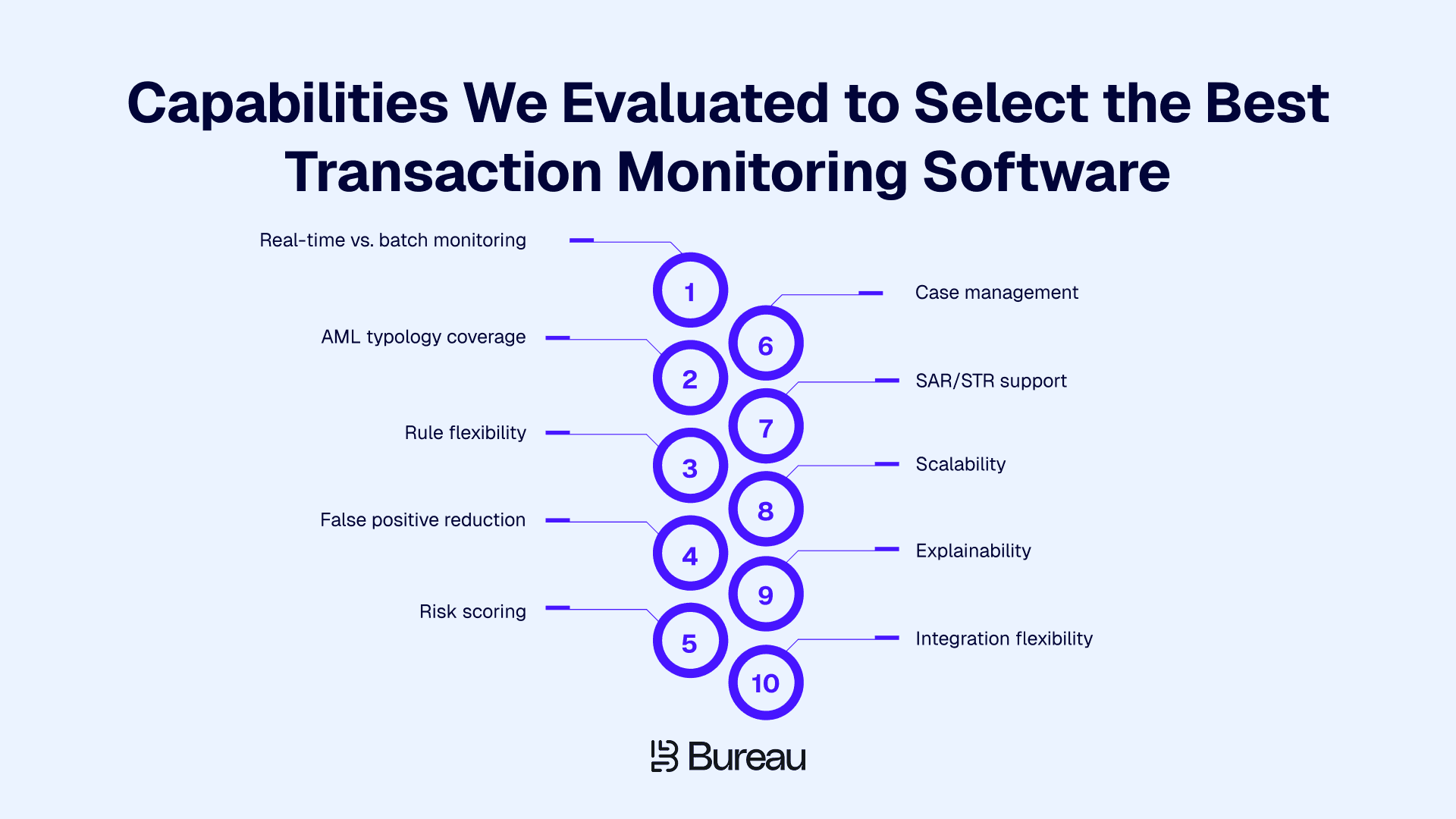
To compare the platforms fairly, we evaluated them across the capabilities that matter most to AML, compliance, and risk teams:
Real-time vs. batch monitoring: Support for real-time transaction interdiction, post-event monitoring, batch reviews, or a combination of all three.
AML typology coverage: Detection of structuring, layering, mule activity, rapid fund movement, unusual velocity, sanctions exposure, high-risk geographies, and account behavior anomalies.
Rule flexibility: Ability for compliance teams to build, test, tune, and deploy rules without heavy engineering involvement.
False positive reduction: Use of segmentation, behavioral baselines, adaptive thresholds, machine learning, and risk-based prioritization to reduce alert noise.
Risk scoring: Ability to score transactions, customers, accounts, counterparties, devices, and networks.
Case management: Support for investigations, evidence collection, escalations, alert disposition, and documentation.
SAR/STR support: Workflow support for suspicious activity reporting, audit trails, and evidence capture.
Scalability: Ability to handle growing transaction volumes without affecting performance.
Explainability: Clear visibility into why a transaction was flagged and which risk signals contributed to the alert.
Integration flexibility: Support for APIs, SDKs, webhooks, core banking systems, payment infrastructure, and fraud tools.
PwC's 2024 EMEA AML Survey found that 90–95% of alerts from traditional rule-based systems turn out to be legitimate activity, meaning compliance teams can spend the vast majority of their investigation hours on noise rather than genuine risk. This makes false positive reduction a necessary capability to include in your shortlisting criteria.
The platforms below were evaluated against these criteria to determine how well they support AML compliance, investigator productivity, and operational efficiency at scale.
10 Best Transaction Monitoring Software for AML Compliance
The platforms in this list take different approaches to transaction monitoring. Some focus primarily on AML compliance and suspicious activity reporting, while others connect transaction monitoring with broader fraud, identity, and risk intelligence.
The right choice depends on your transaction volume, regulatory obligations, operating model, and the types of risk you need to detect.
1. Bureau ID
Bureau ID is an AI-powered Unified Risk Decisioning Platform built for businesses that need transaction monitoring connected to the broader customer risk journey. Instead of evaluating transactions in isolation, Bureau ID combines identity, device, behavioral, network, and transaction signals to help teams detect suspicious activity earlier and make more informed risk decisions.
This approach is particularly valuable when risks span multiple stages of the customer lifecycle. A transaction may appear normal on its own, but become high-risk when viewed alongside device anomalies, linked accounts, behavioral changes, or known fraud networks.
Key strengths:
Unified risk view: Combines device, behavioral, identity, network, and transaction signals to deliver a single, actionable risk decision.
Real-time decisions: Enables instant risk scoring with explainable outputs and configurable workflows to reduce manual review time.
Network intelligence: Uses the Graph Identity Network to expose linked accounts, fraud rings, and coordinated abuse.
Deeper detection: Surfaces suspicious activity that standalone transaction rules often miss, improving fraud catch rates.
Mule risk coverage: Strengthens money mule detection by connecting transaction patterns with identity and network signals.
Repeat offender tracking: Leverages persistent Device ID to identify returning bad actors, device resets, and multi-accounting.
What to consider:
Best suited for teams seeking unified fraud and AML risk decisioning, not just a standalone transaction rule engine.
Buyers should define which workflows to consolidate and validate geography-specific AML reporting requirements during evaluation.
Best for: Fintechs, lenders, banks, NBFCs, marketplaces, gaming platforms, and other high-risk digital businesses that need transaction monitoring connected to broader fraud prevention and risk intelligence.
2. ComplyAdvantage
ComplyAdvantage is an AML-first transaction monitoring platform designed for teams that want AI-driven alerting, flexible rule creation, and automated compliance workflows. It focuses heavily on suspicious activity detection, false positive reduction, and real-time transaction monitoring for regulated financial businesses.
Key strengths:
AI-powered monitoring: Uses machine learning to support AML and CTF transaction analysis.
Flexible rule support: Enables behavioral, aggregate, pattern-based, and threshold-driven detection approaches.
Alert optimization: Helps reduce false positives and prioritize higher-risk alerts.
Workflow configuration: Provides configurable workflows, audit trails, and case management tools.
Industry alignment: Designed to support fintechs, payment firms, and digital banks.
What to consider:
Buyers may need additional tools for identity intelligence, device risk, and fraud network analysis.
Some reviewers mention that customization and reporting requirements can require additional setup effort.
Best for: Fintechs, payment companies, digital banks, remittance providers, and regulated firms looking for AI-led AML transaction monitoring.
3. NICE Actimize

NICE Actimize is an enterprise-grade suspicious activity monitoring platform built for large financial institutions. Its approach combines entity-centric monitoring, machine learning, predictive scoring, and relationship analysis to help compliance teams identify complex money laundering and financial crime patterns.
Key strengths:
Entity-centric monitoring: Provides a unified view across customers, accounts, and transactions to support more comprehensive risk assessment.
Machine learning models: Enhances anomaly detection and enables predictive alert scoring to improve prioritization.
Graph analytics: Identifies connected risks and hidden relationships to uncover complex financial crime patterns.
Enterprise-scale monitoring: Supports large-scale AML and suspicious activity monitoring programs with robust capabilities.
Designed for complex environments: Aligns with the needs of organizations operating in mature and highly regulated compliance environments.
What to consider:
Implementation timelines and costs can be significant for smaller organizations.
Workflow customization and rule changes may require more technical involvement than lighter-weight platforms.
Best for: Large banks, enterprise financial institutions, payment networks, and organizations with mature AML compliance operations.
4. FICO
FICO provides an enterprise-grade financial crime platform that combines transaction monitoring, customer risk scoring, AI-driven analytics, and case management to help financial institutions detect suspicious activity across the customer lifecycle. The platform is designed for organizations managing large transaction volumes that need explainable risk models, configurable detection scenarios, and centralized investigation workflows.
Key strengths:
AI-driven transaction monitoring: Uses machine learning, predictive analytics, and risk scoring to identify suspicious transactions while helping reduce false positives.
Holistic customer risk assessment: Combines transaction behavior, customer profiles, and relationship data to deliver more contextual risk decisions.
Integrated investigations: Supports alert management, case workflows, evidence collection, and regulatory reporting within a unified investigation environment.
Flexible detection scenarios: Enables compliance teams to configure and refine monitoring rules and risk thresholds as fraud typologies evolve.
Enterprise scalability: Built for large financial institutions with high transaction volumes, governance requirements, and complex compliance operations.
What to consider:
Enterprise deployments typically require dedicated implementation resources and careful model calibration.
Organizations may need experienced compliance and analytics teams to fully utilize the platform's advanced risk modeling capabilities.
Best for: Banks, payment processors, and large financial institutions that need AI-driven transaction monitoring and enterprise-scale financial crime compliance.
5. Fenergo
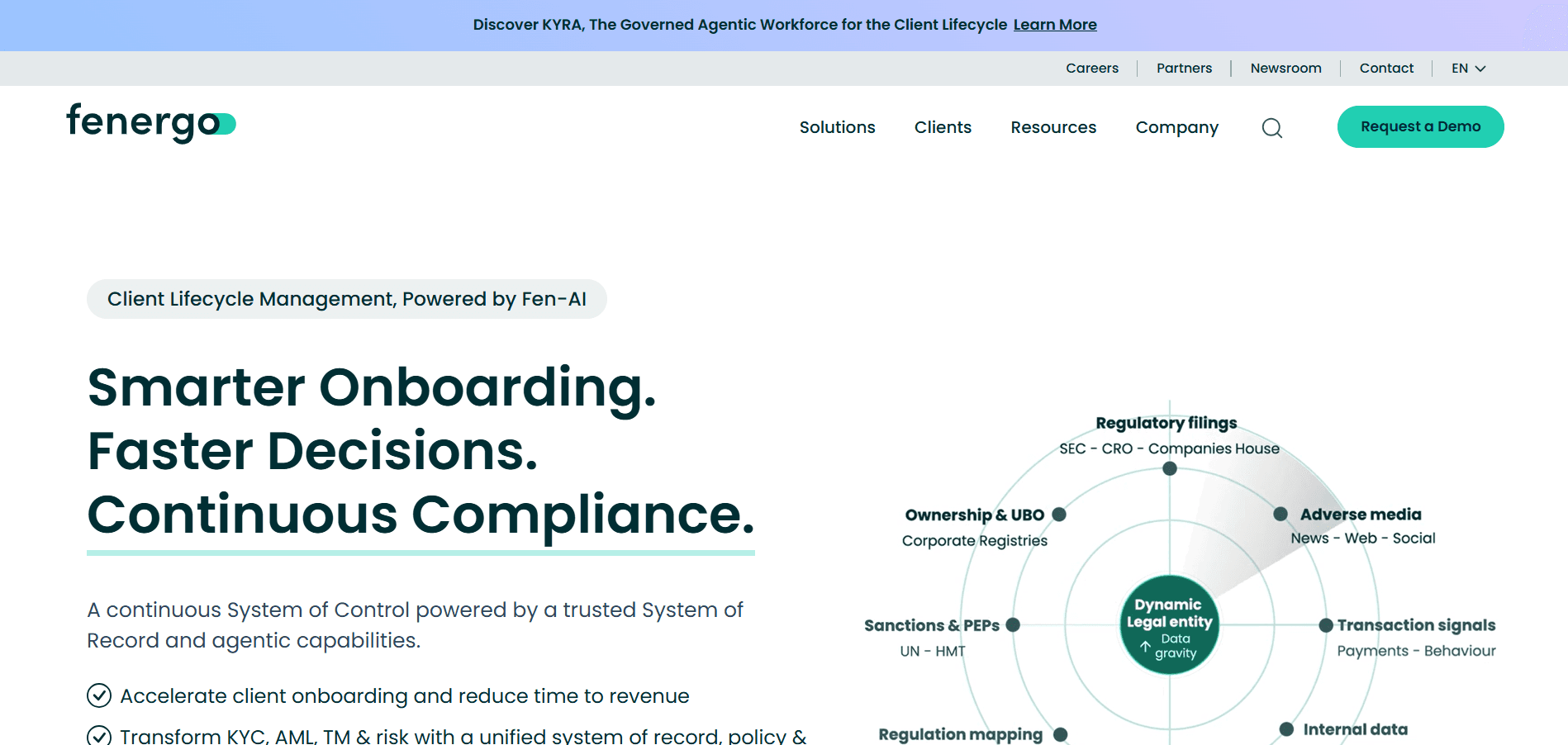
Fenergo combines transaction monitoring with customer lifecycle compliance, helping financial institutions connect KYC, risk scoring, sanctions screening, and transaction activity. Its platform supports both real-time and post-event monitoring through configurable workflows and entity-based risk intelligence.
Key strengths:
Real-time and post-event monitoring: Supports both real-time and post-event transaction monitoring to help identify suspicious activity across different timeframes.
Hybrid detection capabilities: Uses a combination of machine learning and prebuilt scenarios to enhance detection accuracy and adaptability.
Unified customer risk view: Connects customer profiles, risk scoring, sanctions screening, and transaction data for more comprehensive risk assessment.
Flexible workflow configuration: Offers no-code configuration to adapt workflows across jurisdictions with reduced operational complexity.
Modern integration approach: Provides an API-first architecture to support integration with existing systems and evolving infrastructure.
What to consider:
Stronger on compliance orchestration than broader fraud intelligence and device-risk analysis.
Users should confirm which customization and workflow configurations require significant planning upfront.
Best for: Financial institutions that want to connect KYC, customer risk, AML transaction monitoring, and compliance workflows.
6. Unit21
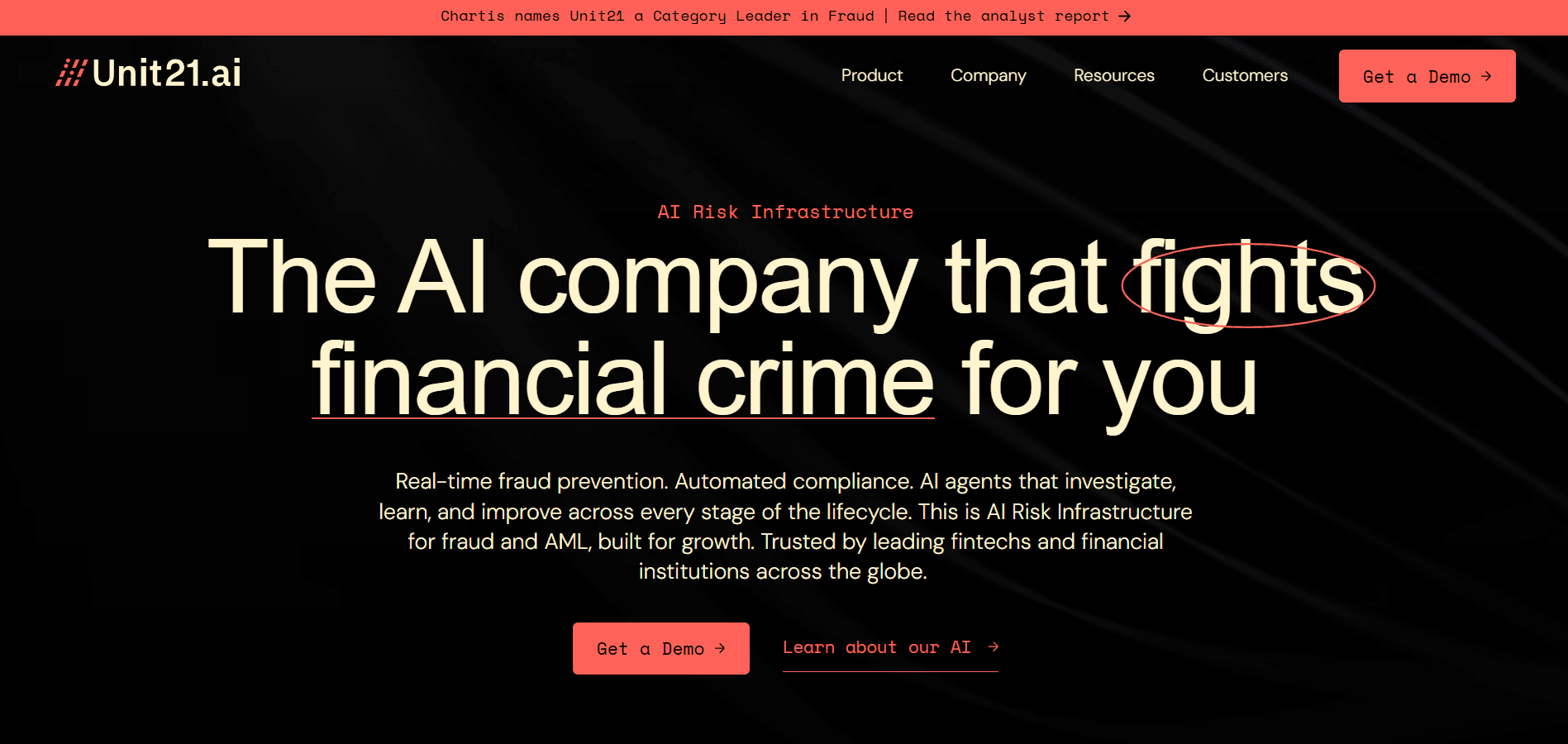
Unit21 is a no-code AML and fraud operations platform that combines transaction monitoring, case management, sanctions screening, and investigation workflows in a single environment. It is designed for fintechs, banks, payment companies, and digital platforms that want compliance teams to build, test, and refine AML programs without relying heavily on engineering resources.
Key strengths:
No-code transaction monitoring: Enables compliance teams to create, test, and deploy AML rules and detection scenarios without extensive technical support.
Integrated investigations: Combines alert management, case management, SAR workflows, and evidence collection within a centralized investigation platform.
Flexible risk detection: Supports configurable risk scoring, behavioral rules, and typology-based monitoring to improve suspicious activity detection.
Operational efficiency: Helps reduce manual review through automated workflows, alert prioritization, and collaborative investigation tools.
Broad integration ecosystem: Connects with payment systems, banking infrastructure, identity providers, and third-party data sources to support end-to-end AML operations.
What to consider:
Advanced rule configuration and complex workflows may require additional planning, particularly for organizations with highly customized AML programs.
Some reviewers mention that the reporting interface and certain advanced workflows could be more intuitive, especially for new users configuring complex rules.
Best for: Fintechs, banks, payment processors, crypto companies, and digital platforms that want configurable transaction monitoring and modern AML investigation workflows.
7. Flagright
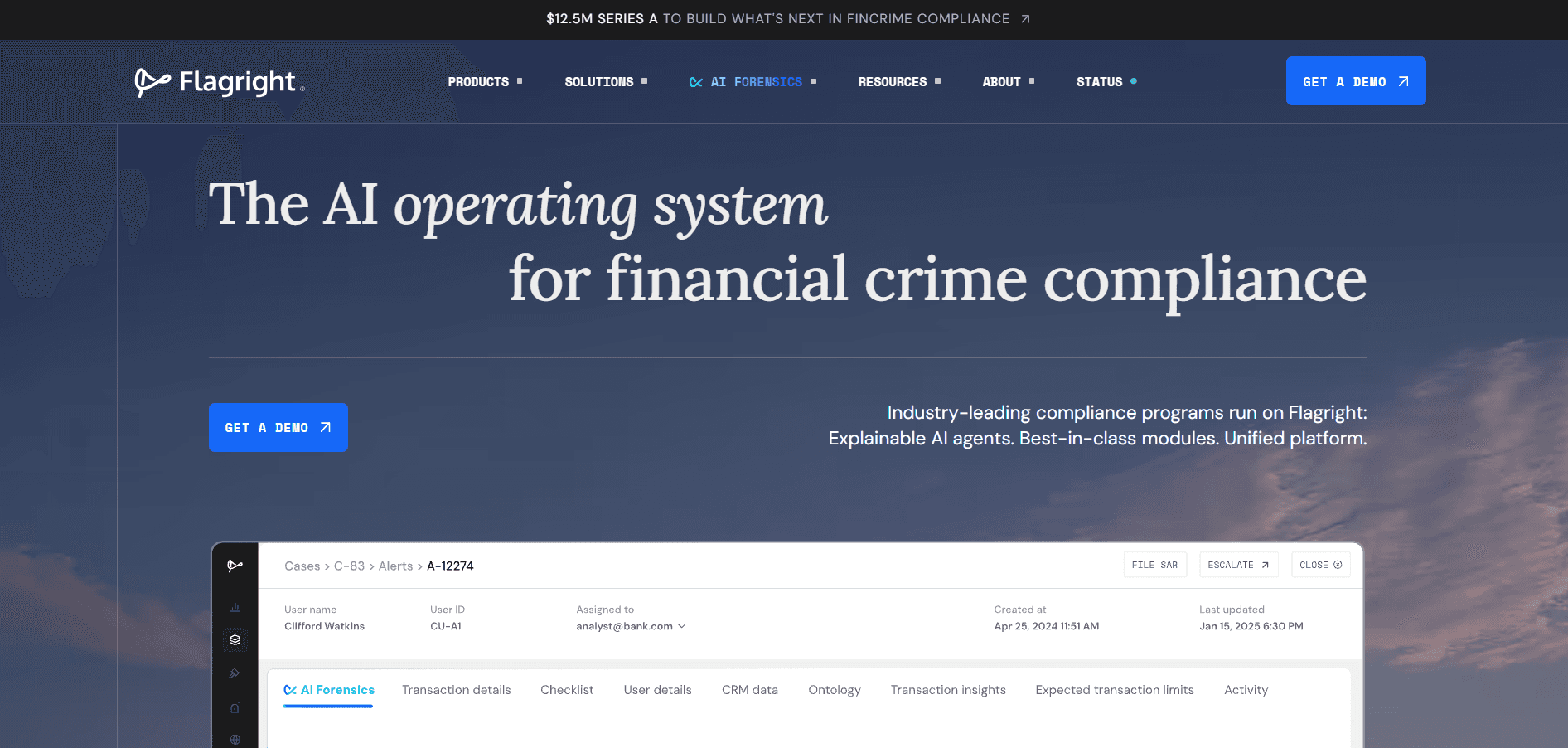
Flagright is an AI-native AML platform built for fintechs and payment businesses that need fast deployment, no-code rule management, and real-time transaction monitoring. Its platform emphasizes operational agility through configurable workflows, dynamic risk scoring, and automated compliance processes.
Key strengths:
No-code rule builder: Enables compliance teams to create and update monitoring scenarios without engineering support.
Real-time risk scoring: Evaluates transactions using behavioral signals, KYC data, and transaction history.
Threshold optimization: Uses AI-assisted tuning to improve detection accuracy and reduce false positives.
Integrated compliance workflows: Supports case management, watchlist screening, and regulatory processes.
Fast deployment: Designed for teams that need to iterate quickly as risks and regulations evolve.
What to consider:
Buyers should validate fit for their regulatory geography and reporting obligations.
Some reviewers note that certain advanced workflows require additional time and slow down the process.
Best for: Fintechs, neobanks, payment processors, crypto firms, and remittance businesses that need agile AML monitoring.
8. Napier AI
Napier AI focuses on configurable AML monitoring through prebuilt typologies, flexible rule creation, and scalable analytics infrastructure. The platform is designed to help compliance teams manage transaction monitoring, testing, investigations, and reporting without relying heavily on technical resources.
Key strengths:
Prebuilt typologies: Includes more than 100 AML typologies covering common suspicious activity patterns.
No-code configuration: Allows teams to build and test monitoring rules without extensive development effort.
Sandbox testing: Supports scenario validation before deploying changes into production environments.
Scalable architecture: Handles large transaction volumes through a big-data processing framework.
Regulatory reporting support: Helps move investigations through reporting and submission workflows.
What to consider:
Buyers should assess implementation complexity and data readiness requirements.
Organizations may still require additional identity or fraud intelligence layers depending on risk exposure.
Best for: Banks, fintechs, and compliance teams that want configurable AML typologies and sandbox-based rule testing.
9. Alessa
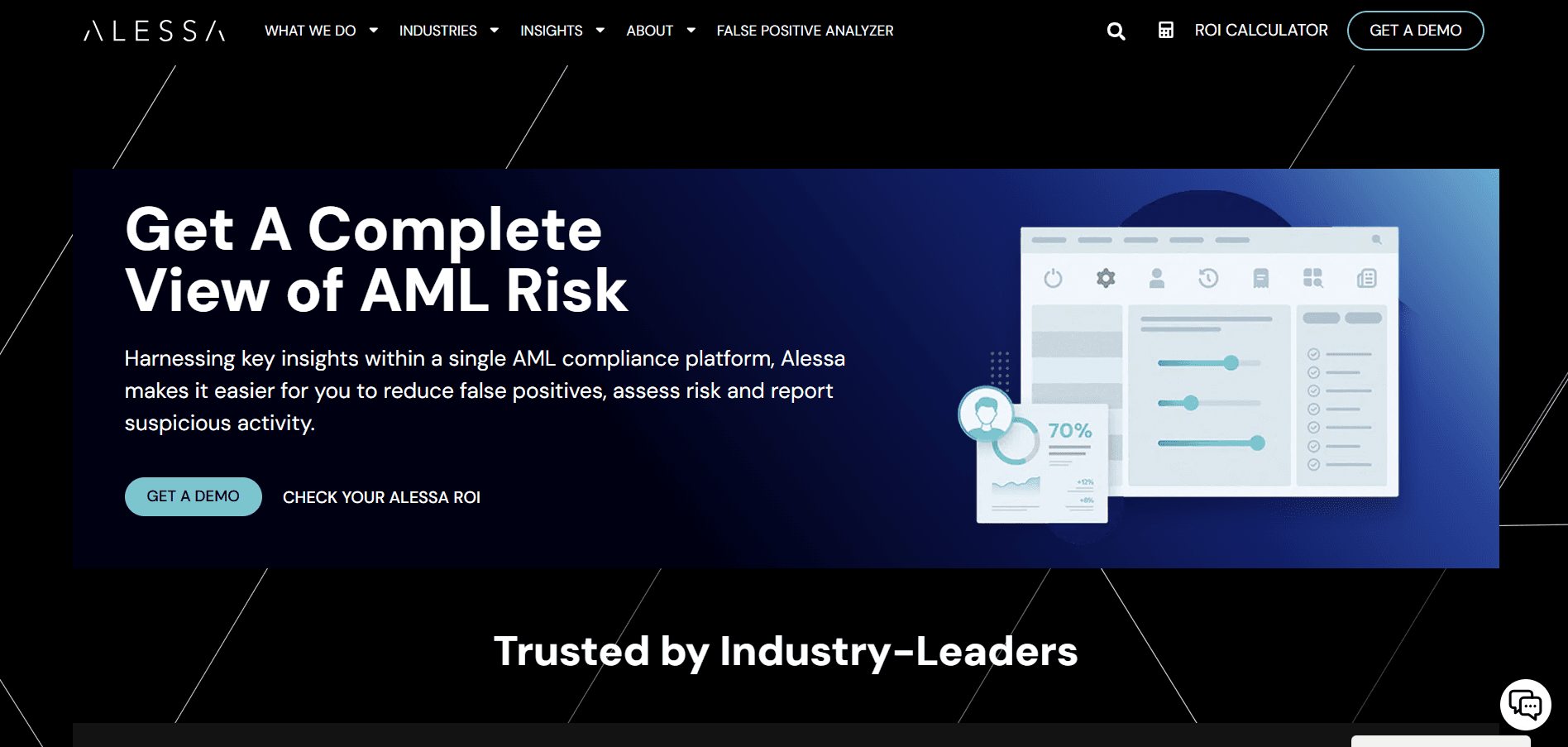
Alessa is an integrated AML compliance platform that combines transaction monitoring, screening, risk scoring, investigations, and regulatory reporting. Its monitoring framework supports real-time, periodic, and event-driven analysis to help compliance teams manage a broad range of AML requirements.
Key strengths:
Flexible monitoring modes: Supports real-time, periodic, and event-based transaction monitoring.
Risk-based detection: Uses rules-based analytics and machine learning to identify suspicious activity.
Integrated screening: Screens transactions and entities against sanctions and watchlists.
Case management workflows: Provides configurable investigation and escalation processes.
Broad compliance coverage: Combines monitoring, KYC, screening, risk scoring, and reporting capabilities.
What to consider:
Buyers should assess suitability for API-first fintech environments and high-velocity transaction flows.
Additional configuration effort may be needed when tailoring rules and workflows to specific requirements.
Best for: Banks, MSBs, casinos, fintechs, lenders, and regulated businesses needing an integrated AML compliance platform.
10. Oscilar
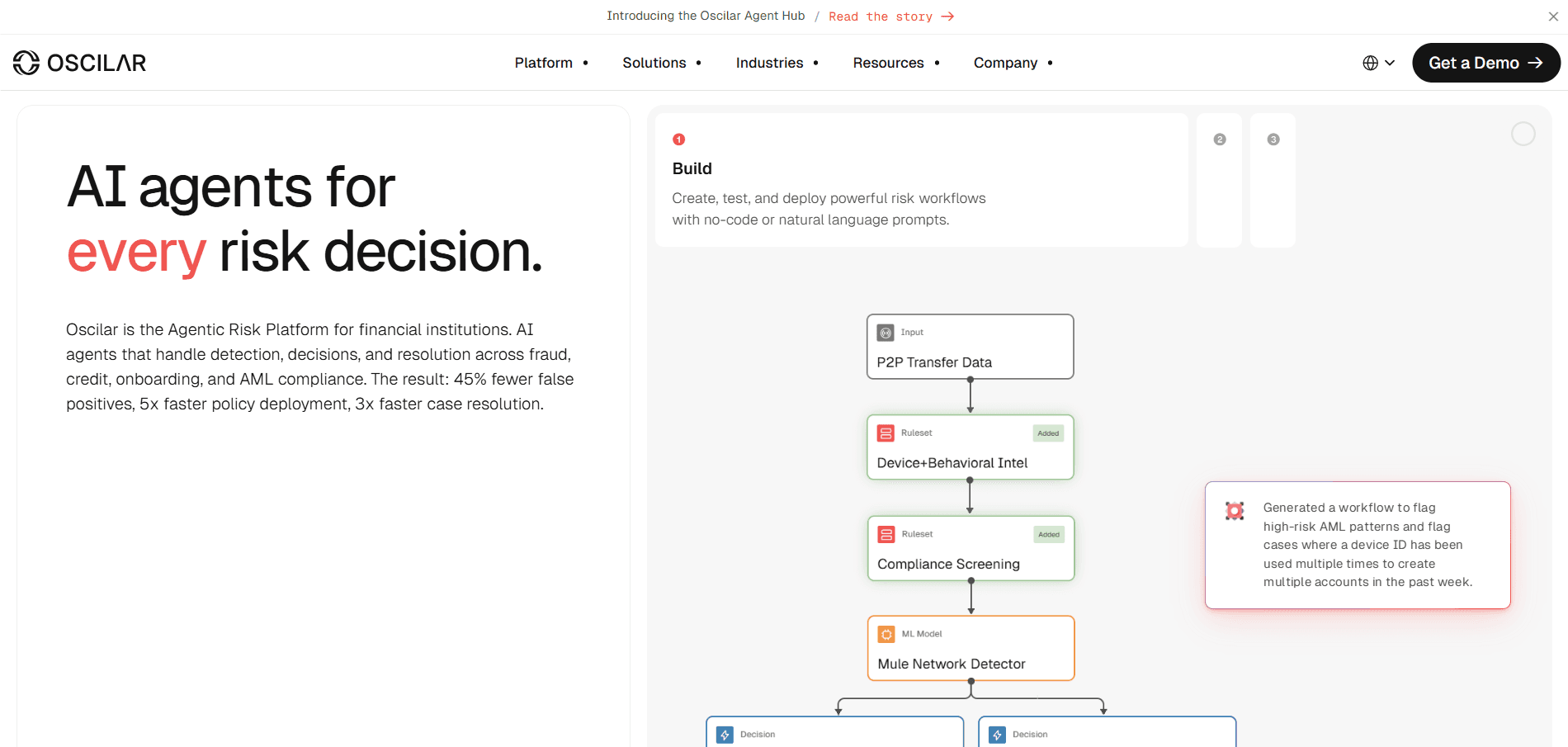
Oscilar is an AI-powered risk decisioning platform that combines transaction monitoring, fraud detection, case management, and decision automation within a unified risk engine. Built for fintechs, banks, lenders, and digital businesses, it helps teams monitor transactions in real time while connecting AML controls with broader fraud and customer risk signals.
Key strengths:
AI-powered transaction monitoring: Detects suspicious transactions using configurable rules, machine learning, and real-time risk scoring.
Unified risk decisioning: Combines transaction, identity, behavioral, and fraud signals to provide more contextual risk assessments.
Flexible workflow automation: Enables compliance and risk teams to configure monitoring rules, decision flows, and alert handling with minimal engineering effort.
Integrated case management: Supports investigations, alert prioritization, evidence collection, and compliance workflows from a centralized interface.
Fast implementation: API-first architecture and no-code configuration help organizations deploy and iterate quickly as risk requirements evolve.
What to consider:
Some reviewers mention that the initial implementation and configuration can require additional planning before teams realize the platform's full operational benefits.
Buyers should assess the breadth of third-party integrations and advanced investigation features needed for complex, large-scale financial crime operations.
Best for: Fintechs, digital banks, lenders, payment companies, and other digital businesses that want transaction monitoring integrated with broader fraud detection and AI-driven risk decisioning.
How to Shortlist the Right Transaction Monitoring System?
Nasdaq Verafin's 2026 Global Financial Crime Report found that 90% of financial crime professionals globally reported an increase in AI-driven attacks at their institution over the past two years, a signal that transaction monitoring systems relying on static rules are increasingly operating at a structural disadvantage.
The right transaction monitoring system depends on the decisions your team needs to make every day. A bank investigating complex money laundering patterns will have very different requirements from a fintech focused on real-time payment fraud or a crypto platform monitoring high-risk transactions.
Instead of starting with features, start with your operating model.
Define the risks you need to detect, the workflows you need to support, and the level of control your compliance team requires.
Then evaluate vendors based on how well they fit those requirements rather than on how many capabilities appear on a product sheet.
The checklist below can help you compare vendors against the criteria that matter most to your business.
Transaction Monitoring Software Buyer Checklist
Evaluation Area | Buyer Question |
AML Coverage | Does the tool cover our top AML typologies and suspicious activity scenarios? |
Real-Time Monitoring | Can it score, block, or escalate transactions instantly when needed? |
Batch Monitoring | Can it support periodic review and post-event monitoring? |
Rule Builder | Can compliance teams build and tune rules without engineering? |
Risk Scoring | Can it score customers, accounts, transactions, counterparties, and networks? |
False Positive Reduction | Does it reduce alert noise without missing true suspicious activity? |
Case Management | Can analysts investigate, document, escalate, and disposition alerts? |
SAR/STR Filing | Does it support evidence capture and reporting workflows? |
Explainability | Can analysts and auditors understand why a transaction was flagged? |
Scalability | Can it handle peak transaction volumes and future growth? |
Integrations | Does it connect with core banking, payment, onboarding, KYC, and fraud systems? |
Governance | Does it support audit logs, maker-checker workflows, model validation, and rule versioning? |
While evaluating vendors, it is also worth considering how transaction monitoring fits into the broader risk stack.
For teams that need transaction monitoring connected to fraud prevention, Bureau ID is worth evaluating. It combines identity, device, behavioral, network, and transaction intelligence within a single decisioning layer, helping risk teams identify mule activity, linked fraud rings, repeat bad actors, and suspicious transaction behavior without relying solely on static transaction rules.
Related Read: How to Choose the Right Fraud Prevention Software for E-Commerce Teams
Reduce False Positives With Smarter Transaction Monitoring
As fraud patterns, mule networks, scams, and account behavior evolve, static rules alone become harder to maintain. Modern transaction monitoring requires real-time decisioning, flexible rule controls, risk scoring, investigation workflows, and the ability to connect signals across the customer journey.
For teams looking to move beyond standalone transaction monitoring, Bureau ID brings identity, device, behavioral, network, and transaction intelligence into a single decisioning layer. With Bureau ID, you can:
Uncover hidden relationships across accounts, devices, and networks
Detect mule activity and coordinated fraud earlier
Reduce false positives with richer, connected signals
Improve risk decisions without adding operational complexity
Book a quick demo with Bureau ID to see how unified risk decisioning can help your team detect suspicious transaction activity, reduce false positives, uncover mule networks, and make faster risk decisions across the customer lifecycle.
FAQs
1. What is the best transaction monitoring software for AML compliance?
The best transaction monitoring software depends on your transaction volume, risk profile, and compliance requirements. Popular options include Bureau ID, ComplyAdvantage, NICE Actimize, FICO, Fenergo, Unit21, Flagright, Napier AI, Alessa, and Oscilar.
2. What features should a transaction monitoring system have?
A transaction monitoring system should support real-time monitoring, risk scoring, configurable rules, case management, false positive reduction, audit trails, SAR/STR workflows, and integrations with KYC, payment, and fraud systems.
3. How does Bureau ID help reduce false positives in transaction monitoring?
Bureau ID reduces false positives by combining risk scoring, behavioral analysis, identity and device intelligence, network signals, and adaptive rules to provide richer context. This helps teams prioritize genuinely suspicious activity and avoid unnecessary alerts.
4. What is the difference between transaction monitoring and transaction screening?
Transaction monitoring analyzes transaction behavior and patterns over time to identify suspicious activity. Transaction screening checks customers, counterparties, or payments against sanctions lists, PEP databases, watchlists, and adverse media sources.
5. Do fintechs need real-time transaction monitoring?
Yes. Real-time transaction monitoring helps fintechs identify suspicious transactions before funds move, reducing fraud losses, compliance exposure, and manual investigation workloads while improving customer experience.
6. How do I choose the right transaction monitoring software?
Start by evaluating your risk exposure, transaction volume, regulatory obligations, and operational workflows. Then compare vendors based on monitoring capabilities, rule flexibility, false positive reduction, case management, explainability, and integration support.
A transaction that should have been blocked moves funds across three accounts in minutes. Meanwhile, compliance teams are still working through hundreds of low-risk alerts that will never become cases.
As transaction volumes increase across banks, fintechs, payment companies, lenders, and digital platforms, teams need systems that can detect suspicious activity in real time, support accurate risk scoring, and improve false positive reduction without creating more manual review work.
In this guide, we'll compare the best transaction monitoring software platforms on the market and help you shortlist the right solution for your compliance and risk requirements.
Transaction Monitoring Software: Top Tools at a Glance
This transaction monitoring software comparison gives compliance and risk teams a quick view of the leading platforms before we dive into detailed reviews.
While all of these solutions support AML monitoring, they differ significantly in rule flexibility, risk intelligence, investigation workflows, and how they connect with broader fraud, identity, and transaction screening software capabilities.
Tool | Best For | Core Strength | Real-Time Monitoring | Rule Flexibility | Key Consideration |
Bureau ID | Unified transaction risk decisioning | Identity, device, behavior, network, and transaction signals | Yes | High | Best for teams that want transaction monitoring connected to broader fraud and mule-risk decisions |
ComplyAdvantage | AI-led AML transaction monitoring | AML data, alert automation, rules, and false-positive reduction | Yes | High | Strong AML-first platform; evaluate fit for identity and device intelligence needs |
NICE Actimize | Enterprise suspicious activity monitoring | Entity-centric AML, ML analytics, predictive scoring | Yes | High | Best suited for mature financial institutions with enterprise compliance operations |
FICO | Financial institutions requiring AI-driven financial crime prevention | AI-powered transaction monitoring, customer risk scoring, and financial crime analytics | Yes | High | Strong for organizations seeking AI-driven AML and fraud detection across large transaction volumes |
Fenergo | Financial institutions needing KYC plus transaction compliance | Real-time and post-event monitoring with entity profiles | Yes | High | Strong where KYC and transaction monitoring need to be connected |
Unit21 | Fintechs building customizable AML operations | No-code transaction monitoring, case management, and investigation workflows | Yes | Very High | Strong for teams that want configurable AML operations and flexible investigation workflows |
Flagright | Fast-moving fintechs and payment companies | No-code AML rules, real-time risk scoring, case automation | Yes | Very High | Strong for agile compliance teams that need fast rule iteration |
Napier AI | AML compliance teams needing typology coverage | 100+ AML typologies, sandbox testing, no-code rules | Yes | High | Strong for teams that want configurable typology-led monitoring |
Alessa | Banks, MSBs, casinos, and regulated businesses | Real-time, periodic, and event-based monitoring | Yes | Medium to High | Strong AML suite; evaluate depth for real-time digital risk use cases |
Oscilar | Fintechs and digital businesses needing unified risk decisioning | AI-powered risk engine combining transaction monitoring, fraud detection, and decision automation | Yes | High | Strong for teams that want transaction monitoring integrated with broader fraud and risk decisioning |
The right platform depends on whether your priority is AML automation, suspicious activity detection, real-time interdiction, false positive reduction, fraud intelligence, or end-to-end compliance workflows.
Understanding how these platforms are assessed helps clarify which capabilities truly matter when selecting transaction monitoring software.
Capabilities We Evaluated to Select the Best Transaction Monitoring Software
To compare the platforms fairly, we evaluated them across the capabilities that matter most to AML, compliance, and risk teams:
Real-time vs. batch monitoring: Support for real-time transaction interdiction, post-event monitoring, batch reviews, or a combination of all three.
AML typology coverage: Detection of structuring, layering, mule activity, rapid fund movement, unusual velocity, sanctions exposure, high-risk geographies, and account behavior anomalies.
Rule flexibility: Ability for compliance teams to build, test, tune, and deploy rules without heavy engineering involvement.
False positive reduction: Use of segmentation, behavioral baselines, adaptive thresholds, machine learning, and risk-based prioritization to reduce alert noise.
Risk scoring: Ability to score transactions, customers, accounts, counterparties, devices, and networks.
Case management: Support for investigations, evidence collection, escalations, alert disposition, and documentation.
SAR/STR support: Workflow support for suspicious activity reporting, audit trails, and evidence capture.
Scalability: Ability to handle growing transaction volumes without affecting performance.
Explainability: Clear visibility into why a transaction was flagged and which risk signals contributed to the alert.
Integration flexibility: Support for APIs, SDKs, webhooks, core banking systems, payment infrastructure, and fraud tools.
PwC's 2024 EMEA AML Survey found that 90–95% of alerts from traditional rule-based systems turn out to be legitimate activity, meaning compliance teams can spend the vast majority of their investigation hours on noise rather than genuine risk. This makes false positive reduction a necessary capability to include in your shortlisting criteria.
The platforms below were evaluated against these criteria to determine how well they support AML compliance, investigator productivity, and operational efficiency at scale.
10 Best Transaction Monitoring Software for AML Compliance
The platforms in this list take different approaches to transaction monitoring. Some focus primarily on AML compliance and suspicious activity reporting, while others connect transaction monitoring with broader fraud, identity, and risk intelligence.
The right choice depends on your transaction volume, regulatory obligations, operating model, and the types of risk you need to detect.
1. Bureau ID
Bureau ID is an AI-powered Unified Risk Decisioning Platform built for businesses that need transaction monitoring connected to the broader customer risk journey. Instead of evaluating transactions in isolation, Bureau ID combines identity, device, behavioral, network, and transaction signals to help teams detect suspicious activity earlier and make more informed risk decisions.
This approach is particularly valuable when risks span multiple stages of the customer lifecycle. A transaction may appear normal on its own, but become high-risk when viewed alongside device anomalies, linked accounts, behavioral changes, or known fraud networks.
Key strengths:
Unified risk view: Combines device, behavioral, identity, network, and transaction signals to deliver a single, actionable risk decision.
Real-time decisions: Enables instant risk scoring with explainable outputs and configurable workflows to reduce manual review time.
Network intelligence: Uses the Graph Identity Network to expose linked accounts, fraud rings, and coordinated abuse.
Deeper detection: Surfaces suspicious activity that standalone transaction rules often miss, improving fraud catch rates.
Mule risk coverage: Strengthens money mule detection by connecting transaction patterns with identity and network signals.
Repeat offender tracking: Leverages persistent Device ID to identify returning bad actors, device resets, and multi-accounting.
What to consider:
Best suited for teams seeking unified fraud and AML risk decisioning, not just a standalone transaction rule engine.
Buyers should define which workflows to consolidate and validate geography-specific AML reporting requirements during evaluation.
Best for: Fintechs, lenders, banks, NBFCs, marketplaces, gaming platforms, and other high-risk digital businesses that need transaction monitoring connected to broader fraud prevention and risk intelligence.
2. ComplyAdvantage
ComplyAdvantage is an AML-first transaction monitoring platform designed for teams that want AI-driven alerting, flexible rule creation, and automated compliance workflows. It focuses heavily on suspicious activity detection, false positive reduction, and real-time transaction monitoring for regulated financial businesses.
Key strengths:
AI-powered monitoring: Uses machine learning to support AML and CTF transaction analysis.
Flexible rule support: Enables behavioral, aggregate, pattern-based, and threshold-driven detection approaches.
Alert optimization: Helps reduce false positives and prioritize higher-risk alerts.
Workflow configuration: Provides configurable workflows, audit trails, and case management tools.
Industry alignment: Designed to support fintechs, payment firms, and digital banks.
What to consider:
Buyers may need additional tools for identity intelligence, device risk, and fraud network analysis.
Some reviewers mention that customization and reporting requirements can require additional setup effort.
Best for: Fintechs, payment companies, digital banks, remittance providers, and regulated firms looking for AI-led AML transaction monitoring.
3. NICE Actimize
NICE Actimize is an enterprise-grade suspicious activity monitoring platform built for large financial institutions. Its approach combines entity-centric monitoring, machine learning, predictive scoring, and relationship analysis to help compliance teams identify complex money laundering and financial crime patterns.
Key strengths:
Entity-centric monitoring: Provides a unified view across customers, accounts, and transactions to support more comprehensive risk assessment.
Machine learning models: Enhances anomaly detection and enables predictive alert scoring to improve prioritization.
Graph analytics: Identifies connected risks and hidden relationships to uncover complex financial crime patterns.
Enterprise-scale monitoring: Supports large-scale AML and suspicious activity monitoring programs with robust capabilities.
Designed for complex environments: Aligns with the needs of organizations operating in mature and highly regulated compliance environments.
What to consider:
Implementation timelines and costs can be significant for smaller organizations.
Workflow customization and rule changes may require more technical involvement than lighter-weight platforms.
Best for: Large banks, enterprise financial institutions, payment networks, and organizations with mature AML compliance operations.
4. FICO
FICO provides an enterprise-grade financial crime platform that combines transaction monitoring, customer risk scoring, AI-driven analytics, and case management to help financial institutions detect suspicious activity across the customer lifecycle. The platform is designed for organizations managing large transaction volumes that need explainable risk models, configurable detection scenarios, and centralized investigation workflows.
Key strengths:
AI-driven transaction monitoring: Uses machine learning, predictive analytics, and risk scoring to identify suspicious transactions while helping reduce false positives.
Holistic customer risk assessment: Combines transaction behavior, customer profiles, and relationship data to deliver more contextual risk decisions.
Integrated investigations: Supports alert management, case workflows, evidence collection, and regulatory reporting within a unified investigation environment.
Flexible detection scenarios: Enables compliance teams to configure and refine monitoring rules and risk thresholds as fraud typologies evolve.
Enterprise scalability: Built for large financial institutions with high transaction volumes, governance requirements, and complex compliance operations.
What to consider:
Enterprise deployments typically require dedicated implementation resources and careful model calibration.
Organizations may need experienced compliance and analytics teams to fully utilize the platform's advanced risk modeling capabilities.
Best for: Banks, payment processors, and large financial institutions that need AI-driven transaction monitoring and enterprise-scale financial crime compliance.
5. Fenergo
Fenergo combines transaction monitoring with customer lifecycle compliance, helping financial institutions connect KYC, risk scoring, sanctions screening, and transaction activity. Its platform supports both real-time and post-event monitoring through configurable workflows and entity-based risk intelligence.
Key strengths:
Real-time and post-event monitoring: Supports both real-time and post-event transaction monitoring to help identify suspicious activity across different timeframes.
Hybrid detection capabilities: Uses a combination of machine learning and prebuilt scenarios to enhance detection accuracy and adaptability.
Unified customer risk view: Connects customer profiles, risk scoring, sanctions screening, and transaction data for more comprehensive risk assessment.
Flexible workflow configuration: Offers no-code configuration to adapt workflows across jurisdictions with reduced operational complexity.
Modern integration approach: Provides an API-first architecture to support integration with existing systems and evolving infrastructure.
What to consider:
Stronger on compliance orchestration than broader fraud intelligence and device-risk analysis.
Users should confirm which customization and workflow configurations require significant planning upfront.
Best for: Financial institutions that want to connect KYC, customer risk, AML transaction monitoring, and compliance workflows.
6. Unit21
Unit21 is a no-code AML and fraud operations platform that combines transaction monitoring, case management, sanctions screening, and investigation workflows in a single environment. It is designed for fintechs, banks, payment companies, and digital platforms that want compliance teams to build, test, and refine AML programs without relying heavily on engineering resources.
Key strengths:
No-code transaction monitoring: Enables compliance teams to create, test, and deploy AML rules and detection scenarios without extensive technical support.
Integrated investigations: Combines alert management, case management, SAR workflows, and evidence collection within a centralized investigation platform.
Flexible risk detection: Supports configurable risk scoring, behavioral rules, and typology-based monitoring to improve suspicious activity detection.
Operational efficiency: Helps reduce manual review through automated workflows, alert prioritization, and collaborative investigation tools.
Broad integration ecosystem: Connects with payment systems, banking infrastructure, identity providers, and third-party data sources to support end-to-end AML operations.
What to consider:
Advanced rule configuration and complex workflows may require additional planning, particularly for organizations with highly customized AML programs.
Some reviewers mention that the reporting interface and certain advanced workflows could be more intuitive, especially for new users configuring complex rules.
Best for: Fintechs, banks, payment processors, crypto companies, and digital platforms that want configurable transaction monitoring and modern AML investigation workflows.
7. Flagright
Flagright is an AI-native AML platform built for fintechs and payment businesses that need fast deployment, no-code rule management, and real-time transaction monitoring. Its platform emphasizes operational agility through configurable workflows, dynamic risk scoring, and automated compliance processes.
Key strengths:
No-code rule builder: Enables compliance teams to create and update monitoring scenarios without engineering support.
Real-time risk scoring: Evaluates transactions using behavioral signals, KYC data, and transaction history.
Threshold optimization: Uses AI-assisted tuning to improve detection accuracy and reduce false positives.
Integrated compliance workflows: Supports case management, watchlist screening, and regulatory processes.
Fast deployment: Designed for teams that need to iterate quickly as risks and regulations evolve.
What to consider:
Buyers should validate fit for their regulatory geography and reporting obligations.
Some reviewers note that certain advanced workflows require additional time and slow down the process.
Best for: Fintechs, neobanks, payment processors, crypto firms, and remittance businesses that need agile AML monitoring.
8. Napier AI
Napier AI focuses on configurable AML monitoring through prebuilt typologies, flexible rule creation, and scalable analytics infrastructure. The platform is designed to help compliance teams manage transaction monitoring, testing, investigations, and reporting without relying heavily on technical resources.
Key strengths:
Prebuilt typologies: Includes more than 100 AML typologies covering common suspicious activity patterns.
No-code configuration: Allows teams to build and test monitoring rules without extensive development effort.
Sandbox testing: Supports scenario validation before deploying changes into production environments.
Scalable architecture: Handles large transaction volumes through a big-data processing framework.
Regulatory reporting support: Helps move investigations through reporting and submission workflows.
What to consider:
Buyers should assess implementation complexity and data readiness requirements.
Organizations may still require additional identity or fraud intelligence layers depending on risk exposure.
Best for: Banks, fintechs, and compliance teams that want configurable AML typologies and sandbox-based rule testing.
9. Alessa
Alessa is an integrated AML compliance platform that combines transaction monitoring, screening, risk scoring, investigations, and regulatory reporting. Its monitoring framework supports real-time, periodic, and event-driven analysis to help compliance teams manage a broad range of AML requirements.
Key strengths:
Flexible monitoring modes: Supports real-time, periodic, and event-based transaction monitoring.
Risk-based detection: Uses rules-based analytics and machine learning to identify suspicious activity.
Integrated screening: Screens transactions and entities against sanctions and watchlists.
Case management workflows: Provides configurable investigation and escalation processes.
Broad compliance coverage: Combines monitoring, KYC, screening, risk scoring, and reporting capabilities.
What to consider:
Buyers should assess suitability for API-first fintech environments and high-velocity transaction flows.
Additional configuration effort may be needed when tailoring rules and workflows to specific requirements.
Best for: Banks, MSBs, casinos, fintechs, lenders, and regulated businesses needing an integrated AML compliance platform.
10. Oscilar
Oscilar is an AI-powered risk decisioning platform that combines transaction monitoring, fraud detection, case management, and decision automation within a unified risk engine. Built for fintechs, banks, lenders, and digital businesses, it helps teams monitor transactions in real time while connecting AML controls with broader fraud and customer risk signals.
Key strengths:
AI-powered transaction monitoring: Detects suspicious transactions using configurable rules, machine learning, and real-time risk scoring.
Unified risk decisioning: Combines transaction, identity, behavioral, and fraud signals to provide more contextual risk assessments.
Flexible workflow automation: Enables compliance and risk teams to configure monitoring rules, decision flows, and alert handling with minimal engineering effort.
Integrated case management: Supports investigations, alert prioritization, evidence collection, and compliance workflows from a centralized interface.
Fast implementation: API-first architecture and no-code configuration help organizations deploy and iterate quickly as risk requirements evolve.
What to consider:
Some reviewers mention that the initial implementation and configuration can require additional planning before teams realize the platform's full operational benefits.
Buyers should assess the breadth of third-party integrations and advanced investigation features needed for complex, large-scale financial crime operations.
Best for: Fintechs, digital banks, lenders, payment companies, and other digital businesses that want transaction monitoring integrated with broader fraud detection and AI-driven risk decisioning.
How to Shortlist the Right Transaction Monitoring System?
Nasdaq Verafin's 2026 Global Financial Crime Report found that 90% of financial crime professionals globally reported an increase in AI-driven attacks at their institution over the past two years, a signal that transaction monitoring systems relying on static rules are increasingly operating at a structural disadvantage.
The right transaction monitoring system depends on the decisions your team needs to make every day. A bank investigating complex money laundering patterns will have very different requirements from a fintech focused on real-time payment fraud or a crypto platform monitoring high-risk transactions.
Instead of starting with features, start with your operating model.
Define the risks you need to detect, the workflows you need to support, and the level of control your compliance team requires.
Then evaluate vendors based on how well they fit those requirements rather than on how many capabilities appear on a product sheet.
The checklist below can help you compare vendors against the criteria that matter most to your business.
Transaction Monitoring Software Buyer Checklist
Evaluation Area | Buyer Question |
AML Coverage | Does the tool cover our top AML typologies and suspicious activity scenarios? |
Real-Time Monitoring | Can it score, block, or escalate transactions instantly when needed? |
Batch Monitoring | Can it support periodic review and post-event monitoring? |
Rule Builder | Can compliance teams build and tune rules without engineering? |
Risk Scoring | Can it score customers, accounts, transactions, counterparties, and networks? |
False Positive Reduction | Does it reduce alert noise without missing true suspicious activity? |
Case Management | Can analysts investigate, document, escalate, and disposition alerts? |
SAR/STR Filing | Does it support evidence capture and reporting workflows? |
Explainability | Can analysts and auditors understand why a transaction was flagged? |
Scalability | Can it handle peak transaction volumes and future growth? |
Integrations | Does it connect with core banking, payment, onboarding, KYC, and fraud systems? |
Governance | Does it support audit logs, maker-checker workflows, model validation, and rule versioning? |
While evaluating vendors, it is also worth considering how transaction monitoring fits into the broader risk stack.
For teams that need transaction monitoring connected to fraud prevention, Bureau ID is worth evaluating. It combines identity, device, behavioral, network, and transaction intelligence within a single decisioning layer, helping risk teams identify mule activity, linked fraud rings, repeat bad actors, and suspicious transaction behavior without relying solely on static transaction rules.
Related Read: How to Choose the Right Fraud Prevention Software for E-Commerce Teams
Reduce False Positives With Smarter Transaction Monitoring
As fraud patterns, mule networks, scams, and account behavior evolve, static rules alone become harder to maintain. Modern transaction monitoring requires real-time decisioning, flexible rule controls, risk scoring, investigation workflows, and the ability to connect signals across the customer journey.
For teams looking to move beyond standalone transaction monitoring, Bureau ID brings identity, device, behavioral, network, and transaction intelligence into a single decisioning layer. With Bureau ID, you can:
Uncover hidden relationships across accounts, devices, and networks
Detect mule activity and coordinated fraud earlier
Reduce false positives with richer, connected signals
Improve risk decisions without adding operational complexity
Book a quick demo with Bureau ID to see how unified risk decisioning can help your team detect suspicious transaction activity, reduce false positives, uncover mule networks, and make faster risk decisions across the customer lifecycle.
FAQs
1. What is the best transaction monitoring software for AML compliance?
The best transaction monitoring software depends on your transaction volume, risk profile, and compliance requirements. Popular options include Bureau ID, ComplyAdvantage, NICE Actimize, FICO, Fenergo, Unit21, Flagright, Napier AI, Alessa, and Oscilar.
2. What features should a transaction monitoring system have?
A transaction monitoring system should support real-time monitoring, risk scoring, configurable rules, case management, false positive reduction, audit trails, SAR/STR workflows, and integrations with KYC, payment, and fraud systems.
3. How does Bureau ID help reduce false positives in transaction monitoring?
Bureau ID reduces false positives by combining risk scoring, behavioral analysis, identity and device intelligence, network signals, and adaptive rules to provide richer context. This helps teams prioritize genuinely suspicious activity and avoid unnecessary alerts.
4. What is the difference between transaction monitoring and transaction screening?
Transaction monitoring analyzes transaction behavior and patterns over time to identify suspicious activity. Transaction screening checks customers, counterparties, or payments against sanctions lists, PEP databases, watchlists, and adverse media sources.
5. Do fintechs need real-time transaction monitoring?
Yes. Real-time transaction monitoring helps fintechs identify suspicious transactions before funds move, reducing fraud losses, compliance exposure, and manual investigation workloads while improving customer experience.
6. How do I choose the right transaction monitoring software?
Start by evaluating your risk exposure, transaction volume, regulatory obligations, and operational workflows. Then compare vendors based on monitoring capabilities, rule flexibility, false positive reduction, case management, explainability, and integration support.
TABLE OF CONTENTS
See More
Recommended Blogs


Landing Page.
Simple, bold.
Sign Up
Download

Products
Solutions


© 2026 Bureau . All rights reserved.
Solutions
Industries
Resources
Company
Solutions
Industries
Resources
Company
© 2026 Bureau . All rights reserved.
Follow Us
Leave behind fragmented tools. Stop fraud rings, cut false declines, and deliver secure digital journeys at scale
Our Presence








Leave behind fragmented tools. Stop fraud rings, cut false declines, and deliver secure digital journeys at scale
Our Presence
© 2026 Bureau . All rights reserved.