How Businesses Detect and Prevent Payment Fraud
How Businesses Detect and Prevent Payment Fraud
How Businesses Detect and Prevent Payment Fraud
Explore payment fraud, how it happens, common fraud schemes, warning signs, and practical ways to improve payment fraud detection.
Author
Team Bureau


See how Bureau has helped industry leaders defend against networked Industrial-scale frauds →
Schedule a Demo
TABLE OF CONTENTS
See Less
A payment can be approved, settled, and completed, and still turn out to be fraudulent.
Payment fraud has expanded far beyond stolen credit card details. It includes account takeover fraud, business email compromise, synthetic identities, wire fraud, chargeback abuse, and coordinated fraud rings that exploit weaknesses across the payment journey.
In this guide, we'll explain what payment fraud is, how it happens, the most common types of payment fraud businesses face today, and the practical payment fraud prevention and payment fraud detection strategies teams can use to reduce risk without adding unnecessary friction for genuine customers.
What Is Payment Fraud?
Payment fraud is the unauthorized or deceptive use of payment information, accounts, identities, or transaction processes to steal money, goods, services, or financial access. It can happen through stolen cards, account takeover, fake invoices, wire fraud, check fraud, chargeback abuse, or social engineering.
Payment fraud is not always the result of a stolen payment credential. In many cases, the transaction appears legitimate because the fraudster has gained access to a real account, manipulated a payment process, or convinced someone to authorize a payment under false pretenses.
As a result, payment fraud can be unauthorized, manipulated, or deceptively authorized. It can involve multiple payment methods and processes, including:
Credit and debit cards
Bank transfers
Digital wallets
Payment accounts
Invoices and refunds
Disputes and chargebacks
The impact extends beyond consumers to businesses, which often absorb direct financial losses, chargebacks, operational costs, compliance exposure, and reputational damage.
How Does Payment Fraud Happen?
Payment fraud usually happens when fraudsters exploit one or more weak points in the payment journey. In some cases, they steal access to legitimate accounts or payment credentials. In others, they manipulate people, processes, or systems to authorize payments that should never have been approved.
Common payment fraud methods include:
Stealing payment credentials through phishing attacks, data breaches, malware, or credential stuffing campaigns.
Taking over legitimate accounts and using saved cards, digital wallets, rewards balances, or payout details to make unauthorized transactions.
Impersonating vendors, executives, or employees to redirect payments through invoice fraud, wire fraud, or business email compromise schemes.
Creating fake or synthetic identities to open accounts, access credit, or establish fraudulent payment relationships.
Abusing refunds, returns, and chargebacks after receiving goods or services, creating losses long after the original transaction is completed.
Moving stolen funds through mule accounts and fraud rings to obscure money trails and make recovery more difficult.
In fact, according to Recorded Future's 2024 Payment Fraud Intelligence Report, 269 million card records were posted across dark web and clear web platforms in 2024 while Magecart e-skimmer infections nearly tripled, reaching close to 11,000 unique e-commerce domains.
While these attacks use different tactics, they all target the same objective of gaining unauthorized access to money, goods, services, or financial systems. Understanding how they work is the first step toward building stronger payment fraud prevention controls.
What Are the Most Common Types of Payment Fraud?
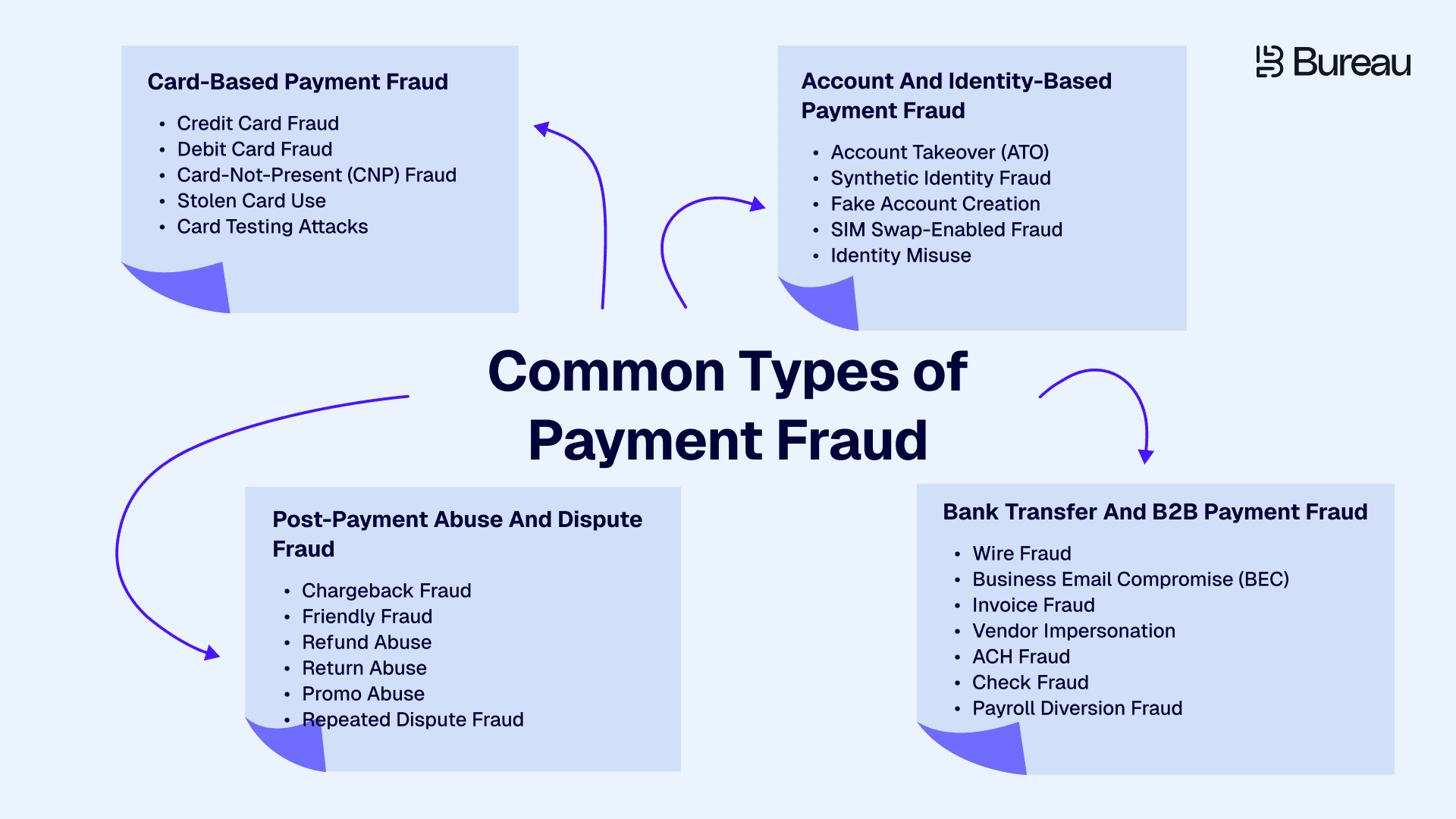
Payment fraud can occur at multiple stages of the payment lifecycle, from account creation and authentication to transaction processing, payouts, refunds, and disputes. While fraud tactics continue to evolve, most schemes fall into four broad categories based on how fraudsters gain access to funds or exploit payment systems.
The table below summarizes the most common types of payment fraud, how they work, the warning signs businesses should watch for, and the detection techniques most often used to identify them.
Type of Payment Fraud | How It Works | Common Warning Signs | Best Detection Techniques |
Card-Based Payment Fraud | Fraudsters use stolen card details or saved payment methods to make unauthorized purchases. | Multiple failed attempts, mismatched billing details, unusual location, high transaction velocity. | Transaction monitoring, device intelligence, velocity checks, IP risk analysis, behavioral signals. |
Account and Identity-Based Payment Fraud | Fraudsters misuse accounts, identities, or synthetic profiles to initiate payments or access financial services. | New device usage, unusual login behavior, profile changes, sudden payment activity. | Identity verification, behavioral biometrics, device fingerprinting, risk-based authentication. |
Bank Transfer and B2B Payment Fraud | Fraudsters manipulate invoices, wire transfers, checks, payroll processes, or vendor payment instructions. | Urgent payment requests, bank detail changes, unusual payee behavior. | Payee verification, anomaly detection, approval workflows, transaction monitoring. |
Post-Payment Abuse and Dispute Fraud | Fraudsters exploit chargebacks, refunds, returns, promotions, or dispute processes after payment is completed. | Repeated disputes, refund spikes, multiple linked accounts, repeated device usage. | Graph-based detection, device intelligence, refund pattern analysis, dispute monitoring. |
While these categories are distinct, they often overlap in practice. A fraudster may take over an account, use a saved card to make purchases, move funds through mule accounts, and later exploit dispute processes to recover additional value.
Understanding how each fraud type works makes it easier to identify risk signals before losses occur.
Card-Based Payment Fraud
Card-based payment fraud is one of the most common types of payment fraud and includes credit card fraud, debit card fraud, card-not-present (CNP) fraud, stolen card use, and card testing attacks.
It is particularly prevalent across eCommerce, marketplaces, subscription businesses, digital goods, and app-based transactions where physical card verification is not possible.
Common examples include:
A fraudster uses stolen card details to place an online order and ship goods to a new address.
A bot runs hundreds of small transactions to identify valid cards before larger fraudulent purchases are attempted.
A fraudster gains access to a customer account and uses the saved payment method already linked to the profile.
Card-based fraud often creates downstream losses beyond the original transaction. Unauthorized purchases can later result in disputes and chargebacks, making effective chargeback fraud prevention an important part of a broader payment risk strategy.
Businesses typically detect card-based payment fraud using a combination of:
Transaction monitoring
Card testing velocity checks
Device intelligence
IP and location risk analysis
Billing and shipping mismatch checks
Behavioral analytics during checkout
Evaluating these signals together helps distinguish genuine customers from fraudsters attempting to blend in with legitimate payment activity.
Account and Identity-Based Payment Fraud
Account and identity-based payment fraud occurs when fraudsters misuse legitimate accounts, stolen identities, or synthetic profiles to initiate transactions or gain access to financial services. These attacks are particularly difficult to detect because the payment itself often appears legitimate, and the fraud happens because the person behind the transaction is not who they claim to be.
This category includes account takeover fraud, synthetic identity fraud, fake account creation, SIM swap-enabled fraud, and other forms of identity misuse.
Common examples include:
A fraudster logs into a genuine account using stolen credentials and uses saved payment methods to make unauthorized purchases.
A synthetic identity is used to open an account, establish credit history, and access financial products.
A fake account is created to exploit signup bonuses, digital wallets, loyalty rewards, or referral programs.
Businesses typically use account takeover prevention strategies to detect account and identity-based payment fraud using a combination of:
Identity verification
Device fingerprinting
Behavioral biometrics
Risk-based authentication
Liveness checks
Graph-based identity risk analysis
Step-up verification for suspicious sessions
By evaluating identity, device, and behavioral signals together, businesses can identify suspicious activity earlier and reduce the likelihood of unauthorized payments reaching the transaction stage.
Bank Transfer and B2B Payment Fraud
Bank transfer and B2B payment fraud targets the processes businesses use to send and receive money. Instead of stealing payment cards or customer accounts, fraudsters manipulate invoices, payment instructions, vendors, employees, or internal approval workflows to redirect funds to accounts they control.
This category includes wire fraud, check fraud, ACH fraud, business email compromise (BEC), invoice fraud, vendor impersonation, and payroll diversion schemes. These attacks often rely on social engineering and operational blind spots rather than technical vulnerabilities.
According to AFP's 2025 Payments Fraud and Control Survey Report, business email compromise was the top fraud vector reported by 63% of organizations in 2024, highlighting just how consistently BEC exploits B2B payment processes.
Common examples include:
A fake vendor email asks the finance team to update bank account details before an upcoming payment.
A fraudster impersonates a senior executive and requests an urgent wire transfer for a confidential business matter.
A forged or altered check is used to withdraw funds from a business account.
Unlike card fraud, these attacks often involve larger transaction values and can remain undetected until funds have already moved. In many cases, stolen or redirected money is quickly transferred through networks of intermediary accounts, making money mule detection an important part of identifying and disrupting fraud flows.
Businesses typically detect bank transfer and B2B payment fraud using a combination of:
Payee verification
Vendor change verification
Dual approval workflows
Transaction anomaly detection
Email domain and communication pattern checks
High-risk transfer monitoring
Manual review for unusual payment instructions
The goal is not only to verify the payment itself but also to verify the people, accounts, and processes behind the payment request before funds are released.
Post-Payment Abuse and Dispute Fraud
Not all payment fraud happens before or during a transaction. In many cases, the abuse occurs after a payment has been approved, fulfilled, or completed.
Post-payment abuse and dispute fraud includes chargeback fraud, friendly fraud, refund abuse, return abuse, promo abuse, and repeated dispute fraud. These schemes exploit policies designed to protect customers, turning operational processes into opportunities for financial loss.
The Chargebacks911 2024 report found that nearly half of respondents estimated friendly fraud was responsible for 50% or more of their chargebacks, and that merchants reported nearly one-quarter of all their refunds were fraudulent.
Common examples include:
A customer claims a legitimate purchase was unauthorized and files a chargeback after receiving the product.
A user repeatedly requests refunds after consuming a digital service or subscription.
Multiple accounts use the same device to exploit referral bonuses, discounts, cashback offers, or promotional campaigns.
Because the fraud surfaces after payment, businesses need visibility beyond the transaction itself. They typically detect post-payment abuse and dispute fraud using a combination of:
Device intelligence
Graph-based fraud ring detection
Refund and chargeback pattern analysis
Account history checks
Behavioral analytics
Promo abuse monitoring
Repeat offender detection
A good example comes from a proptech company that used Bureau ID to identify and block fraudulent transactions before they escalated into chargebacks, helping the business save $1.25 million in potential losses.
The key advantage was the ability to connect device, identity, behavioral, and transaction signals, making it easier to identify coordinated abuse that would have appeared legitimate when viewed one transaction at a time.
Read the full case study → A Leading PropTech Saves $1.25M in Chargeback Fraud
As fraudsters increasingly operate across multiple accounts, devices, and payment methods, post-payment fraud detection depends on understanding relationships and patterns rather than evaluating individual transactions in isolation.
How Can Businesses Prevent Payment Fraud?
There is no single control that stops every type of payment fraud. The most effective approach is to build protections across the entire payment journey, from onboarding and authentication to transactions, refunds, and payouts.
Use this checklist as a starting point:
Verify users before high-risk actions: Use identity verification, KYC/KYB checks, document verification, liveness detection, and business verification where appropriate. The goal is to establish trust before users can access sensitive accounts, payment methods, or financial services.
Identify trusted and risky devices: Monitor for devices associated with spoofing, emulators, VPNs, TOR networks, frequent resets, or multiple linked accounts. Device-level risk often reveals fraud that credentials alone cannot.
Analyze behavior, not just credentials: Look for unusual typing patterns, navigation behavior, mouse movements, touchscreen gestures, and session activity. Behavioral signals can help identify bots, fraud farms, and account misuse.
Monitor transactions in real time: Evaluate payments based on transaction amount, velocity, location, account age, payment method, payout destination, and historical activity. Context often reveals risk that individual transactions do not.
Use risk-based authentication: Allow low-risk users to transact with minimal friction. Apply step-up verification only when the user, device, behavior, or transaction shows signs of elevated risk.
Review refunds, chargebacks, and payouts: Fraud does not end at authorization. Monitor unusual refund requests, repeated disputes, payout changes, high-value transfers, and new payee details for signs of abuse.
Detect connected fraud networks: Analyze relationships between accounts, devices, phone numbers, emails, payment methods, and payout destinations. Many fraud schemes become visible only when these connections are mapped together.
Strengthen internal payment controls: Implement approval workflows, vendor verification procedures, payment instruction checks, and employee awareness training to reduce exposure to business email compromise, invoice fraud, and wire fraud.
Treat PCI DSS as a starting point, not the finish line: PCI DSS helps secure payment data, but compliance alone does not prevent fraud. Effective prevention also requires transaction monitoring, identity intelligence, and connected risk decisioning across the customer journey.
For many businesses, the challenge is connecting fraud signals. A unified risk decisioning platform helps bring identity, device, behavioral, and transaction intelligence together so fraud teams can make faster, more accurate decisions without adding unnecessary friction for legitimate users.
Related Read: Best Fraud Detection Software in 2026 for Unified Risk Decisions
What Payment Fraud Metrics Should Businesses Track?
Tracking the right metrics helps fraud teams understand two things: how much fraud they're stopping and whether their controls are creating friction for legitimate customers.
Focus on these key indicators:
Metric | What It Measures |
Fraud Loss Rate | Revenue lost to confirmed fraud. |
Chargeback & Refund Abuse Rate | Disputes, chargebacks, and suspicious refund activity after payment. |
False Positive Rate | Legitimate users or transactions incorrectly blocked. |
Payment Approval Rate | How often genuine transactions successfully pass fraud controls. |
Account Takeover Rate | Frequency of compromised customer accounts. |
Manual Review Rate | Operational effort required to investigate risky transactions. |
Detection & Response Speed | How quickly fraud is identified and fraud rules are updated to address new attack patterns. |
The objective is to reduce fraud losses while making smarter risk decisions that protect revenue, reduce manual effort, and preserve the experience for genuine customers.
Protect Customers From Payment Fraud
The strongest payment fraud prevention strategies evaluate risk across the entire customer journey, not just at checkout.
Bureau ID brings identity, device, behavioral, network, and transaction signals into one decisioning layer, helping businesses detect fraud in real time without adding friction for genuine users.
If you work with Bureau ID, they can help:
Improve fraud detection accuracy by combining multiple risk signals into a single decision
Reduce false positives and protect the experience for genuine customers
Respond faster to emerging fraud patterns with real-time decisioning
Lower operational costs by minimizing manual reviews
Gain a unified view of risk across onboarding, authentication, and payments
Schedule a demo with Bureau ID today and see how real-time fraud detection can help protect payments while keeping the experience smooth for trusted users.
FAQs
1. What is the most common type of payment fraud?
Card-not-present (CNP) fraud is one of the most common forms of payment fraud, especially in eCommerce and digital payments. Fraudsters use stolen card details to make purchases without possessing the physical card, often leading to chargebacks and financial losses.
2. How can businesses detect payment fraud?
Businesses detect payment fraud by analyzing identity, device, behavioral, and transaction signals. Common techniques include transaction monitoring, device intelligence, behavioral analytics, velocity checks, anomaly detection, and risk-based authentication.
3. What is the difference between payment fraud and chargeback fraud?
Payment fraud refers to any unauthorized or deceptive payment activity. Chargeback fraud is a specific type of payment fraud where a customer disputes a legitimate transaction to obtain a refund while keeping the product or service.
4. Can payment fraud happen even if a transaction is authorized?
Yes. Many fraud attacks involve account takeover, business email compromise, or social engineering, where a legitimate user unknowingly authorizes a fraudulent transaction. These are often called authorized or deceptively authorized fraud attacks.
5. How does account takeover lead to payment fraud?
In an account takeover attack, fraudsters gain access to a genuine user's account using stolen credentials or social engineering. They can then use saved payment methods, change payout details, or make unauthorized transactions that appear legitimate.
6. What is the best way to prevent payment fraud?
The most effective approach combines identity verification, device intelligence, behavioral analytics, transaction monitoring, and risk-based authentication. Platforms like Bureau ID unify these signals into a single decisioning layer, helping businesses detect fraud earlier while minimizing friction for legitimate users.
A payment can be approved, settled, and completed, and still turn out to be fraudulent.
Payment fraud has expanded far beyond stolen credit card details. It includes account takeover fraud, business email compromise, synthetic identities, wire fraud, chargeback abuse, and coordinated fraud rings that exploit weaknesses across the payment journey.
In this guide, we'll explain what payment fraud is, how it happens, the most common types of payment fraud businesses face today, and the practical payment fraud prevention and payment fraud detection strategies teams can use to reduce risk without adding unnecessary friction for genuine customers.
What Is Payment Fraud?
Payment fraud is the unauthorized or deceptive use of payment information, accounts, identities, or transaction processes to steal money, goods, services, or financial access. It can happen through stolen cards, account takeover, fake invoices, wire fraud, check fraud, chargeback abuse, or social engineering.
Payment fraud is not always the result of a stolen payment credential. In many cases, the transaction appears legitimate because the fraudster has gained access to a real account, manipulated a payment process, or convinced someone to authorize a payment under false pretenses.
As a result, payment fraud can be unauthorized, manipulated, or deceptively authorized. It can involve multiple payment methods and processes, including:
Credit and debit cards
Bank transfers
Digital wallets
Payment accounts
Invoices and refunds
Disputes and chargebacks
The impact extends beyond consumers to businesses, which often absorb direct financial losses, chargebacks, operational costs, compliance exposure, and reputational damage.
How Does Payment Fraud Happen?
Payment fraud usually happens when fraudsters exploit one or more weak points in the payment journey. In some cases, they steal access to legitimate accounts or payment credentials. In others, they manipulate people, processes, or systems to authorize payments that should never have been approved.
Common payment fraud methods include:
Stealing payment credentials through phishing attacks, data breaches, malware, or credential stuffing campaigns.
Taking over legitimate accounts and using saved cards, digital wallets, rewards balances, or payout details to make unauthorized transactions.
Impersonating vendors, executives, or employees to redirect payments through invoice fraud, wire fraud, or business email compromise schemes.
Creating fake or synthetic identities to open accounts, access credit, or establish fraudulent payment relationships.
Abusing refunds, returns, and chargebacks after receiving goods or services, creating losses long after the original transaction is completed.
Moving stolen funds through mule accounts and fraud rings to obscure money trails and make recovery more difficult.
In fact, according to Recorded Future's 2024 Payment Fraud Intelligence Report, 269 million card records were posted across dark web and clear web platforms in 2024 while Magecart e-skimmer infections nearly tripled, reaching close to 11,000 unique e-commerce domains.
While these attacks use different tactics, they all target the same objective of gaining unauthorized access to money, goods, services, or financial systems. Understanding how they work is the first step toward building stronger payment fraud prevention controls.
What Are the Most Common Types of Payment Fraud?
Payment fraud can occur at multiple stages of the payment lifecycle, from account creation and authentication to transaction processing, payouts, refunds, and disputes. While fraud tactics continue to evolve, most schemes fall into four broad categories based on how fraudsters gain access to funds or exploit payment systems.
The table below summarizes the most common types of payment fraud, how they work, the warning signs businesses should watch for, and the detection techniques most often used to identify them.
Type of Payment Fraud | How It Works | Common Warning Signs | Best Detection Techniques |
Card-Based Payment Fraud | Fraudsters use stolen card details or saved payment methods to make unauthorized purchases. | Multiple failed attempts, mismatched billing details, unusual location, high transaction velocity. | Transaction monitoring, device intelligence, velocity checks, IP risk analysis, behavioral signals. |
Account and Identity-Based Payment Fraud | Fraudsters misuse accounts, identities, or synthetic profiles to initiate payments or access financial services. | New device usage, unusual login behavior, profile changes, sudden payment activity. | Identity verification, behavioral biometrics, device fingerprinting, risk-based authentication. |
Bank Transfer and B2B Payment Fraud | Fraudsters manipulate invoices, wire transfers, checks, payroll processes, or vendor payment instructions. | Urgent payment requests, bank detail changes, unusual payee behavior. | Payee verification, anomaly detection, approval workflows, transaction monitoring. |
Post-Payment Abuse and Dispute Fraud | Fraudsters exploit chargebacks, refunds, returns, promotions, or dispute processes after payment is completed. | Repeated disputes, refund spikes, multiple linked accounts, repeated device usage. | Graph-based detection, device intelligence, refund pattern analysis, dispute monitoring. |
While these categories are distinct, they often overlap in practice. A fraudster may take over an account, use a saved card to make purchases, move funds through mule accounts, and later exploit dispute processes to recover additional value.
Understanding how each fraud type works makes it easier to identify risk signals before losses occur.
Card-Based Payment Fraud
Card-based payment fraud is one of the most common types of payment fraud and includes credit card fraud, debit card fraud, card-not-present (CNP) fraud, stolen card use, and card testing attacks.
It is particularly prevalent across eCommerce, marketplaces, subscription businesses, digital goods, and app-based transactions where physical card verification is not possible.
Common examples include:
A fraudster uses stolen card details to place an online order and ship goods to a new address.
A bot runs hundreds of small transactions to identify valid cards before larger fraudulent purchases are attempted.
A fraudster gains access to a customer account and uses the saved payment method already linked to the profile.
Card-based fraud often creates downstream losses beyond the original transaction. Unauthorized purchases can later result in disputes and chargebacks, making effective chargeback fraud prevention an important part of a broader payment risk strategy.
Businesses typically detect card-based payment fraud using a combination of:
Transaction monitoring
Card testing velocity checks
Device intelligence
IP and location risk analysis
Billing and shipping mismatch checks
Behavioral analytics during checkout
Evaluating these signals together helps distinguish genuine customers from fraudsters attempting to blend in with legitimate payment activity.
Account and Identity-Based Payment Fraud
Account and identity-based payment fraud occurs when fraudsters misuse legitimate accounts, stolen identities, or synthetic profiles to initiate transactions or gain access to financial services. These attacks are particularly difficult to detect because the payment itself often appears legitimate, and the fraud happens because the person behind the transaction is not who they claim to be.
This category includes account takeover fraud, synthetic identity fraud, fake account creation, SIM swap-enabled fraud, and other forms of identity misuse.
Common examples include:
A fraudster logs into a genuine account using stolen credentials and uses saved payment methods to make unauthorized purchases.
A synthetic identity is used to open an account, establish credit history, and access financial products.
A fake account is created to exploit signup bonuses, digital wallets, loyalty rewards, or referral programs.
Businesses typically use account takeover prevention strategies to detect account and identity-based payment fraud using a combination of:
Identity verification
Device fingerprinting
Behavioral biometrics
Risk-based authentication
Liveness checks
Graph-based identity risk analysis
Step-up verification for suspicious sessions
By evaluating identity, device, and behavioral signals together, businesses can identify suspicious activity earlier and reduce the likelihood of unauthorized payments reaching the transaction stage.
Bank Transfer and B2B Payment Fraud
Bank transfer and B2B payment fraud targets the processes businesses use to send and receive money. Instead of stealing payment cards or customer accounts, fraudsters manipulate invoices, payment instructions, vendors, employees, or internal approval workflows to redirect funds to accounts they control.
This category includes wire fraud, check fraud, ACH fraud, business email compromise (BEC), invoice fraud, vendor impersonation, and payroll diversion schemes. These attacks often rely on social engineering and operational blind spots rather than technical vulnerabilities.
According to AFP's 2025 Payments Fraud and Control Survey Report, business email compromise was the top fraud vector reported by 63% of organizations in 2024, highlighting just how consistently BEC exploits B2B payment processes.
Common examples include:
A fake vendor email asks the finance team to update bank account details before an upcoming payment.
A fraudster impersonates a senior executive and requests an urgent wire transfer for a confidential business matter.
A forged or altered check is used to withdraw funds from a business account.
Unlike card fraud, these attacks often involve larger transaction values and can remain undetected until funds have already moved. In many cases, stolen or redirected money is quickly transferred through networks of intermediary accounts, making money mule detection an important part of identifying and disrupting fraud flows.
Businesses typically detect bank transfer and B2B payment fraud using a combination of:
Payee verification
Vendor change verification
Dual approval workflows
Transaction anomaly detection
Email domain and communication pattern checks
High-risk transfer monitoring
Manual review for unusual payment instructions
The goal is not only to verify the payment itself but also to verify the people, accounts, and processes behind the payment request before funds are released.
Post-Payment Abuse and Dispute Fraud
Not all payment fraud happens before or during a transaction. In many cases, the abuse occurs after a payment has been approved, fulfilled, or completed.
Post-payment abuse and dispute fraud includes chargeback fraud, friendly fraud, refund abuse, return abuse, promo abuse, and repeated dispute fraud. These schemes exploit policies designed to protect customers, turning operational processes into opportunities for financial loss.
The Chargebacks911 2024 report found that nearly half of respondents estimated friendly fraud was responsible for 50% or more of their chargebacks, and that merchants reported nearly one-quarter of all their refunds were fraudulent.
Common examples include:
A customer claims a legitimate purchase was unauthorized and files a chargeback after receiving the product.
A user repeatedly requests refunds after consuming a digital service or subscription.
Multiple accounts use the same device to exploit referral bonuses, discounts, cashback offers, or promotional campaigns.
Because the fraud surfaces after payment, businesses need visibility beyond the transaction itself. They typically detect post-payment abuse and dispute fraud using a combination of:
Device intelligence
Graph-based fraud ring detection
Refund and chargeback pattern analysis
Account history checks
Behavioral analytics
Promo abuse monitoring
Repeat offender detection
A good example comes from a proptech company that used Bureau ID to identify and block fraudulent transactions before they escalated into chargebacks, helping the business save $1.25 million in potential losses.
The key advantage was the ability to connect device, identity, behavioral, and transaction signals, making it easier to identify coordinated abuse that would have appeared legitimate when viewed one transaction at a time.
Read the full case study → A Leading PropTech Saves $1.25M in Chargeback Fraud
As fraudsters increasingly operate across multiple accounts, devices, and payment methods, post-payment fraud detection depends on understanding relationships and patterns rather than evaluating individual transactions in isolation.
How Can Businesses Prevent Payment Fraud?
There is no single control that stops every type of payment fraud. The most effective approach is to build protections across the entire payment journey, from onboarding and authentication to transactions, refunds, and payouts.
Use this checklist as a starting point:
Verify users before high-risk actions: Use identity verification, KYC/KYB checks, document verification, liveness detection, and business verification where appropriate. The goal is to establish trust before users can access sensitive accounts, payment methods, or financial services.
Identify trusted and risky devices: Monitor for devices associated with spoofing, emulators, VPNs, TOR networks, frequent resets, or multiple linked accounts. Device-level risk often reveals fraud that credentials alone cannot.
Analyze behavior, not just credentials: Look for unusual typing patterns, navigation behavior, mouse movements, touchscreen gestures, and session activity. Behavioral signals can help identify bots, fraud farms, and account misuse.
Monitor transactions in real time: Evaluate payments based on transaction amount, velocity, location, account age, payment method, payout destination, and historical activity. Context often reveals risk that individual transactions do not.
Use risk-based authentication: Allow low-risk users to transact with minimal friction. Apply step-up verification only when the user, device, behavior, or transaction shows signs of elevated risk.
Review refunds, chargebacks, and payouts: Fraud does not end at authorization. Monitor unusual refund requests, repeated disputes, payout changes, high-value transfers, and new payee details for signs of abuse.
Detect connected fraud networks: Analyze relationships between accounts, devices, phone numbers, emails, payment methods, and payout destinations. Many fraud schemes become visible only when these connections are mapped together.
Strengthen internal payment controls: Implement approval workflows, vendor verification procedures, payment instruction checks, and employee awareness training to reduce exposure to business email compromise, invoice fraud, and wire fraud.
Treat PCI DSS as a starting point, not the finish line: PCI DSS helps secure payment data, but compliance alone does not prevent fraud. Effective prevention also requires transaction monitoring, identity intelligence, and connected risk decisioning across the customer journey.
For many businesses, the challenge is connecting fraud signals. A unified risk decisioning platform helps bring identity, device, behavioral, and transaction intelligence together so fraud teams can make faster, more accurate decisions without adding unnecessary friction for legitimate users.
Related Read: Best Fraud Detection Software in 2026 for Unified Risk Decisions
What Payment Fraud Metrics Should Businesses Track?
Tracking the right metrics helps fraud teams understand two things: how much fraud they're stopping and whether their controls are creating friction for legitimate customers.
Focus on these key indicators:
Metric | What It Measures |
Fraud Loss Rate | Revenue lost to confirmed fraud. |
Chargeback & Refund Abuse Rate | Disputes, chargebacks, and suspicious refund activity after payment. |
False Positive Rate | Legitimate users or transactions incorrectly blocked. |
Payment Approval Rate | How often genuine transactions successfully pass fraud controls. |
Account Takeover Rate | Frequency of compromised customer accounts. |
Manual Review Rate | Operational effort required to investigate risky transactions. |
Detection & Response Speed | How quickly fraud is identified and fraud rules are updated to address new attack patterns. |
The objective is to reduce fraud losses while making smarter risk decisions that protect revenue, reduce manual effort, and preserve the experience for genuine customers.
Protect Customers From Payment Fraud
The strongest payment fraud prevention strategies evaluate risk across the entire customer journey, not just at checkout.
Bureau ID brings identity, device, behavioral, network, and transaction signals into one decisioning layer, helping businesses detect fraud in real time without adding friction for genuine users.
If you work with Bureau ID, they can help:
Improve fraud detection accuracy by combining multiple risk signals into a single decision
Reduce false positives and protect the experience for genuine customers
Respond faster to emerging fraud patterns with real-time decisioning
Lower operational costs by minimizing manual reviews
Gain a unified view of risk across onboarding, authentication, and payments
Schedule a demo with Bureau ID today and see how real-time fraud detection can help protect payments while keeping the experience smooth for trusted users.
FAQs
1. What is the most common type of payment fraud?
Card-not-present (CNP) fraud is one of the most common forms of payment fraud, especially in eCommerce and digital payments. Fraudsters use stolen card details to make purchases without possessing the physical card, often leading to chargebacks and financial losses.
2. How can businesses detect payment fraud?
Businesses detect payment fraud by analyzing identity, device, behavioral, and transaction signals. Common techniques include transaction monitoring, device intelligence, behavioral analytics, velocity checks, anomaly detection, and risk-based authentication.
3. What is the difference between payment fraud and chargeback fraud?
Payment fraud refers to any unauthorized or deceptive payment activity. Chargeback fraud is a specific type of payment fraud where a customer disputes a legitimate transaction to obtain a refund while keeping the product or service.
4. Can payment fraud happen even if a transaction is authorized?
Yes. Many fraud attacks involve account takeover, business email compromise, or social engineering, where a legitimate user unknowingly authorizes a fraudulent transaction. These are often called authorized or deceptively authorized fraud attacks.
5. How does account takeover lead to payment fraud?
In an account takeover attack, fraudsters gain access to a genuine user's account using stolen credentials or social engineering. They can then use saved payment methods, change payout details, or make unauthorized transactions that appear legitimate.
6. What is the best way to prevent payment fraud?
The most effective approach combines identity verification, device intelligence, behavioral analytics, transaction monitoring, and risk-based authentication. Platforms like Bureau ID unify these signals into a single decisioning layer, helping businesses detect fraud earlier while minimizing friction for legitimate users.
TABLE OF CONTENTS
See More
Recommended Blogs


Landing Page.
Simple, bold.
Sign Up
Download

Products
Solutions


© 2026 Bureau . All rights reserved.
Solutions
Industries
Resources
Company
Solutions
Industries
Resources
Company
© 2026 Bureau . All rights reserved.
Follow Us
Leave behind fragmented tools. Stop fraud rings, cut false declines, and deliver secure digital journeys at scale
Our Presence








Leave behind fragmented tools. Stop fraud rings, cut false declines, and deliver secure digital journeys at scale
Our Presence
© 2026 Bureau . All rights reserved.