Gaming Fraud Prevention: 6 Steps to Protect the Player Lifecycle
Gaming Fraud Prevention: 6 Steps to Protect the Player Lifecycle
Gaming Fraud Prevention: 6 Steps to Protect the Player Lifecycle
Learn what gaming fraud prevention is, how it detects linked accounts, stolen logins, collusion, and payment abuse without slowing trusted players.
Author
Team Bureau


See how Bureau has helped industry leaders defend against networked Industrial-scale frauds →
Schedule a Demo
TABLE OF CONTENTS
See Less
Most gaming fraud looks like a new player claiming a bonus, a familiar account logging in from a different device, or a withdrawal request that meets every basic rule.
The problem appears when those events connect. A device tied to several “new” players, a bonus account sharing a payout destination with older accounts, or a genuine player suddenly changing how they log in and move funds can point to multi-accounting, collusion, or account takeover.
When registration, gameplay, payment, and withdrawal checks operate separately, those relationships are easy to miss.
Effective gaming fraud prevention gives operators a connected view of risk across the full player lifecycle. This blog explains which schemes deserve the most attention, where they surface, and how to stop them without creating unnecessary friction for trusted players.
What Is Gaming Fraud Prevention?
Gaming fraud prevention is the process of identifying and stopping fraudulent players, accounts, devices, payments, and gameplay activity across an online gaming or iGaming platform.
It combines identity verification, device intelligence, behavioral analytics, linked-account detection, transaction monitoring, and real-time decisions to prevent bonus abuse, multi-accounting, account takeover, bots, collusion, payment fraud, and suspicious withdrawals.
Effective gaming fraud prevention solutions connect risk signals across the full player journey. This gives operators stronger player fraud detection and online gaming fraud protection while keeping trusted players moving with minimal friction.
Where Does Gaming Fraud Occur in the Player Lifecycle?
Gaming fraud can appear from registration through cash-out. Effective fraud prevention for gaming platforms connects signals across these stages instead of reviewing each event separately.
Player lifecycle stage | Common fraud risks | Signals to evaluate | Possible action |
Registration and verification | Fake accounts, bots, multi-accounting, stolen identities, deepfakes | Device, identity, email, phone, IP, biometrics, liveness | Approve, verify, review, reject |
Login and account recovery | Account takeover, credential stuffing, account sharing | Known device, behavior, location, login velocity, session history | Allow, step up, restrict |
Bonuses and deposits | Bonus abuse, referral loops, card testing, payment fraud | Shared devices, payment methods, account velocity, behavioral patterns | Approve, authenticate, hold, block |
Gameplay and transfers | Bots, collusion, chip dumping, laundering, asset theft | Timing, behavioral patterns, device links, transfer networks | Monitor, limit, investigate, suspend |
Withdrawals and disputes | Mule activity, suspicious cash-outs, chargeback abuse, false claims | Beneficiary links, payout velocity, account history, behavioral change | Approve, review, challenge, restrict |
A withdrawal may look legitimate until it is linked to a new account, an abused bonus, minimal gameplay, a shared device, and a common payout destination.
What Gaming Fraud Risks Should Operators Watch For?
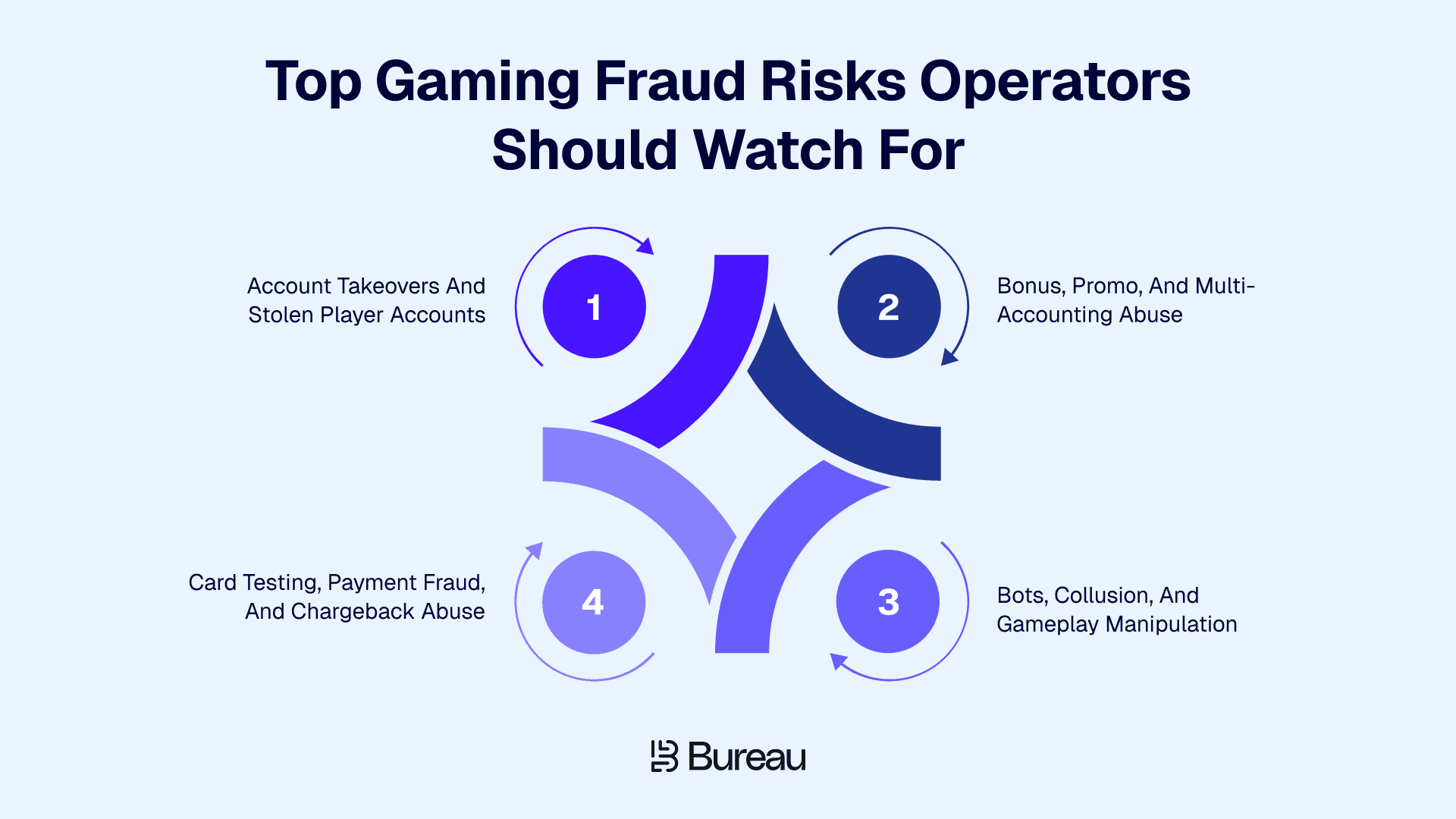
Gaming fraud usually involves compromised accounts, repeated bonus claims, fraudulent payments, or coordinated gameplay. These methods often overlap as fraudsters move from registration to cash-out.
1. Account Takeovers
A valid username and password do not guarantee a trusted user. Verizon’s 2025 Data Breach Investigations Report found that credential abuse was the initial access vector in 22% of cases. Even if an account seems to be trustworthy, teams should still evaluate device, location, session, and behavioral signals.
Attackers use credential stuffing, phishing, stolen sessions, or weak recovery flows to access genuine player accounts. A valid login may still come from the wrong person. Once inside, they may change passwords, contact details, or payout information. They can then steal balances, rewards, stored payment methods, or virtual assets.
Key warning signs include:
A new or manipulated device
An unusual login location
Sudden behavioral changes
Password or payout updates
Transfers or withdrawals soon after login
Related Read: Top 6 Account Takeover Prevention Software for 2026
2. Bonus and Multi-Accounting Abuse
Bonus abuse often starts with one person creating multiple accounts to claim welcome offers, free bets, cashback, or referral rewards repeatedly. Fraudsters hide those links using fake identities, disposable contact details, emulators, app clones, VPNs, and proxies.
Some accounts complete only the minimum wagering requirement before withdrawing through the same payment method or beneficiary. Persistent device intelligence helps operators connect those accounts even when users change account details or device settings.
3. Payment and Chargeback Fraud
Criminals may test stolen cards through small deposits or in-game purchases. Valid cards can then fund larger transactions, transferable assets, or rapid withdrawals. Chargeback abuse happens when players dispute payments after receiving bonuses, virtual items, or gameplay value.
Common signals include:
Repeated low-value attempts
High card or account velocity
Several cards linked to one device
Payment and identity mismatches
Fast deposit-to-withdrawal activity
Repeated disputes from connected accounts
Card-not-present fraud cases increased 22% year-over-year during the first half of 2025, according to UK Finance’s Half Year Fraud Report. Deposit velocity, card reuse, device relationships, identity mismatches, and subsequent withdrawals can reveal whether stolen payment details are being converted into bonuses or transferable value.
4. Bots, Collusion, and Gameplay Abuse
Bots and scripts can automate signups, bonus claims, credential testing, repetitive play, micro-transactions, and virtual currency trades. Fraudsters often use headless browsers, emulators, virtual machines, or device farms to control many accounts at once.
Colluding players may manipulate matches, abuse auction houses, bypass self-exclusion controls, or dump chips by deliberately transferring value to another player through staged losses. Funds can move across several linked accounts before reaching one payout destination, making each account look legitimate in isolation.
IBIA’s Sports Betting Integrity Report recorded 300 suspicious betting alerts across 16 sports in 2025, up 29% from 2024. The strongest signals usually appear when operators connect device links, synchronized behavior, gameplay patterns, transfers, and shared beneficiaries.
How Does Gaming Fraud Detection Work?
Gaming fraud detection combines identity, device, behavioral, network, gameplay, payment, and transaction signals across the player lifecycle. It then turns those signals into an action, such as approve, monitor, request verification, hold a reward or withdrawal, review the case, or block the activity.
Device intelligence and location checks: Build a persistent device profile and assess emulators, app clones, virtual machines, spoofing, VPNs, proxies, TOR, and location mismatches. This helps identify repeat users, shared devices, and access from restricted regions.
Behavioral biometrics and bot detection: Analyze typing, swiping, navigation, timing, and repeated actions. These signals can reveal bots, scripts, account sharing, account takeover, and unusual changes in player behavior.
Identity verification and digital footprint checks: Validate documents, biometrics, liveness, age, phone, email, IP, and account history. These checks help flag fake identities, disposable details, and suspicious mismatches.
Graph intelligence and velocity analysis: Connect accounts through shared devices, contact details, payment methods, IPs, behaviors, and beneficiaries. This can expose multi-accounting, referral loops, fraud rings, and coordinated withdrawals.
Gameplay and transaction monitoring: Track repetitive play, synchronized actions, chip dumping, payment failures, deposit velocity, asset transfers, chargebacks, and rapid cash-outs.
Real-time scoring and adaptive workflows: Combine all available signals into a contextual decision. Low-risk players can continue without friction, while higher-risk activity triggers stronger controls.
A new device, VPN, or location change is only a signal. Accurate online gaming fraud detection looks at several signals together before deciding how to respond.
How to Prevent Fraud Across the Gaming Lifecycle
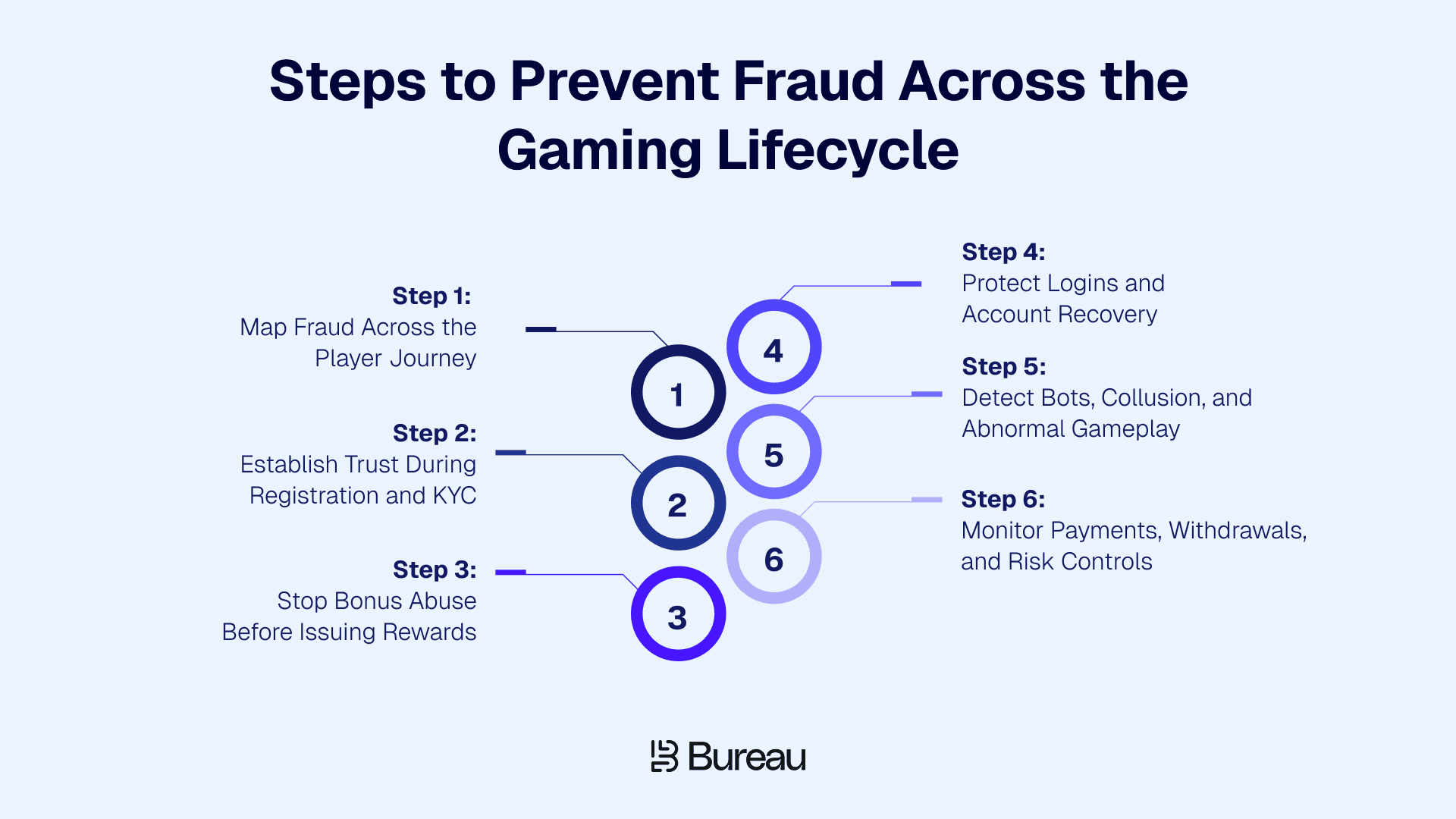
Building a gaming fraud prevention strategy starts with one principle: risk must be managed across the full player lifecycle.
The six steps below show how to strengthen controls from registration and bonus use to gameplay, payments, and withdrawals. Each step focuses on connecting the right signals, applying proportionate friction, and improving decisions as new fraud patterns emerge.
Step 1: Map Fraud Across the Player Journey
Start by documenting risk at each stage, from registration and KYC to gameplay, withdrawals, disputes, and support.
For every stage, record:
The fraud scenario and likely actor
Available signals and existing controls
Gaps in detection or response
The required action, owner, and escalation path
The metric used to measure success
Prioritize scenarios by likelihood, financial impact, speed of scale, customer impact, compliance exposure, and detection difficulty. This helps teams focus first on risks that can create the greatest loss or operational burden.
Step 2: Establish Trust During Registration and KYC
Registration controls should detect automated, fake, or ineligible users without applying the same level of verification to everyone. Assess device integrity, email, phone, IP, digital footprint, and links to existing accounts. Use identity verification, biometrics, liveness, and age checks when risk or regulation requires them.
A successful KYC check confirms the identity presented at registration. It does not show whether that player is linked to previously blocked accounts, using a shared device, or signing up only to exploit a promotion.
Registration decisions should therefore combine verification results with device history, account relationships, and behavioral signals before approving, reviewing, or restricting the player.
Step 3: Stop Bonus Abuse Before Issuing Rewards
Score the player before approving a welcome bonus, referral reward, free bet, or deposit match.
Look for repeat devices, emulators, app clones, virtual machines, shared contact details, linked payment methods, and common beneficiaries. Persistent device intelligence and graph intelligence can help connect accounts that appear unrelated.
A practical flow is:
Bonus requested → relationships checked → linked accounts found → reward held → context reviewed → approve or reject.
Effective promo abuse prevention should continue through wagering and withdrawal. Waiting until cash-out means the platform may already have absorbed bonus, acquisition, payment, and review costs.
Step 4: Protect Logins and Account Recovery
Account takeover controls should recognize trusted players while detecting credential stuffing, automated logins, suspicious recovery attempts, and changes in normal behavior. Monitor device, location, session history, and interaction patterns before and after authentication.
Apply stronger checks after password resets, payout-detail changes, unfamiliar logins, or withdrawals soon after recovery. A cooling period may also be appropriate after sensitive account changes. MFA should support account takeover protection, alongside device intelligence, behavioral monitoring, secure recovery, and post-login transaction checks.
Step 5: Detect Bots, Collusion, and Abnormal Gameplay
Use device-integrity checks, emulator detection, headless-browser signals, interaction timing, account velocity, and repeated action patterns to identify automation. CAPTCHA can support these controls, but it should not be the only defense.
To detect collusion, connect:
Shared devices and locations
Repeated co-play between linked accounts
Synchronized actions or one-way transfers
Chip dumping and coordinated cash-outs
Common payment methods or payout beneficiaries
Behavioral biometrics, bot detection, and linked-account analysis can also reveal sudden performance changes, continuous play without human variation, and behavior designed only to meet bonus conditions.
Step 6: Monitor Payments, Withdrawals, and Outcomes
Payment and withdrawal decisions should consider the player’s full history, not only the current transaction.
Review deposit velocity, repeated failures, card reuse, rapid deposit-to-withdrawal activity, minimal gameplay before cash-out, shared beneficiaries, chargebacks, account recovery events, and transfers between linked players.
Match the response to the context. For instance, a new network may only need monitoring, while an emulator linked to several bonus accounts may require an immediate hold. Track losses, false positives, review volume, approval rates, withdrawal delays, and verification drop-off. Use confirmed outcomes to update rules, thresholds, models, and workflows as fraud patterns change.
How Bureau Helps Gaming Platforms Prevent Fraud
Bureau connects identity, device, behavior, account relationships, and transaction signals across registration, login, bonuses, gameplay, payments, and withdrawals. This gives operators a shared view of risk and supports faster decisions across fraud prevention for gaming platforms.
Connect risk across the player lifecycle: Bureau’s Unified Risk Decisioning Platform evaluates KYC, login, bonus claims, gameplay, payments, and withdrawals within one decisioning layer. Operators can use the same risk context to approve, monitor, verify, hold, review, or block activity.
Detect bonus abuse and multi-accounting: Persistent device intelligence and graph intelligence connect accounts through devices, identities, contact details, behavior, payment methods, and beneficiaries. Bureau’s device ID maintains 99.97% persistence, helping identify repeat users even after common resets and evasion attempts. This strengthens promo abuse prevention before rewards are issued.
Identify bots, ATO, and collusion: Device signals, behavioral biometrics, and linked-account analysis help surface emulators, scripts, unusual sessions, account sharing, and coordinated player activity. Operators can apply stronger bot detection and account takeover protection without relying on credentials alone.
Apply friction based on risk: Trusted players can continue with minimal interruption. Higher-risk activity can trigger additional verification, limits, reward holds, withdrawal reviews, or account restrictions.
Adapt controls faster: Configurable rules, thresholds, review flows, and actions help operators respond to new bonus abuse patterns, bot attacks, and connected fraud networks without waiting for lengthy engineering cycles.
Together, these controls help operators act on connected risk earlier, reduce avoidable review, and keep trusted players moving across the platform.
Strengthen Fraud Controls Across the Player Lifecycle
Gaming fraud becomes harder to stop when connected activity is reviewed through separate accounts, sessions, payments, and tools.
Bureau brings player, device, identity, behavior, gameplay, payment, and transaction signals into one decisioning layer. This helps risk teams recognize trusted players faster, uncover linked abuse, reduce manual review, and apply friction only where risk is higher.
Instead of relying on isolated rules, Bureau gives operators the context needed to respond to multi-accounting, account takeover, collusion, and payment fraud without disrupting genuine registrations, gameplay, or withdrawals.
Schedule a demo with Bureau today and see how connected risk decisions can strengthen gaming fraud prevention for your business.
FAQs
1. What is gaming fraud prevention?
Gaming fraud prevention uses identity, device, behavioral, account-linking, gameplay, payment, and transaction controls to detect and stop abuse across the player lifecycle. It helps operators identify risks during registration, login, bonus use, gameplay, deposits, transfers, and withdrawals, then apply the right action before suspicious activity leads to loss.
2. What are the most common types of gaming fraud?
Common gaming fraud types include bonus abuse, multi-accounting, account takeover, identity fraud, payment fraud, card testing, chargeback abuse, bots, player collusion, location spoofing, and suspicious withdrawals. Fraudsters often combine several methods, such as using multiple accounts and stolen cards before transferring value to a shared payout destination.
3. How can gaming platforms detect multi-accounting?
Gaming platforms can detect multi-accounting by combining persistent device recognition with shared identity details, phone numbers, emails, payment methods, locations, and behavioral patterns. Velocity rules can flag repeated registrations or bonus claims, while graph analysis connects accounts that share devices, beneficiaries, or other relationships.
4. How can gaming operators prevent bonus abuse?
Gaming operators can prevent bonus abuse by scoring players before issuing rewards. They should identify repeat devices and linked accounts, monitor referral relationships, and review wagering patterns. Suspicious bonuses can be held until the risk is resolved, with continued monitoring through redemption and withdrawal.
5. How does Bureau ID’s device intelligence help prevent gaming fraud?
Bureau ID’s device intelligence creates a persistent device profile that helps identify repeat users, shared devices, emulators, app clones, and spoofed environments. It can also distinguish trusted returning players from users attempting to appear new, giving operators stronger context for bonus, login, and withdrawal decisions.
6. How can gaming platforms prevent account takeover?
Gaming platforms can prevent account takeover by recognizing trusted devices, blocking credential-stuffing attempts, monitoring changes in player behavior, and securing account recovery. Adaptive authentication should be triggered when risk increases, followed by continued monitoring of password changes, payout updates, transfers, deposits, and withdrawals.
Most gaming fraud looks like a new player claiming a bonus, a familiar account logging in from a different device, or a withdrawal request that meets every basic rule.
The problem appears when those events connect. A device tied to several “new” players, a bonus account sharing a payout destination with older accounts, or a genuine player suddenly changing how they log in and move funds can point to multi-accounting, collusion, or account takeover.
When registration, gameplay, payment, and withdrawal checks operate separately, those relationships are easy to miss.
Effective gaming fraud prevention gives operators a connected view of risk across the full player lifecycle. This blog explains which schemes deserve the most attention, where they surface, and how to stop them without creating unnecessary friction for trusted players.
What Is Gaming Fraud Prevention?
Gaming fraud prevention is the process of identifying and stopping fraudulent players, accounts, devices, payments, and gameplay activity across an online gaming or iGaming platform.
It combines identity verification, device intelligence, behavioral analytics, linked-account detection, transaction monitoring, and real-time decisions to prevent bonus abuse, multi-accounting, account takeover, bots, collusion, payment fraud, and suspicious withdrawals.
Effective gaming fraud prevention solutions connect risk signals across the full player journey. This gives operators stronger player fraud detection and online gaming fraud protection while keeping trusted players moving with minimal friction.
Where Does Gaming Fraud Occur in the Player Lifecycle?
Gaming fraud can appear from registration through cash-out. Effective fraud prevention for gaming platforms connects signals across these stages instead of reviewing each event separately.
Player lifecycle stage | Common fraud risks | Signals to evaluate | Possible action |
Registration and verification | Fake accounts, bots, multi-accounting, stolen identities, deepfakes | Device, identity, email, phone, IP, biometrics, liveness | Approve, verify, review, reject |
Login and account recovery | Account takeover, credential stuffing, account sharing | Known device, behavior, location, login velocity, session history | Allow, step up, restrict |
Bonuses and deposits | Bonus abuse, referral loops, card testing, payment fraud | Shared devices, payment methods, account velocity, behavioral patterns | Approve, authenticate, hold, block |
Gameplay and transfers | Bots, collusion, chip dumping, laundering, asset theft | Timing, behavioral patterns, device links, transfer networks | Monitor, limit, investigate, suspend |
Withdrawals and disputes | Mule activity, suspicious cash-outs, chargeback abuse, false claims | Beneficiary links, payout velocity, account history, behavioral change | Approve, review, challenge, restrict |
A withdrawal may look legitimate until it is linked to a new account, an abused bonus, minimal gameplay, a shared device, and a common payout destination.
What Gaming Fraud Risks Should Operators Watch For?
Gaming fraud usually involves compromised accounts, repeated bonus claims, fraudulent payments, or coordinated gameplay. These methods often overlap as fraudsters move from registration to cash-out.
1. Account Takeovers
A valid username and password do not guarantee a trusted user. Verizon’s 2025 Data Breach Investigations Report found that credential abuse was the initial access vector in 22% of cases. Even if an account seems to be trustworthy, teams should still evaluate device, location, session, and behavioral signals.
Attackers use credential stuffing, phishing, stolen sessions, or weak recovery flows to access genuine player accounts. A valid login may still come from the wrong person. Once inside, they may change passwords, contact details, or payout information. They can then steal balances, rewards, stored payment methods, or virtual assets.
Key warning signs include:
A new or manipulated device
An unusual login location
Sudden behavioral changes
Password or payout updates
Transfers or withdrawals soon after login
Related Read: Top 6 Account Takeover Prevention Software for 2026
2. Bonus and Multi-Accounting Abuse
Bonus abuse often starts with one person creating multiple accounts to claim welcome offers, free bets, cashback, or referral rewards repeatedly. Fraudsters hide those links using fake identities, disposable contact details, emulators, app clones, VPNs, and proxies.
Some accounts complete only the minimum wagering requirement before withdrawing through the same payment method or beneficiary. Persistent device intelligence helps operators connect those accounts even when users change account details or device settings.
3. Payment and Chargeback Fraud
Criminals may test stolen cards through small deposits or in-game purchases. Valid cards can then fund larger transactions, transferable assets, or rapid withdrawals. Chargeback abuse happens when players dispute payments after receiving bonuses, virtual items, or gameplay value.
Common signals include:
Repeated low-value attempts
High card or account velocity
Several cards linked to one device
Payment and identity mismatches
Fast deposit-to-withdrawal activity
Repeated disputes from connected accounts
Card-not-present fraud cases increased 22% year-over-year during the first half of 2025, according to UK Finance’s Half Year Fraud Report. Deposit velocity, card reuse, device relationships, identity mismatches, and subsequent withdrawals can reveal whether stolen payment details are being converted into bonuses or transferable value.
4. Bots, Collusion, and Gameplay Abuse
Bots and scripts can automate signups, bonus claims, credential testing, repetitive play, micro-transactions, and virtual currency trades. Fraudsters often use headless browsers, emulators, virtual machines, or device farms to control many accounts at once.
Colluding players may manipulate matches, abuse auction houses, bypass self-exclusion controls, or dump chips by deliberately transferring value to another player through staged losses. Funds can move across several linked accounts before reaching one payout destination, making each account look legitimate in isolation.
IBIA’s Sports Betting Integrity Report recorded 300 suspicious betting alerts across 16 sports in 2025, up 29% from 2024. The strongest signals usually appear when operators connect device links, synchronized behavior, gameplay patterns, transfers, and shared beneficiaries.
How Does Gaming Fraud Detection Work?
Gaming fraud detection combines identity, device, behavioral, network, gameplay, payment, and transaction signals across the player lifecycle. It then turns those signals into an action, such as approve, monitor, request verification, hold a reward or withdrawal, review the case, or block the activity.
Device intelligence and location checks: Build a persistent device profile and assess emulators, app clones, virtual machines, spoofing, VPNs, proxies, TOR, and location mismatches. This helps identify repeat users, shared devices, and access from restricted regions.
Behavioral biometrics and bot detection: Analyze typing, swiping, navigation, timing, and repeated actions. These signals can reveal bots, scripts, account sharing, account takeover, and unusual changes in player behavior.
Identity verification and digital footprint checks: Validate documents, biometrics, liveness, age, phone, email, IP, and account history. These checks help flag fake identities, disposable details, and suspicious mismatches.
Graph intelligence and velocity analysis: Connect accounts through shared devices, contact details, payment methods, IPs, behaviors, and beneficiaries. This can expose multi-accounting, referral loops, fraud rings, and coordinated withdrawals.
Gameplay and transaction monitoring: Track repetitive play, synchronized actions, chip dumping, payment failures, deposit velocity, asset transfers, chargebacks, and rapid cash-outs.
Real-time scoring and adaptive workflows: Combine all available signals into a contextual decision. Low-risk players can continue without friction, while higher-risk activity triggers stronger controls.
A new device, VPN, or location change is only a signal. Accurate online gaming fraud detection looks at several signals together before deciding how to respond.
How to Prevent Fraud Across the Gaming Lifecycle
Building a gaming fraud prevention strategy starts with one principle: risk must be managed across the full player lifecycle.
The six steps below show how to strengthen controls from registration and bonus use to gameplay, payments, and withdrawals. Each step focuses on connecting the right signals, applying proportionate friction, and improving decisions as new fraud patterns emerge.
Step 1: Map Fraud Across the Player Journey
Start by documenting risk at each stage, from registration and KYC to gameplay, withdrawals, disputes, and support.
For every stage, record:
The fraud scenario and likely actor
Available signals and existing controls
Gaps in detection or response
The required action, owner, and escalation path
The metric used to measure success
Prioritize scenarios by likelihood, financial impact, speed of scale, customer impact, compliance exposure, and detection difficulty. This helps teams focus first on risks that can create the greatest loss or operational burden.
Step 2: Establish Trust During Registration and KYC
Registration controls should detect automated, fake, or ineligible users without applying the same level of verification to everyone. Assess device integrity, email, phone, IP, digital footprint, and links to existing accounts. Use identity verification, biometrics, liveness, and age checks when risk or regulation requires them.
A successful KYC check confirms the identity presented at registration. It does not show whether that player is linked to previously blocked accounts, using a shared device, or signing up only to exploit a promotion.
Registration decisions should therefore combine verification results with device history, account relationships, and behavioral signals before approving, reviewing, or restricting the player.
Step 3: Stop Bonus Abuse Before Issuing Rewards
Score the player before approving a welcome bonus, referral reward, free bet, or deposit match.
Look for repeat devices, emulators, app clones, virtual machines, shared contact details, linked payment methods, and common beneficiaries. Persistent device intelligence and graph intelligence can help connect accounts that appear unrelated.
A practical flow is:
Bonus requested → relationships checked → linked accounts found → reward held → context reviewed → approve or reject.
Effective promo abuse prevention should continue through wagering and withdrawal. Waiting until cash-out means the platform may already have absorbed bonus, acquisition, payment, and review costs.
Step 4: Protect Logins and Account Recovery
Account takeover controls should recognize trusted players while detecting credential stuffing, automated logins, suspicious recovery attempts, and changes in normal behavior. Monitor device, location, session history, and interaction patterns before and after authentication.
Apply stronger checks after password resets, payout-detail changes, unfamiliar logins, or withdrawals soon after recovery. A cooling period may also be appropriate after sensitive account changes. MFA should support account takeover protection, alongside device intelligence, behavioral monitoring, secure recovery, and post-login transaction checks.
Step 5: Detect Bots, Collusion, and Abnormal Gameplay
Use device-integrity checks, emulator detection, headless-browser signals, interaction timing, account velocity, and repeated action patterns to identify automation. CAPTCHA can support these controls, but it should not be the only defense.
To detect collusion, connect:
Shared devices and locations
Repeated co-play between linked accounts
Synchronized actions or one-way transfers
Chip dumping and coordinated cash-outs
Common payment methods or payout beneficiaries
Behavioral biometrics, bot detection, and linked-account analysis can also reveal sudden performance changes, continuous play without human variation, and behavior designed only to meet bonus conditions.
Step 6: Monitor Payments, Withdrawals, and Outcomes
Payment and withdrawal decisions should consider the player’s full history, not only the current transaction.
Review deposit velocity, repeated failures, card reuse, rapid deposit-to-withdrawal activity, minimal gameplay before cash-out, shared beneficiaries, chargebacks, account recovery events, and transfers between linked players.
Match the response to the context. For instance, a new network may only need monitoring, while an emulator linked to several bonus accounts may require an immediate hold. Track losses, false positives, review volume, approval rates, withdrawal delays, and verification drop-off. Use confirmed outcomes to update rules, thresholds, models, and workflows as fraud patterns change.
How Bureau Helps Gaming Platforms Prevent Fraud
Bureau connects identity, device, behavior, account relationships, and transaction signals across registration, login, bonuses, gameplay, payments, and withdrawals. This gives operators a shared view of risk and supports faster decisions across fraud prevention for gaming platforms.
Connect risk across the player lifecycle: Bureau’s Unified Risk Decisioning Platform evaluates KYC, login, bonus claims, gameplay, payments, and withdrawals within one decisioning layer. Operators can use the same risk context to approve, monitor, verify, hold, review, or block activity.
Detect bonus abuse and multi-accounting: Persistent device intelligence and graph intelligence connect accounts through devices, identities, contact details, behavior, payment methods, and beneficiaries. Bureau’s device ID maintains 99.97% persistence, helping identify repeat users even after common resets and evasion attempts. This strengthens promo abuse prevention before rewards are issued.
Identify bots, ATO, and collusion: Device signals, behavioral biometrics, and linked-account analysis help surface emulators, scripts, unusual sessions, account sharing, and coordinated player activity. Operators can apply stronger bot detection and account takeover protection without relying on credentials alone.
Apply friction based on risk: Trusted players can continue with minimal interruption. Higher-risk activity can trigger additional verification, limits, reward holds, withdrawal reviews, or account restrictions.
Adapt controls faster: Configurable rules, thresholds, review flows, and actions help operators respond to new bonus abuse patterns, bot attacks, and connected fraud networks without waiting for lengthy engineering cycles.
Together, these controls help operators act on connected risk earlier, reduce avoidable review, and keep trusted players moving across the platform.
Strengthen Fraud Controls Across the Player Lifecycle
Gaming fraud becomes harder to stop when connected activity is reviewed through separate accounts, sessions, payments, and tools.
Bureau brings player, device, identity, behavior, gameplay, payment, and transaction signals into one decisioning layer. This helps risk teams recognize trusted players faster, uncover linked abuse, reduce manual review, and apply friction only where risk is higher.
Instead of relying on isolated rules, Bureau gives operators the context needed to respond to multi-accounting, account takeover, collusion, and payment fraud without disrupting genuine registrations, gameplay, or withdrawals.
Schedule a demo with Bureau today and see how connected risk decisions can strengthen gaming fraud prevention for your business.
FAQs
1. What is gaming fraud prevention?
Gaming fraud prevention uses identity, device, behavioral, account-linking, gameplay, payment, and transaction controls to detect and stop abuse across the player lifecycle. It helps operators identify risks during registration, login, bonus use, gameplay, deposits, transfers, and withdrawals, then apply the right action before suspicious activity leads to loss.
2. What are the most common types of gaming fraud?
Common gaming fraud types include bonus abuse, multi-accounting, account takeover, identity fraud, payment fraud, card testing, chargeback abuse, bots, player collusion, location spoofing, and suspicious withdrawals. Fraudsters often combine several methods, such as using multiple accounts and stolen cards before transferring value to a shared payout destination.
3. How can gaming platforms detect multi-accounting?
Gaming platforms can detect multi-accounting by combining persistent device recognition with shared identity details, phone numbers, emails, payment methods, locations, and behavioral patterns. Velocity rules can flag repeated registrations or bonus claims, while graph analysis connects accounts that share devices, beneficiaries, or other relationships.
4. How can gaming operators prevent bonus abuse?
Gaming operators can prevent bonus abuse by scoring players before issuing rewards. They should identify repeat devices and linked accounts, monitor referral relationships, and review wagering patterns. Suspicious bonuses can be held until the risk is resolved, with continued monitoring through redemption and withdrawal.
5. How does Bureau ID’s device intelligence help prevent gaming fraud?
Bureau ID’s device intelligence creates a persistent device profile that helps identify repeat users, shared devices, emulators, app clones, and spoofed environments. It can also distinguish trusted returning players from users attempting to appear new, giving operators stronger context for bonus, login, and withdrawal decisions.
6. How can gaming platforms prevent account takeover?
Gaming platforms can prevent account takeover by recognizing trusted devices, blocking credential-stuffing attempts, monitoring changes in player behavior, and securing account recovery. Adaptive authentication should be triggered when risk increases, followed by continued monitoring of password changes, payout updates, transfers, deposits, and withdrawals.
TABLE OF CONTENTS
See More
Recommended Blogs


Landing Page.
Simple, bold.
Sign Up
Download

Products
Solutions


© 2026 Bureau . All rights reserved.
Solutions
Industries
Resources
Company
Solutions
Industries
Resources
Company
© 2026 Bureau . All rights reserved.
Follow Us
Leave behind fragmented tools. Stop fraud rings, cut false declines, and deliver secure digital journeys at scale
Our Presence








Leave behind fragmented tools. Stop fraud rings, cut false declines, and deliver secure digital journeys at scale
Our Presence
© 2026 Bureau . All rights reserved.