How to Detect Loan Application Fraud Before Disbursement
How to Detect Loan Application Fraud Before Disbursement
How to Detect Loan Application Fraud Before Disbursement
Explore loan application fraud detection methods for digital lenders, including document checks, device intelligence, risk scoring, and link analysis.
Author
Team Bureau


See how Bureau has helped industry leaders defend against networked Industrial-scale frauds →
Schedule a Demo
TABLE OF CONTENTS
See Less
A loan application can pass basic checks and still be fraudulent. The device may be linked to earlier fraudulent applications, the salary evidence may be manipulated, or the applicant profile may combine real and fabricated data.
Loan application fraud detection is the process of identifying false identities, forged documents, fabricated income, synthetic profiles, and other deceptive information before approval and disbursement.
For digital lenders, fintechs, BNPL providers, and NBFCs, effective digital lending fraud detection must answer three questions:
Is the applicant legitimate?
Is the supporting evidence genuine?
Is the application connected to repeat or coordinated abuse?
This blog explains how to strengthen loan fraud detection by combining applicant, document, device, behavioral, credit, and relationship signals in one pre-disbursement workflow.
How Does Loan Application Fraud Happen?
Loan application fraud happens when an individual or organized group submits stolen, fabricated, altered, or misleading information to obtain credit. The applicant may misuse a genuine identity, impersonate another person, or construct a synthetic profile from real and invented data.
The process usually follows a simple pattern:
Identity or applicant data is stolen, fabricated, or combined.
Income, employment, documents, or credit information is manipulated.
The application is submitted through a new, spoofed, or disguised device and network.
Basic identity, document, or credit checks are passed or bypassed.
The lender approves the application and disburses the funds.
According to the RBI’s Annual Report 2025–26, Indian banks reported 8,640 fraud cases in the advances category involving ₹40,774 crore during FY26. Advances accounted for nearly 85% of the total value involved in reported banking fraud, reinforcing the need to identify deceptive applications before credit is approved and disbursed.
By the time fraud surfaces through victim complaints, early non-payment, or links to other suspicious applications, the loss has already occurred. That is why detection must happen before approval and disbursement.
What Types of Loan Application Fraud Should Lenders Detect?
Loan application fraud may involve a genuine applicant, a stolen identity, a fabricated identity, or legitimate information that has been materially altered. The main categories lenders should detect include:
First-party fraud: An applicant uses their real identity but deliberately inflates income, conceals liabilities, falsifies employment information, or applies for credit without intending to repay.
Third-party identity fraud: A fraudster applies using another person’s stolen identity, documents, contact details, or financial information.
Synthetic identity fraud: The application combines genuine identifiers with fabricated names, addresses, phone numbers, documents, or employment details to create a false borrower profile.
Income and employment misrepresentation: Salary, business revenue, employment status, tenure, employer details, or existing financial obligations are deliberately misstated.
Document fraud: Identity documents, bank statements, salary slips, tax records, employment letters, or business documents are forged, edited, reused, or generated.
Loan stacking: An applicant submits multiple applications to different lenders before the new inquiries or credit obligations become visible across the lending ecosystem.
Credit washing: Legitimate negative credit information is disputed or temporarily removed to make the applicant appear more creditworthy during underwriting.
Organized application fraud: Brokers, fraud farms, or coordinated rings submit applications using shared devices, documents, addresses, bank accounts, employers, or contact details.
Poor repayment or weak creditworthiness does not automatically indicate first-party fraud. The distinguishing factor is intentional deception at the application stage, which means lenders must separate suspected fraud from ordinary credit risk.
What Are the Red Flags of a Fraudulent Loan Application?
A fraudulent loan application rarely depends on one obvious inconsistency. Risk becomes clearer when identity, document, income, device, behavioral, credit, and relationship signals are reviewed together.
Identity and contact mismatches: Applicant details change across forms or documents, while phone numbers, email addresses, or identity records have little history or do not align with the applicant.
Document anomalies: Files appear edited, cropped, layered, recently manipulated, or inconsistent with expected formats. Reused salary slips, signatures, seals, bank statements, or templates across applications are also high-risk signals.
Income and employment gaps: Declared earnings conflict with bank credits, occupation, liabilities, or employer records, or the employer cannot be independently verified.
Device and behavior risks: One device supports several unrelated applicants, survives resets or reinstalls, uses emulators or masked networks, or shows excessive copy-paste activity, unusual speed, or scripted navigation.
Credit and network patterns: Applications cluster within a short period, recent inquiries rise sharply, or several applicants share devices, addresses, employers, bank accounts, beneficiaries, or contact details.
A single signal should usually trigger further evaluation rather than automatic rejection. Shared household devices, limited credit histories, and irregular income may still be legitimate in many lending markets.
How to Detect Loan Application Fraud Before Disbursement: 5 Strategies
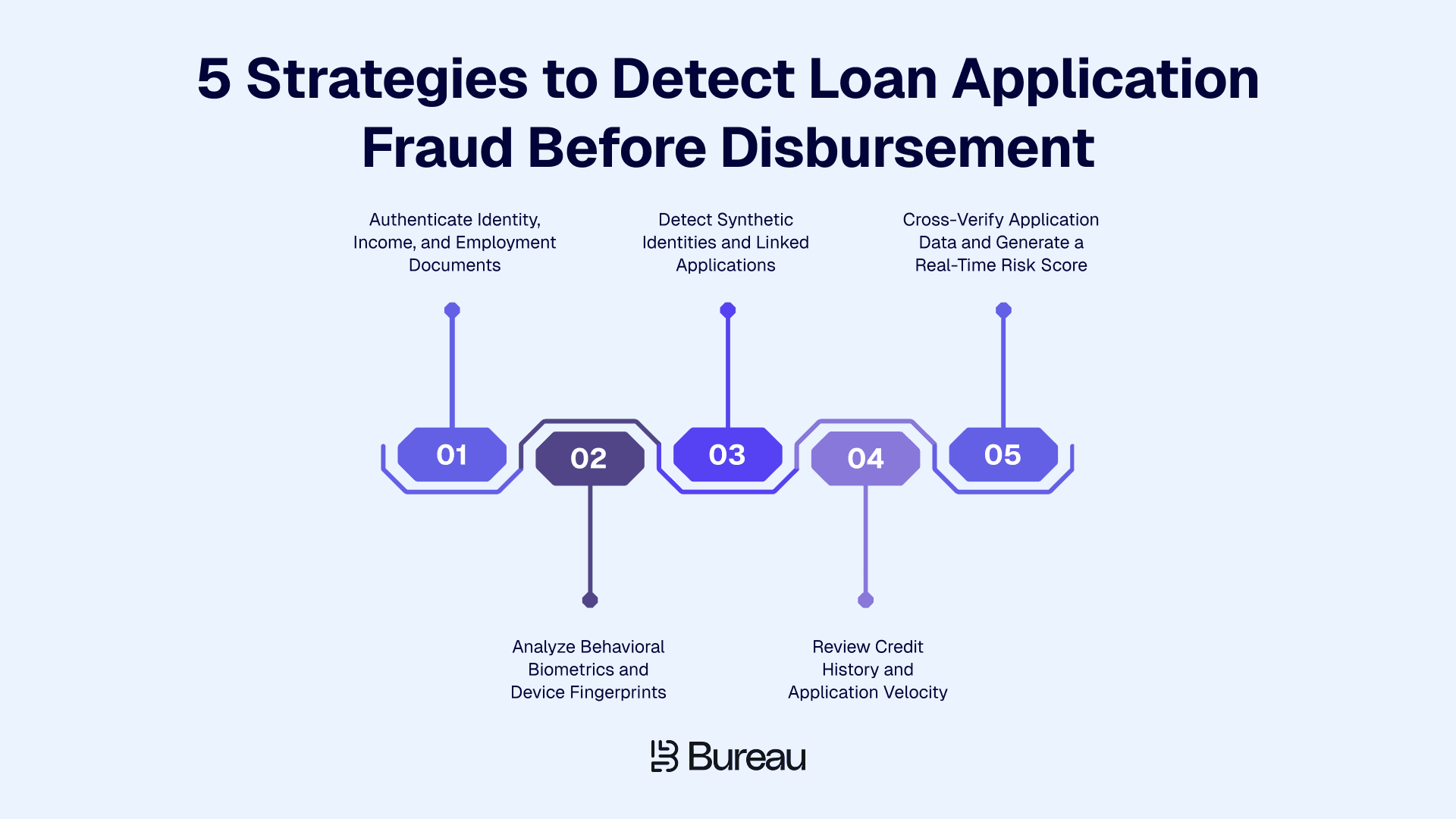
Effective loan application fraud detection combines multiple checks to confirm that the applicant, supporting evidence, and application behavior are credible and not connected to wider fraud.
1. Authenticate Identity, Income, and Employment Documents
Check identity documents, salary slips, bank statements, tax records, and employment letters for altered text, image layering, mismatched fonts, unusual metadata, and reused signatures or templates. Then compare the information across sources, including:
Names, addresses, employers, income, and salary dates should remain consistent throughout the application.
Declared salary credits should also come from the stated employer at a credible amount and frequency.
For example, income may appear in a bank statement but originate from personal accounts shortly before the application. This may indicate temporary balance inflation rather than genuine earnings.
2. Analyze Behavioral Biometrics and Device Fingerprints
Device intelligence identifies where the application originates, while behavioral biometrics evaluates how it is completed.
High-risk device signals include reuse across unrelated applicants, emulators, rooted devices, app tampering, location masking, and links to previous fraud. Behavioral biometrics can flag excessive copy-paste activity, scripted navigation, unusual typing patterns, and application journeys repeated across several identities.
These signals are especially useful for detecting bots, fraud farms, and applications submitted with stolen personal data.
NIST found that single-image morph detectors could identify up to 100% of familiar morphing attacks at a 1% false-detection rate. However, detection could fall below 40% when the morphs were generated using software unfamiliar to the model, reinforcing the need to combine identity checks with device and behavioral signals
3. Detect Synthetic Identities and Linked Applications
Synthetic identities often contain enough genuine information to pass isolated checks. Lenders should cross-reference identity numbers, names, dates of birth, addresses, phone numbers, emails, devices, bank accounts, and credit history to determine whether the profile is coherent.
Link analysis can also uncover applications connected through:
Shared devices
Contact details
Employers
Documents
Bank accounts
These relationships may expose fraud rings that would remain hidden if each application were reviewed separately.
4. Review Credit History and Application Velocity
Review recent inquiries, newly opened accounts, borrowing activity, and changes in the applicant’s credit profile. Several applications submitted within a short period may indicate loan stacking before new obligations appear across every lender’s data.
Signal | Possible concern |
Several recent inquiries | Loan stacking |
Multiple accounts opened rapidly | Coordinated borrowing |
Sudden improvement after disputes | Credit washing |
Several applications from one device | Organized application fraud |
Loan request conflicts with declared liabilities | Financial misrepresentation |
The consequences of weak application controls were visible in the UK’s Bounce Back Loan Scheme. By September 2025, lenders had flagged £1.87 billion of the £46.47 billion drawn under the programme as suspected fraud, equivalent to approximately 4% of the total value disbursed
Velocity thresholds should vary by product, loan amount, channel, and applicant segment, as their significance depends on context. Credit activity becomes more meaningful when it is evaluated alongside identity, document, or device anomalies.
5. Cross-Verify Application Data and Generate a Real-Time Risk Score
Bring identity, document, income, banking, credit, device, behavioral, contact, velocity, and relationship signals into one pre-disbursement decision.
Risk models can identify inconsistencies that pass individual checks and assign an appropriate action:
Applicant risk | Application action |
Low | Continue to underwriting |
Moderate | Request additional verification |
High | Route to fraud review |
Critical | Hold or reject under lender policy |
A loan fraud detection solution should also provide clear reason codes. Fraud teams need to understand which signals triggered an escalation rather than rely on an unexplained score.
A 2026 systematic review of 555 marketplace-lending studies found that ensemble models achieved 92–96% detection with 1–2% false positives, compared with 72–78% detection and 8–12% false positives for rule-based systems. Since the studies used different datasets and evaluation methods, these ranges are indicative rather than guaranteed.
How to Build a Loan Application Fraud Detection Workflow With Bureau
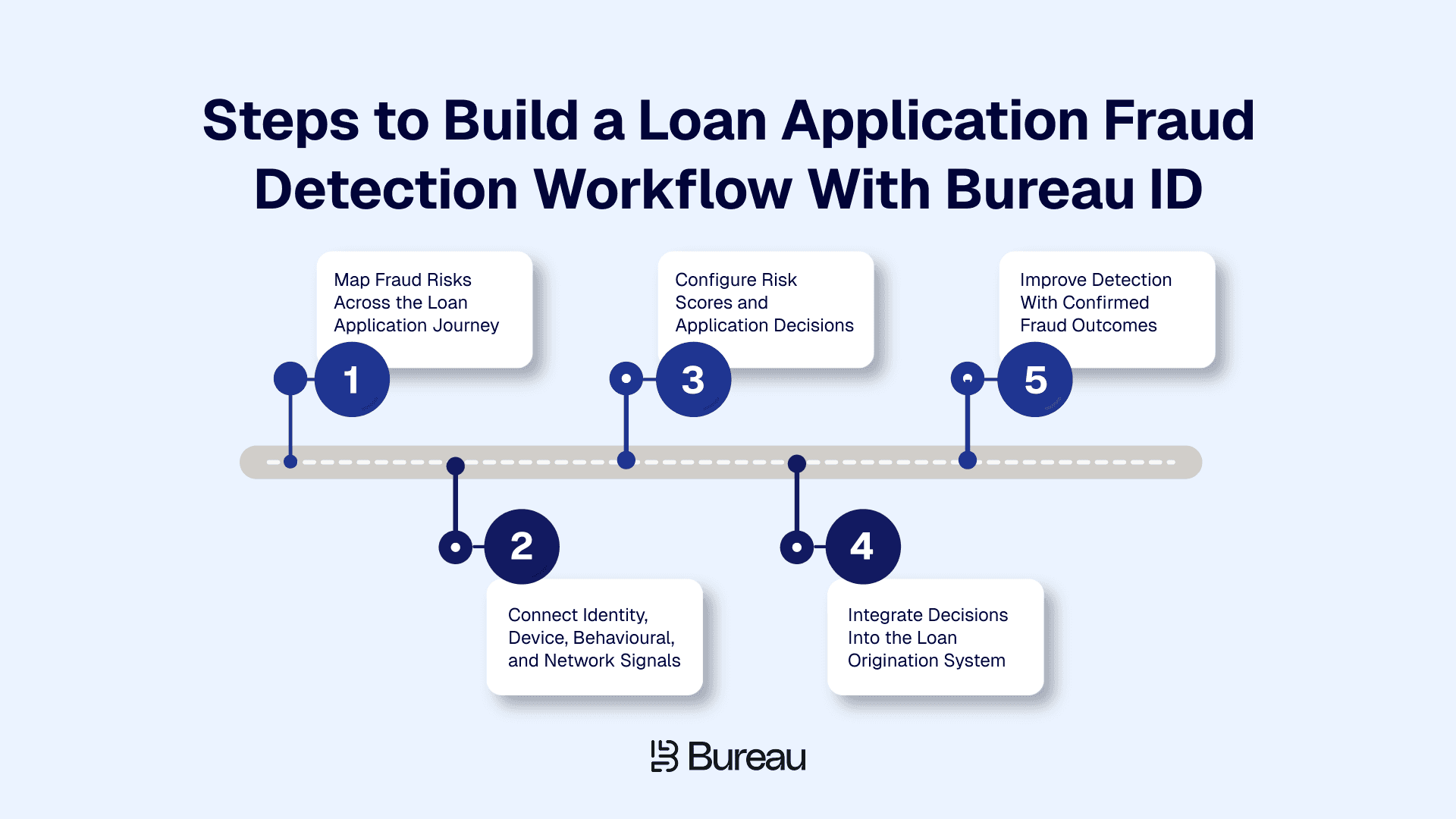
A loan application fraud detection workflow should evaluate risk from account creation through the final pre-disbursement check.
Bureau brings identity, device, behavioral, network, and application signals into one decisioning layer, reducing the need to operate each control through a separate workflow.
Building that workflow starts with identifying where fraud can enter the loan journey, which signals are available at each stage, and what action should follow when risk appears.
Step 1: Map Fraud Risks Across the Loan Application Journey
Map fraud exposure across account creation, identity verification, document upload, income checks, underwriting, approval, and disbursement.
For each stage, define:
The fraud scenario and signals required
The existing control and detection gap
The risk owner and possible action
For example, account creation may expose repeat-device activity, document upload may reveal a forged salary slip, and the final disbursement check may identify a bank account linked to suspicious applicants. This mapping ensures signals are captured when they first appear rather than added after underwriting.
Step 2: Connect Identity, Device, Behavioral, and Network Signals
Bring the evidence collected across the application into a shared applicant-risk profile. This can include:
Identity, facial match, liveness, and document-authentication results
Income, employment, phone, email, and address consistency
Device reputation and links to previous applications
Behavioral patterns indicating bots, scripts, fraud farms, or stolen data
Relationships with shared accounts, devices, documents, and known fraud
Bureau connects these inputs through Identity Document Verification, Device ID, Behavioral Biometrics, and the Graph Identity Network.
This connected view helps lenders identify contradictions and coordinated fraud that may not surface through individual checks. For example, a BNPL provider used Bureau to identify synthetic identities during onboarding before credit was extended.
Step 3: Configure Risk Scores and Application Decisions
Combine identity confidence, document authenticity, income consistency, device risk, behavioral anomalies, credit activity, application velocity, graph relationships, and historical fraud outcomes into one decision.
Bureau’s Unified Risk Decisioning Platform allows risk teams to configure rules, thresholds, reason codes, and decision paths without rebuilding the workflow for every policy change.
Risk outcome | Action |
Approve | Continue to underwriting or approval |
Step up | Request additional identity, liveness, income, or bank verification |
Review | Route to fraud operations with supporting evidence |
Hold or reject | Apply lender policy when critical signals converge |
One weak signal should rarely determine the outcome. Decisions should reflect the combined evidence and the lender’s defined risk appetite.
Step 4: Integrate Decisions Into the Loan Origination System
Connect the fraud workflow to the loan origination system through APIs or SDKs. Send risk scores, reason codes, and recommended actions to the appropriate underwriting or fraud-review queue while preserving the evidence behind each decision.
A practical flow looks like this:
Application submitted → Signals collected → Fraud risk assessed → Approve, step up, review, or reject → Credit decision → Final pre-disbursement check
Fraud scoring and credit underwriting should exchange relevant information but remain distinct. Fraud scoring evaluates deception and applicant legitimacy, while underwriting evaluates repayment capacity and credit risk.
Step 5: Improve Detection With Confirmed Fraud Outcomes
Feed confirmed synthetic identities, forged-document findings, identity-theft complaints, manual-review outcomes, false positives, repeat devices, and newly identified fraud clusters back into the workflow.
Track the metrics that show whether detection is improving:
Fraud caught before disbursement
Manual-review and false-positive rates
Approval rate for genuine applicants
Time to application decision
Fraud loss per amount disbursed
Missed payments and early defaults should not automatically be classified as fraud. Feedback must distinguish deliberate application deception from genuine credit deterioration.
Stop Loan Fraud Before Credit Is Extended
The costliest application fraud is discovered only after funds have moved.
For digital lenders, the next step is to identify weak decision points, define clear triggers for step-up verification or manual review, and run a final risk check before disbursement. The goal is to stop deceptive applications without slowing down legitimate borrowers.
Bureau supports this through a Unified Risk Decisioning Platform that connects identity verification, device intelligence, behavioral signals, graph relationships, and configurable decision rules in one workflow. Fraud teams gain clearer context for investigations, faster policy changes, and stronger control over high-risk applications before credit is extended.
Schedule a demo with Bureau to identify hidden gaps, strengthen pre-disbursement checks, and build a more effective loan application fraud detection workflow.
FAQs
1. What is loan application fraud detection?
Loan application fraud detection identifies stolen or synthetic identities, forged documents, false income claims, and coordinated applications before approval. It combines identity verification, document analysis, device intelligence, behavioral signals, credit data, and real-time risk scoring.
2. How do lenders detect fraudulent loan applications?
Lenders compare identity, income, employment, banking, credit, device, and behavioral data. Inconsistencies, reused attributes, suspicious application velocity, or links to known fraud can trigger additional verification, specialist review, or rejection under the lender’s policy.
3. What are the red flags of loan application fraud?
Common red flags include altered documents, income that does not match bank activity, newly created contact details, multiple applicants using one device, excessive copy-paste behavior, rapid credit inquiries, and shared accounts or addresses across unrelated applications.
4. How does Bureau help detect synthetic identity fraud?
Bureau helps detect synthetic identity fraud by connecting identity, device, behavioral, contact, and application signals. It uses graph-based intelligence to surface reused attributes, inconsistent identity histories, and links between applicants, devices, accounts, and known fraud patterns in real time.
5. How can lenders detect loan stacking before disbursement?
Lenders detect loan stacking by monitoring recent credit inquiries, newly opened accounts, application velocity, repeated devices, and linked applicants. Risk increases when several applications appear within a short period before new obligations become visible in credit-bureau data.
6. What should a loan fraud detection solution include?
A loan fraud detection solution should combine identity, document, income, device, behavioral, credit, and network checks to identify deceptive applications, prioritize high-risk cases, support explainable decisions, and stop fraudulent loans before approval or disbursement without adding unnecessary friction for legitimate applicants.
A loan application can pass basic checks and still be fraudulent. The device may be linked to earlier fraudulent applications, the salary evidence may be manipulated, or the applicant profile may combine real and fabricated data.
Loan application fraud detection is the process of identifying false identities, forged documents, fabricated income, synthetic profiles, and other deceptive information before approval and disbursement.
For digital lenders, fintechs, BNPL providers, and NBFCs, effective digital lending fraud detection must answer three questions:
Is the applicant legitimate?
Is the supporting evidence genuine?
Is the application connected to repeat or coordinated abuse?
This blog explains how to strengthen loan fraud detection by combining applicant, document, device, behavioral, credit, and relationship signals in one pre-disbursement workflow.
How Does Loan Application Fraud Happen?
Loan application fraud happens when an individual or organized group submits stolen, fabricated, altered, or misleading information to obtain credit. The applicant may misuse a genuine identity, impersonate another person, or construct a synthetic profile from real and invented data.
The process usually follows a simple pattern:
Identity or applicant data is stolen, fabricated, or combined.
Income, employment, documents, or credit information is manipulated.
The application is submitted through a new, spoofed, or disguised device and network.
Basic identity, document, or credit checks are passed or bypassed.
The lender approves the application and disburses the funds.
According to the RBI’s Annual Report 2025–26, Indian banks reported 8,640 fraud cases in the advances category involving ₹40,774 crore during FY26. Advances accounted for nearly 85% of the total value involved in reported banking fraud, reinforcing the need to identify deceptive applications before credit is approved and disbursed.
By the time fraud surfaces through victim complaints, early non-payment, or links to other suspicious applications, the loss has already occurred. That is why detection must happen before approval and disbursement.
What Types of Loan Application Fraud Should Lenders Detect?
Loan application fraud may involve a genuine applicant, a stolen identity, a fabricated identity, or legitimate information that has been materially altered. The main categories lenders should detect include:
First-party fraud: An applicant uses their real identity but deliberately inflates income, conceals liabilities, falsifies employment information, or applies for credit without intending to repay.
Third-party identity fraud: A fraudster applies using another person’s stolen identity, documents, contact details, or financial information.
Synthetic identity fraud: The application combines genuine identifiers with fabricated names, addresses, phone numbers, documents, or employment details to create a false borrower profile.
Income and employment misrepresentation: Salary, business revenue, employment status, tenure, employer details, or existing financial obligations are deliberately misstated.
Document fraud: Identity documents, bank statements, salary slips, tax records, employment letters, or business documents are forged, edited, reused, or generated.
Loan stacking: An applicant submits multiple applications to different lenders before the new inquiries or credit obligations become visible across the lending ecosystem.
Credit washing: Legitimate negative credit information is disputed or temporarily removed to make the applicant appear more creditworthy during underwriting.
Organized application fraud: Brokers, fraud farms, or coordinated rings submit applications using shared devices, documents, addresses, bank accounts, employers, or contact details.
Poor repayment or weak creditworthiness does not automatically indicate first-party fraud. The distinguishing factor is intentional deception at the application stage, which means lenders must separate suspected fraud from ordinary credit risk.
What Are the Red Flags of a Fraudulent Loan Application?
A fraudulent loan application rarely depends on one obvious inconsistency. Risk becomes clearer when identity, document, income, device, behavioral, credit, and relationship signals are reviewed together.
Identity and contact mismatches: Applicant details change across forms or documents, while phone numbers, email addresses, or identity records have little history or do not align with the applicant.
Document anomalies: Files appear edited, cropped, layered, recently manipulated, or inconsistent with expected formats. Reused salary slips, signatures, seals, bank statements, or templates across applications are also high-risk signals.
Income and employment gaps: Declared earnings conflict with bank credits, occupation, liabilities, or employer records, or the employer cannot be independently verified.
Device and behavior risks: One device supports several unrelated applicants, survives resets or reinstalls, uses emulators or masked networks, or shows excessive copy-paste activity, unusual speed, or scripted navigation.
Credit and network patterns: Applications cluster within a short period, recent inquiries rise sharply, or several applicants share devices, addresses, employers, bank accounts, beneficiaries, or contact details.
A single signal should usually trigger further evaluation rather than automatic rejection. Shared household devices, limited credit histories, and irregular income may still be legitimate in many lending markets.
How to Detect Loan Application Fraud Before Disbursement: 5 Strategies
Effective loan application fraud detection combines multiple checks to confirm that the applicant, supporting evidence, and application behavior are credible and not connected to wider fraud.
1. Authenticate Identity, Income, and Employment Documents
Check identity documents, salary slips, bank statements, tax records, and employment letters for altered text, image layering, mismatched fonts, unusual metadata, and reused signatures or templates. Then compare the information across sources, including:
Names, addresses, employers, income, and salary dates should remain consistent throughout the application.
Declared salary credits should also come from the stated employer at a credible amount and frequency.
For example, income may appear in a bank statement but originate from personal accounts shortly before the application. This may indicate temporary balance inflation rather than genuine earnings.
2. Analyze Behavioral Biometrics and Device Fingerprints
Device intelligence identifies where the application originates, while behavioral biometrics evaluates how it is completed.
High-risk device signals include reuse across unrelated applicants, emulators, rooted devices, app tampering, location masking, and links to previous fraud. Behavioral biometrics can flag excessive copy-paste activity, scripted navigation, unusual typing patterns, and application journeys repeated across several identities.
These signals are especially useful for detecting bots, fraud farms, and applications submitted with stolen personal data.
NIST found that single-image morph detectors could identify up to 100% of familiar morphing attacks at a 1% false-detection rate. However, detection could fall below 40% when the morphs were generated using software unfamiliar to the model, reinforcing the need to combine identity checks with device and behavioral signals
3. Detect Synthetic Identities and Linked Applications
Synthetic identities often contain enough genuine information to pass isolated checks. Lenders should cross-reference identity numbers, names, dates of birth, addresses, phone numbers, emails, devices, bank accounts, and credit history to determine whether the profile is coherent.
Link analysis can also uncover applications connected through:
Shared devices
Contact details
Employers
Documents
Bank accounts
These relationships may expose fraud rings that would remain hidden if each application were reviewed separately.
4. Review Credit History and Application Velocity
Review recent inquiries, newly opened accounts, borrowing activity, and changes in the applicant’s credit profile. Several applications submitted within a short period may indicate loan stacking before new obligations appear across every lender’s data.
Signal | Possible concern |
Several recent inquiries | Loan stacking |
Multiple accounts opened rapidly | Coordinated borrowing |
Sudden improvement after disputes | Credit washing |
Several applications from one device | Organized application fraud |
Loan request conflicts with declared liabilities | Financial misrepresentation |
The consequences of weak application controls were visible in the UK’s Bounce Back Loan Scheme. By September 2025, lenders had flagged £1.87 billion of the £46.47 billion drawn under the programme as suspected fraud, equivalent to approximately 4% of the total value disbursed
Velocity thresholds should vary by product, loan amount, channel, and applicant segment, as their significance depends on context. Credit activity becomes more meaningful when it is evaluated alongside identity, document, or device anomalies.
5. Cross-Verify Application Data and Generate a Real-Time Risk Score
Bring identity, document, income, banking, credit, device, behavioral, contact, velocity, and relationship signals into one pre-disbursement decision.
Risk models can identify inconsistencies that pass individual checks and assign an appropriate action:
Applicant risk | Application action |
Low | Continue to underwriting |
Moderate | Request additional verification |
High | Route to fraud review |
Critical | Hold or reject under lender policy |
A loan fraud detection solution should also provide clear reason codes. Fraud teams need to understand which signals triggered an escalation rather than rely on an unexplained score.
A 2026 systematic review of 555 marketplace-lending studies found that ensemble models achieved 92–96% detection with 1–2% false positives, compared with 72–78% detection and 8–12% false positives for rule-based systems. Since the studies used different datasets and evaluation methods, these ranges are indicative rather than guaranteed.
How to Build a Loan Application Fraud Detection Workflow With Bureau
A loan application fraud detection workflow should evaluate risk from account creation through the final pre-disbursement check.
Bureau brings identity, device, behavioral, network, and application signals into one decisioning layer, reducing the need to operate each control through a separate workflow.
Building that workflow starts with identifying where fraud can enter the loan journey, which signals are available at each stage, and what action should follow when risk appears.
Step 1: Map Fraud Risks Across the Loan Application Journey
Map fraud exposure across account creation, identity verification, document upload, income checks, underwriting, approval, and disbursement.
For each stage, define:
The fraud scenario and signals required
The existing control and detection gap
The risk owner and possible action
For example, account creation may expose repeat-device activity, document upload may reveal a forged salary slip, and the final disbursement check may identify a bank account linked to suspicious applicants. This mapping ensures signals are captured when they first appear rather than added after underwriting.
Step 2: Connect Identity, Device, Behavioral, and Network Signals
Bring the evidence collected across the application into a shared applicant-risk profile. This can include:
Identity, facial match, liveness, and document-authentication results
Income, employment, phone, email, and address consistency
Device reputation and links to previous applications
Behavioral patterns indicating bots, scripts, fraud farms, or stolen data
Relationships with shared accounts, devices, documents, and known fraud
Bureau connects these inputs through Identity Document Verification, Device ID, Behavioral Biometrics, and the Graph Identity Network.
This connected view helps lenders identify contradictions and coordinated fraud that may not surface through individual checks. For example, a BNPL provider used Bureau to identify synthetic identities during onboarding before credit was extended.
Step 3: Configure Risk Scores and Application Decisions
Combine identity confidence, document authenticity, income consistency, device risk, behavioral anomalies, credit activity, application velocity, graph relationships, and historical fraud outcomes into one decision.
Bureau’s Unified Risk Decisioning Platform allows risk teams to configure rules, thresholds, reason codes, and decision paths without rebuilding the workflow for every policy change.
Risk outcome | Action |
Approve | Continue to underwriting or approval |
Step up | Request additional identity, liveness, income, or bank verification |
Review | Route to fraud operations with supporting evidence |
Hold or reject | Apply lender policy when critical signals converge |
One weak signal should rarely determine the outcome. Decisions should reflect the combined evidence and the lender’s defined risk appetite.
Step 4: Integrate Decisions Into the Loan Origination System
Connect the fraud workflow to the loan origination system through APIs or SDKs. Send risk scores, reason codes, and recommended actions to the appropriate underwriting or fraud-review queue while preserving the evidence behind each decision.
A practical flow looks like this:
Application submitted → Signals collected → Fraud risk assessed → Approve, step up, review, or reject → Credit decision → Final pre-disbursement check
Fraud scoring and credit underwriting should exchange relevant information but remain distinct. Fraud scoring evaluates deception and applicant legitimacy, while underwriting evaluates repayment capacity and credit risk.
Step 5: Improve Detection With Confirmed Fraud Outcomes
Feed confirmed synthetic identities, forged-document findings, identity-theft complaints, manual-review outcomes, false positives, repeat devices, and newly identified fraud clusters back into the workflow.
Track the metrics that show whether detection is improving:
Fraud caught before disbursement
Manual-review and false-positive rates
Approval rate for genuine applicants
Time to application decision
Fraud loss per amount disbursed
Missed payments and early defaults should not automatically be classified as fraud. Feedback must distinguish deliberate application deception from genuine credit deterioration.
Stop Loan Fraud Before Credit Is Extended
The costliest application fraud is discovered only after funds have moved.
For digital lenders, the next step is to identify weak decision points, define clear triggers for step-up verification or manual review, and run a final risk check before disbursement. The goal is to stop deceptive applications without slowing down legitimate borrowers.
Bureau supports this through a Unified Risk Decisioning Platform that connects identity verification, device intelligence, behavioral signals, graph relationships, and configurable decision rules in one workflow. Fraud teams gain clearer context for investigations, faster policy changes, and stronger control over high-risk applications before credit is extended.
Schedule a demo with Bureau to identify hidden gaps, strengthen pre-disbursement checks, and build a more effective loan application fraud detection workflow.
FAQs
1. What is loan application fraud detection?
Loan application fraud detection identifies stolen or synthetic identities, forged documents, false income claims, and coordinated applications before approval. It combines identity verification, document analysis, device intelligence, behavioral signals, credit data, and real-time risk scoring.
2. How do lenders detect fraudulent loan applications?
Lenders compare identity, income, employment, banking, credit, device, and behavioral data. Inconsistencies, reused attributes, suspicious application velocity, or links to known fraud can trigger additional verification, specialist review, or rejection under the lender’s policy.
3. What are the red flags of loan application fraud?
Common red flags include altered documents, income that does not match bank activity, newly created contact details, multiple applicants using one device, excessive copy-paste behavior, rapid credit inquiries, and shared accounts or addresses across unrelated applications.
4. How does Bureau help detect synthetic identity fraud?
Bureau helps detect synthetic identity fraud by connecting identity, device, behavioral, contact, and application signals. It uses graph-based intelligence to surface reused attributes, inconsistent identity histories, and links between applicants, devices, accounts, and known fraud patterns in real time.
5. How can lenders detect loan stacking before disbursement?
Lenders detect loan stacking by monitoring recent credit inquiries, newly opened accounts, application velocity, repeated devices, and linked applicants. Risk increases when several applications appear within a short period before new obligations become visible in credit-bureau data.
6. What should a loan fraud detection solution include?
A loan fraud detection solution should combine identity, document, income, device, behavioral, credit, and network checks to identify deceptive applications, prioritize high-risk cases, support explainable decisions, and stop fraudulent loans before approval or disbursement without adding unnecessary friction for legitimate applicants.
TABLE OF CONTENTS
See More
Recommended Blogs


Landing Page.
Simple, bold.
Sign Up
Download

Products
Solutions


© 2026 Bureau . All rights reserved.
Solutions
Industries
Resources
Company
Solutions
Industries
Resources
Company
© 2026 Bureau . All rights reserved.
Follow Us
Leave behind fragmented tools. Stop fraud rings, cut false declines, and deliver secure digital journeys at scale
Our Presence








Leave behind fragmented tools. Stop fraud rings, cut false declines, and deliver secure digital journeys at scale
Our Presence
© 2026 Bureau . All rights reserved.