Bureau RASP: Protecting Mobile Applications from Runtime Threats
Bureau RASP: Protecting Mobile Applications from Runtime Threats
Bureau RASP: Protecting Mobile Applications from Runtime Threats
Real-time runtime protection detects mobile application tampering and compromised environments, enabling businesses to act before attacks reach critical digital and financial journeys.
Author
Team Bureau


See how Bureau has helped industry leaders defend against networked Industrial-scale frauds →
Schedule a Demo
TABLE OF CONTENTS
See Less
Mobile applications have become a critical interface for banking, payments, commerce, and several other digital services. They also present an expanded attack surface.
Fraudsters can reverse engineer application logic, tamper with binaries, inject code, manipulate runtime behavior, spoof location, or use emulator farms to automate attacks. Once an application is compromised, attackers can interfere with the systems responsible for executing sensitive actions and generating trusted signals. This level of compromise goes un-detected by the backend and existing fraud defenses.
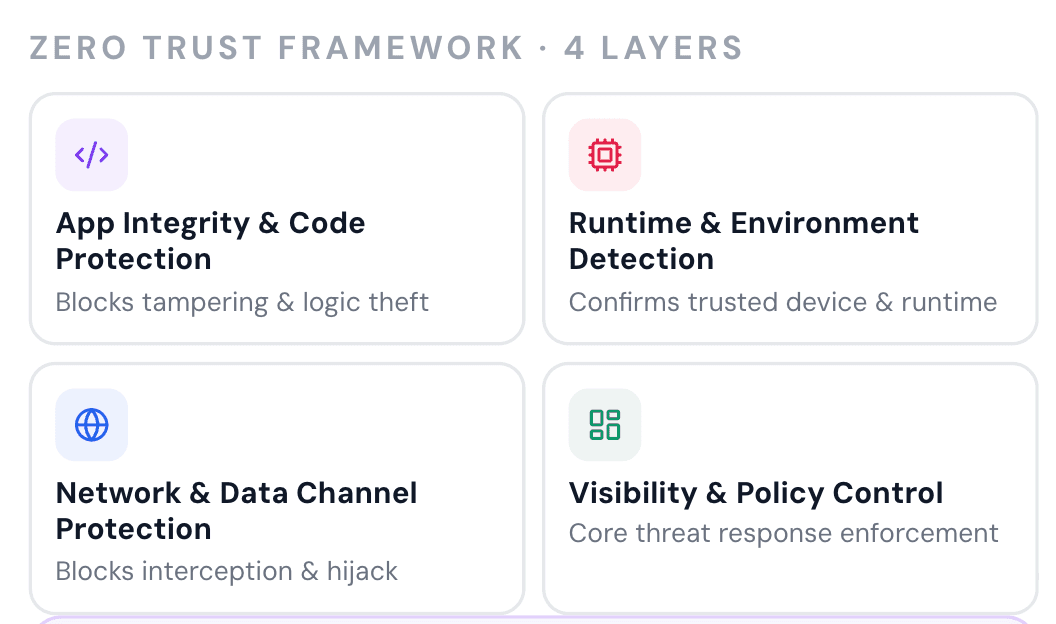
Bureau RASP (Runtime Application Self-Protection) works on a zero-trust framework, verifying each session to protect the device and network signal integrity, and code and app integrity. This four-layer protection approach ensures continuous protection and uncompromised trust. It works on device, in real-time, detecting threats at the operating system-level and enables businesses to respond through configurable security policies, allowing you to monitor, warn, or block the app’s session while a threat is detected.
The app code protection is powered by Bureau’s XVM framework, a unique virtualization-based runtime framework, which protects critical application logic against reverse engineering, code injection, and binary tampering. Going beyond standard code obfuscation and ensuring decompilers like Ghidra, or advanced scripts and LLMs can’t read the app’s code.
Securing the Application at Runtime
Traditional application security focuses heavily on protecting code during development and before deployment. Runtime threats require protection during execution. Bureau RASP monitors the application environment for indicators of compromise, including:
Rooted or jailbroken devices
Emulator activity and emulator farms
Application and binary tampering
Code injection
Reverse engineering
Location spoofing
Hooking frameworks such as Frida and Xposed
Man-in-the-middle proxy interception
RASP provides visibility into these conditions while the application is active, allowing businesses to enforce security policies before a compromised environment becomes a pathway to fraud.
An Automated Kill Switch for Active Threats
Identifying a threat is only part of the security response. Businesses also need to determine what happens when a threat is detected. Bureau RASP provides configurable responses based on the nature and severity of the threat, such as:
Monitor: Capture suspicious activity while allowing the application to continue.
Warn: Alert the user when a potentially compromised environment is detected.
Block: Immediately stop the compromised application or session.
This creates an automated kill switch at the application layer.
For example, if RASP detects a hooking framework manipulating application behavior during a sensitive transaction, a policy can block the session before the activity reaches the payment or transaction layer. Security teams can, therefore, move directly from detection to enforcement without relying on manual intervention.
Protecting Application Logic
Runtime attacks can target more than the device environment. Attackers can also attempt to understand and manipulate the application itself.
Bureau’s XVM framework converts critical application logic into a private instruction format, adding a layer of protection designed to make that logic harder to reverse engineer or tamper with. This conversion helps protect sensitive application functionality against techniques such as code injection and binary manipulation.
The combination of application protection and runtime threat detection gives businesses greater visibility and control over the environment in which their mobile applications operate.
Deploy in Minutes With Zero Engineering Friction
Security controls can sometimes create additional dependencies on development teams and application release cycles. Bureau RASP is designed to reduce that dependency.
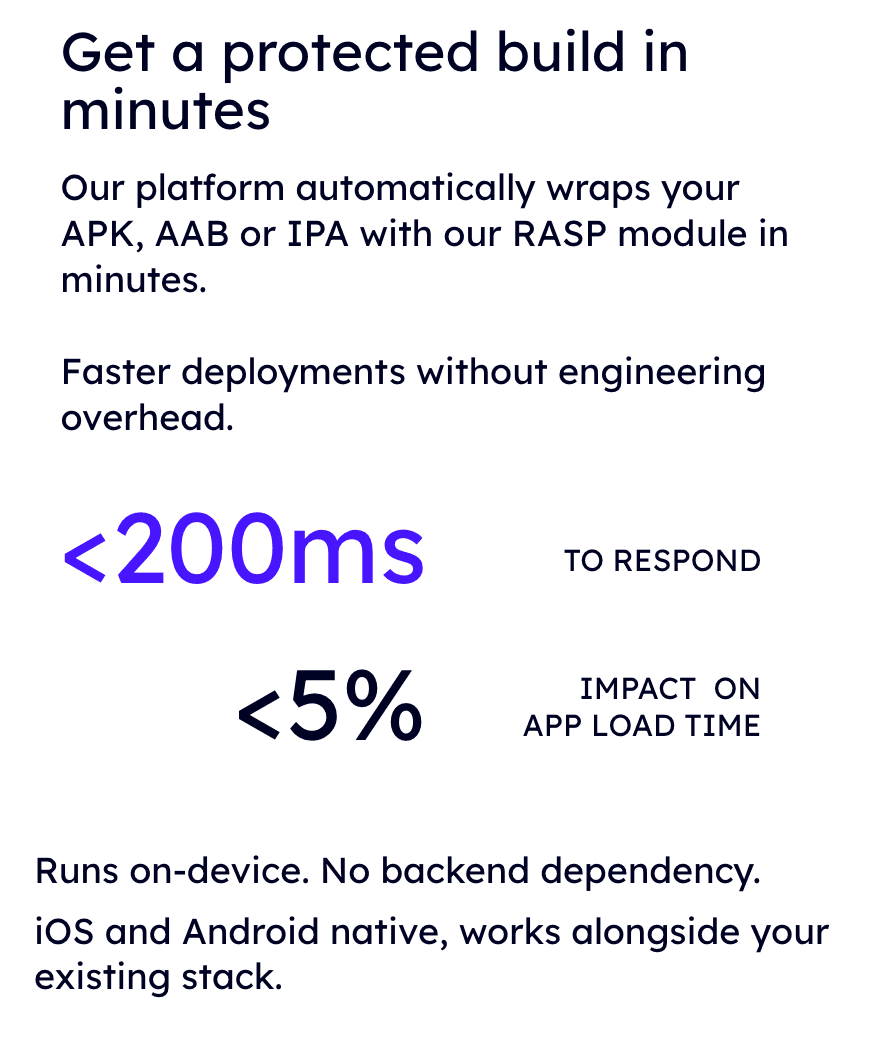
Security and application teams can repackage APK and IPA builds through the Bureau dashboard and deploy protected versions without modifying the underlying application source code. This allows businesses to add runtime protection to existing mobile applications without restructuring development roadmaps or rebuilding application logic around a new security layer. Any changes to the policy controls can be made through the dashboard, are delivered over the air, and act immediately while the app is running.
Connecting Runtime Security With Fraud Intelligence
Application security and fraud prevention increasingly intersect. A compromised device can be a security threat in its own right. It can also be an indicator of broader malicious activity when combined with identity, account, behavioral, and transaction signals.
Runtime telemetry from Bureau RASP can contribute to Bureau’s wider risk decisioning environment and feed into the Graph Identity Network (GIN), which can then correlate relationships across identities, devices, accounts, and transaction activity.
A device exhibiting application manipulation, for example, may also be connected to multiple identities or accounts showing suspicious behavior. This additional context can help businesses identify coordinated activity and fraud patterns that may remain hidden when application and fraud signals are assessed independently.
Built for High-Risk Digital Journeys
RASP is particularly relevant wherever mobile applications handle sensitive identity or financial activity.
For banks, it can protect mobile banking applications against runtime compromise during account access and transactions.
For payment providers and wallets, it can help identify manipulated environments before sensitive payment activity is executed.
For fintech businesses, it provides an additional security layer across authentication, account activity, and financial transactions.
The underlying principle is consistent: application integrity needs to be maintained while the application is being used, especially when sensitive actions are taking place.
Protecting What Happens Inside the Application
More and more customers now use mobile applications to authenticate, access accounts, and move money. That makes application integrity an important part of the wider digital risk equation.
Bureau RASP combines runtime threat detection, application protection, and automated enforcement to help businesses respond when the application environment is compromised. With configurable actions ranging from monitoring to blocking, protection of critical application logic through XVM, and runtime signals that can contribute to broader fraud intelligence, RASP gives security teams a way to act closer to the point of attack.
Detect the compromise. Assess the threat. Take action before the attack reaches the transaction. See Bureau RASP in action. Schedule a demo.
Mobile applications have become a critical interface for banking, payments, commerce, and several other digital services. They also present an expanded attack surface.
Fraudsters can reverse engineer application logic, tamper with binaries, inject code, manipulate runtime behavior, spoof location, or use emulator farms to automate attacks. Once an application is compromised, attackers can interfere with the systems responsible for executing sensitive actions and generating trusted signals. This level of compromise goes un-detected by the backend and existing fraud defenses.
Bureau RASP (Runtime Application Self-Protection) works on a zero-trust framework, verifying each session to protect the device and network signal integrity, and code and app integrity. This four-layer protection approach ensures continuous protection and uncompromised trust. It works on device, in real-time, detecting threats at the operating system-level and enables businesses to respond through configurable security policies, allowing you to monitor, warn, or block the app’s session while a threat is detected.
The app code protection is powered by Bureau’s XVM framework, a unique virtualization-based runtime framework, which protects critical application logic against reverse engineering, code injection, and binary tampering. Going beyond standard code obfuscation and ensuring decompilers like Ghidra, or advanced scripts and LLMs can’t read the app’s code.
Securing the Application at Runtime
Traditional application security focuses heavily on protecting code during development and before deployment. Runtime threats require protection during execution. Bureau RASP monitors the application environment for indicators of compromise, including:
Rooted or jailbroken devices
Emulator activity and emulator farms
Application and binary tampering
Code injection
Reverse engineering
Location spoofing
Hooking frameworks such as Frida and Xposed
Man-in-the-middle proxy interception
RASP provides visibility into these conditions while the application is active, allowing businesses to enforce security policies before a compromised environment becomes a pathway to fraud.
An Automated Kill Switch for Active Threats
Identifying a threat is only part of the security response. Businesses also need to determine what happens when a threat is detected. Bureau RASP provides configurable responses based on the nature and severity of the threat, such as:
Monitor: Capture suspicious activity while allowing the application to continue.
Warn: Alert the user when a potentially compromised environment is detected.
Block: Immediately stop the compromised application or session.
This creates an automated kill switch at the application layer.
For example, if RASP detects a hooking framework manipulating application behavior during a sensitive transaction, a policy can block the session before the activity reaches the payment or transaction layer. Security teams can, therefore, move directly from detection to enforcement without relying on manual intervention.
Protecting Application Logic
Runtime attacks can target more than the device environment. Attackers can also attempt to understand and manipulate the application itself.
Bureau’s XVM framework converts critical application logic into a private instruction format, adding a layer of protection designed to make that logic harder to reverse engineer or tamper with. This conversion helps protect sensitive application functionality against techniques such as code injection and binary manipulation.
The combination of application protection and runtime threat detection gives businesses greater visibility and control over the environment in which their mobile applications operate.
Deploy in Minutes With Zero Engineering Friction
Security controls can sometimes create additional dependencies on development teams and application release cycles. Bureau RASP is designed to reduce that dependency.
Security and application teams can repackage APK and IPA builds through the Bureau dashboard and deploy protected versions without modifying the underlying application source code. This allows businesses to add runtime protection to existing mobile applications without restructuring development roadmaps or rebuilding application logic around a new security layer. Any changes to the policy controls can be made through the dashboard, are delivered over the air, and act immediately while the app is running.
Connecting Runtime Security With Fraud Intelligence
Application security and fraud prevention increasingly intersect. A compromised device can be a security threat in its own right. It can also be an indicator of broader malicious activity when combined with identity, account, behavioral, and transaction signals.
Runtime telemetry from Bureau RASP can contribute to Bureau’s wider risk decisioning environment and feed into the Graph Identity Network (GIN), which can then correlate relationships across identities, devices, accounts, and transaction activity.
A device exhibiting application manipulation, for example, may also be connected to multiple identities or accounts showing suspicious behavior. This additional context can help businesses identify coordinated activity and fraud patterns that may remain hidden when application and fraud signals are assessed independently.
Built for High-Risk Digital Journeys
RASP is particularly relevant wherever mobile applications handle sensitive identity or financial activity.
For banks, it can protect mobile banking applications against runtime compromise during account access and transactions.
For payment providers and wallets, it can help identify manipulated environments before sensitive payment activity is executed.
For fintech businesses, it provides an additional security layer across authentication, account activity, and financial transactions.
The underlying principle is consistent: application integrity needs to be maintained while the application is being used, especially when sensitive actions are taking place.
Protecting What Happens Inside the Application
More and more customers now use mobile applications to authenticate, access accounts, and move money. That makes application integrity an important part of the wider digital risk equation.
Bureau RASP combines runtime threat detection, application protection, and automated enforcement to help businesses respond when the application environment is compromised. With configurable actions ranging from monitoring to blocking, protection of critical application logic through XVM, and runtime signals that can contribute to broader fraud intelligence, RASP gives security teams a way to act closer to the point of attack.
Detect the compromise. Assess the threat. Take action before the attack reaches the transaction. See Bureau RASP in action. Schedule a demo.
TABLE OF CONTENTS
See More
Recommended Blogs


Landing Page.
Simple, bold.
Sign Up
Download

Products
Solutions


© 2026 Bureau . All rights reserved.
Solutions
Industries
Resources
Company
Solutions
Industries
Resources
Company
© 2026 Bureau . All rights reserved.
Follow Us
Leave behind fragmented tools. Stop fraud rings, cut false declines, and deliver secure digital journeys at scale
Our Presence








Leave behind fragmented tools. Stop fraud rings, cut false declines, and deliver secure digital journeys at scale
Our Presence
© 2026 Bureau . All rights reserved.