Adaptive Authentication: Risk-decisioning That Responds to a Session’s Changing Risk
Adaptive Authentication: Risk-decisioning That Responds to a Session’s Changing Risk
Adaptive Authentication: Risk-decisioning That Responds to a Session’s Changing Risk
Continuously evaluating risk across the customer journey, Bureau’s Adaptive Authentication provides a dynamic risk-scoring system that detects rising threats in real time.
Author
Team Bureau

See how Bureau has helped industry leaders defend against networked Industrial-scale frauds →
Schedule a Demo
TABLE OF CONTENTS
See Less
A customer logs into a banking app from a familiar device. The session looks normal. A few minutes later, a new beneficiary is added and a high-value transfer is initiated.
What this means is: the authentication decision made at login using a set of static credentials cannot account for what happens throughout that session.
Risk evolves throughout a customer session. A legitimate login can turn into an account takeover. A trusted device can become compromised. Transaction behavior can shift as an attacker takes control. New connections between a device, behavior, and identity can also reveal risk that was invisible at the start of the session.
Bureau’s Adaptive Authentication is designed for this reality. It continuously evaluates risk as customers interact with digital services, bringing identity, behavior, device, location, network, and identity graph signals into a unified risk decisioning engine. Businesses can then apply the appropriate authentication response (multi-factor authentication, face verification, biometric check, etc.) the moment the risk changes.
The result is authentication that responds to the risk of the interaction, rather than relying on a single checkpoint.
Risk Scored With Four Signal Families
Adaptive Authentication evaluates risk in real-time as the session progresses and brings together risk signals across four signal families:
Identity Graph: Signals associated with the customer and account
Behavior: Interaction patterns such as typing rhythm and navigation
Device: Device characteristics and security posture (VPN, emulators, etc.)
Location and network: Identify proxy use, GPS spoofing, impossible travel
By combining these signals, Bureau develops a more complete view of the session and the risk associated with it.
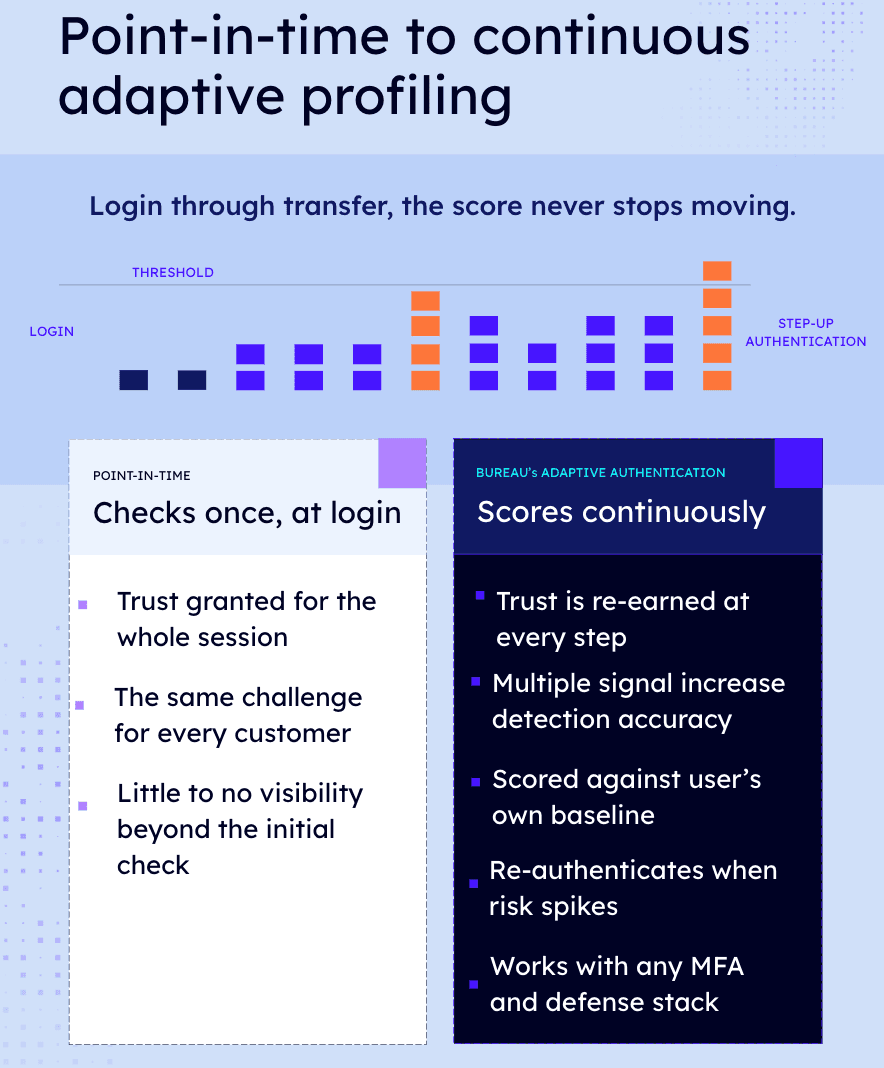
Monitor All Sessions, Step-up or Block The Risky Ones
Consider the earlier banking scenario. The customer logs in from a known device and follows an expected behavioral pattern. The initial risk assessment is low, so the session proceeds without additional friction. However, the customer later adds a beneficiary and initiates a high-value transfer. This activity now presents a different risk profile.
Bureau’s Adaptive Authentication captures and co-relates these with changing behavioral and device signals to identify a risky session. This allows businesses to reassess the session and trigger a step-up authentication requirement before the transaction is completed.
The important shift here is in the timing of the decision being made. Risk is now being assessed when the customer is taking a meaningful action, using the context available at that point. Therefore, authentication becomes a dynamic part of the digital journey rather than a one-time gate at the entrance.
Precision Matters as Much as Protection
Stronger blanket authentication methods can introduce customer friction. If every session receives the same level of scrutiny, legitimate customers may face unnecessary challenges while fraud teams continue to deal with false positives.
Adaptive Authentication enables businesses to make more selective decisions. It allows low-risk sessions to continue with minimal interruption. Sessions showing elevated risk can receive additional verification requirements or other preventive actions. The response can be aligned with the severity and context of the activity.
In early pilot deployments across tier-1 corporate banking and retail digital brands, Bureau’s Adaptive Authentication demonstrated the potential of this approach. It helped these businesses achieve a 50-60% increase in high-risk fraud detection and a 5-6% reduction in false positives, while step-up authentication was triggered for only 1 in 70 sessions.
The objective is straightforward: strengthen protection where it matters while keeping routine digital interactions efficient.
Protecting Critical Moments Across the Journey
Adaptive Authentication can support risk-based decisions across multiple digital touchpoints, including:
Account opening: Identity, device, behavioral, and other contextual signals can help establish risk during onboarding.
Beneficiary addition: New payment destinations can be evaluated alongside the wider session and identity context.
UPI, net banking, cards, and wallets: Authentication decisions can incorporate transaction behavior and other real-time signals as customers initiate financial activity.
High-value transfers: Additional authentication can be triggered when the combined risk context crosses a defined threshold.
This creates a consistent risk decisioning layer across the moments that matter most.
Extending Risk Intelligence Beyond the Session
The context generated during a digital interaction can also provide value beyond an individual authentication decision. Signals from customer journeys can feed into Bureau’s Graph Identity Network (GIN), where relationships across identities, devices, accounts, and transaction activity can reveal broader patterns.
Related Read: Graph Identity Networks vs. Mule Fraud in Banking |
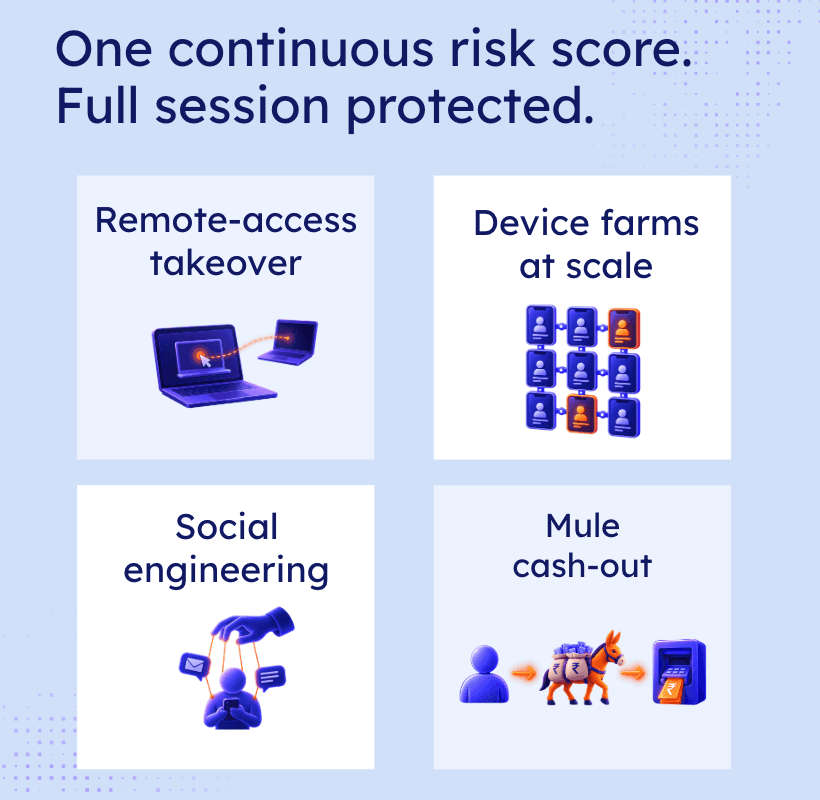
A suspicious device may be connected to multiple accounts. An identity may appear across seemingly unrelated activities. A transaction pattern may share characteristics with activity observed elsewhere. These relationships provide additional context for future decisions and help businesses move from assessing isolated events to understanding connected risk.
Authentication Built To Fight Evolving Fraud
Digital businesses operate at a pace where risk decisions need to keep up with customer activity.
Bureau’s Adaptive Authentication brings continuous risk assessment and real-time decisioning into the same framework. It evaluates changing risk context across the customer journey and enables businesses to determine when additional authentication is warranted.The result is a more precise approach to digital protection: Customers with low-risk activity can move through journeys with less friction. Higher-risk activity can receive stronger authentication at the moment it matters.
As digital interactions become more sophisticated and attacks become increasingly automated, authentication needs to respond to the full risk context of a session.
Learn how Adaptive Authentication gives businesses the intelligence and decisioning capability to do exactly that. Book a demo now.
A customer logs into a banking app from a familiar device. The session looks normal. A few minutes later, a new beneficiary is added and a high-value transfer is initiated.
What this means is: the authentication decision made at login using a set of static credentials cannot account for what happens throughout that session.
Risk evolves throughout a customer session. A legitimate login can turn into an account takeover. A trusted device can become compromised. Transaction behavior can shift as an attacker takes control. New connections between a device, behavior, and identity can also reveal risk that was invisible at the start of the session.
Bureau’s Adaptive Authentication is designed for this reality. It continuously evaluates risk as customers interact with digital services, bringing identity, behavior, device, location, network, and identity graph signals into a unified risk decisioning engine. Businesses can then apply the appropriate authentication response (multi-factor authentication, face verification, biometric check, etc.) the moment the risk changes.
The result is authentication that responds to the risk of the interaction, rather than relying on a single checkpoint.
Risk Scored With Four Signal Families
Adaptive Authentication evaluates risk in real-time as the session progresses and brings together risk signals across four signal families:
Identity Graph: Signals associated with the customer and account
Behavior: Interaction patterns such as typing rhythm and navigation
Device: Device characteristics and security posture (VPN, emulators, etc.)
Location and network: Identify proxy use, GPS spoofing, impossible travel
By combining these signals, Bureau develops a more complete view of the session and the risk associated with it.
Monitor All Sessions, Step-up or Block The Risky Ones
Consider the earlier banking scenario. The customer logs in from a known device and follows an expected behavioral pattern. The initial risk assessment is low, so the session proceeds without additional friction. However, the customer later adds a beneficiary and initiates a high-value transfer. This activity now presents a different risk profile.
Bureau’s Adaptive Authentication captures and co-relates these with changing behavioral and device signals to identify a risky session. This allows businesses to reassess the session and trigger a step-up authentication requirement before the transaction is completed.
The important shift here is in the timing of the decision being made. Risk is now being assessed when the customer is taking a meaningful action, using the context available at that point. Therefore, authentication becomes a dynamic part of the digital journey rather than a one-time gate at the entrance.
Precision Matters as Much as Protection
Stronger blanket authentication methods can introduce customer friction. If every session receives the same level of scrutiny, legitimate customers may face unnecessary challenges while fraud teams continue to deal with false positives.
Adaptive Authentication enables businesses to make more selective decisions. It allows low-risk sessions to continue with minimal interruption. Sessions showing elevated risk can receive additional verification requirements or other preventive actions. The response can be aligned with the severity and context of the activity.
In early pilot deployments across tier-1 corporate banking and retail digital brands, Bureau’s Adaptive Authentication demonstrated the potential of this approach. It helped these businesses achieve a 50-60% increase in high-risk fraud detection and a 5-6% reduction in false positives, while step-up authentication was triggered for only 1 in 70 sessions.
The objective is straightforward: strengthen protection where it matters while keeping routine digital interactions efficient.
Protecting Critical Moments Across the Journey
Adaptive Authentication can support risk-based decisions across multiple digital touchpoints, including:
Account opening: Identity, device, behavioral, and other contextual signals can help establish risk during onboarding.
Beneficiary addition: New payment destinations can be evaluated alongside the wider session and identity context.
UPI, net banking, cards, and wallets: Authentication decisions can incorporate transaction behavior and other real-time signals as customers initiate financial activity.
High-value transfers: Additional authentication can be triggered when the combined risk context crosses a defined threshold.
This creates a consistent risk decisioning layer across the moments that matter most.
Extending Risk Intelligence Beyond the Session
The context generated during a digital interaction can also provide value beyond an individual authentication decision. Signals from customer journeys can feed into Bureau’s Graph Identity Network (GIN), where relationships across identities, devices, accounts, and transaction activity can reveal broader patterns.
Related Read: Graph Identity Networks vs. Mule Fraud in Banking |
A suspicious device may be connected to multiple accounts. An identity may appear across seemingly unrelated activities. A transaction pattern may share characteristics with activity observed elsewhere. These relationships provide additional context for future decisions and help businesses move from assessing isolated events to understanding connected risk.
Authentication Built To Fight Evolving Fraud
Digital businesses operate at a pace where risk decisions need to keep up with customer activity.
Bureau’s Adaptive Authentication brings continuous risk assessment and real-time decisioning into the same framework. It evaluates changing risk context across the customer journey and enables businesses to determine when additional authentication is warranted.The result is a more precise approach to digital protection: Customers with low-risk activity can move through journeys with less friction. Higher-risk activity can receive stronger authentication at the moment it matters.
As digital interactions become more sophisticated and attacks become increasingly automated, authentication needs to respond to the full risk context of a session.
Learn how Adaptive Authentication gives businesses the intelligence and decisioning capability to do exactly that. Book a demo now.
TABLE OF CONTENTS
See More
Recommended Blogs



Landing Page.
Simple, bold.
Sign Up
Download

Products
Solutions


© 2026 Bureau . All rights reserved.
Solutions
Industries
Resources
Company
Solutions
Industries
Resources
Company
© 2026 Bureau . All rights reserved.
Follow Us
Leave behind fragmented tools. Stop fraud rings, cut false declines, and deliver secure digital journeys at scale
Our Presence








Leave behind fragmented tools. Stop fraud rings, cut false declines, and deliver secure digital journeys at scale
Our Presence
© 2026 Bureau . All rights reserved.