How to Detect First-Party Fraud Before Losses Escalate
How to Detect First-Party Fraud Before Losses Escalate
How to Detect First-Party Fraud Before Losses Escalate
Learn what first-party fraud is, how it differs from third-party fraud, common examples, and signals that help detect abuse earlier.
Author
Team Bureau


See how Bureau has helped industry leaders defend against networked Industrial-scale frauds →
Schedule a Demo
TABLE OF CONTENTS
See Less
Some fraud losses come from users who look legitimate until the moment they decide to abuse the trust they were given. They may pass onboarding and behave normally before exploiting credit, disputes, refunds, chargebacks, or promotions for financial gain.
For fraud and risk teams, this creates a difficult question: “When does a legitimate customer become a fraud risk?”
This guide breaks down what first-party fraud is, how it differs from third-party fraud, the most common first-party fraud examples, and the signals that help detect dishonest intent across the customer lifecycle.
What Is First-Party Fraud?
First-party fraud happens when a real user uses their own identity, account, or credentials to intentionally deceive a business for financial gain. Unlike third-party fraud, where a fraudster uses stolen identity data, first-party fraud often starts with a legitimate-looking customer who later abuses credit, refunds, disputes, promotions, or repayment systems.
A first-party fraudster may use their real name, phone number, documents, device, and payment credentials, which is why the risk often slips past controls designed to catch stolen identities or fake accounts.
It can happen at several points in the customer lifecycle:
During application: When a user misrepresents income, employment, intent, or eligibility.
During transactions: When they purchase goods or services with the intent to dispute later.
During repayment: When they access credit with no intention of paying.
During promotions: When they create linked accounts to exploit rewards.
During support or disputes: When they manipulate refund, chargeback, or reimbursement workflows.
First-party fraud usually involves:
A real user or account holder
Legitimate identity details
Misrepresentation or dishonest intent
Abuse of credit, refund, dispute, promotion, or repayment systems
Detection challenges because the user may pass onboarding checks
The key point remains that not every refund, dispute, default, or failed repayment is fraud, which is why the challenge is separating genuine customer issues from deliberate abuse.
Related Read: Best Fraud Detection Software in 2026 for Unified Risk Decisions
Common Types of First-Party Fraud
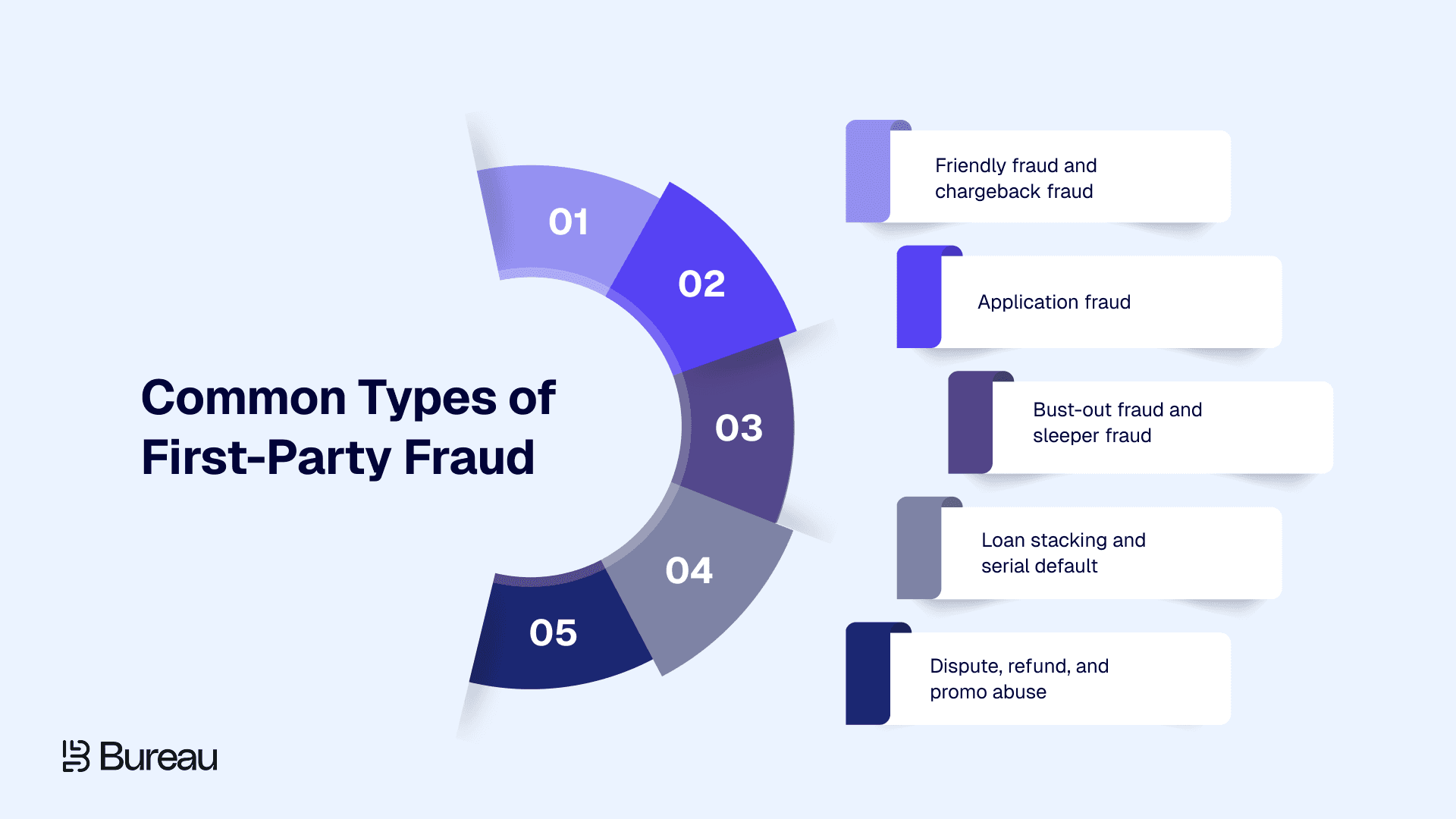
First-party fraud usually shows up when a business has already extended trust, such as through a credit line, refund policy, or higher transaction limit. The account may look legitimate, but the user’s intent changes how that trust is used.
The most common first-party fraud examples include:
Friendly fraud and chargeback fraud: This happens when a customer completes a genuine transaction and later disputes it as unauthorized. The business loses the revenue, pays chargeback fees, and spends time gathering evidence to prove the transaction was valid. This becomes harder to manage when dispute teams cannot connect transaction history, device data, customer behavior, and repeat claims.
Application fraud: A real user submits false or manipulated information to access credit, insurance, telecom services, employment, or another financial product. The identity may be genuine, but the application is not. Common patterns include inflated income, fake employment details, unverifiable addresses, manipulated documents, and identity misrepresentation.
Bust-out fraud and sleeper fraud: In both cases, the user builds trust before creating a loss. With bust-out fraud, the user may increase credit limits or transaction access and then quickly cash out. Sleeper fraud takes longer because the user behaves normally for months before requesting more credit or higher limits and then disappears after extracting value.
Loan stacking and serial default: A borrower applies for multiple loans or BNPL lines across platforms before the full exposure appears in credit or repayment data. In serial default, the user accesses credit, goods, or services with little or no intent to repay. Without connected fraud, credit, collections, and support data, these losses are often written off as bad debt instead of being investigated as fraud.
Dispute, refund, and promo abuse: Some users repeatedly exploit support and incentive workflows. They may claim non-delivery, request refunds after use, file repeated unauthorized-transaction claims, or create linked accounts to claim referral rewards and discounts.
Visa’s 2025 Global Ecommerce Payments & Fraud Report found that among merchants facing refund or policy abuse, 50% reported false “goods not received” claims and 46% reported returns of used or damaged goods.
These patterns often overlap. For instance, a user abusing refunds may also be linked to promo abuse, or a borrower showing serial default behavior may share devices, addresses, or payout accounts with other risky users.
That is why first-party fraud detection becomes stronger when teams can connect identity, device, transaction, repayment, support, and relationship signals instead of reviewing each event in isolation.
Bureau ID’s case work shows how connected signals can expose abuse that looks normal at the account level. In one food delivery case, Bureau helped eliminate a 2,700-user fraud ring by mapping shared devices, phone numbers, and behavioral patterns.
First-Party Fraud vs Third-Party Fraud
The simplest difference between first-party and third-party fraud is whose identity is being used. In first-party fraud, the real user commits the dishonest act in the first case. However, in third-party fraud, an external fraudster uses someone else’s identity, account, credentials, or payment data without authorization.
Factor | First-Party Fraud | Third-Party Fraud |
Who commits it | The real user, applicant, or account holder | An external fraudster |
Identity used | Own identity, account, or credentials | Stolen identity, stolen card data, compromised credentials, or synthetic identity |
Common examples | Friendly fraud, chargeback fraud, bust-out fraud, application fraud, loan stacking, dispute abuse, promo abuse | Account takeover, stolen card fraud, phishing, credential stuffing, identity theft |
Why it is hard to detect | The user may pass KYC, credit, and onboarding checks because the identity is real | The challenge is identifying stolen credentials, identity mismatch, or account compromise |
Main detection question | Is this real user acting dishonestly or abusing the system? | Is this person actually the legitimate user? |
Best detection approach | Behavioral monitoring, device intelligence, transaction history, repayment patterns, dispute history, graph signals | Identity verification, authentication controls, device anomaly detection, login risk checks |
The distinction matters because chargeback losses are rarely caused by one fraud type alone.
Mastercard and Datos 2025 Insights found that merchants identify about 45% of chargebacks as fraudulent, combining first-party and third-party fraudulent chargebacks. That makes classification important for deciding whether the control should focus on customer intent, stolen credentials, or account compromise.
For third-party threats such as stolen credentials and account compromise, account takeover protection remains a separate but related control layer.
Why Is First-Party Fraud Hard to Detect?
First-party fraud is hard to detect because most fraud systems are built to detect if the user is genuine. In many first-party fraud cases, the answer is yes, and the harder question is whether that genuine user intends to abuse the system later.
That creates three detection problems.
First, the identity checks out. A user can pass KYC, use valid documents, and still misrepresent intent, making first-party fraud different from stolen identity fraud, where mismatch signals are usually easier to spot.
Second, the risk appears late. The account may look normal until a credit line is used, a dispute is filed, a refund is requested, or a repayment is missed. By then, the business had already extended trust.
Third, the loss is easy to mislabel. What looks like bad debt to a credit team may look like a support issue to operations or a chargeback problem to payments. When those signals stay separated, repeated abuse is harder to connect.
This is also why aggressive rules can backfire, because not every default, refund request, or dispute is fraud. First-party fraud detection needs enough context to separate dishonest behavior from genuine customer issues.
In fact, MRC's 2026 Global eCommerce Payments and Fraud Report found that 62% of merchants globally report increasing rates of first-party misuse, with one in four seeing increases of 25% or more, confirming that this is now a mainstream fraud challenge.
What Signals Help Detect First-Party Fraud?
The most useful signals usually come from changes in behavior and connections across events:
Identity and application signals: Look for inconsistencies in income, employment, address history, document usage, or credit-seeking behavior. These signals are especially useful when application fraud or identity misrepresentation is the entry point.
Device and network signals: Check whether the same device, IP, or network environment appears across multiple accounts or past abuse cases. Device resets, emulator activity, proxy usage, and location masking can indicate attempts to avoid being recognized.
Behavioral signals: Review how the account moves through high-risk journeys. Scripted navigation, repeated form-filling patterns, sudden behavior changes, or unusual dispute behavior can point to planned abuse rather than normal customer activity.
Transaction and repayment signals: Track what happens after trust is extended. Fast credit drawdown, first-payment default, failed repayment attempts, early chargebacks, or refund claims after successful usage can reveal misuse that was not visible at onboarding.
Relationship signals: Connect accounts through shared devices, phone numbers, addresses, referral codes, payout accounts, or transaction flows. A single account may look low risk, while the connected cluster tells a very different story.
Platforms like Bureau ID combine device, behavioral, identity, network, and transaction signals into a single decisioning layer. That helps fraud teams connect suspicious activity earlier instead of investigating each claim, account, or transaction as a separate event.
Related Read: Detecting and Preventing SIM Swap Fraud Before It Strikes
How to Detect and Prevent First-Party Fraud?
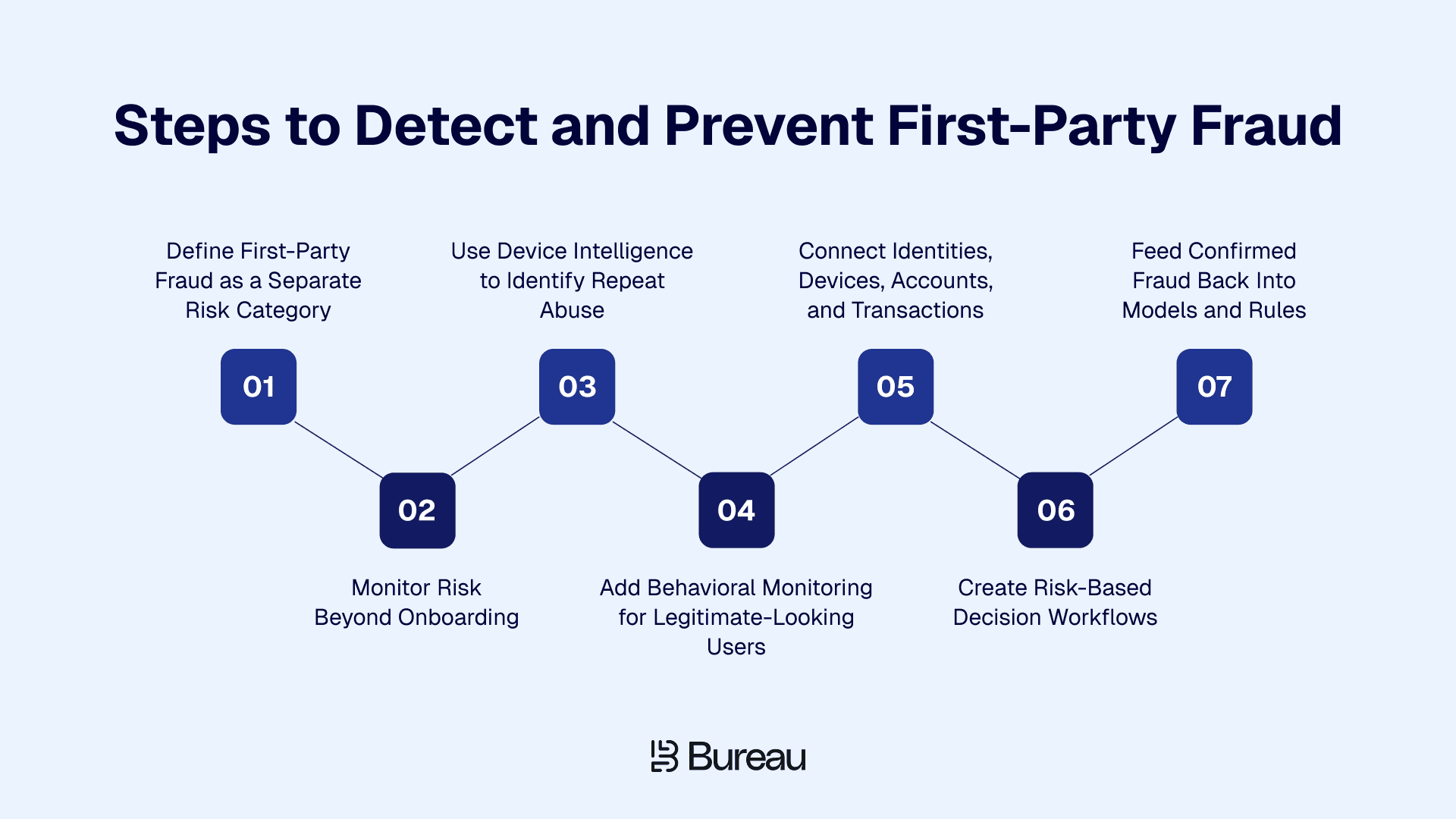
First-party fraud prevention works best when teams treat it as a lifecycle risk. Instead of relying only on onboarding checks, businesses need to monitor risk at application, transaction, repayment, dispute, refund, withdrawal, and promotion stages.
Step 1: Define First-Party Fraud as a Separate Risk Category
Teams should avoid burying this risk inside credit loss, chargebacks, returns, or refund leakage. The first step is to create clear internal definitions for friendly fraud, bust-out fraud, dispute abuse, serial default, loan stacking, and promo abuse.
That definition should also clarify ownership across fraud, risk, credit, payments, support, compliance, and product. When first-party fraud detection is tracked separately from third-party fraud, teams can see whether losses are coming from compromised users, dishonest real users, or operational gaps.
Risk Type | Where It Appears | Owner | Common Misclassification |
Friendly fraud | Payments and disputes | Payments/Fraud Ops | Customer dispute |
Bust-out fraud | Lending and credit | Credit/Risk | Bad debt |
Promo abuse | Signup and referral | Product/Fraud Ops | Marketing cost |
Loan stacking | Credit application | Risk/Credit | High-risk borrower |
Refund abuse | Post-purchase | Support/Trust & Safety | Customer service issue |
Step 2: Monitor Risk Beyond Onboarding
Many first-party fraud examples only become visible after signup, verification, or account approval, which is why you should monitor risk at moments where intent becomes clearer:
Credit limit increase
Repayment due date
Dispute filing
Refund request
Withdrawal
Referral payout
High-value purchase
Post-onboarding risk scoring helps teams identify changes in behavior instead of relying on a single decision made at account opening.
Step 3: Use Device Intelligence to Identify Repeat Abuse
Device intelligence helps detect repeat offenders who create new accounts, reset devices, use incognito mode, hide behind VPNs, or rotate identifiers to avoid detection.
The goal is to connect device history with downstream outcomes such as chargebacks, promo abuse, loan defaults, refund claims, and dispute patterns. This also helps reduce false positives. A known trusted device should not be treated the same way as a device linked to repeated losses across accounts.
Bureau ID’s device intelligence is built around persistent device identification that can help identify repeat abuse even when users attempt resets or create new accounts. Its Device ID has 99.97% persistence, which is useful when fraudsters try to re-enter the system with different account details.
Step 4: Add Behavioral Monitoring for Legitimate-Looking Users
Behavioral monitoring is useful because first-party abuse may not show an identity mismatch. The user is real, but the way they move through the journey may still reveal risk.
Behavioral signals such as navigation speed, typing behavior, form-filling patterns, dispute behavior, and post-transaction activity can help detect scripted abuse, fraud farms, account sharing, and abnormal intent. These signals should support risk scoring and investigation rather than act as a standalone reason to block.
Step 5: Connect Identities, Devices, Accounts, and Transactions
First-party abuse is easier to spot when relationships are visible. Graph analysis can connect accounts by device, address, phone, email, referral code, payout account, IP, payment instrument, or transaction flow.
This matters because fraud rings, mule networks, coordinated disputes, and repeat promo abuse often look harmless when each account is reviewed alone. The pattern only becomes clear when shared infrastructure and repeated outcomes are mapped together.
Bureau ID’s Graph Identity Network is an example of relationship intelligence used to uncover connected accounts, devices, behaviors, and fraud networks.
Step 6: Create Risk-Based Decision Workflows
Every suspicious signal should not become an automatic block. Risk-based workflows help teams act according to confidence level while allowing genuine users to continue.
Risk Level | Action |
Low risk | Approve |
Medium risk | Monitor, limit, or step up |
High risk | Manual review, payout hold, or transaction limit |
Critical risk | Block, freeze, reject, or escalate |
The workflow should also capture evidence for disputes, investigations, collections, and compliance reviews.
Step 7: Feed Confirmed Fraud Back Into Models and Rules
Confirmed fraud outcomes should improve future decisions. Chargeback outcomes, collection results, refund reversals, dispute evidence, and investigation notes can all strengthen rules, thresholds, models, and review workflows.
Teams should reassess rules after product launches, new promotions, credit policy changes, or market expansion. A promotion that was safe at one volume may become attractive to organized abuse once incentives change.
Useful metrics include:
First-payment default rate
Chargeback rate
Dispute win/loss rate
Refund abuse rate
Promo abuse rate
Manual review rate
False positive rate
Repeat offender rate
Fraud loss by journey stage
This feedback loop should connect fraud, credit, support, payments, compliance, and product teams. Otherwise, the same abuse pattern keeps resurfacing under different labels.
Build a Stronger First-Party Fraud Detection Strategy
The next step is reviewing where first-party fraud appears across the customer lifecycle and asking whether the business can connect identity, device, behavioral, transaction, dispute, repayment, and relationship signals quickly enough to act before loss occurs.
This is where Bureau ID can help businesses move beyond fragmented fraud checks. By bringing device, behavior, identity, network, and transaction intelligence into one risk decisioning layer, Bureau helps teams detect suspicious patterns earlier, reduce false positives, and act across onboarding, transactions, disputes, and repeat account activity.
Book a demo with Bureau ID today and see how unified risk decisioning can help your team detect first-party fraud patterns earlier without slowing down trusted users.
FAQs
1. What is first-party fraud?
First-party fraud happens when a real user uses their own identity or account to intentionally deceive a business for financial gain. It often appears through false disputes, credit misuse, refund abuse, application fraud, or promotion abuse after the user has already been trusted.
2. What are common first-party fraud examples?
Common first-party fraud examples include friendly fraud, chargeback fraud, application fraud, bust-out fraud, sleeper fraud, loan stacking, refund abuse, dispute abuse, and promo abuse. These patterns vary by industry, but all involve a legitimate-looking user misusing trust.
3. What is the difference between first-party fraud and third-party fraud?
First-party fraud is committed by the real user or account holder using their own identity. Third-party fraud involves an external fraudster using stolen credentials, stolen payment details, or another person’s identity to access accounts or complete transactions.
4. Is friendly fraud the same as first-party fraud?
Friendly fraud is a type of first-party fraud. It usually happens when a legitimate customer disputes a valid transaction, claims a purchase was unauthorized, or says goods were not received despite receiving value from the transaction.
5. Why is first-party fraud hard to detect?
First-party fraud is hard to detect because the identity often checks out. The risk usually appears later through repayment failure, repeated disputes, refund claims, chargebacks, or promotion abuse, making it easy to misclassify as bad debt or customer support loss.
6. How can businesses detect first-party fraud?
Businesses can improve first-party fraud detection by connecting identity, device, behavioral, transaction, repayment, dispute, and relationship signals. This helps teams identify repeated abuse patterns without treating every refund, dispute, or missed payment as fraud.
Some fraud losses come from users who look legitimate until the moment they decide to abuse the trust they were given. They may pass onboarding and behave normally before exploiting credit, disputes, refunds, chargebacks, or promotions for financial gain.
For fraud and risk teams, this creates a difficult question: “When does a legitimate customer become a fraud risk?”
This guide breaks down what first-party fraud is, how it differs from third-party fraud, the most common first-party fraud examples, and the signals that help detect dishonest intent across the customer lifecycle.
What Is First-Party Fraud?
First-party fraud happens when a real user uses their own identity, account, or credentials to intentionally deceive a business for financial gain. Unlike third-party fraud, where a fraudster uses stolen identity data, first-party fraud often starts with a legitimate-looking customer who later abuses credit, refunds, disputes, promotions, or repayment systems.
A first-party fraudster may use their real name, phone number, documents, device, and payment credentials, which is why the risk often slips past controls designed to catch stolen identities or fake accounts.
It can happen at several points in the customer lifecycle:
During application: When a user misrepresents income, employment, intent, or eligibility.
During transactions: When they purchase goods or services with the intent to dispute later.
During repayment: When they access credit with no intention of paying.
During promotions: When they create linked accounts to exploit rewards.
During support or disputes: When they manipulate refund, chargeback, or reimbursement workflows.
First-party fraud usually involves:
A real user or account holder
Legitimate identity details
Misrepresentation or dishonest intent
Abuse of credit, refund, dispute, promotion, or repayment systems
Detection challenges because the user may pass onboarding checks
The key point remains that not every refund, dispute, default, or failed repayment is fraud, which is why the challenge is separating genuine customer issues from deliberate abuse.
Related Read: Best Fraud Detection Software in 2026 for Unified Risk Decisions
Common Types of First-Party Fraud
First-party fraud usually shows up when a business has already extended trust, such as through a credit line, refund policy, or higher transaction limit. The account may look legitimate, but the user’s intent changes how that trust is used.
The most common first-party fraud examples include:
Friendly fraud and chargeback fraud: This happens when a customer completes a genuine transaction and later disputes it as unauthorized. The business loses the revenue, pays chargeback fees, and spends time gathering evidence to prove the transaction was valid. This becomes harder to manage when dispute teams cannot connect transaction history, device data, customer behavior, and repeat claims.
Application fraud: A real user submits false or manipulated information to access credit, insurance, telecom services, employment, or another financial product. The identity may be genuine, but the application is not. Common patterns include inflated income, fake employment details, unverifiable addresses, manipulated documents, and identity misrepresentation.
Bust-out fraud and sleeper fraud: In both cases, the user builds trust before creating a loss. With bust-out fraud, the user may increase credit limits or transaction access and then quickly cash out. Sleeper fraud takes longer because the user behaves normally for months before requesting more credit or higher limits and then disappears after extracting value.
Loan stacking and serial default: A borrower applies for multiple loans or BNPL lines across platforms before the full exposure appears in credit or repayment data. In serial default, the user accesses credit, goods, or services with little or no intent to repay. Without connected fraud, credit, collections, and support data, these losses are often written off as bad debt instead of being investigated as fraud.
Dispute, refund, and promo abuse: Some users repeatedly exploit support and incentive workflows. They may claim non-delivery, request refunds after use, file repeated unauthorized-transaction claims, or create linked accounts to claim referral rewards and discounts.
Visa’s 2025 Global Ecommerce Payments & Fraud Report found that among merchants facing refund or policy abuse, 50% reported false “goods not received” claims and 46% reported returns of used or damaged goods.
These patterns often overlap. For instance, a user abusing refunds may also be linked to promo abuse, or a borrower showing serial default behavior may share devices, addresses, or payout accounts with other risky users.
That is why first-party fraud detection becomes stronger when teams can connect identity, device, transaction, repayment, support, and relationship signals instead of reviewing each event in isolation.
Bureau ID’s case work shows how connected signals can expose abuse that looks normal at the account level. In one food delivery case, Bureau helped eliminate a 2,700-user fraud ring by mapping shared devices, phone numbers, and behavioral patterns.
First-Party Fraud vs Third-Party Fraud
The simplest difference between first-party and third-party fraud is whose identity is being used. In first-party fraud, the real user commits the dishonest act in the first case. However, in third-party fraud, an external fraudster uses someone else’s identity, account, credentials, or payment data without authorization.
Factor | First-Party Fraud | Third-Party Fraud |
Who commits it | The real user, applicant, or account holder | An external fraudster |
Identity used | Own identity, account, or credentials | Stolen identity, stolen card data, compromised credentials, or synthetic identity |
Common examples | Friendly fraud, chargeback fraud, bust-out fraud, application fraud, loan stacking, dispute abuse, promo abuse | Account takeover, stolen card fraud, phishing, credential stuffing, identity theft |
Why it is hard to detect | The user may pass KYC, credit, and onboarding checks because the identity is real | The challenge is identifying stolen credentials, identity mismatch, or account compromise |
Main detection question | Is this real user acting dishonestly or abusing the system? | Is this person actually the legitimate user? |
Best detection approach | Behavioral monitoring, device intelligence, transaction history, repayment patterns, dispute history, graph signals | Identity verification, authentication controls, device anomaly detection, login risk checks |
The distinction matters because chargeback losses are rarely caused by one fraud type alone.
Mastercard and Datos 2025 Insights found that merchants identify about 45% of chargebacks as fraudulent, combining first-party and third-party fraudulent chargebacks. That makes classification important for deciding whether the control should focus on customer intent, stolen credentials, or account compromise.
For third-party threats such as stolen credentials and account compromise, account takeover protection remains a separate but related control layer.
Why Is First-Party Fraud Hard to Detect?
First-party fraud is hard to detect because most fraud systems are built to detect if the user is genuine. In many first-party fraud cases, the answer is yes, and the harder question is whether that genuine user intends to abuse the system later.
That creates three detection problems.
First, the identity checks out. A user can pass KYC, use valid documents, and still misrepresent intent, making first-party fraud different from stolen identity fraud, where mismatch signals are usually easier to spot.
Second, the risk appears late. The account may look normal until a credit line is used, a dispute is filed, a refund is requested, or a repayment is missed. By then, the business had already extended trust.
Third, the loss is easy to mislabel. What looks like bad debt to a credit team may look like a support issue to operations or a chargeback problem to payments. When those signals stay separated, repeated abuse is harder to connect.
This is also why aggressive rules can backfire, because not every default, refund request, or dispute is fraud. First-party fraud detection needs enough context to separate dishonest behavior from genuine customer issues.
In fact, MRC's 2026 Global eCommerce Payments and Fraud Report found that 62% of merchants globally report increasing rates of first-party misuse, with one in four seeing increases of 25% or more, confirming that this is now a mainstream fraud challenge.
What Signals Help Detect First-Party Fraud?
The most useful signals usually come from changes in behavior and connections across events:
Identity and application signals: Look for inconsistencies in income, employment, address history, document usage, or credit-seeking behavior. These signals are especially useful when application fraud or identity misrepresentation is the entry point.
Device and network signals: Check whether the same device, IP, or network environment appears across multiple accounts or past abuse cases. Device resets, emulator activity, proxy usage, and location masking can indicate attempts to avoid being recognized.
Behavioral signals: Review how the account moves through high-risk journeys. Scripted navigation, repeated form-filling patterns, sudden behavior changes, or unusual dispute behavior can point to planned abuse rather than normal customer activity.
Transaction and repayment signals: Track what happens after trust is extended. Fast credit drawdown, first-payment default, failed repayment attempts, early chargebacks, or refund claims after successful usage can reveal misuse that was not visible at onboarding.
Relationship signals: Connect accounts through shared devices, phone numbers, addresses, referral codes, payout accounts, or transaction flows. A single account may look low risk, while the connected cluster tells a very different story.
Platforms like Bureau ID combine device, behavioral, identity, network, and transaction signals into a single decisioning layer. That helps fraud teams connect suspicious activity earlier instead of investigating each claim, account, or transaction as a separate event.
Related Read: Detecting and Preventing SIM Swap Fraud Before It Strikes
How to Detect and Prevent First-Party Fraud?
First-party fraud prevention works best when teams treat it as a lifecycle risk. Instead of relying only on onboarding checks, businesses need to monitor risk at application, transaction, repayment, dispute, refund, withdrawal, and promotion stages.
Step 1: Define First-Party Fraud as a Separate Risk Category
Teams should avoid burying this risk inside credit loss, chargebacks, returns, or refund leakage. The first step is to create clear internal definitions for friendly fraud, bust-out fraud, dispute abuse, serial default, loan stacking, and promo abuse.
That definition should also clarify ownership across fraud, risk, credit, payments, support, compliance, and product. When first-party fraud detection is tracked separately from third-party fraud, teams can see whether losses are coming from compromised users, dishonest real users, or operational gaps.
Risk Type | Where It Appears | Owner | Common Misclassification |
Friendly fraud | Payments and disputes | Payments/Fraud Ops | Customer dispute |
Bust-out fraud | Lending and credit | Credit/Risk | Bad debt |
Promo abuse | Signup and referral | Product/Fraud Ops | Marketing cost |
Loan stacking | Credit application | Risk/Credit | High-risk borrower |
Refund abuse | Post-purchase | Support/Trust & Safety | Customer service issue |
Step 2: Monitor Risk Beyond Onboarding
Many first-party fraud examples only become visible after signup, verification, or account approval, which is why you should monitor risk at moments where intent becomes clearer:
Credit limit increase
Repayment due date
Dispute filing
Refund request
Withdrawal
Referral payout
High-value purchase
Post-onboarding risk scoring helps teams identify changes in behavior instead of relying on a single decision made at account opening.
Step 3: Use Device Intelligence to Identify Repeat Abuse
Device intelligence helps detect repeat offenders who create new accounts, reset devices, use incognito mode, hide behind VPNs, or rotate identifiers to avoid detection.
The goal is to connect device history with downstream outcomes such as chargebacks, promo abuse, loan defaults, refund claims, and dispute patterns. This also helps reduce false positives. A known trusted device should not be treated the same way as a device linked to repeated losses across accounts.
Bureau ID’s device intelligence is built around persistent device identification that can help identify repeat abuse even when users attempt resets or create new accounts. Its Device ID has 99.97% persistence, which is useful when fraudsters try to re-enter the system with different account details.
Step 4: Add Behavioral Monitoring for Legitimate-Looking Users
Behavioral monitoring is useful because first-party abuse may not show an identity mismatch. The user is real, but the way they move through the journey may still reveal risk.
Behavioral signals such as navigation speed, typing behavior, form-filling patterns, dispute behavior, and post-transaction activity can help detect scripted abuse, fraud farms, account sharing, and abnormal intent. These signals should support risk scoring and investigation rather than act as a standalone reason to block.
Step 5: Connect Identities, Devices, Accounts, and Transactions
First-party abuse is easier to spot when relationships are visible. Graph analysis can connect accounts by device, address, phone, email, referral code, payout account, IP, payment instrument, or transaction flow.
This matters because fraud rings, mule networks, coordinated disputes, and repeat promo abuse often look harmless when each account is reviewed alone. The pattern only becomes clear when shared infrastructure and repeated outcomes are mapped together.
Bureau ID’s Graph Identity Network is an example of relationship intelligence used to uncover connected accounts, devices, behaviors, and fraud networks.
Step 6: Create Risk-Based Decision Workflows
Every suspicious signal should not become an automatic block. Risk-based workflows help teams act according to confidence level while allowing genuine users to continue.
Risk Level | Action |
Low risk | Approve |
Medium risk | Monitor, limit, or step up |
High risk | Manual review, payout hold, or transaction limit |
Critical risk | Block, freeze, reject, or escalate |
The workflow should also capture evidence for disputes, investigations, collections, and compliance reviews.
Step 7: Feed Confirmed Fraud Back Into Models and Rules
Confirmed fraud outcomes should improve future decisions. Chargeback outcomes, collection results, refund reversals, dispute evidence, and investigation notes can all strengthen rules, thresholds, models, and review workflows.
Teams should reassess rules after product launches, new promotions, credit policy changes, or market expansion. A promotion that was safe at one volume may become attractive to organized abuse once incentives change.
Useful metrics include:
First-payment default rate
Chargeback rate
Dispute win/loss rate
Refund abuse rate
Promo abuse rate
Manual review rate
False positive rate
Repeat offender rate
Fraud loss by journey stage
This feedback loop should connect fraud, credit, support, payments, compliance, and product teams. Otherwise, the same abuse pattern keeps resurfacing under different labels.
Build a Stronger First-Party Fraud Detection Strategy
The next step is reviewing where first-party fraud appears across the customer lifecycle and asking whether the business can connect identity, device, behavioral, transaction, dispute, repayment, and relationship signals quickly enough to act before loss occurs.
This is where Bureau ID can help businesses move beyond fragmented fraud checks. By bringing device, behavior, identity, network, and transaction intelligence into one risk decisioning layer, Bureau helps teams detect suspicious patterns earlier, reduce false positives, and act across onboarding, transactions, disputes, and repeat account activity.
Book a demo with Bureau ID today and see how unified risk decisioning can help your team detect first-party fraud patterns earlier without slowing down trusted users.
FAQs
1. What is first-party fraud?
First-party fraud happens when a real user uses their own identity or account to intentionally deceive a business for financial gain. It often appears through false disputes, credit misuse, refund abuse, application fraud, or promotion abuse after the user has already been trusted.
2. What are common first-party fraud examples?
Common first-party fraud examples include friendly fraud, chargeback fraud, application fraud, bust-out fraud, sleeper fraud, loan stacking, refund abuse, dispute abuse, and promo abuse. These patterns vary by industry, but all involve a legitimate-looking user misusing trust.
3. What is the difference between first-party fraud and third-party fraud?
First-party fraud is committed by the real user or account holder using their own identity. Third-party fraud involves an external fraudster using stolen credentials, stolen payment details, or another person’s identity to access accounts or complete transactions.
4. Is friendly fraud the same as first-party fraud?
Friendly fraud is a type of first-party fraud. It usually happens when a legitimate customer disputes a valid transaction, claims a purchase was unauthorized, or says goods were not received despite receiving value from the transaction.
5. Why is first-party fraud hard to detect?
First-party fraud is hard to detect because the identity often checks out. The risk usually appears later through repayment failure, repeated disputes, refund claims, chargebacks, or promotion abuse, making it easy to misclassify as bad debt or customer support loss.
6. How can businesses detect first-party fraud?
Businesses can improve first-party fraud detection by connecting identity, device, behavioral, transaction, repayment, dispute, and relationship signals. This helps teams identify repeated abuse patterns without treating every refund, dispute, or missed payment as fraud.
TABLE OF CONTENTS
See More
Recommended Blogs


Landing Page.
Simple, bold.
Sign Up
Download

Products
Solutions


© 2026 Bureau . All rights reserved.
Solutions
Industries
Resources
Company
Solutions
Industries
Resources
Company
© 2026 Bureau . All rights reserved.
Follow Us
Leave behind fragmented tools. Stop fraud rings, cut false declines, and deliver secure digital journeys at scale
Our Presence








Leave behind fragmented tools. Stop fraud rings, cut false declines, and deliver secure digital journeys at scale
Our Presence
© 2026 Bureau . All rights reserved.