Compare the 9 Best Device Intelligence Platform Vendors in 2026
Compare the 9 Best Device Intelligence Platform Vendors in 2026
Compare the 9 Best Device Intelligence Platform Vendors in 2026
Explore the best device intelligence platform options and compare persistent IDs, device signals, emulator detection, and multi-accounting support.
Author
Team Bureau


See how Bureau has helped industry leaders defend against networked Industrial-scale frauds →
Schedule a Demo
TABLE OF CONTENTS
See Less
Device intelligence platforms are widely evaluated by banks, fintechs, marketplaces, and other digital businesses that need to recognize repeat devices and assess session risk.
But as fraud expands across accounts, devices, networks, and app environments, buyers increasingly need more than a basic device fingerprint. They need persistent identification, device and network signals, emulator detection, behavioral analysis, multi-accounting coverage, and real-time risk decisions.
To make this comparison useful, this list evaluates nine platforms by the fraud problems they solve, the signals they use, and the workflows they fit best. Before comparing vendors, here’s a look at how device intelligence differs from device fingerprinting.
Device Intelligence vs Device Fingerprinting
Device fingerprinting helps recognize a browser or device. Device intelligence goes further by assessing whether that device, its environment, and the current session can be trusted.
The comparison below shows how the two approaches differ in scope, signals, fraud coverage, and decision support.
Factor | Device Fingerprinting | Device Intelligence |
Primary purpose | Recognize a browser or device | Assess device and session trust |
Typical output | Device hash or identifier | Identifier, risk signals, score, or decision |
Signals | Browser, hardware, and software attributes | Device, network, integrity, location, behavioral, and historical signals |
Fraud coverage | Repeat-device recognition | Multi-accounting, emulators, spoofing, bots, ATO, app cloning, and linked fraud |
Decision support | Usually requires additional logic | May include scoring, rules, workflows, and real-time enforcement |
The practical difference is how each approach performs when fraudsters try to appear as new users. Platforms with persistent device identification can help recognize repeat devices even when users clear cookies, switch browsers, change networks, or attempt other common evasion techniques.
Related Read: How Device Intelligence Detects Fraud Across the User Lifecycle
Best Device Intelligence Platforms at a Glance
Device intelligence platforms help businesses recognize returning devices, detect device manipulation, assess session risk, and support fraud decisions using device, network, behavioral, and environmental signals.
The comparison below highlights where each device intelligence platform fits and what buyers should examine before adding it to their shortlist.
Platform | Core Approach | Persistent Device Identification | Emulator and Tampering Detection | Multi-Accounting Coverage | Best For |
Bureau | Device, behavior, graph, and decisioning | Strong focus | Yes | Device-account graph analysis | Connected device and fraud-ring detection |
Fingerprint | Persistent visitor ID and Smart Signals | Core strength | Yes | Requires customer rules | Developer-led web and mobile identification |
SEON | Device, contact, IP, and risk scoring | Yes | Yes | Hashes, velocity, and behavior | Device intelligence with digital-footprint enrichment |
SHIELD | Persistent Device ID and continuous risk signals | Core strength | Yes | Mobile account-linking focus | Mobile-first fraud and multi-accounting |
JuicyScore | Probabilistic Device ID and risk signals | Core strength | Yes | Device and behavioral patterns | Financial services and emerging-market risk |
Sumsub | Identity verification plus device intelligence | Yes | Yes | Signals within verification workflows | KYC-led businesses needing post-verification signals |
DataVisor | Device intelligence and unsupervised ML | Yes | Yes | Device and anomaly clustering | Enterprise teams using ML-led detection |
Unit21 | Device Risk Score within rules and cases | Yes | Yes | Device links and graph context | Fraud and AML teams needing integrated workflows |
Feedzai | Device, behavior, malware, and transaction intelligence | Broader trust analysis | Yes | Network and behavioral context | Large banks and payment institutions |
The right choice depends on the fraud problems that need to be solved, the signals it relies on, and how device intelligence fits into a broader risk stack.
Capabilities to Look for When Evaluating Device Intelligence Platforms
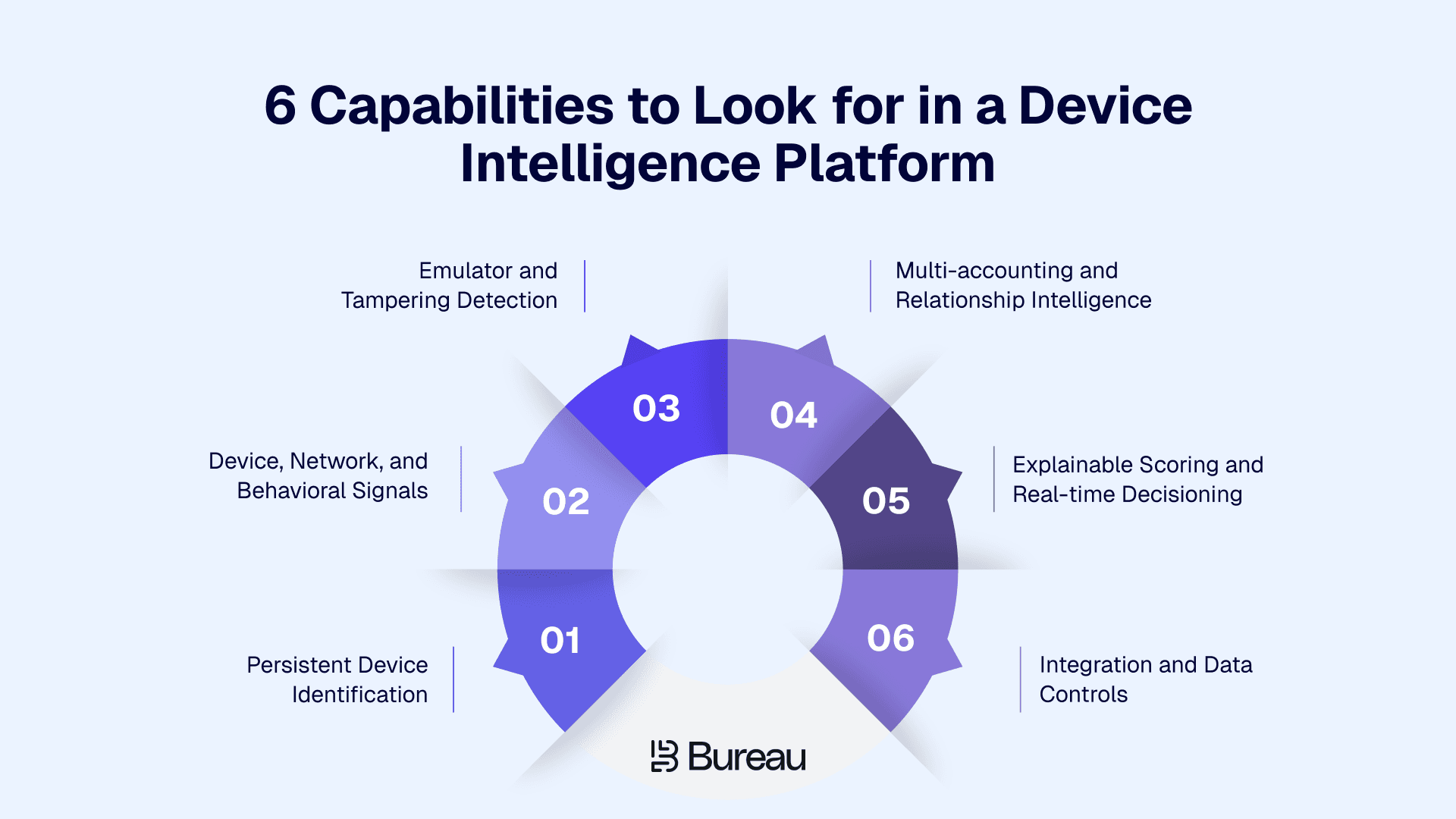
To compare these platforms consistently, here are the capabilities that matter most to fraud, risk, and product teams:
Persistent device identification: Recognizes repeat devices despite cookie deletion, browser changes, app reinstalls, resets, or manipulated parameters.
Device, network, and behavioral signals: Evaluates device integrity, network risk, location, configuration, user behavior, and historical activity.
Emulator and tampering detection: Flags emulators, rooted devices, cloned apps, spoofing, remote-access tools, and automated environments.
Multi-accounting and relationship intelligence: Connects devices, accounts, IPs, contact details, payments, and behavior to expose linked abuse.
Explainable scoring and real-time decisioning: Returns clear risk indicators and supports actions such as step-up checks, review, restriction, or blocking.
Integration and data controls: Supports web and mobile environments, APIs, SDKs, operational control, data residency, retention, and regional requirements.
Buyers should also assess whether behavioral biometrics adds useful context to device risk. Europol’s 2025 SIMCARTEL operation seized 1,200 SIM-box devices and 40,000 active SIM cards linked to more than 49 million online accounts.
The scale shows why platforms must detect clusters across devices, phone numbers, IP addresses, signup velocity, and shared infrastructure rather than assess each registration in isolation.
The platforms below were evaluated against these criteria for device fraud detection, fraud-team efficiency, and real-time decisioning at scale.
9 Best Device Intelligence Platforms for Fraud Prevention
The platforms below include both pure-play device intelligence tools and broader fraud platforms with native device capabilities. A focused product may suit teams that already have a risk engine, while a unified platform may be a better fit when device signals need to work alongside identity, behavior, transactions, graph analysis, rules, and investigations.
1. Bureau

Bureau is an AI-powered unified risk decisioning platform that helps fintech teams transition from account-level defense to network-level intelligence by verifying users, detecting fraud, and managing risk across onboarding, authentication, transactions, and ongoing account activity. It combines device intelligence, behavioral biometrics, identity verification, graph analysis, and KYC, KYB, and AML workflows within one decisioning layer.
Key strengths:
Persistent device identification: Bureau’s Device ID recognizes repeat and risky devices across resets, reinstalls, incognito sessions, and other evasion attempts, helping teams stop returning fraudsters without repeatedly challenging genuine users.
Device intelligence and behavioral biometrics: Combines device signals with behavioral biometrics to distinguish genuine users from bots, fraud farms, and compromised sessions before suspicious activity turns into losses.
Multi-accounting and promo abuse prevention: Links shared devices and infrastructure across accounts to detect repeat registrations, referral fraud, and coordinated abuse.
Emulator and tampering detection: Identifies cloned apps, emulators, rooted or jailbroken devices, virtualized environments, location spoofing, and manipulated sessions before they can bypass fraud controls.
Graph Identity Network: The Graph Identity Network connects identities, devices, behaviors, and transactions to reveal fraud rings, mule networks, and synthetic identities.
Explainable real-time decisions: Delivers transparent risk assessments that help teams approve, challenge, review, or block activity during live customer journeys.
Configurable compliance workflows: Lets teams adapt KYC, KYB, and AML rules, thresholds, review logic, and approval flows without relying on engineering for every policy change.
These capabilities are most useful when fraud spans several attack methods at once. A synthetic identity may also involve a cloned app, a reused device, manipulated network data, and links to other accounts that appear legitimate in isolation. The Jupiter Edge case study shows how Bureau handled that combination in practice.
How Bureau Helped Jupiter Edge Stop Synthetic Identity Fraud
Jupiter Edge, a BNPL micro-loan app, offers instant credit with minimal onboarding friction. Fraudsters exploited the process using stolen identities, cloned applications, spoofed devices, and manipulated network signals to bypass checks, access credit, and disappear before the existing risk setup could detect the attack.
What Bureau implemented:
Detected cloned apps and suspicious device reuse
Flagged malicious applications and spoofed environments
Identified anomalous IP and geolocation signals
Cross-checked names, phone numbers, and email addresses
Connected identity, device, network, and behavioral risk
Scored suspicious applications in real time
Results achieved:
More than 500 fraudsters blocked in one day
A coordinated fraud ring identified within hours
Credit lines closed before funds could be moved
No added friction for genuine applicants
Read the full case study here → Stopping Synthetic ID Fraud to Protect BNPL Customers.
What to consider:
Bureau is better suited to teams that need connected fraud decisioning than buyers seeking only a lightweight device-identification API.
Buyers should define which existing tools and workflows the platform will replace, complement, or orchestrate.
Use-case fit: Neobanks, digital lenders, BNPL providers, payment processors, wallets, marketplaces, and cross-border fintechs that need persistent device identification, device-tampering detection, multi-accounting coverage, and connected fraud analysis.
Teams evaluating whether Bureau fits their current risk stack can book a quick 30-minute demo to review relevant use cases, integration options, and decisioning workflows.
2. Fingerprint
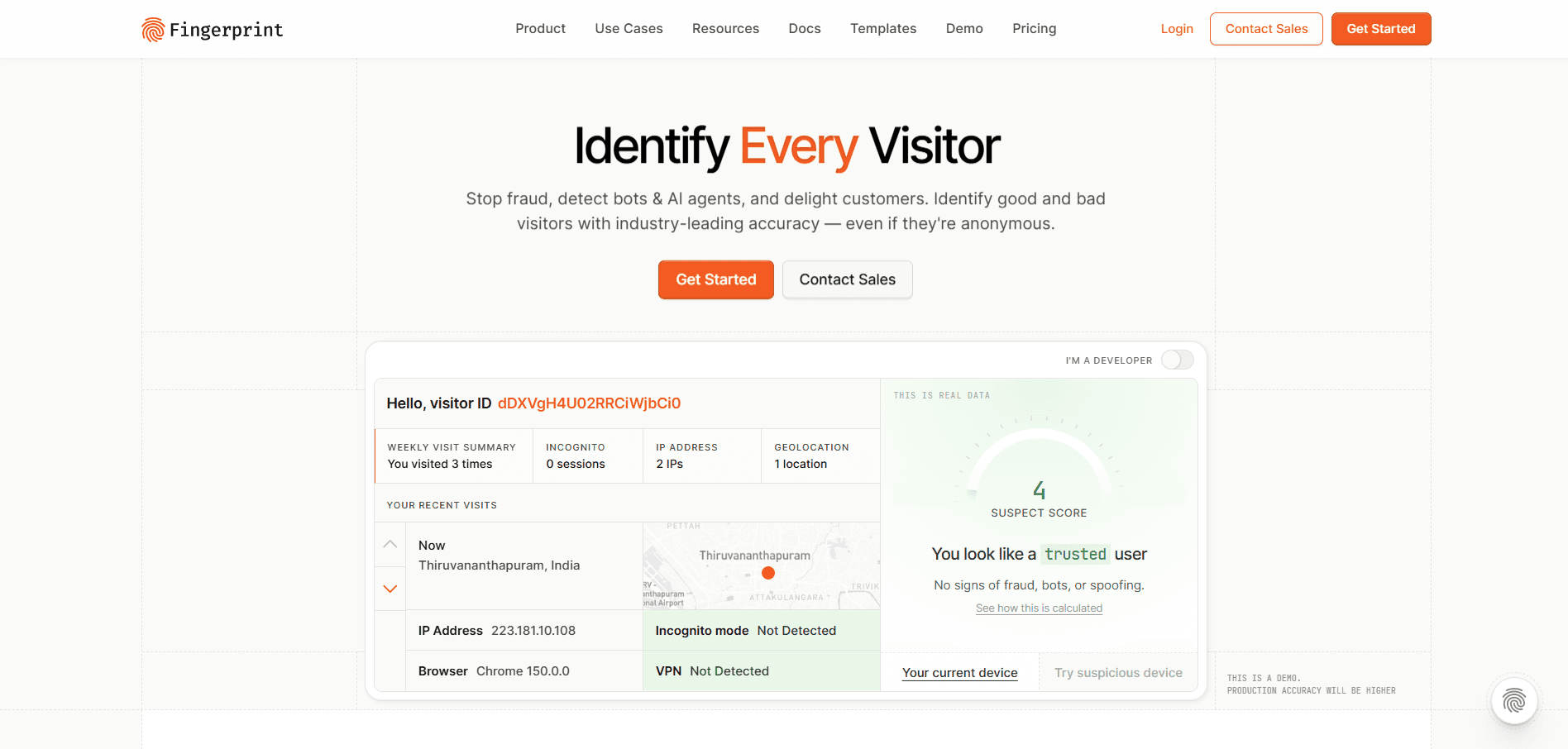
Fingerprint is a developer-focused device intelligence platform built around a persistent visitor ID for web and mobile applications. It uses more than 100 device, browser, network, and behavioral signals to recognize returning users and provides modular Smart Signals that can integrate with an organization's existing fraud stack.
Key strengths:
Persistent visitor identification: Creates a stable visitor ID to recognize returning users across browsers, devices, and common privacy-related changes.
Signal depth: Uses device, browser, network, and behavioral signals to provide additional risk context.
Emulator and tampering detection: Detects emulators, virtual machines, browser tampering, VPNs, proxies, bots, and geolocation spoofing.
Developer-first architecture: Offers SDKs, APIs, server-side validation, and integrations for existing fraud workflows.
Flexible deployment: Fits teams that already have risk scoring, orchestration, and case management in place.
What to consider:
Some reviewers report that specific bot or browser classifications can be inaccurate, so teams should validate named risk indicators against their own traffic and test environments.
Fingerprint is strongest as a device intelligence layer; broader fraud logic, graph analysis, investigations, and case management may still require additional tools.
Use-case fit: Developer-led fintech, SaaS, ecommerce, marketplace, and gaming teams with an existing fraud engine. It is well suited for teams that need persistent device identification and rich device signals without replacing their current decisioning platform.
3. SEON
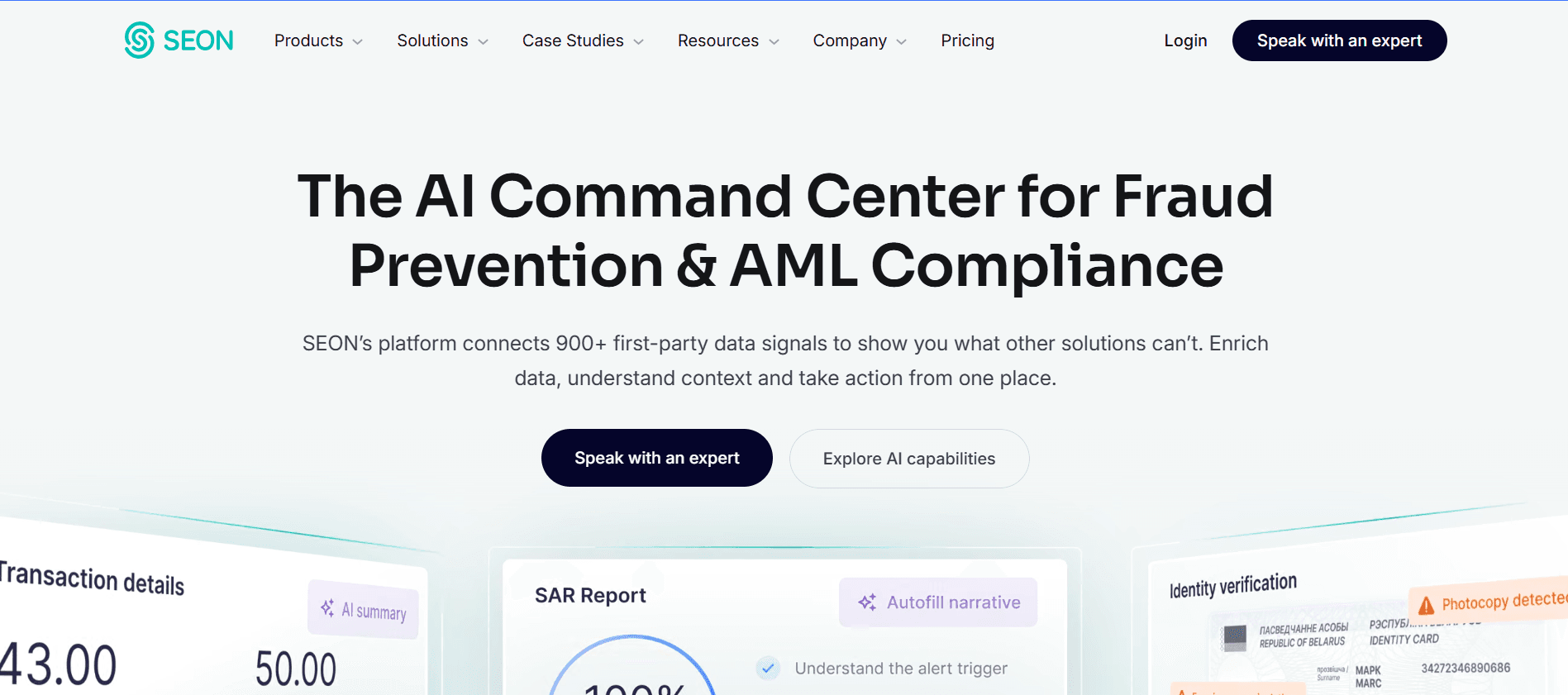
SEON is a broader fraud and compliance platform that combines device intelligence with behavioral biometrics, email, phone, IP, digital-footprint, scoring, and workflow capabilities. It supports fraud checks across registration, login, checkout, and transaction journeys for web and mobile environments.
Key strengths:
Persistent device identification: Uses device fingerprints, browser hashes, and True Device ID to recognize returning devices across web and mobile.
Signal depth: Adds email, phone, IP, location, behavioral, and digital-footprint data to device risk analysis.
Emulator and tampering detection: Flags rooted or jailbroken devices, emulators, virtual machines, cloned apps, manipulated environments, and simulated locations.
Multi-accounting coverage: Supports rules based on shared devices, repeated identifiers, and linked activity across accounts and transactions.
Configurable scoring and workflows: Provides explainable outputs, custom rules, sanctions screening, and configurable decision routes.
What to consider:
Some users highlighted that rule back-testing does not support velocity logic, which can make it harder to validate more complex fraud scenarios.
The same review pointed to limited customization for field layouts, tooltips, and list views, which may affect day-to-day analysis.
Use-case fit: Fintech, payments, iGaming, ecommerce, and digital businesses that want device intelligence alongside enrichment, fraud scoring, configurable rules, and compliance capabilities.
4. SHIELD
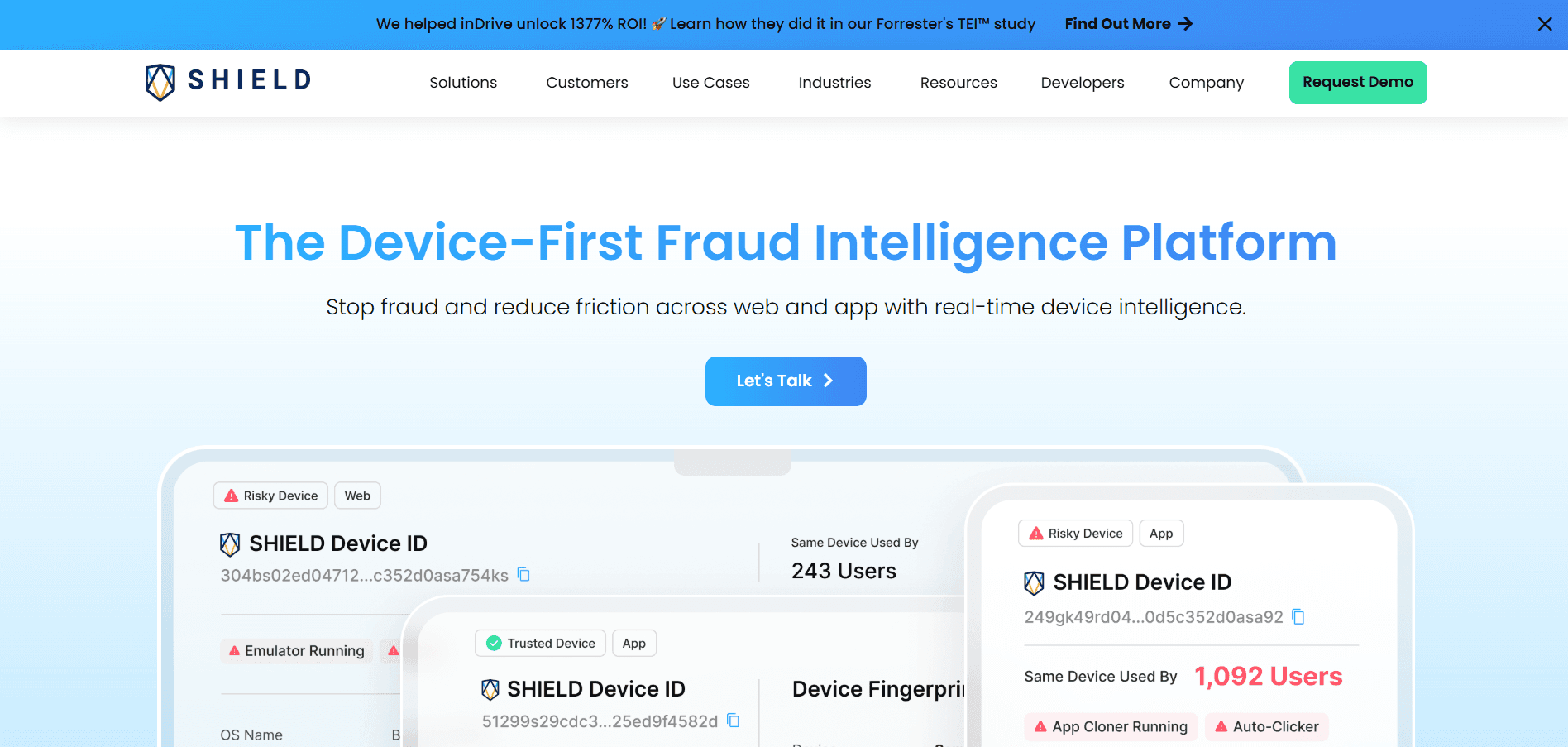
SHIELD is a device-first fraud intelligence platform focused on mobile environments. It provides persistent device identification, continuous session analysis, and device-integrity signals across app and web journeys. SHIELD states that its Device ID identifies devices with more than 99.9% accuracy and remains resilient through factory resets, device manipulation, and other evasion attempts.
Key strengths:
Persistent device identification: Recognizes returning devices across app and web environments, including after factory resets and advanced manipulation.
Signal depth: Continuously evaluates device, application, network, location, and session-level signals.
Emulator and tampering detection: Flags emulators, cloned apps, rooted or jailbroken devices, tampered applications, and GPS spoofing.
Multi-accounting coverage: Connects shared devices and related activity across accounts to detect fake registrations and repeat abuse.
Device clusters and relationships: Groups linked devices and accounts to help teams investigate coordinated fraud networks.
What to consider:
Users also reported that lowering latency sometimes resulted in Device IDs not being generated for a meaningful share of transactions.
Buyers should test identifier generation, latency, and coverage under their expected transaction volumes and app conditions.
Use-case fit: Mobile-first marketplaces, delivery platforms, gaming businesses, wallets, ride-hailing companies, ecommerce platforms, and neobanks facing device manipulation, multi-accounting, and app-integrity risks.
5. JuicyScore
JuicyScore is a device and behavioral risk provider focused on financial services, digital lending, emerging markets, and privacy-conscious device analysis. It returns device-level risk signals and probabilistic identifiers that teams can use inside their own fraud, credit, and underwriting models.
Its approach is designed to recognize users across browsers and private sessions while identifying technical, network, and behavioral anomalies that may indicate fraud.
Key strengths:
Persistent device identification: Uses probabilistic identification to link devices across browsers, private sessions, and changes to common identifiers.
Signal depth: Evaluates device, browser, network, behavioral, IPv6, and environment-level parameters.
Emulator and tampering detection: Flags emulators, virtual machines, anti-detect environments, DOM injection, and manipulated device conditions.
Remote-access and behavioral risk: Detects remote-access tools, abnormal interaction patterns, and signals linked to account compromise or assisted fraud.
Model-ready risk outputs: Supplies attributes, indicators, and risk vectors that can feed internal fraud, credit, and underwriting models.
What to consider:
Some reviewers encountered minor technical issues during onboarding, although the problems were resolved quickly and were ultimately traced to the customer’s setup.
The limited volume of public reviews makes it harder to assess long-term product performance and support across a broader customer base.
Use-case fit: Banks, digital lenders, insurers, fintechs, gaming operators, and marketplaces that want device and behavioral signals for use inside custom fraud, credit, or underwriting models.
6. Sumsub

Sumsub is an identity verification and fraud platform that incorporates device intelligence into KYC, transaction monitoring, and ongoing risk controls. Its device capabilities add session and environment context during onboarding and after verification, while stable identifiers, app-reinstallation recognition, and manipulated-environment detection are powered by Fingerprint.
Key strengths:
Persistent device identification: Generates stable identifiers across sessions and can recognize mobile devices after app reinstallation.
Signal depth: Combines device context with identity verification, transaction monitoring, and ongoing customer-risk signals.
Emulator and tampering detection: Flags emulated, tampered, and manipulated environments linked to spoofing or device-based fraud.
Onboarding and ongoing monitoring: Applies device signals during initial verification and later account or transaction activity.
KYC and device intelligence: Brings identity checks, device risk, and compliance workflows into one platform.
What to consider:
Few users noted limited pricing clarity and usage visibility, particularly as verification volumes increase.
Buyers should confirm which device capabilities are native or partner-powered and assess whether the broader KYC stack matches their primary requirements.
Buyers should also confirm which device capabilities are native and which are supplied through Fingerprint, then assess the depth of graph-based multi-accounting and fraud-ring analysis.
Use-case fit: Regulated fintech, crypto, trading, mobility, marketplace, and gaming companies that want device intelligence within a broader KYC and compliance stack.
7. DataVisor
DataVisor is an enterprise fraud platform that combines device intelligence, real-time decisioning, and machine-learning-led detection of known and previously unseen fraud patterns. It is built for organizations that want device signals connected directly to fraud rules, behavioral analysis, and broader risk models.
Key strengths:
Persistent device identification: Recognizes devices even when common identifiers are altered or manipulated.
Signal depth: Evaluates more than 100 device, behavioral, reputation, and environment-level signals in real time.
Emulator and tampering detection: Flags emulators, app cloners, GPS spoofing, rooting, hooking, and other manipulation methods.
Device reputation: Uses historical activity and associated risk patterns to strengthen fraud decisions.
Machine-learning integration: Connects device signals with supervised and unsupervised models to detect known and emerging threats.
What to consider:
Some users mentioned that the platform can contain subtle configuration or modeling pitfalls that are not immediately obvious.
Buyers should assess analyst usability, automation depth, and the operational effort required to manage a highly customizable platform.
Use-case fit: Banks, payment providers, large fintechs, and enterprise digital businesses that need device intelligence inside a mature fraud and real-time decisioning platform.
8. Unit21

Unit21 is a fraud and AML operations platform that embeds device risk into fraud rules, alerts, graph analysis, case management, and investigations. Its Device Risk Score combines more than 40 curated signals into a transparent 0–100 score that analysts can use across fraud and compliance workflows.
Key strengths:
Device risk scoring: Captures real-time device signals and produces a transparent 0–100 score for fraud decisions.
Signal depth: Evaluates rooted devices, VPNs, risky networks, emulators, tampered browsers, and account takeover indicators.
Multi-accounting coverage: Connects devices, accounts, IP addresses, and wallets through graph analysis.
Fraud and AML workflows: Embeds device intelligence into rules, alerts, enforcement, case management, and investigations.
Explainable decisioning: Shows the signals contributing to device scores and alerts so analysts can understand why risk was flagged.
What to consider:
Some reviewers reported that Unit21’s flexibility depends on accurate data mapping and a strong understanding of internal transaction fields.
Building a new rule set can involve a learning curve, so teams may need to start with priority fraud scenarios and expand iteratively.
Use-case fit: Fintechs, banks, payment platforms, crypto businesses, and AML teams that want device intelligence embedded directly into fraud operations, investigations, and compliance workflows.
9. Feedzai

Feedzai is an enterprise financial-crime platform that combines device intelligence with behavioral biometrics, malware intelligence, account history, and transaction patterns. Its Digital Trust capabilities continuously assess device and session risk across authentication, payments, and ongoing customer activity.
Key strengths:
Continuous session monitoring: Evaluates device, behavioral, malware, and authentication signals throughout the customer journey.
Signal depth: Combines device context with login history, account behavior, payment data, and transaction patterns.
Malware and remote-access detection: Identifies malware indicators, remote-access activity, and session anomalies linked to scams and account compromise.
Scam and social-engineering detection: Uses behavioral and device signals to identify manipulated customers and suspicious payment journeys.
Transaction-level decisioning: Correlates session intelligence with payment activity to support real-time approval, review, or block decisions.
What to consider:
Feedzai’s broad platform scope may require more implementation effort and internal expertise than a standalone device intelligence tool.
Buyers should assess data readiness, integration requirements, and the resources needed to manage models, rules, and workflows over time.
Use-case fit: Large banks, card issuers, payment providers, acquirers, and mature financial institutions that want device intelligence connected to transaction fraud, scam prevention, and enterprise financial-crime decisioning.
How to Shortlist the Right Device Intelligence Platform
The right device intelligence platform depends on what a team needs the device signal to accomplish. A fintech adding persistent identification to an existing risk engine will have different requirements from a marketplace investigating multi-accounting or a bank connecting device risk with transaction and AML workflows. Start by defining the fraud problem, existing stack, and level of decisioning required.
Use the checklist below to compare vendors against those needs.
Evaluation Area | Buyer Question | Platforms to Consider |
Identification and persistence | Can the platform recognize returning devices across sessions, reinstalls, incognito use, resets, and identifier manipulation? | Fingerprint, SHIELD, Bureau |
Signal and platform coverage | Does it capture relevant device, browser, app, network, location, and behavioral signals across web, Android, and iOS? | SEON, Bureau, JuicyScore |
Device manipulation detection | Can it identify emulators, rooted or jailbroken devices, cloned apps, hooking, spoofing, and tampered environments? | SHIELD, SEON, Sumsub |
Multi-accounting and relationships | Can it connect devices with multiple accounts, identities, phone numbers, emails, payment methods, IPs, and transactions? | Bureau, Unit21, DataVisor |
Real-time decisioning and explainability | Can device risk trigger an approval, challenge, review, restriction, or block while showing analysts why the action was taken? | Feedzai, DataVisor, Bureau |
Integration and control | Does it provide the SDKs, APIs, rules, and workflow controls needed to fit the existing fraud stack without excessive engineering effort? | Fingerprint, SEON, Unit21 |
Scale, privacy, and governance | Can it support peak traffic, audit requirements, access controls, data residency, and applicable privacy obligations? | Feedzai, Sumsub, Unit21 |
While evaluating vendors, it is also worth considering how device intelligence fits into the broader risk stack. UK Finance’s 2026 Annual Fraud Report found that remote-purchase fraud cases rose 13% in 2025, with losses reaching £423.5 million. Buyers should test whether device and session risk carries into payment authentication, beneficiary changes, digital-wallet enrollment, and withdrawals.
Buyers should validate each platform through a proof of concept using confirmed fraud cases, genuine-user traffic, and the device-evasion methods most relevant to their business.
Related Read: Top 9 Identity Verification Solution Providers
Move From Device Fingerprints to Connected Risk Decisions
Device intelligence becomes more valuable when it can support decisions across signup, login, transactions, and ongoing account activity.
The next step is understanding whether the current stack can recognize repeat risk across device resets, emulators, masked networks, multiple accounts, and coordinated fraud clusters.
For teams that need this broader context, Bureau connects Device ID, behavioral biometrics, graph relationships, identity, and transaction signals within one decisioning layer to provide businesses with network-level intelligence against account-level defense.
A typical evaluation would include:
Reviewing where device-led fraud enters the customer journey.
Identifying gaps across onboarding, authentication, transactions, and investigations.
Mapping the right signals, rules, and workflows to the use case.
Choosing the right integration path across APIs, SDKs, or no-code workflows.
Defining success metrics such as lower fraud losses, fewer false positives, and faster reviews.
Schedule a demo with Bureau to see how connected device intelligence fits the existing fraud stack.
FAQs
1. What is a device intelligence platform?
A device intelligence platform identifies a device and evaluates the risk associated with its environment and activity. It analyzes device, browser, application, network, behavioral, and historical signals to help fraud teams recognize repeat users, detect manipulated environments, and make better decisions across onboarding, login, payments, and ongoing account activity.
2. What is the difference between device intelligence and device fingerprinting?
Device fingerprinting primarily creates an identifier from device and browser attributes. Device intelligence goes further by assessing environment integrity, behavioral patterns, network context, historical activity, and risk indicators. This allows teams to understand not only whether a device has appeared before, but also whether its current activity suggests fraud or abuse.
3. How does a persistent device ID work?
A persistent device ID works by analyzing a combination of relatively stable and dynamic attributes rather than relying on a cookie, IP address, or one resettable identifier. The platform compares these signals over time to estimate whether sessions belong to the same device, even when some attributes change or are deliberately manipulated.
4. How does Bureau detect multi-accounting?
Bureau detects multi-accounting by linking devices with accounts, identities, phone numbers, network activity, behavioral patterns, payments, and transaction history. Its graph-based analysis helps fraud teams identify related accounts and coordinated clusters, providing stronger evidence than simply flagging several accounts that appear to share one device.
5. Can Bureau detect emulators and manipulated devices?
Bureau uses device and behavioral signals to identify indicators associated with emulators, rooted devices, app cloning, spoofing, automation, and tampered environments. It can evaluate those indicators alongside identity, account, and transaction context, helping teams distinguish isolated technical anomalies from activity that presents a meaningful fraud risk.
6. What should fintechs look for in a device intelligence solution?
Fintechs should evaluate persistent identification, emulator and rooting detection, behavioral signals, account takeover coverage, multi-accounting links, and real-time scoring. The platform should also provide explainable outputs, maintain low false-positive rates, and integrate cleanly with KYC, transaction monitoring, fraud rules, case management, and existing decision workflows.
Device intelligence platforms are widely evaluated by banks, fintechs, marketplaces, and other digital businesses that need to recognize repeat devices and assess session risk.
But as fraud expands across accounts, devices, networks, and app environments, buyers increasingly need more than a basic device fingerprint. They need persistent identification, device and network signals, emulator detection, behavioral analysis, multi-accounting coverage, and real-time risk decisions.
To make this comparison useful, this list evaluates nine platforms by the fraud problems they solve, the signals they use, and the workflows they fit best. Before comparing vendors, here’s a look at how device intelligence differs from device fingerprinting.
Device Intelligence vs Device Fingerprinting
Device fingerprinting helps recognize a browser or device. Device intelligence goes further by assessing whether that device, its environment, and the current session can be trusted.
The comparison below shows how the two approaches differ in scope, signals, fraud coverage, and decision support.
Factor | Device Fingerprinting | Device Intelligence |
Primary purpose | Recognize a browser or device | Assess device and session trust |
Typical output | Device hash or identifier | Identifier, risk signals, score, or decision |
Signals | Browser, hardware, and software attributes | Device, network, integrity, location, behavioral, and historical signals |
Fraud coverage | Repeat-device recognition | Multi-accounting, emulators, spoofing, bots, ATO, app cloning, and linked fraud |
Decision support | Usually requires additional logic | May include scoring, rules, workflows, and real-time enforcement |
The practical difference is how each approach performs when fraudsters try to appear as new users. Platforms with persistent device identification can help recognize repeat devices even when users clear cookies, switch browsers, change networks, or attempt other common evasion techniques.
Related Read: How Device Intelligence Detects Fraud Across the User Lifecycle
Best Device Intelligence Platforms at a Glance
Device intelligence platforms help businesses recognize returning devices, detect device manipulation, assess session risk, and support fraud decisions using device, network, behavioral, and environmental signals.
The comparison below highlights where each device intelligence platform fits and what buyers should examine before adding it to their shortlist.
Platform | Core Approach | Persistent Device Identification | Emulator and Tampering Detection | Multi-Accounting Coverage | Best For |
Bureau | Device, behavior, graph, and decisioning | Strong focus | Yes | Device-account graph analysis | Connected device and fraud-ring detection |
Fingerprint | Persistent visitor ID and Smart Signals | Core strength | Yes | Requires customer rules | Developer-led web and mobile identification |
SEON | Device, contact, IP, and risk scoring | Yes | Yes | Hashes, velocity, and behavior | Device intelligence with digital-footprint enrichment |
SHIELD | Persistent Device ID and continuous risk signals | Core strength | Yes | Mobile account-linking focus | Mobile-first fraud and multi-accounting |
JuicyScore | Probabilistic Device ID and risk signals | Core strength | Yes | Device and behavioral patterns | Financial services and emerging-market risk |
Sumsub | Identity verification plus device intelligence | Yes | Yes | Signals within verification workflows | KYC-led businesses needing post-verification signals |
DataVisor | Device intelligence and unsupervised ML | Yes | Yes | Device and anomaly clustering | Enterprise teams using ML-led detection |
Unit21 | Device Risk Score within rules and cases | Yes | Yes | Device links and graph context | Fraud and AML teams needing integrated workflows |
Feedzai | Device, behavior, malware, and transaction intelligence | Broader trust analysis | Yes | Network and behavioral context | Large banks and payment institutions |
The right choice depends on the fraud problems that need to be solved, the signals it relies on, and how device intelligence fits into a broader risk stack.
Capabilities to Look for When Evaluating Device Intelligence Platforms
To compare these platforms consistently, here are the capabilities that matter most to fraud, risk, and product teams:
Persistent device identification: Recognizes repeat devices despite cookie deletion, browser changes, app reinstalls, resets, or manipulated parameters.
Device, network, and behavioral signals: Evaluates device integrity, network risk, location, configuration, user behavior, and historical activity.
Emulator and tampering detection: Flags emulators, rooted devices, cloned apps, spoofing, remote-access tools, and automated environments.
Multi-accounting and relationship intelligence: Connects devices, accounts, IPs, contact details, payments, and behavior to expose linked abuse.
Explainable scoring and real-time decisioning: Returns clear risk indicators and supports actions such as step-up checks, review, restriction, or blocking.
Integration and data controls: Supports web and mobile environments, APIs, SDKs, operational control, data residency, retention, and regional requirements.
Buyers should also assess whether behavioral biometrics adds useful context to device risk. Europol’s 2025 SIMCARTEL operation seized 1,200 SIM-box devices and 40,000 active SIM cards linked to more than 49 million online accounts.
The scale shows why platforms must detect clusters across devices, phone numbers, IP addresses, signup velocity, and shared infrastructure rather than assess each registration in isolation.
The platforms below were evaluated against these criteria for device fraud detection, fraud-team efficiency, and real-time decisioning at scale.
9 Best Device Intelligence Platforms for Fraud Prevention
The platforms below include both pure-play device intelligence tools and broader fraud platforms with native device capabilities. A focused product may suit teams that already have a risk engine, while a unified platform may be a better fit when device signals need to work alongside identity, behavior, transactions, graph analysis, rules, and investigations.
1. Bureau
Bureau is an AI-powered unified risk decisioning platform that helps fintech teams transition from account-level defense to network-level intelligence by verifying users, detecting fraud, and managing risk across onboarding, authentication, transactions, and ongoing account activity. It combines device intelligence, behavioral biometrics, identity verification, graph analysis, and KYC, KYB, and AML workflows within one decisioning layer.
Key strengths:
Persistent device identification: Bureau’s Device ID recognizes repeat and risky devices across resets, reinstalls, incognito sessions, and other evasion attempts, helping teams stop returning fraudsters without repeatedly challenging genuine users.
Device intelligence and behavioral biometrics: Combines device signals with behavioral biometrics to distinguish genuine users from bots, fraud farms, and compromised sessions before suspicious activity turns into losses.
Multi-accounting and promo abuse prevention: Links shared devices and infrastructure across accounts to detect repeat registrations, referral fraud, and coordinated abuse.
Emulator and tampering detection: Identifies cloned apps, emulators, rooted or jailbroken devices, virtualized environments, location spoofing, and manipulated sessions before they can bypass fraud controls.
Graph Identity Network: The Graph Identity Network connects identities, devices, behaviors, and transactions to reveal fraud rings, mule networks, and synthetic identities.
Explainable real-time decisions: Delivers transparent risk assessments that help teams approve, challenge, review, or block activity during live customer journeys.
Configurable compliance workflows: Lets teams adapt KYC, KYB, and AML rules, thresholds, review logic, and approval flows without relying on engineering for every policy change.
These capabilities are most useful when fraud spans several attack methods at once. A synthetic identity may also involve a cloned app, a reused device, manipulated network data, and links to other accounts that appear legitimate in isolation. The Jupiter Edge case study shows how Bureau handled that combination in practice.
How Bureau Helped Jupiter Edge Stop Synthetic Identity Fraud
Jupiter Edge, a BNPL micro-loan app, offers instant credit with minimal onboarding friction. Fraudsters exploited the process using stolen identities, cloned applications, spoofed devices, and manipulated network signals to bypass checks, access credit, and disappear before the existing risk setup could detect the attack.
What Bureau implemented:
Detected cloned apps and suspicious device reuse
Flagged malicious applications and spoofed environments
Identified anomalous IP and geolocation signals
Cross-checked names, phone numbers, and email addresses
Connected identity, device, network, and behavioral risk
Scored suspicious applications in real time
Results achieved:
More than 500 fraudsters blocked in one day
A coordinated fraud ring identified within hours
Credit lines closed before funds could be moved
No added friction for genuine applicants
Read the full case study here → Stopping Synthetic ID Fraud to Protect BNPL Customers.
What to consider:
Bureau is better suited to teams that need connected fraud decisioning than buyers seeking only a lightweight device-identification API.
Buyers should define which existing tools and workflows the platform will replace, complement, or orchestrate.
Use-case fit: Neobanks, digital lenders, BNPL providers, payment processors, wallets, marketplaces, and cross-border fintechs that need persistent device identification, device-tampering detection, multi-accounting coverage, and connected fraud analysis.
Teams evaluating whether Bureau fits their current risk stack can book a quick 30-minute demo to review relevant use cases, integration options, and decisioning workflows.
2. Fingerprint
Fingerprint is a developer-focused device intelligence platform built around a persistent visitor ID for web and mobile applications. It uses more than 100 device, browser, network, and behavioral signals to recognize returning users and provides modular Smart Signals that can integrate with an organization's existing fraud stack.
Key strengths:
Persistent visitor identification: Creates a stable visitor ID to recognize returning users across browsers, devices, and common privacy-related changes.
Signal depth: Uses device, browser, network, and behavioral signals to provide additional risk context.
Emulator and tampering detection: Detects emulators, virtual machines, browser tampering, VPNs, proxies, bots, and geolocation spoofing.
Developer-first architecture: Offers SDKs, APIs, server-side validation, and integrations for existing fraud workflows.
Flexible deployment: Fits teams that already have risk scoring, orchestration, and case management in place.
What to consider:
Some reviewers report that specific bot or browser classifications can be inaccurate, so teams should validate named risk indicators against their own traffic and test environments.
Fingerprint is strongest as a device intelligence layer; broader fraud logic, graph analysis, investigations, and case management may still require additional tools.
Use-case fit: Developer-led fintech, SaaS, ecommerce, marketplace, and gaming teams with an existing fraud engine. It is well suited for teams that need persistent device identification and rich device signals without replacing their current decisioning platform.
3. SEON
SEON is a broader fraud and compliance platform that combines device intelligence with behavioral biometrics, email, phone, IP, digital-footprint, scoring, and workflow capabilities. It supports fraud checks across registration, login, checkout, and transaction journeys for web and mobile environments.
Key strengths:
Persistent device identification: Uses device fingerprints, browser hashes, and True Device ID to recognize returning devices across web and mobile.
Signal depth: Adds email, phone, IP, location, behavioral, and digital-footprint data to device risk analysis.
Emulator and tampering detection: Flags rooted or jailbroken devices, emulators, virtual machines, cloned apps, manipulated environments, and simulated locations.
Multi-accounting coverage: Supports rules based on shared devices, repeated identifiers, and linked activity across accounts and transactions.
Configurable scoring and workflows: Provides explainable outputs, custom rules, sanctions screening, and configurable decision routes.
What to consider:
Some users highlighted that rule back-testing does not support velocity logic, which can make it harder to validate more complex fraud scenarios.
The same review pointed to limited customization for field layouts, tooltips, and list views, which may affect day-to-day analysis.
Use-case fit: Fintech, payments, iGaming, ecommerce, and digital businesses that want device intelligence alongside enrichment, fraud scoring, configurable rules, and compliance capabilities.
4. SHIELD
SHIELD is a device-first fraud intelligence platform focused on mobile environments. It provides persistent device identification, continuous session analysis, and device-integrity signals across app and web journeys. SHIELD states that its Device ID identifies devices with more than 99.9% accuracy and remains resilient through factory resets, device manipulation, and other evasion attempts.
Key strengths:
Persistent device identification: Recognizes returning devices across app and web environments, including after factory resets and advanced manipulation.
Signal depth: Continuously evaluates device, application, network, location, and session-level signals.
Emulator and tampering detection: Flags emulators, cloned apps, rooted or jailbroken devices, tampered applications, and GPS spoofing.
Multi-accounting coverage: Connects shared devices and related activity across accounts to detect fake registrations and repeat abuse.
Device clusters and relationships: Groups linked devices and accounts to help teams investigate coordinated fraud networks.
What to consider:
Users also reported that lowering latency sometimes resulted in Device IDs not being generated for a meaningful share of transactions.
Buyers should test identifier generation, latency, and coverage under their expected transaction volumes and app conditions.
Use-case fit: Mobile-first marketplaces, delivery platforms, gaming businesses, wallets, ride-hailing companies, ecommerce platforms, and neobanks facing device manipulation, multi-accounting, and app-integrity risks.
5. JuicyScore
JuicyScore is a device and behavioral risk provider focused on financial services, digital lending, emerging markets, and privacy-conscious device analysis. It returns device-level risk signals and probabilistic identifiers that teams can use inside their own fraud, credit, and underwriting models.
Its approach is designed to recognize users across browsers and private sessions while identifying technical, network, and behavioral anomalies that may indicate fraud.
Key strengths:
Persistent device identification: Uses probabilistic identification to link devices across browsers, private sessions, and changes to common identifiers.
Signal depth: Evaluates device, browser, network, behavioral, IPv6, and environment-level parameters.
Emulator and tampering detection: Flags emulators, virtual machines, anti-detect environments, DOM injection, and manipulated device conditions.
Remote-access and behavioral risk: Detects remote-access tools, abnormal interaction patterns, and signals linked to account compromise or assisted fraud.
Model-ready risk outputs: Supplies attributes, indicators, and risk vectors that can feed internal fraud, credit, and underwriting models.
What to consider:
Some reviewers encountered minor technical issues during onboarding, although the problems were resolved quickly and were ultimately traced to the customer’s setup.
The limited volume of public reviews makes it harder to assess long-term product performance and support across a broader customer base.
Use-case fit: Banks, digital lenders, insurers, fintechs, gaming operators, and marketplaces that want device and behavioral signals for use inside custom fraud, credit, or underwriting models.
6. Sumsub
Sumsub is an identity verification and fraud platform that incorporates device intelligence into KYC, transaction monitoring, and ongoing risk controls. Its device capabilities add session and environment context during onboarding and after verification, while stable identifiers, app-reinstallation recognition, and manipulated-environment detection are powered by Fingerprint.
Key strengths:
Persistent device identification: Generates stable identifiers across sessions and can recognize mobile devices after app reinstallation.
Signal depth: Combines device context with identity verification, transaction monitoring, and ongoing customer-risk signals.
Emulator and tampering detection: Flags emulated, tampered, and manipulated environments linked to spoofing or device-based fraud.
Onboarding and ongoing monitoring: Applies device signals during initial verification and later account or transaction activity.
KYC and device intelligence: Brings identity checks, device risk, and compliance workflows into one platform.
What to consider:
Few users noted limited pricing clarity and usage visibility, particularly as verification volumes increase.
Buyers should confirm which device capabilities are native or partner-powered and assess whether the broader KYC stack matches their primary requirements.
Buyers should also confirm which device capabilities are native and which are supplied through Fingerprint, then assess the depth of graph-based multi-accounting and fraud-ring analysis.
Use-case fit: Regulated fintech, crypto, trading, mobility, marketplace, and gaming companies that want device intelligence within a broader KYC and compliance stack.
7. DataVisor
DataVisor is an enterprise fraud platform that combines device intelligence, real-time decisioning, and machine-learning-led detection of known and previously unseen fraud patterns. It is built for organizations that want device signals connected directly to fraud rules, behavioral analysis, and broader risk models.
Key strengths:
Persistent device identification: Recognizes devices even when common identifiers are altered or manipulated.
Signal depth: Evaluates more than 100 device, behavioral, reputation, and environment-level signals in real time.
Emulator and tampering detection: Flags emulators, app cloners, GPS spoofing, rooting, hooking, and other manipulation methods.
Device reputation: Uses historical activity and associated risk patterns to strengthen fraud decisions.
Machine-learning integration: Connects device signals with supervised and unsupervised models to detect known and emerging threats.
What to consider:
Some users mentioned that the platform can contain subtle configuration or modeling pitfalls that are not immediately obvious.
Buyers should assess analyst usability, automation depth, and the operational effort required to manage a highly customizable platform.
Use-case fit: Banks, payment providers, large fintechs, and enterprise digital businesses that need device intelligence inside a mature fraud and real-time decisioning platform.
8. Unit21
Unit21 is a fraud and AML operations platform that embeds device risk into fraud rules, alerts, graph analysis, case management, and investigations. Its Device Risk Score combines more than 40 curated signals into a transparent 0–100 score that analysts can use across fraud and compliance workflows.
Key strengths:
Device risk scoring: Captures real-time device signals and produces a transparent 0–100 score for fraud decisions.
Signal depth: Evaluates rooted devices, VPNs, risky networks, emulators, tampered browsers, and account takeover indicators.
Multi-accounting coverage: Connects devices, accounts, IP addresses, and wallets through graph analysis.
Fraud and AML workflows: Embeds device intelligence into rules, alerts, enforcement, case management, and investigations.
Explainable decisioning: Shows the signals contributing to device scores and alerts so analysts can understand why risk was flagged.
What to consider:
Some reviewers reported that Unit21’s flexibility depends on accurate data mapping and a strong understanding of internal transaction fields.
Building a new rule set can involve a learning curve, so teams may need to start with priority fraud scenarios and expand iteratively.
Use-case fit: Fintechs, banks, payment platforms, crypto businesses, and AML teams that want device intelligence embedded directly into fraud operations, investigations, and compliance workflows.
9. Feedzai
Feedzai is an enterprise financial-crime platform that combines device intelligence with behavioral biometrics, malware intelligence, account history, and transaction patterns. Its Digital Trust capabilities continuously assess device and session risk across authentication, payments, and ongoing customer activity.
Key strengths:
Continuous session monitoring: Evaluates device, behavioral, malware, and authentication signals throughout the customer journey.
Signal depth: Combines device context with login history, account behavior, payment data, and transaction patterns.
Malware and remote-access detection: Identifies malware indicators, remote-access activity, and session anomalies linked to scams and account compromise.
Scam and social-engineering detection: Uses behavioral and device signals to identify manipulated customers and suspicious payment journeys.
Transaction-level decisioning: Correlates session intelligence with payment activity to support real-time approval, review, or block decisions.
What to consider:
Feedzai’s broad platform scope may require more implementation effort and internal expertise than a standalone device intelligence tool.
Buyers should assess data readiness, integration requirements, and the resources needed to manage models, rules, and workflows over time.
Use-case fit: Large banks, card issuers, payment providers, acquirers, and mature financial institutions that want device intelligence connected to transaction fraud, scam prevention, and enterprise financial-crime decisioning.
How to Shortlist the Right Device Intelligence Platform
The right device intelligence platform depends on what a team needs the device signal to accomplish. A fintech adding persistent identification to an existing risk engine will have different requirements from a marketplace investigating multi-accounting or a bank connecting device risk with transaction and AML workflows. Start by defining the fraud problem, existing stack, and level of decisioning required.
Use the checklist below to compare vendors against those needs.
Evaluation Area | Buyer Question | Platforms to Consider |
Identification and persistence | Can the platform recognize returning devices across sessions, reinstalls, incognito use, resets, and identifier manipulation? | Fingerprint, SHIELD, Bureau |
Signal and platform coverage | Does it capture relevant device, browser, app, network, location, and behavioral signals across web, Android, and iOS? | SEON, Bureau, JuicyScore |
Device manipulation detection | Can it identify emulators, rooted or jailbroken devices, cloned apps, hooking, spoofing, and tampered environments? | SHIELD, SEON, Sumsub |
Multi-accounting and relationships | Can it connect devices with multiple accounts, identities, phone numbers, emails, payment methods, IPs, and transactions? | Bureau, Unit21, DataVisor |
Real-time decisioning and explainability | Can device risk trigger an approval, challenge, review, restriction, or block while showing analysts why the action was taken? | Feedzai, DataVisor, Bureau |
Integration and control | Does it provide the SDKs, APIs, rules, and workflow controls needed to fit the existing fraud stack without excessive engineering effort? | Fingerprint, SEON, Unit21 |
Scale, privacy, and governance | Can it support peak traffic, audit requirements, access controls, data residency, and applicable privacy obligations? | Feedzai, Sumsub, Unit21 |
While evaluating vendors, it is also worth considering how device intelligence fits into the broader risk stack. UK Finance’s 2026 Annual Fraud Report found that remote-purchase fraud cases rose 13% in 2025, with losses reaching £423.5 million. Buyers should test whether device and session risk carries into payment authentication, beneficiary changes, digital-wallet enrollment, and withdrawals.
Buyers should validate each platform through a proof of concept using confirmed fraud cases, genuine-user traffic, and the device-evasion methods most relevant to their business.
Related Read: Top 9 Identity Verification Solution Providers
Move From Device Fingerprints to Connected Risk Decisions
Device intelligence becomes more valuable when it can support decisions across signup, login, transactions, and ongoing account activity.
The next step is understanding whether the current stack can recognize repeat risk across device resets, emulators, masked networks, multiple accounts, and coordinated fraud clusters.
For teams that need this broader context, Bureau connects Device ID, behavioral biometrics, graph relationships, identity, and transaction signals within one decisioning layer to provide businesses with network-level intelligence against account-level defense.
A typical evaluation would include:
Reviewing where device-led fraud enters the customer journey.
Identifying gaps across onboarding, authentication, transactions, and investigations.
Mapping the right signals, rules, and workflows to the use case.
Choosing the right integration path across APIs, SDKs, or no-code workflows.
Defining success metrics such as lower fraud losses, fewer false positives, and faster reviews.
Schedule a demo with Bureau to see how connected device intelligence fits the existing fraud stack.
FAQs
1. What is a device intelligence platform?
A device intelligence platform identifies a device and evaluates the risk associated with its environment and activity. It analyzes device, browser, application, network, behavioral, and historical signals to help fraud teams recognize repeat users, detect manipulated environments, and make better decisions across onboarding, login, payments, and ongoing account activity.
2. What is the difference between device intelligence and device fingerprinting?
Device fingerprinting primarily creates an identifier from device and browser attributes. Device intelligence goes further by assessing environment integrity, behavioral patterns, network context, historical activity, and risk indicators. This allows teams to understand not only whether a device has appeared before, but also whether its current activity suggests fraud or abuse.
3. How does a persistent device ID work?
A persistent device ID works by analyzing a combination of relatively stable and dynamic attributes rather than relying on a cookie, IP address, or one resettable identifier. The platform compares these signals over time to estimate whether sessions belong to the same device, even when some attributes change or are deliberately manipulated.
4. How does Bureau detect multi-accounting?
Bureau detects multi-accounting by linking devices with accounts, identities, phone numbers, network activity, behavioral patterns, payments, and transaction history. Its graph-based analysis helps fraud teams identify related accounts and coordinated clusters, providing stronger evidence than simply flagging several accounts that appear to share one device.
5. Can Bureau detect emulators and manipulated devices?
Bureau uses device and behavioral signals to identify indicators associated with emulators, rooted devices, app cloning, spoofing, automation, and tampered environments. It can evaluate those indicators alongside identity, account, and transaction context, helping teams distinguish isolated technical anomalies from activity that presents a meaningful fraud risk.
6. What should fintechs look for in a device intelligence solution?
Fintechs should evaluate persistent identification, emulator and rooting detection, behavioral signals, account takeover coverage, multi-accounting links, and real-time scoring. The platform should also provide explainable outputs, maintain low false-positive rates, and integrate cleanly with KYC, transaction monitoring, fraud rules, case management, and existing decision workflows.
TABLE OF CONTENTS
See More
Recommended Blogs


Landing Page.
Simple, bold.
Sign Up
Download

Products
Solutions


© 2026 Bureau . All rights reserved.
Solutions
Industries
Resources
Company
Solutions
Industries
Resources
Company
© 2026 Bureau . All rights reserved.
Follow Us
Leave behind fragmented tools. Stop fraud rings, cut false declines, and deliver secure digital journeys at scale
Our Presence








Leave behind fragmented tools. Stop fraud rings, cut false declines, and deliver secure digital journeys at scale
Our Presence
© 2026 Bureau . All rights reserved.