How to Choose the Right Fraud Prevention Software for E-Commerce Teams
How to Choose the Right Fraud Prevention Software for E-Commerce Teams
How to Choose the Right Fraud Prevention Software for E-Commerce Teams
Compare the top fraud prevention software for e-commerce, key features, pricing factors, and how to choose the right tool for your store.
Author
Team Bureau

See how Bureau has helped industry leaders defend against networked Industrial-scale frauds →
Schedule a Demo
TABLE OF CONTENTS
See Less
For many online stores, fraud affects every stage of the customer journey and quietly eats into revenue through chargebacks, account takeover, promo abuse, return fraud, and false declines.
In fact, the MRC’s 2026 Global eCommerce Payments and Fraud Report found that merchants lost 3.2% of annual e-commerce revenue to payment fraud globally, while 57% reported rising refund or policy abuse.
As fraud tactics become more sophisticated, fraud prevention software for e-commerce has become essential for protecting margins without adding friction for genuine customers.
In this guide, we compare the best e-commerce fraud prevention tools for 2026, including Bureau ID, Signifyd, Kount, Forter, SEON, Sift, ClearSale, Riskified, Wyllo, and Fingerprint. We’ll cover their key features, strengths, ideal use cases, and how to choose the right fraud prevention software for your online store.
Features to Look for in E-commerce Fraud Prevention Software
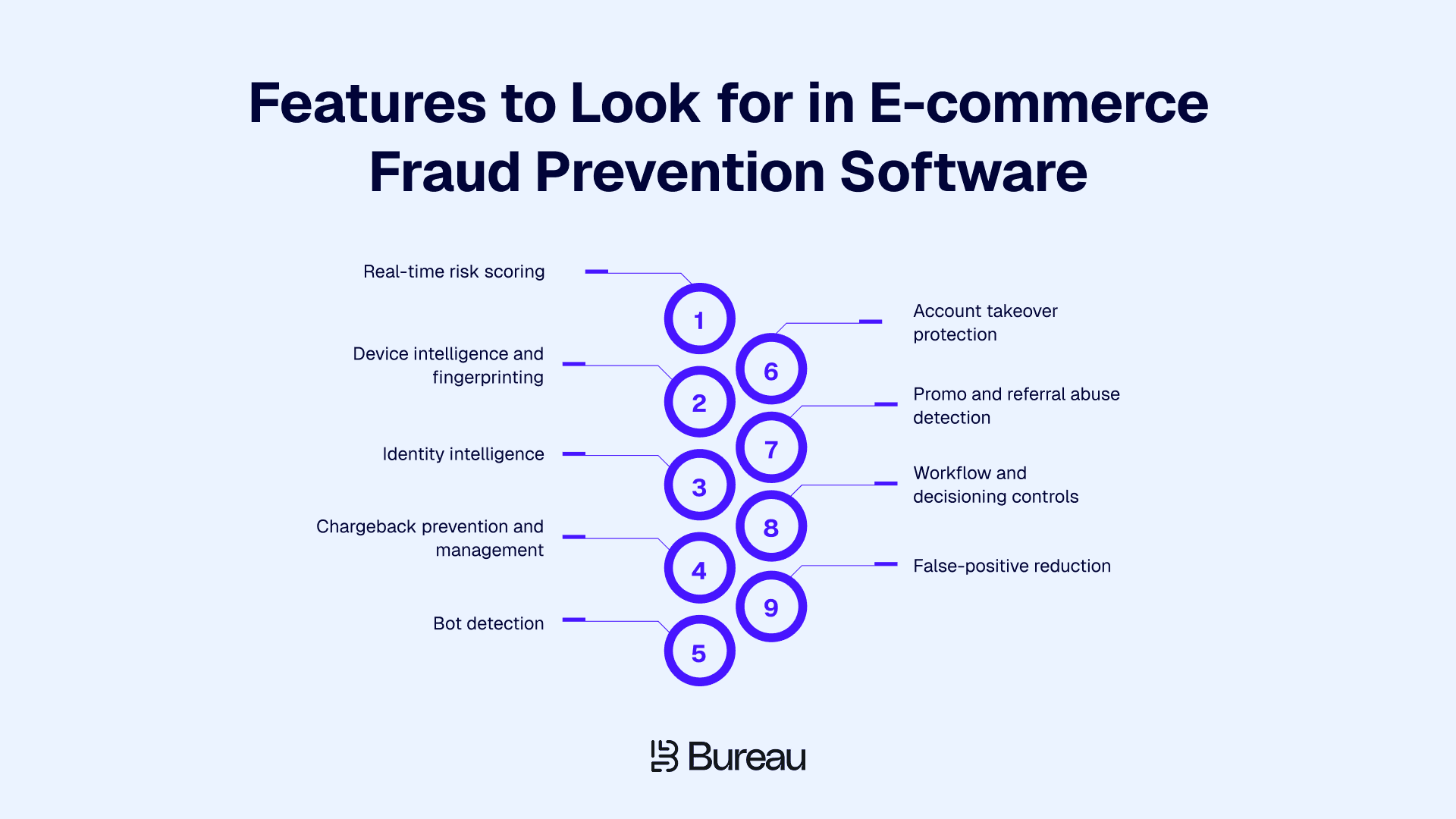
Before comparing individual tools, it helps to understand what separates a basic fraud solution from one that can actually protect your business as it scales. When evaluating fraud prevention software for e-commerce, look for solutions that can assess risk across the entire customer journey, including:
Account signup and onboarding
Login and account activity
Checkout and payment authorization
Order fulfillment and delivery
Refunds, returns, and repeat purchases
Here are the key features that matter most:
Real-time risk scoring: Evaluates transactions and user activity instantly so fraud can be stopped before an order is processed.
Device intelligence and fingerprinting: Helps identify repeat offenders, device spoofing, and users creating multiple accounts.
Identity intelligence: Verifies whether a customer’s identity signals are consistent and trustworthy.
Chargeback prevention and management: Reduces fraud-related disputes and helps recover lost revenue.
Bot detection: Blocks automated attacks such as card testing, fake account creation, and credential stuffing.
Account takeover protection: Detects suspicious login behavior and compromised accounts.
Promo and referral abuse detection: Prevents fraudsters from exploiting discounts, loyalty programs, and incentives.
Workflow and decisioning controls: Allows fraud teams to automate approvals, reviews, declines, and step-up verification checks.
False-positive reduction: Ensures legitimate customers are not incorrectly blocked, protecting both revenue and customer experience.
Features like chargeback protection become even more important as card-not-present fraud rises. UK Finance’s 2025 Half Year Fraud Report found that remote purchase fraud losses reached £215.4 million in the first half of 2025, up 8%, while cases rose 22% to 1.66 million.
In fact, the same report claimed that e-commerce card fraud alone reached an estimated £159 million, which shows why online stores need real-time order screening before fulfillment.
One important point: not every business needs the same type of fraud protection.
For instance, if chargebacks are your biggest challenge, prioritize tools with strong chargeback prevention capabilities. If fake accounts, repeat offenders, or promo abuse are driving losses, focus on platforms with robust device intelligence, behavioral analysis, and identity-based risk signals.
With these evaluation criteria in mind, let's look at the leading e-commerce fraud prevention tools and see how they compare.
The 10 Best Fraud Prevention Software for E-commerce
Fraud prevention software for e-commerce helps online stores detect, block, and reduce fraudulent activity across checkout, payments, accounts, refunds, and chargebacks. It uses risk scoring, transaction monitoring, device signals, rules, and AI-based detection to identify suspicious orders before they create losses.
Understanding how each tool differs is important when evaluating the right fit for your store.
1. Bureau ID

Bureau ID is an AI-powered unified risk decisioning platform that helps e-commerce businesses detect and prevent fraud across the entire customer journey. By combining device intelligence, identity signals, behavioral analytics, network intelligence, and transaction monitoring into a single decisioning layer, it enables real-time risk assessment without relying on multiple disconnected tools.
This makes it particularly effective for brands looking to reduce fraud while maintaining a seamless customer experience.
Key e-commerce fraud coverage:
Fake account creation and multi-accounting detection
Promo abuse, referral fraud, and loyalty program abuse prevention
Account takeover (ATO) and suspicious login activity monitoring
Bot abuse, device spoofing, and automated attack detection
Chargeback risk assessment, RTO prediction, and suspicious checkout behavior analysis
Key strengths:
Unified risk decisioning: Combines user, device, identity, behavioral, network, and transaction signals into a single risk decision, reducing the need for multiple point solutions.
Persistent device intelligence: Helps identify repeat offenders even when they attempt to return using new accounts, devices, or payment methods.
Flexible workflow automation: Enables fraud teams to build and adjust risk policies quickly through no-code workflows, reducing operational overhead.
Explainable real-time decisions: Provides transparent risk insights and step-up authentication triggers that help prevent fraud without unnecessarily increasing customer friction.
Where it fits best: Bureau ID is best suited for high-volume e-commerce brands, marketplaces, DTC businesses, and promo-heavy growth teams that need visibility into fraud risks beyond checkout. It is particularly valuable for organizations dealing with fake signups, repeat offenders, account abuse, and operational losses such as RTOs.
That said, buyers should still evaluate a few considerations before making a decision:
Businesses looking primarily for chargeback guarantees or liability-shift programs may find more specialized offerings from chargeback-focused providers.
Teams seeking a fully managed fraud review service should assess whether they have the internal resources to configure and optimize risk workflows effectively.
2. Signifyd
Signifyd is a leading e-commerce fraud protection platform best known for its Guaranteed Fraud Protection offering. The platform combines AI-driven risk assessment, automated order approval, chargeback protection, chargeback recovery, and return abuse insights to help merchants reduce fraud losses while increasing approval rates and minimizing manual review workloads.
Key e-commerce fraud coverage:
Payment fraud and card-not-present (CNP) fraud
Chargeback prevention and reimbursement
Friendly fraud detection
Return and refund abuse monitoring
Order risk assessment and approval optimization
Key strengths:
Chargeback guarantee: Helps merchants shift fraud liability on approved orders, reducing direct fraud losses.
Automated decisioning: Approves or declines orders in real time, reducing manual review effort and operational overhead.
Higher approval rates: Uses machine learning to identify legitimate customers that traditional rules may incorrectly decline.
Commerce-focused insights: Provides visibility into returns, disputes, and customer behavior patterns that impact profitability.
Where it fits best: Signifyd is best suited for mid-market and enterprise retailers that process significant transaction volumes and want strong chargeback protection with minimal operational involvement. It is particularly valuable for merchants looking to outsource much of their transaction fraud decisioning.
That said, buyers should evaluate a few considerations before committing:
Some reviewers note that pricing can become expensive as transaction volumes scale, particularly for smaller merchants.
Businesses dealing heavily with fake accounts, promo abuse, or pre-checkout fraud may require additional tools.
3. Kount
Kount is an established fraud prevention platform that combines machine learning, identity trust signals, customizable policies, and real-time transaction monitoring. It is commonly used by retailers seeking broad fraud coverage across payments, account activity, loyalty programs, and omnichannel commerce environments.
Key e-commerce fraud coverage:
Credit card and payment fraud
Account takeover prevention
Promo and loyalty abuse detection
Friendly fraud and chargeback fraud
Affiliate and policy abuse monitoring
Key strengths:
Customizable risk controls: Gives fraud teams flexibility to tailor policies and workflows to their specific risk appetite.
Identity trust network: Leverages shared intelligence to identify suspicious users and repeat offenders more effectively.
Omnichannel coverage: Supports fraud prevention across online, mobile, and offline commerce channels.
Detailed risk visibility: Provides granular transaction insights that help teams investigate and optimize fraud decisions.
Where it fits best: Kount works well for retailers with multiple sales channels and fraud teams that want significant control over risk policies and decision logic. It is often a strong fit for organizations with dedicated fraud operations resources.
However, buyers should consider the following:
Smaller teams may find ongoing policy management and optimization resource-intensive compared with more managed solutions.
Some users report a learning curve when configuring rules and workflows, particularly during onboarding.
4. Forter
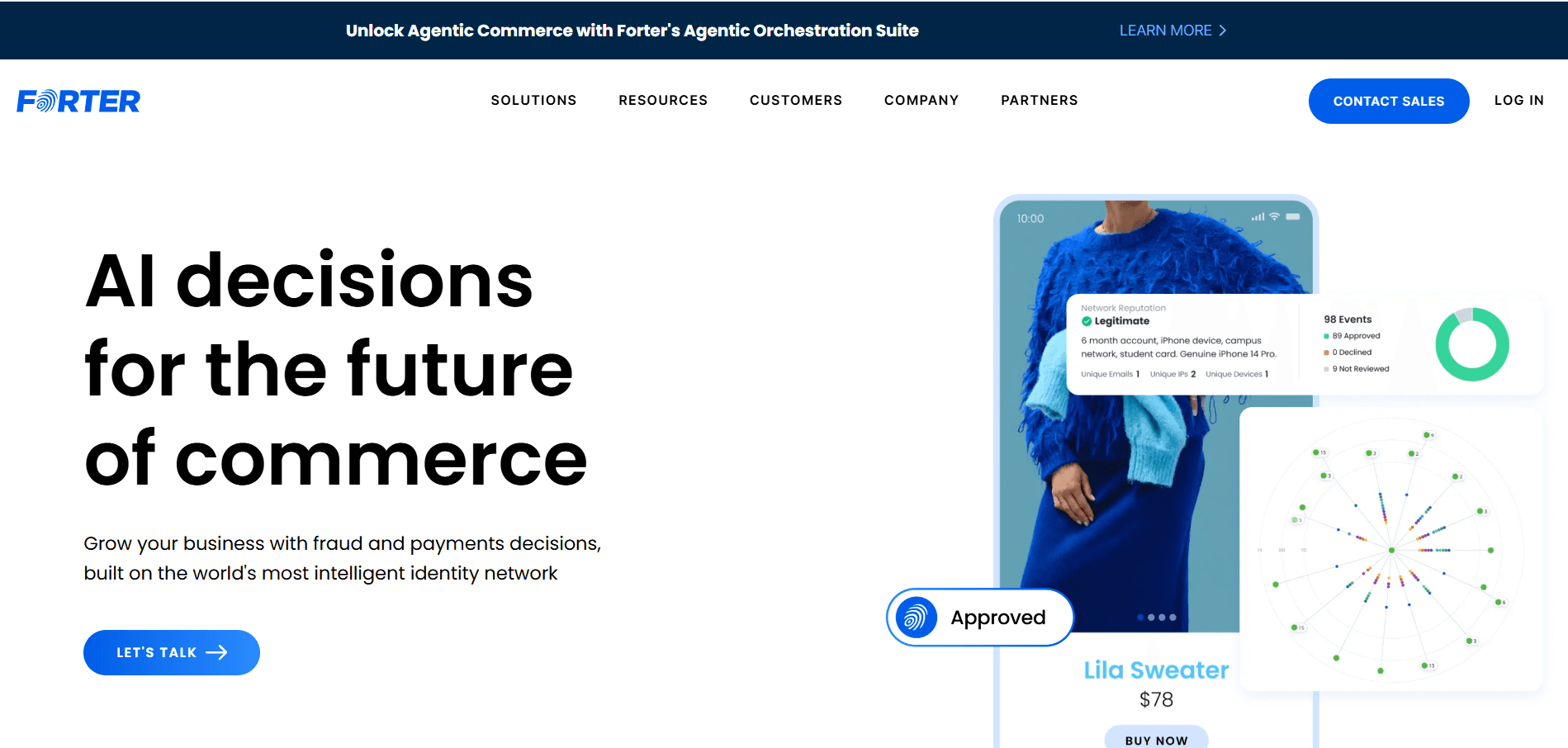
Forter is an enterprise-focused fraud prevention platform that uses identity intelligence and machine learning to make real-time commerce decisions. The platform evaluates customer behavior across transactions and account activity to help merchants reduce fraud, improve approval rates, and minimize customer friction.
Key e-commerce fraud coverage:
Payment fraud prevention
Account takeover detection
Chargeback reduction
Policy and abuse prevention
Checkout risk assessment
Key strengths:
Real-time approvals: Delivers instant fraud decisions that help maintain fast checkout experiences.
Identity-based decisioning: Evaluates users holistically rather than relying solely on transaction-level signals.
False decline reduction: Helps merchants approve more legitimate customers without increasing fraud exposure.
Enterprise scalability: Supports large transaction volumes across global commerce operations.
Where it fits best: Forter is best suited for enterprise retailers and global e-commerce brands focused on maximizing approvals while maintaining strong fraud controls. It is particularly attractive for organizations prioritizing automation.
Before selecting Forter, buyers should review:
Some reviewers mention limited transparency into decision logic compared with highly configurable rule-based systems.
Teams seeking extensive manual rule customization may find the platform less flexible than some alternatives.
5. SEON
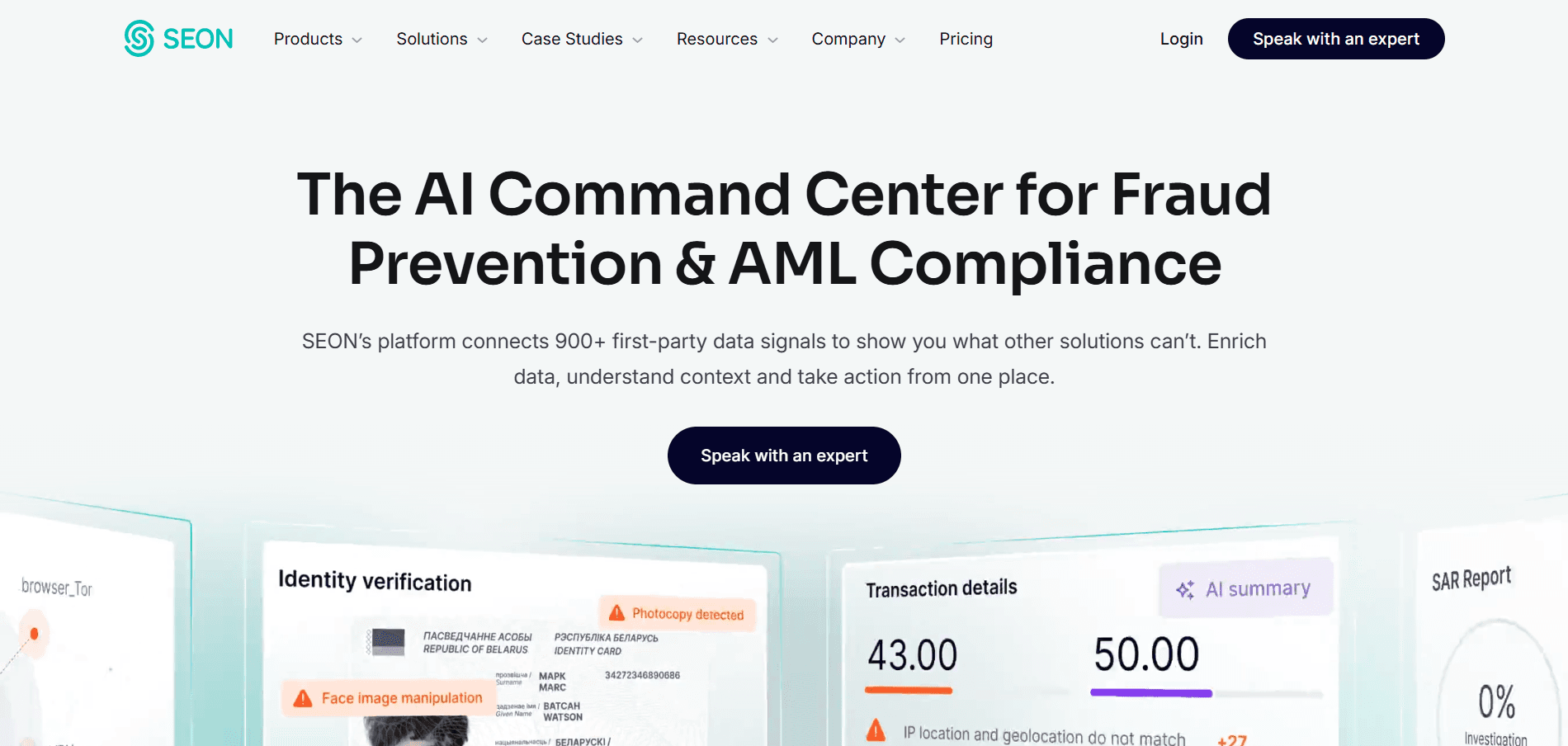
SEON is a fraud prevention platform known for its extensive digital footprint analysis and flexible risk scoring capabilities. By combining email, phone, IP, device, behavioral, and social signals, SEON helps businesses identify suspicious users, fake accounts, and fraudulent transactions before losses occur.
Key e-commerce fraud coverage:
Fake account detection
Payment fraud prevention
Promo abuse monitoring
Account abuse and multi-accounting
Device and identity risk assessment
Key strengths:
Rich data enrichment: Provides extensive user intelligence using hundreds of digital footprint signals.
Flexible rule engine: Allows fraud teams to build highly customized risk workflows.
Fast deployment: Offers API-first integrations that support rapid implementation.
Explainable scoring: Helps analysts understand why users are flagged as risky.
Where it fits best: SEON is a strong fit for mid-market merchants, marketplaces, and fraud teams that want flexible enrichment and risk scoring capabilities. It is especially useful when fake accounts and abuse prevention are major concerns.
Potential considerations include:
Some users report that maximizing value requires active rule tuning and fraud expertise.
Businesses seeking fully managed fraud operations may prefer platforms with more automated decision ownership.
6. Sift
Sift is a digital trust and safety platform that helps businesses manage fraud, abuse, and account risk across the customer lifecycle. Its identity-centric approach enables organizations to detect payment fraud, account takeover, fake accounts, and policy abuse using machine learning and network intelligence.
Key e-commerce fraud coverage:
Payment fraud detection
Account takeover prevention
Fake account identification
Policy abuse prevention
Marketplace and platform abuse monitoring
Key strengths:
Identity-level intelligence: Connects activity across accounts and transactions to uncover hidden fraud patterns.
Broad abuse coverage: Addresses multiple fraud vectors beyond payments alone.
Machine learning automation: Continuously improves detection accuracy using large-scale behavioral data.
Scalable trust platform: Supports complex digital ecosystems and high-growth businesses.
Where it fits best: Sift is particularly well suited for marketplaces, digital platforms, and e-commerce businesses facing multiple forms of abuse beyond traditional payment fraud. It works best when fraud prevention and trust operations are closely linked.
Buyers should also consider:
Some reviewers say device data can be tricky to interpret at times, and features like broader API integrations are needed.
Pricing may be less attractive for smaller businesses with limited fraud volumes.
7. ClearSale

ClearSale combines artificial intelligence with human fraud analysts to help merchants reduce chargebacks while minimizing false declines. Its hybrid approach is designed to improve approval rates and provide merchants with managed fraud review support rather than requiring extensive in-house fraud operations.
Key e-commerce fraud coverage:
Payment fraud prevention
Chargeback reduction
False decline mitigation
Order risk assessment
Manual fraud review support
Key strengths:
Human-assisted reviews: Adds analyst expertise to improve decision quality on complex transactions.
Chargeback protection: Helps reduce fraud losses through proactive transaction screening.
Higher approval rates: Focuses on approving legitimate customers that automated systems may reject.
Managed service model: Reduces the burden on internal fraud teams.
Where it fits best: ClearSale is a strong option for merchants that prefer managed fraud operations and want support from dedicated fraud analysts. It can be particularly useful for retailers with limited internal fraud expertise.
A few considerations include:
Businesses requiring fully automated instant decisions may prefer platforms with less analyst involvement.
Some users report occasional delays associated with manual review workflows during peak periods.
8. Riskified

Riskified is a widely adopted e-commerce fraud prevention platform known for its Chargeback Guarantee and approval optimization capabilities. The platform uses machine learning and transaction intelligence to help merchants approve more legitimate orders while protecting against fraud-related losses.
Key e-commerce fraud coverage:
Payment fraud prevention
Chargeback protection
Friendly fraud mitigation
Policy abuse detection
Checkout risk assessment
Key strengths:
Chargeback guarantee: Provides fraud liability protection on approved transactions.
Revenue optimization: Helps merchants increase approval rates without significantly increasing risk.
Enterprise-grade scale: Supports large retailers operating across multiple markets.
Fast decisioning: Delivers near-instant transaction approvals and declines.
Where it fits best: Riskified is best suited for enterprise retailers and high-volume e-commerce brands focused on maximizing revenue while reducing chargeback exposure. It is particularly attractive for merchants prioritizing checkout performance.
Before making a decision, buyers should evaluate:
Some reviewers note limited visibility into underlying decision logic compared with highly configurable platforms.
Organizations facing significant pre-checkout abuse may require additional identity or device intelligence solutions.
9. Wyllo

Wyllo (previously NoFraud) is a fraud prevention solution designed to simplify transaction screening and chargeback management for online merchants. The platform combines automated risk analysis with fraud review services to help businesses reduce fraud without building large internal fraud teams.
Key e-commerce fraud coverage:
Fraudulent order detection
Chargeback prevention
Transaction risk screening
Suspicious purchase monitoring
Manual fraud review support
Key strengths:
Simple deployment: Enables merchants to implement fraud protection quickly with minimal complexity.
Managed fraud operations: Reduces the need for dedicated in-house fraud analysts.
Chargeback reduction: Helps identify risky transactions before fulfillment.
Merchant-friendly workflows: Designed for ease of use and operational simplicity.
Where it fits best: Wyllo is a good fit for small and mid-sized online stores, Shopify merchants, and businesses that want straightforward fraud protection without extensive configuration requirements.
Potential limitations include:
Some users indicate that customization options are more limited than enterprise-focused platforms.
Businesses needing advanced device intelligence or broader abuse prevention capabilities may outgrow the platform over time.
10. Fingerprint
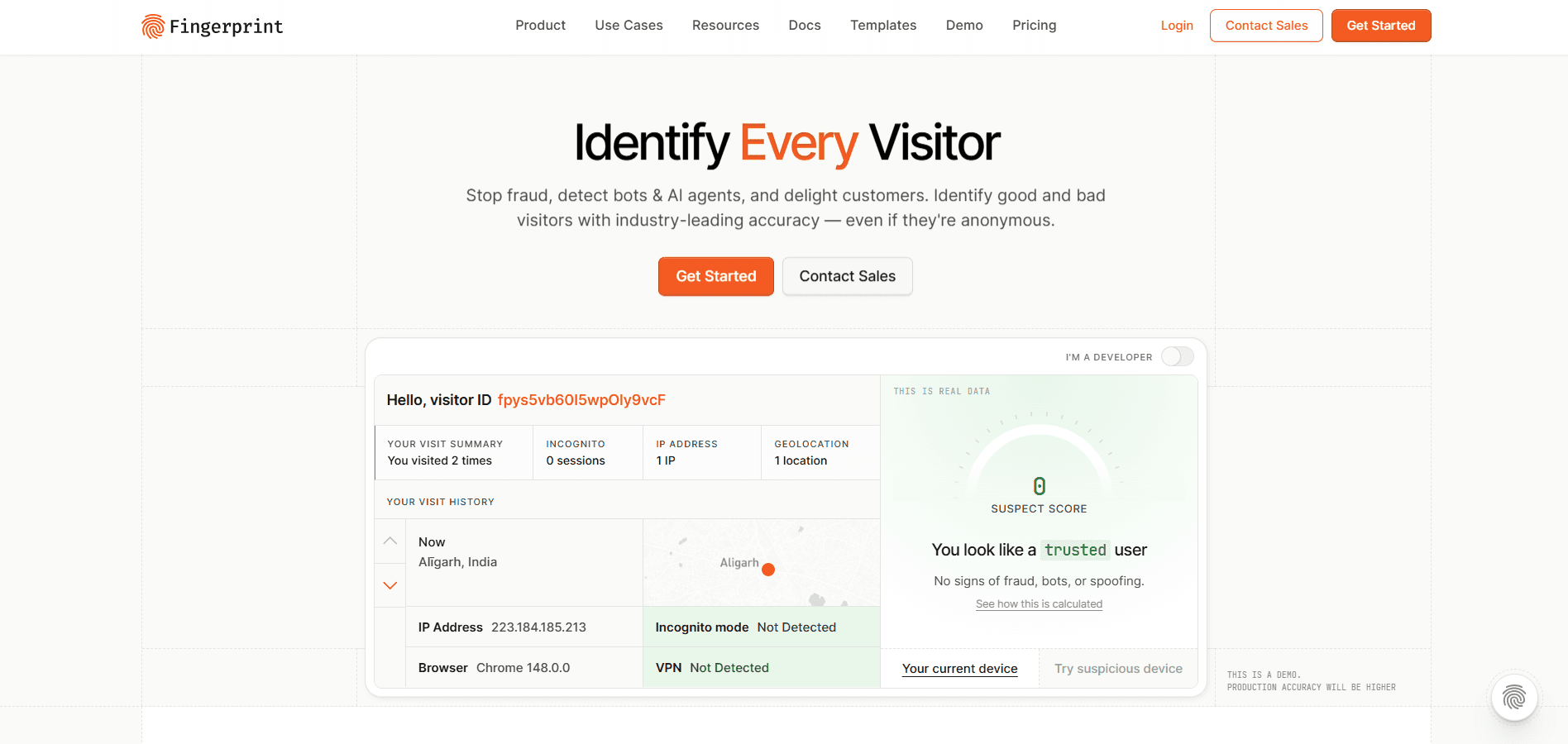
Fingerprint is a device intelligence platform that helps businesses identify visitors, detect suspicious devices, and uncover repeat offenders. Rather than functioning as a complete fraud decisioning platform, it specializes in persistent device identification that remains effective even when users attempt to evade detection.
Key e-commerce fraud coverage:
Fraudulent order detection
Promo abuse prevention
Account takeover support
Bot and automation detection
Repeat offender identification
Key strengths:
Persistent device identification: Helps recognize returning users even when traditional identifiers change.
Fraudster detection: Makes it easier to uncover repeat offenders operating multiple accounts.
Bot resistance: Identifies automated traffic and suspicious browser activity.
Developer flexibility: Supports custom fraud workflows through APIs and integrations.
Where it fits best: Fingerprint is best suited for developer-led organizations and fraud teams that need strong device intelligence as part of a broader fraud stack. It is particularly valuable when repeat offenders and multi-account abuse are recurring challenges.
Before adopting Fingerprint, buyers should consider:
Organizations seeking built-in transaction scoring, chargeback management, or identity verification may need additional tools
Some users mention that deeper investigation workflow capabilities, such as basic case management, note-taking, and the ability to group related device activity, would make the platform more useful for fraud analysis.
A Side-by-Side Comparison: Top 10 E-commerce Fraud Prevention Tools
The table below is a quick way to compare the leading e-commerce fraud prevention tools. As you review them, focus on the problems you need to solve first. While some platforms are built around chargeback protection, others specialize in device intelligence, and some provide broader risk decisioning across the customer journey.
Tool | Core fraud coverage | Key signals | Best for |
Bureau ID | Fake accounts, ATO, promo abuse, bots, chargeback risk, RTO risk | Device, behavior, identity, network, transaction | Unified risk decisioning |
Signifyd | Payment fraud, chargebacks, return abuse | Transaction, order, identity, network | Chargeback protection |
Kount | Payment fraud, ATO, policy abuse | Identity trust network, device, transaction | Omnichannel fraud prevention |
Forter | Payment fraud, ATO, abuse | Identity, behavior, transaction | Automated approve or decline decisions |
SEON | Fake accounts, payment fraud, account abuse | Email, phone, IP, device, behavioral signals | Digital footprint enrichment |
Sift | Payment fraud, ATO, policy abuse, fake accounts | Machine learning, behavioral, network signals | Digital trust and safety |
ClearSale | Payment fraud, chargebacks, false declines | AI plus analyst review | Hybrid AI and human review |
Riskified | Payment fraud, chargebacks, policy abuse | AI, device, behavioral, order data | Chargeback guarantee and approval optimization |
Wyllo | Fraudulent orders and chargebacks | Transaction and order review | Managed fraud review |
Fingerprint | CNP fraud, promo abuse, bots, ATO | Persistent device intelligence | Repeat visitor identification |
For merchants selling across regions, card and payment fraud coverage should be evaluated carefully.
The EBA and ECB’s 2025 Fraud Report found that payment fraud in the EU/EEA reached €4.2 billion in 2024, while fraudulent card transactions accounted for €1.3 billion. This makes payment risk, card-not-present fraud prevention, and authentication support important comparison points for global e-commerce teams.
The key takeaway is that these tools are not interchangeable. A platform designed to absorb chargeback liability serves a different purpose than one focused on device fingerprinting or end-to-end risk decisions.
Start with your biggest fraud challenge, then narrow your shortlist to the tools that address it best.
How to Choose the Right Fraud Prevention Software for Your Online Store
Start by identifying the fraud problem that costs you the most. Different tools solve different problems, so the best choice depends on where you're losing revenue.
If chargebacks are your biggest issue, prioritize platforms with chargeback guarantees, dispute management, and approval optimization.
If you're dealing with fake accounts, promo abuse, referral fraud, or repeat offenders, look for strong device intelligence, identity signals, and behavioral analysis.
If account takeover is a growing concern, focus on solutions that monitor login behavior, detect suspicious devices, and support step-up authentication.
If fraud appears across multiple stages of the customer journey, from signup to refunds, consider a unified risk decisioning platform rather than a point solution.
As you compare vendors, ask these practical questions:
Can the platform detect fraud at the stages where you actually see losses, such as signup, login, checkout, promotions, fulfillment, or refunds?
How much manual review will your team need to manage?
Will it integrate easily with your commerce stack, payment providers, and existing workflows?
Does it help reduce false declines, or will it block legitimate customers along with fraudsters?
Can it identify repeat offenders even when they create new accounts or use different payment methods?
Does it give your team enough visibility and control over decisions, rules, and investigations?
The right fraud prevention software should solve your highest-impact fraud problem first while supporting growth, not adding friction for genuine customers.
Related Read: A Buyer’s Guide To Fraud Detection Software For Fintech Teams
How Bureau ID Helps E-commerce Brands Prevent Fraud Without Hurting Conversions
Bureau ID is a strong choice for e-commerce brands because it meets many of the criteria buyers should look for in fraud prevention software: real-time risk scoring, device intelligence, behavioral signals, identity intelligence, workflow control, explainable decisions, and coverage beyond payment fraud.
A good example comes from a leading fashion e-commerce company that was struggling with high Return-to-Origin (RTO) losses. The brand was seeing a growing number of orders that were shipped but never successfully delivered, creating unnecessary logistics costs and operational inefficiencies.
Traditional fraud checks were not enough because the challenge was identifying risky orders before dispatch without disrupting legitimate customer purchases. To address the issue, Bureau ID implemented a targeted RTO risk prediction framework that helped the retailer assess delivery risk before fulfillment.
The solution included:
Real-time RTO risk scoring for incoming orders before dispatch
AI-driven analysis of customer, device, behavioral, and transaction signals
Identification of patterns associated with historically unsuccessful deliveries
Automated decisioning workflows to help operations teams prioritize high-risk orders
Risk segmentation that enabled intervention without adding friction for genuine customers
The outcome was a measurable reduction in fulfillment losses and better operational efficiency. By identifying risky orders earlier in the process, the retailer was able to make more informed dispatch decisions while maintaining a smooth experience for legitimate shoppers.
Key results included:
Predicted approximately 29% of potential RTO orders before shipment
Achieved more than 67% precision in identifying high-risk orders across platforms
Generated roughly $82.8K in cost savings within a three-month period
Reduced the company's RTO rate from 18.1% to 11.2%
Improved fraud and risk visibility without negatively impacting customer conversions
Read the full case study here → A Fashion eCommerce Leader Cuts RTO Losses with 67% Precision
This case highlights why Bureau ID stands out for e-commerce businesses that need more than transaction-level fraud checks.
By combining identity, device, behavioral, network, and transaction intelligence into a unified decisioning layer, Bureau ID helps merchants reduce losses, improve operational outcomes, and protect revenue without creating unnecessary friction for legitimate customers.
Reduce Fraud Across Every Order
Every fraudulent order that slips through, and every genuine customer who gets wrongly blocked, comes directly out of your bottom line. As fraud tactics evolve, relying on isolated signals or disconnected tools can leave critical gaps across signup, login, checkout, promotions, fulfillment, and post-purchase workflows.
By combining device intelligence, behavioral signals, identity insights, network intelligence, and transaction risk into a unified decisioning platform, Bureau ID closes these gaps and enables e-commerce teams to detect fraud earlier, reduce operational losses, minimize false positives, and make faster, more confident risk decisions.
Whether you are dealing with account takeover, promo abuse, repeat offenders, chargeback risk, or high-RTO orders, Bureau ID helps you protect revenue while maintaining a seamless customer experience.
Schedule a demo today to see how unified risk decisioning can help your e-commerce business reduce fraud, protect margins, and scale with confidence.
FAQs
1. What is fraud prevention software for e-commerce?
Fraud prevention software for e-commerce helps online stores detect and stop suspicious activity across checkout, payments, customer accounts, refunds, and chargebacks. Popular solutions include Bureau ID, Signifyd, Kount, Forter, SEON, Sift, ClearSale, Riskified, Wyllo, and Fingerprint. These platforms use signals such as transaction behavior, device data, risk scores, rules, and AI-based detection to identify fraud before it affects revenue or customer trust.
2. How does e-commerce fraud prevention software work?
E-commerce fraud prevention software reviews each order, account, payment, or refund request for risk signals. It checks details such as device behavior, payment patterns, customer identity, location, order history, and velocity. The software can approve low-risk orders, flag suspicious activity for review, or block high-risk transactions.
3. What features should I look for in e-commerce fraud prevention software?
Look for real-time transaction screening, risk scoring, device fingerprinting, bot detection, account takeover protection, chargeback management, refund abuse detection, and manual review workflows. Strong tools should also integrate with e-commerce platforms, payment gateways, and operational systems without slowing down checkout.
4. How can Bureau ID help online stores prevent fraud and reduce chargebacks?
Bureau ID helps online stores identify high-risk transactions, detect account takeover attempts, prevent refund abuse, and reduce chargebacks through real-time risk assessment and fraud detection. By analyzing customer, device, and behavioral signals, Bureau ID enables merchants to stop fraudulent activity while maintaining a smooth checkout experience for legitimate customers.
5. Can fraud prevention software stop account takeover attacks?
Yes. Many fraud prevention platforms help detect and prevent account takeover (ATO) attacks by monitoring login behavior, device signals, credential abuse, and unusual account activity. Advanced solutions like Bureau ID can identify suspicious access attempts in real time and trigger additional verification steps before fraudsters gain control of customer accounts.
6. How can fraud prevention tools protect checkout without hurting conversions?
Fraud prevention tools protect checkout by applying stronger checks only when risk appears high. Low-risk customers can complete purchases with minimal friction, while suspicious transactions receive extra review, verification, or blocking. This risk-based approach helps merchants reduce fraud, false declines, and unnecessary checkout interruptions.
For many online stores, fraud affects every stage of the customer journey and quietly eats into revenue through chargebacks, account takeover, promo abuse, return fraud, and false declines.
In fact, the MRC’s 2026 Global eCommerce Payments and Fraud Report found that merchants lost 3.2% of annual e-commerce revenue to payment fraud globally, while 57% reported rising refund or policy abuse.
As fraud tactics become more sophisticated, fraud prevention software for e-commerce has become essential for protecting margins without adding friction for genuine customers.
In this guide, we compare the best e-commerce fraud prevention tools for 2026, including Bureau ID, Signifyd, Kount, Forter, SEON, Sift, ClearSale, Riskified, Wyllo, and Fingerprint. We’ll cover their key features, strengths, ideal use cases, and how to choose the right fraud prevention software for your online store.
Features to Look for in E-commerce Fraud Prevention Software
Before comparing individual tools, it helps to understand what separates a basic fraud solution from one that can actually protect your business as it scales. When evaluating fraud prevention software for e-commerce, look for solutions that can assess risk across the entire customer journey, including:
Account signup and onboarding
Login and account activity
Checkout and payment authorization
Order fulfillment and delivery
Refunds, returns, and repeat purchases
Here are the key features that matter most:
Real-time risk scoring: Evaluates transactions and user activity instantly so fraud can be stopped before an order is processed.
Device intelligence and fingerprinting: Helps identify repeat offenders, device spoofing, and users creating multiple accounts.
Identity intelligence: Verifies whether a customer’s identity signals are consistent and trustworthy.
Chargeback prevention and management: Reduces fraud-related disputes and helps recover lost revenue.
Bot detection: Blocks automated attacks such as card testing, fake account creation, and credential stuffing.
Account takeover protection: Detects suspicious login behavior and compromised accounts.
Promo and referral abuse detection: Prevents fraudsters from exploiting discounts, loyalty programs, and incentives.
Workflow and decisioning controls: Allows fraud teams to automate approvals, reviews, declines, and step-up verification checks.
False-positive reduction: Ensures legitimate customers are not incorrectly blocked, protecting both revenue and customer experience.
Features like chargeback protection become even more important as card-not-present fraud rises. UK Finance’s 2025 Half Year Fraud Report found that remote purchase fraud losses reached £215.4 million in the first half of 2025, up 8%, while cases rose 22% to 1.66 million.
In fact, the same report claimed that e-commerce card fraud alone reached an estimated £159 million, which shows why online stores need real-time order screening before fulfillment.
One important point: not every business needs the same type of fraud protection.
For instance, if chargebacks are your biggest challenge, prioritize tools with strong chargeback prevention capabilities. If fake accounts, repeat offenders, or promo abuse are driving losses, focus on platforms with robust device intelligence, behavioral analysis, and identity-based risk signals.
With these evaluation criteria in mind, let's look at the leading e-commerce fraud prevention tools and see how they compare.
The 10 Best Fraud Prevention Software for E-commerce
Fraud prevention software for e-commerce helps online stores detect, block, and reduce fraudulent activity across checkout, payments, accounts, refunds, and chargebacks. It uses risk scoring, transaction monitoring, device signals, rules, and AI-based detection to identify suspicious orders before they create losses.
Understanding how each tool differs is important when evaluating the right fit for your store.
1. Bureau ID
Bureau ID is an AI-powered unified risk decisioning platform that helps e-commerce businesses detect and prevent fraud across the entire customer journey. By combining device intelligence, identity signals, behavioral analytics, network intelligence, and transaction monitoring into a single decisioning layer, it enables real-time risk assessment without relying on multiple disconnected tools.
This makes it particularly effective for brands looking to reduce fraud while maintaining a seamless customer experience.
Key e-commerce fraud coverage:
Fake account creation and multi-accounting detection
Promo abuse, referral fraud, and loyalty program abuse prevention
Account takeover (ATO) and suspicious login activity monitoring
Bot abuse, device spoofing, and automated attack detection
Chargeback risk assessment, RTO prediction, and suspicious checkout behavior analysis
Key strengths:
Unified risk decisioning: Combines user, device, identity, behavioral, network, and transaction signals into a single risk decision, reducing the need for multiple point solutions.
Persistent device intelligence: Helps identify repeat offenders even when they attempt to return using new accounts, devices, or payment methods.
Flexible workflow automation: Enables fraud teams to build and adjust risk policies quickly through no-code workflows, reducing operational overhead.
Explainable real-time decisions: Provides transparent risk insights and step-up authentication triggers that help prevent fraud without unnecessarily increasing customer friction.
Where it fits best: Bureau ID is best suited for high-volume e-commerce brands, marketplaces, DTC businesses, and promo-heavy growth teams that need visibility into fraud risks beyond checkout. It is particularly valuable for organizations dealing with fake signups, repeat offenders, account abuse, and operational losses such as RTOs.
That said, buyers should still evaluate a few considerations before making a decision:
Businesses looking primarily for chargeback guarantees or liability-shift programs may find more specialized offerings from chargeback-focused providers.
Teams seeking a fully managed fraud review service should assess whether they have the internal resources to configure and optimize risk workflows effectively.
2. Signifyd
Signifyd is a leading e-commerce fraud protection platform best known for its Guaranteed Fraud Protection offering. The platform combines AI-driven risk assessment, automated order approval, chargeback protection, chargeback recovery, and return abuse insights to help merchants reduce fraud losses while increasing approval rates and minimizing manual review workloads.
Key e-commerce fraud coverage:
Payment fraud and card-not-present (CNP) fraud
Chargeback prevention and reimbursement
Friendly fraud detection
Return and refund abuse monitoring
Order risk assessment and approval optimization
Key strengths:
Chargeback guarantee: Helps merchants shift fraud liability on approved orders, reducing direct fraud losses.
Automated decisioning: Approves or declines orders in real time, reducing manual review effort and operational overhead.
Higher approval rates: Uses machine learning to identify legitimate customers that traditional rules may incorrectly decline.
Commerce-focused insights: Provides visibility into returns, disputes, and customer behavior patterns that impact profitability.
Where it fits best: Signifyd is best suited for mid-market and enterprise retailers that process significant transaction volumes and want strong chargeback protection with minimal operational involvement. It is particularly valuable for merchants looking to outsource much of their transaction fraud decisioning.
That said, buyers should evaluate a few considerations before committing:
Some reviewers note that pricing can become expensive as transaction volumes scale, particularly for smaller merchants.
Businesses dealing heavily with fake accounts, promo abuse, or pre-checkout fraud may require additional tools.
3. Kount
Kount is an established fraud prevention platform that combines machine learning, identity trust signals, customizable policies, and real-time transaction monitoring. It is commonly used by retailers seeking broad fraud coverage across payments, account activity, loyalty programs, and omnichannel commerce environments.
Key e-commerce fraud coverage:
Credit card and payment fraud
Account takeover prevention
Promo and loyalty abuse detection
Friendly fraud and chargeback fraud
Affiliate and policy abuse monitoring
Key strengths:
Customizable risk controls: Gives fraud teams flexibility to tailor policies and workflows to their specific risk appetite.
Identity trust network: Leverages shared intelligence to identify suspicious users and repeat offenders more effectively.
Omnichannel coverage: Supports fraud prevention across online, mobile, and offline commerce channels.
Detailed risk visibility: Provides granular transaction insights that help teams investigate and optimize fraud decisions.
Where it fits best: Kount works well for retailers with multiple sales channels and fraud teams that want significant control over risk policies and decision logic. It is often a strong fit for organizations with dedicated fraud operations resources.
However, buyers should consider the following:
Smaller teams may find ongoing policy management and optimization resource-intensive compared with more managed solutions.
Some users report a learning curve when configuring rules and workflows, particularly during onboarding.
4. Forter
Forter is an enterprise-focused fraud prevention platform that uses identity intelligence and machine learning to make real-time commerce decisions. The platform evaluates customer behavior across transactions and account activity to help merchants reduce fraud, improve approval rates, and minimize customer friction.
Key e-commerce fraud coverage:
Payment fraud prevention
Account takeover detection
Chargeback reduction
Policy and abuse prevention
Checkout risk assessment
Key strengths:
Real-time approvals: Delivers instant fraud decisions that help maintain fast checkout experiences.
Identity-based decisioning: Evaluates users holistically rather than relying solely on transaction-level signals.
False decline reduction: Helps merchants approve more legitimate customers without increasing fraud exposure.
Enterprise scalability: Supports large transaction volumes across global commerce operations.
Where it fits best: Forter is best suited for enterprise retailers and global e-commerce brands focused on maximizing approvals while maintaining strong fraud controls. It is particularly attractive for organizations prioritizing automation.
Before selecting Forter, buyers should review:
Some reviewers mention limited transparency into decision logic compared with highly configurable rule-based systems.
Teams seeking extensive manual rule customization may find the platform less flexible than some alternatives.
5. SEON
SEON is a fraud prevention platform known for its extensive digital footprint analysis and flexible risk scoring capabilities. By combining email, phone, IP, device, behavioral, and social signals, SEON helps businesses identify suspicious users, fake accounts, and fraudulent transactions before losses occur.
Key e-commerce fraud coverage:
Fake account detection
Payment fraud prevention
Promo abuse monitoring
Account abuse and multi-accounting
Device and identity risk assessment
Key strengths:
Rich data enrichment: Provides extensive user intelligence using hundreds of digital footprint signals.
Flexible rule engine: Allows fraud teams to build highly customized risk workflows.
Fast deployment: Offers API-first integrations that support rapid implementation.
Explainable scoring: Helps analysts understand why users are flagged as risky.
Where it fits best: SEON is a strong fit for mid-market merchants, marketplaces, and fraud teams that want flexible enrichment and risk scoring capabilities. It is especially useful when fake accounts and abuse prevention are major concerns.
Potential considerations include:
Some users report that maximizing value requires active rule tuning and fraud expertise.
Businesses seeking fully managed fraud operations may prefer platforms with more automated decision ownership.
6. Sift
Sift is a digital trust and safety platform that helps businesses manage fraud, abuse, and account risk across the customer lifecycle. Its identity-centric approach enables organizations to detect payment fraud, account takeover, fake accounts, and policy abuse using machine learning and network intelligence.
Key e-commerce fraud coverage:
Payment fraud detection
Account takeover prevention
Fake account identification
Policy abuse prevention
Marketplace and platform abuse monitoring
Key strengths:
Identity-level intelligence: Connects activity across accounts and transactions to uncover hidden fraud patterns.
Broad abuse coverage: Addresses multiple fraud vectors beyond payments alone.
Machine learning automation: Continuously improves detection accuracy using large-scale behavioral data.
Scalable trust platform: Supports complex digital ecosystems and high-growth businesses.
Where it fits best: Sift is particularly well suited for marketplaces, digital platforms, and e-commerce businesses facing multiple forms of abuse beyond traditional payment fraud. It works best when fraud prevention and trust operations are closely linked.
Buyers should also consider:
Some reviewers say device data can be tricky to interpret at times, and features like broader API integrations are needed.
Pricing may be less attractive for smaller businesses with limited fraud volumes.
7. ClearSale
ClearSale combines artificial intelligence with human fraud analysts to help merchants reduce chargebacks while minimizing false declines. Its hybrid approach is designed to improve approval rates and provide merchants with managed fraud review support rather than requiring extensive in-house fraud operations.
Key e-commerce fraud coverage:
Payment fraud prevention
Chargeback reduction
False decline mitigation
Order risk assessment
Manual fraud review support
Key strengths:
Human-assisted reviews: Adds analyst expertise to improve decision quality on complex transactions.
Chargeback protection: Helps reduce fraud losses through proactive transaction screening.
Higher approval rates: Focuses on approving legitimate customers that automated systems may reject.
Managed service model: Reduces the burden on internal fraud teams.
Where it fits best: ClearSale is a strong option for merchants that prefer managed fraud operations and want support from dedicated fraud analysts. It can be particularly useful for retailers with limited internal fraud expertise.
A few considerations include:
Businesses requiring fully automated instant decisions may prefer platforms with less analyst involvement.
Some users report occasional delays associated with manual review workflows during peak periods.
8. Riskified
Riskified is a widely adopted e-commerce fraud prevention platform known for its Chargeback Guarantee and approval optimization capabilities. The platform uses machine learning and transaction intelligence to help merchants approve more legitimate orders while protecting against fraud-related losses.
Key e-commerce fraud coverage:
Payment fraud prevention
Chargeback protection
Friendly fraud mitigation
Policy abuse detection
Checkout risk assessment
Key strengths:
Chargeback guarantee: Provides fraud liability protection on approved transactions.
Revenue optimization: Helps merchants increase approval rates without significantly increasing risk.
Enterprise-grade scale: Supports large retailers operating across multiple markets.
Fast decisioning: Delivers near-instant transaction approvals and declines.
Where it fits best: Riskified is best suited for enterprise retailers and high-volume e-commerce brands focused on maximizing revenue while reducing chargeback exposure. It is particularly attractive for merchants prioritizing checkout performance.
Before making a decision, buyers should evaluate:
Some reviewers note limited visibility into underlying decision logic compared with highly configurable platforms.
Organizations facing significant pre-checkout abuse may require additional identity or device intelligence solutions.
9. Wyllo
Wyllo (previously NoFraud) is a fraud prevention solution designed to simplify transaction screening and chargeback management for online merchants. The platform combines automated risk analysis with fraud review services to help businesses reduce fraud without building large internal fraud teams.
Key e-commerce fraud coverage:
Fraudulent order detection
Chargeback prevention
Transaction risk screening
Suspicious purchase monitoring
Manual fraud review support
Key strengths:
Simple deployment: Enables merchants to implement fraud protection quickly with minimal complexity.
Managed fraud operations: Reduces the need for dedicated in-house fraud analysts.
Chargeback reduction: Helps identify risky transactions before fulfillment.
Merchant-friendly workflows: Designed for ease of use and operational simplicity.
Where it fits best: Wyllo is a good fit for small and mid-sized online stores, Shopify merchants, and businesses that want straightforward fraud protection without extensive configuration requirements.
Potential limitations include:
Some users indicate that customization options are more limited than enterprise-focused platforms.
Businesses needing advanced device intelligence or broader abuse prevention capabilities may outgrow the platform over time.
10. Fingerprint
Fingerprint is a device intelligence platform that helps businesses identify visitors, detect suspicious devices, and uncover repeat offenders. Rather than functioning as a complete fraud decisioning platform, it specializes in persistent device identification that remains effective even when users attempt to evade detection.
Key e-commerce fraud coverage:
Fraudulent order detection
Promo abuse prevention
Account takeover support
Bot and automation detection
Repeat offender identification
Key strengths:
Persistent device identification: Helps recognize returning users even when traditional identifiers change.
Fraudster detection: Makes it easier to uncover repeat offenders operating multiple accounts.
Bot resistance: Identifies automated traffic and suspicious browser activity.
Developer flexibility: Supports custom fraud workflows through APIs and integrations.
Where it fits best: Fingerprint is best suited for developer-led organizations and fraud teams that need strong device intelligence as part of a broader fraud stack. It is particularly valuable when repeat offenders and multi-account abuse are recurring challenges.
Before adopting Fingerprint, buyers should consider:
Organizations seeking built-in transaction scoring, chargeback management, or identity verification may need additional tools
Some users mention that deeper investigation workflow capabilities, such as basic case management, note-taking, and the ability to group related device activity, would make the platform more useful for fraud analysis.
A Side-by-Side Comparison: Top 10 E-commerce Fraud Prevention Tools
The table below is a quick way to compare the leading e-commerce fraud prevention tools. As you review them, focus on the problems you need to solve first. While some platforms are built around chargeback protection, others specialize in device intelligence, and some provide broader risk decisioning across the customer journey.
Tool | Core fraud coverage | Key signals | Best for |
Bureau ID | Fake accounts, ATO, promo abuse, bots, chargeback risk, RTO risk | Device, behavior, identity, network, transaction | Unified risk decisioning |
Signifyd | Payment fraud, chargebacks, return abuse | Transaction, order, identity, network | Chargeback protection |
Kount | Payment fraud, ATO, policy abuse | Identity trust network, device, transaction | Omnichannel fraud prevention |
Forter | Payment fraud, ATO, abuse | Identity, behavior, transaction | Automated approve or decline decisions |
SEON | Fake accounts, payment fraud, account abuse | Email, phone, IP, device, behavioral signals | Digital footprint enrichment |
Sift | Payment fraud, ATO, policy abuse, fake accounts | Machine learning, behavioral, network signals | Digital trust and safety |
ClearSale | Payment fraud, chargebacks, false declines | AI plus analyst review | Hybrid AI and human review |
Riskified | Payment fraud, chargebacks, policy abuse | AI, device, behavioral, order data | Chargeback guarantee and approval optimization |
Wyllo | Fraudulent orders and chargebacks | Transaction and order review | Managed fraud review |
Fingerprint | CNP fraud, promo abuse, bots, ATO | Persistent device intelligence | Repeat visitor identification |
For merchants selling across regions, card and payment fraud coverage should be evaluated carefully.
The EBA and ECB’s 2025 Fraud Report found that payment fraud in the EU/EEA reached €4.2 billion in 2024, while fraudulent card transactions accounted for €1.3 billion. This makes payment risk, card-not-present fraud prevention, and authentication support important comparison points for global e-commerce teams.
The key takeaway is that these tools are not interchangeable. A platform designed to absorb chargeback liability serves a different purpose than one focused on device fingerprinting or end-to-end risk decisions.
Start with your biggest fraud challenge, then narrow your shortlist to the tools that address it best.
How to Choose the Right Fraud Prevention Software for Your Online Store
Start by identifying the fraud problem that costs you the most. Different tools solve different problems, so the best choice depends on where you're losing revenue.
If chargebacks are your biggest issue, prioritize platforms with chargeback guarantees, dispute management, and approval optimization.
If you're dealing with fake accounts, promo abuse, referral fraud, or repeat offenders, look for strong device intelligence, identity signals, and behavioral analysis.
If account takeover is a growing concern, focus on solutions that monitor login behavior, detect suspicious devices, and support step-up authentication.
If fraud appears across multiple stages of the customer journey, from signup to refunds, consider a unified risk decisioning platform rather than a point solution.
As you compare vendors, ask these practical questions:
Can the platform detect fraud at the stages where you actually see losses, such as signup, login, checkout, promotions, fulfillment, or refunds?
How much manual review will your team need to manage?
Will it integrate easily with your commerce stack, payment providers, and existing workflows?
Does it help reduce false declines, or will it block legitimate customers along with fraudsters?
Can it identify repeat offenders even when they create new accounts or use different payment methods?
Does it give your team enough visibility and control over decisions, rules, and investigations?
The right fraud prevention software should solve your highest-impact fraud problem first while supporting growth, not adding friction for genuine customers.
Related Read: A Buyer’s Guide To Fraud Detection Software For Fintech Teams
How Bureau ID Helps E-commerce Brands Prevent Fraud Without Hurting Conversions
Bureau ID is a strong choice for e-commerce brands because it meets many of the criteria buyers should look for in fraud prevention software: real-time risk scoring, device intelligence, behavioral signals, identity intelligence, workflow control, explainable decisions, and coverage beyond payment fraud.
A good example comes from a leading fashion e-commerce company that was struggling with high Return-to-Origin (RTO) losses. The brand was seeing a growing number of orders that were shipped but never successfully delivered, creating unnecessary logistics costs and operational inefficiencies.
Traditional fraud checks were not enough because the challenge was identifying risky orders before dispatch without disrupting legitimate customer purchases. To address the issue, Bureau ID implemented a targeted RTO risk prediction framework that helped the retailer assess delivery risk before fulfillment.
The solution included:
Real-time RTO risk scoring for incoming orders before dispatch
AI-driven analysis of customer, device, behavioral, and transaction signals
Identification of patterns associated with historically unsuccessful deliveries
Automated decisioning workflows to help operations teams prioritize high-risk orders
Risk segmentation that enabled intervention without adding friction for genuine customers
The outcome was a measurable reduction in fulfillment losses and better operational efficiency. By identifying risky orders earlier in the process, the retailer was able to make more informed dispatch decisions while maintaining a smooth experience for legitimate shoppers.
Key results included:
Predicted approximately 29% of potential RTO orders before shipment
Achieved more than 67% precision in identifying high-risk orders across platforms
Generated roughly $82.8K in cost savings within a three-month period
Reduced the company's RTO rate from 18.1% to 11.2%
Improved fraud and risk visibility without negatively impacting customer conversions
Read the full case study here → A Fashion eCommerce Leader Cuts RTO Losses with 67% Precision
This case highlights why Bureau ID stands out for e-commerce businesses that need more than transaction-level fraud checks.
By combining identity, device, behavioral, network, and transaction intelligence into a unified decisioning layer, Bureau ID helps merchants reduce losses, improve operational outcomes, and protect revenue without creating unnecessary friction for legitimate customers.
Reduce Fraud Across Every Order
Every fraudulent order that slips through, and every genuine customer who gets wrongly blocked, comes directly out of your bottom line. As fraud tactics evolve, relying on isolated signals or disconnected tools can leave critical gaps across signup, login, checkout, promotions, fulfillment, and post-purchase workflows.
By combining device intelligence, behavioral signals, identity insights, network intelligence, and transaction risk into a unified decisioning platform, Bureau ID closes these gaps and enables e-commerce teams to detect fraud earlier, reduce operational losses, minimize false positives, and make faster, more confident risk decisions.
Whether you are dealing with account takeover, promo abuse, repeat offenders, chargeback risk, or high-RTO orders, Bureau ID helps you protect revenue while maintaining a seamless customer experience.
Schedule a demo today to see how unified risk decisioning can help your e-commerce business reduce fraud, protect margins, and scale with confidence.
FAQs
1. What is fraud prevention software for e-commerce?
Fraud prevention software for e-commerce helps online stores detect and stop suspicious activity across checkout, payments, customer accounts, refunds, and chargebacks. Popular solutions include Bureau ID, Signifyd, Kount, Forter, SEON, Sift, ClearSale, Riskified, Wyllo, and Fingerprint. These platforms use signals such as transaction behavior, device data, risk scores, rules, and AI-based detection to identify fraud before it affects revenue or customer trust.
2. How does e-commerce fraud prevention software work?
E-commerce fraud prevention software reviews each order, account, payment, or refund request for risk signals. It checks details such as device behavior, payment patterns, customer identity, location, order history, and velocity. The software can approve low-risk orders, flag suspicious activity for review, or block high-risk transactions.
3. What features should I look for in e-commerce fraud prevention software?
Look for real-time transaction screening, risk scoring, device fingerprinting, bot detection, account takeover protection, chargeback management, refund abuse detection, and manual review workflows. Strong tools should also integrate with e-commerce platforms, payment gateways, and operational systems without slowing down checkout.
4. How can Bureau ID help online stores prevent fraud and reduce chargebacks?
Bureau ID helps online stores identify high-risk transactions, detect account takeover attempts, prevent refund abuse, and reduce chargebacks through real-time risk assessment and fraud detection. By analyzing customer, device, and behavioral signals, Bureau ID enables merchants to stop fraudulent activity while maintaining a smooth checkout experience for legitimate customers.
5. Can fraud prevention software stop account takeover attacks?
Yes. Many fraud prevention platforms help detect and prevent account takeover (ATO) attacks by monitoring login behavior, device signals, credential abuse, and unusual account activity. Advanced solutions like Bureau ID can identify suspicious access attempts in real time and trigger additional verification steps before fraudsters gain control of customer accounts.
6. How can fraud prevention tools protect checkout without hurting conversions?
Fraud prevention tools protect checkout by applying stronger checks only when risk appears high. Low-risk customers can complete purchases with minimal friction, while suspicious transactions receive extra review, verification, or blocking. This risk-based approach helps merchants reduce fraud, false declines, and unnecessary checkout interruptions.
TABLE OF CONTENTS
See More
Recommended Blogs


Landing Page.
Simple, bold.
Sign Up
Download

Products
Solutions


© 2026 Bureau . All rights reserved.
Solutions
Industries
Resources
Company
Solutions
Industries
Resources
Company
© 2026 Bureau . All rights reserved.
Follow Us
Leave behind fragmented tools. Stop fraud rings, cut false declines, and deliver secure digital journeys at scale
Our Presence








Leave behind fragmented tools. Stop fraud rings, cut false declines, and deliver secure digital journeys at scale
Our Presence
© 2026 Bureau . All rights reserved.