Detecting AI-Generated Fake IDs Before They Pass Verification
Detecting AI-Generated Fake IDs Before They Pass Verification
Detecting AI-Generated Fake IDs Before They Pass Verification
Understand how AI-generated fake IDs work, which verification gaps they exploit, and what layered controls help stop synthetic identity fraud.
Author
Team Bureau


See how Bureau has helped industry leaders defend against networked Industrial-scale frauds →
Schedule a Demo
TABLE OF CONTENTS
See Less
A fake ID no longer needs to look fake.
It can arrive with readable text, the expected government-document layout, a convincing portrait, and a matching selfie. OCR extracts the data, template checks find no obvious issue, and the applicant clears onboarding.
The fraud may only become visible later, when the account begins taking credit, moving funds, or connecting to other synthetic identities.
This is what makes AI-generated fake IDs difficult to manage. Generative AI can produce or alter identity documents without many of the visual defects associated with older forgeries. As a result, fake ID verification can no longer depend on whether a document looks plausible or contains correctly formatted data.
This blog explains how AI-generated fake documents support deepfake KYC bypass, why traditional verification controls miss them, and how synthetic image detection can help prevent deepfake KYC bypass.
What Are AI-Generated Fake IDs?
AI-generated fake IDs are fully or partially fabricated identity documents created using generative AI or AI-assisted image manipulation. They can imitate passports, driving licences, national identity cards, and other government-issued documents closely enough to pass basic OCR, visual inspection, or template checks.
Some are created entirely from scratch, while others alter a genuine document by changing the portrait, name, address, date of birth, document number, or machine-readable fields. The document may represent a person who does not exist or combine stolen personal data with generated images and invented attributes.
These identities can create risk across the account lifecycle:
Financial risk: Credit losses, fraudulent withdrawals, chargebacks, payout fraud, promo abuse, and mule-linked transactions.
Operational risk: More manual reviews, repeated recapture requests, slower onboarding, and higher false-positive rates.
Compliance risk: Weak customer identification, AML blind spots, incomplete audit trails, and failure to identify the true account controller.
Post-onboarding risk: Synthetic identities can build transaction or credit history before being used for loan stacking, bust-out fraud, account resale, or money laundering.
A document that looks correct is only one part of the identity claim. Businesses still need to establish that it is physically present, authentic, unaltered, and connected to a trustworthy applicant.
Why Do Traditional KYC and OCR Checks Fail Against AI Fake IDs?
Traditional KYC and OCR checks often fail because they confirm whether a document is readable and structurally consistent, not whether it is authentic. AI-generated fake IDs can reproduce expected layouts, fonts, portraits, and machine-readable fields closely enough to satisfy basic checks.
The main gaps are:
OCR reads data: It can extract correctly formatted text from a fabricated document.
Template matching compares structure: A generated ID can closely resemble a recognized document format.
Static uploads accept image evidence: Screenshots, scans, generated images, and screen replays may all enter the same workflow.
Face matching checks resemblance: It may approve a document portrait and selfie that have both been manipulated.
Disconnected checks miss the context: Device reuse, repeated applications, and linked identity activity may remain invisible.
In a 2025 FantasyID study, several state-of-the-art forgery detectors produced false-negative rates close to 50% when tested at an operating threshold with a 10% false-positive rate. Under those experimental conditions, nearly half of the manipulated documents went undetected.
Extracting identity data is not the same as authenticating identity documents. Effective verification must establish that the document is physically present, genuine, unaltered, and connected to the rightful applicant.
What Red Flags Can Reveal an AI-Generated Fake ID?
Detection systems typically look for clusters of anomalies rather than one decisive defect. A document may appear convincing on its own, yet become suspicious when its image properties, data fields, and capture method do not align.
Common red flags include:
Image inconsistencies: Uneven sharpness, unnatural textures, mismatched lighting, irregular portrait edges, or signs of local editing.
Document-data mismatches: Visible fields that conflict with MRZ, barcode, QR, NFC, dates, checksums, or document-number formats.
Security-feature anomalies: Holograms, reflections, layouts, or front-and-back images that do not behave or align as expected.
Biometric concerns: Face mismatches, deepfake indicators, replay attempts, virtual-camera use, or age and appearance inconsistencies.
Contextual risk signals: One device linked to several identities, repeated submissions, location masking, scripted behaviour, shared contact details, or connections to mule accounts and fraud rings.
These signals should inform a broader risk decision rather than act as automatic proof of fraud. The strongest detection comes from evaluating them together.
Related Read: How Businesses Can Stop AI Identity Fraud With Connected Risk Intelligence
How Can Businesses Detect and Prevent AI-Generated Fake IDs?
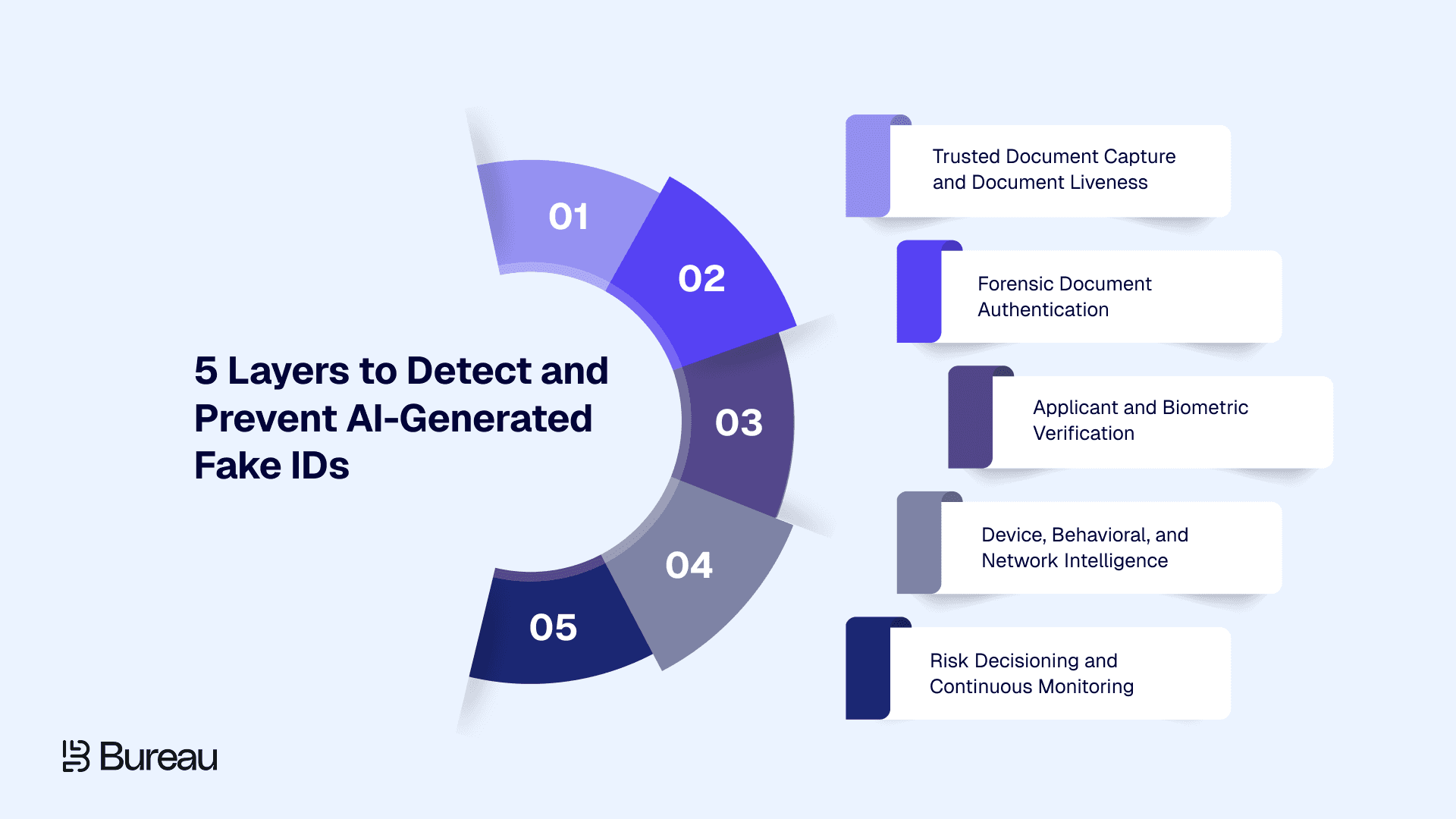
Businesses can detect and prevent AI-generated fake IDs by connecting document capture, document liveness, forensic authentication, biometric verification, contextual risk signals, and ongoing monitoring.
Each layer should answer a specific question before the system approves the identity.
Document presence: Was a physical document presented?
Document authenticity: Is it genuine and unaltered?
Applicant authenticity: Is the applicant live and connected to the submitted document?
Contextual trust: Does the surrounding activity support the identity claim?
Ongoing trust: Does the account remain trustworthy after onboarding?
Layer 1: Trusted Document Capture and Document Liveness
Document liveness establishes whether the applicant presented a physical ID during the active verification session. Higher-risk journeys should require in-session camera capture and bind the submission to the current device and session.
In ACFE’s 2026 survey, 72% reported an increase in deepfake digital-injection attacks, where manipulated or synthetic media is supplied directly to a verification system instead of being captured through a genuine live camera session.
The capture flow should:
Detect screenshots, scans, gallery uploads, screen replays, and injected media
Evaluate movement, perspective, depth, reflections, texture, and surface behaviour
Check how holograms and other physical security features respond
Confirm that the front and back belong to the same document
Trigger a fresh capture when the evidence is weak or inconsistent
Businesses should apply the same standard to account recovery, profile changes, credit applications, withdrawals, and other routes where users can submit identification. A weaker fallback channel can undermine an otherwise strong onboarding process.
Important note: Document liveness confirms that a physical document appears to be present. It does not prove that the document is genuine. |
Layer 2: Forensic Document Authentication
Forensic authentication determines whether the captured ID is genuine and unaltered. It compares the document with the expected version from the issuing authority, then examines its layout, typography, portrait, machine-readable data, and security features for inconsistencies.
The system should verify that visible fields agree with MRZ, barcode, QR, or NFC data where available.
It should also detect edited regions, portrait replacement, duplicated document numbers, invalid checksums, and security elements that do not match the document type or version.
Layer 3: Applicant and Biometric Verification
Applicant verification needs to establish that the person is live, resembles the document portrait, and submitted biometric media through a trusted capture source.
Biometric controls should detect:
Deepfakes
Face swaps
Facial morphing
Replays
Screen presentations
Virtual cameras
Media injection
Elevated-risk sessions may require an adaptive challenge, a new capture, video verification, or specialist review.
However, the result should always be considered alongside document and device evidence. A convincing face match has limited value when both the portrait and selfie have been manipulated.
Gartner predicted that by 2026, AI-generated deepfake attacks on face biometrics will lead 30% of enterprises to no longer consider standalone identity verification and authentication solutions reliable in isolation, underscoring why applicant biometrics must be assessed alongside document and device evidence, not in place of them.
Layer 4: Device, Behavioral, and Network Intelligence
A credible document can still belong to a coordinated fraud attempt. Device and network intelligence helps reveal the activity surrounding the submission.
Risk teams should look for:
One device submitting several unrelated identities
Repeated attempts with small changes to names, portraits, or document fields
Emulators, rooted devices, app tampering, virtual cameras, or location masking
Scripted interactions and abnormal submission velocity
Shared contact details, addresses, beneficiaries, or payment instruments
Links to synthetic identities, mule accounts, or known fraud networks
For example, an ID may clear document and biometric checks while the same device has submitted several identities within a few hours.
Persistent device ID, behavioral biometrics, and graph-based intelligence help surface those relationships before the accounts are assessed separately.
Layer 5: Risk Decisioning and Continuous Monitoring
The final decision should combine the results from every layer and apply a proportionate response.
Risk level | Possible response |
Low | Approve and monitor |
Moderate | Request a fresh document capture |
Elevated | Trigger stronger document or biometric verification |
High | Route to specialist manual review |
Critical | Reject, restrict, or investigate linked applications |
Layered verification should not add every possible check to every journey. Trusted applicants can proceed with minimal interruption, while inconsistent documents, suspicious devices, manipulated media, and linked fraud patterns trigger stronger verification.
Risk should also be reassessed when a user changes devices or contact details, adds a beneficiary, requests credit, or begins unusual transaction activity.
An AI-ready KYC workflow should be able to prove document presence, authenticate the ID, validate the applicant, detect coordinated activity, explain its decision, and continue monitoring after approval. This connected process is what prevents a convincing document from becoming a trusted fraudulent account.
How Bureau Supports Layered Identity Verification
Bureau connects image forensics with identity, device, behavioral, and network intelligence so a document verdict can inform the wider risk decision.
1. Synthetic Image Detection
Bureau’s synthetic image detection uses pixel-level forensic analysis to identify AI-generated, deepfake, manipulated, and recaptured images. Its zero-shot approach reads statistical relationships within the image rather than relying on known generator outputs, watermarks, or metadata.
Each request returns a clear verdict, confidence score, and heatmap showing where manipulation was detected. The system can also flag recaptured images, where a fraudster displays an AI-generated image on another screen and photographs it to make the submission appear camera-captured.
That verdict can then be evaluated alongside device and behavioral signals. Repeated submissions, suspicious devices, scripted activity, or linked attempts may turn one questionable image into evidence of a broader fraud pattern.
2. Detect Synthetic Identities and Linked Fraud Networks
A document check can assess the submitted evidence, but it may not expose the infrastructure supporting the identity. Bureau’s Graph Identity Network connects accounts, devices, phone numbers, emails, and other attributes to reveal repeated applications and synthetic identity clusters.
This helps fraud teams identify:
Multiple identities submitted from one device
Accounts sharing key attributes
Relationships with known money mule activity
Coordinated applications that look credible individually can become much easier to investigate once their shared infrastructure is visible.
3. Adapt Risk Workflows as AI Fraud Evolves
A Unified Risk Decisioning Platform turns these signals into explainable, real-time actions. Risk teams can configure thresholds, introduce step-up verification for elevated-risk applicants, and update workflows through no-code or low-code controls.
Confirmed fraud outcomes can feed back into rules and models, while monitoring continues after onboarding. This allows teams to strengthen controls as attack methods change without adding unnecessary friction to every applicant.
A BNPL synthetic identity case study shows how this connected approach can support detection beyond the document itself.
Case Study: How Jupiter Edge Blocked a Coordinated Synthetic Identity Attack with Bureau
Fraudsters targeted Jupiter Edge’s instant-credit onboarding using stolen identity details, app clones, device spoofing, and multiple accounts. Although individual applications appeared credible, Bureau connected identity mismatches with device reuse, suspicious location signals, and shared attack patterns.
The combined risk signals helped Jupiter Edge:
Identify and block a coordinated ring of more than 500 fraudsters in one day
Close affected credit lines before any money could move
Challenge risky applications without adding friction for genuine customers
Read the full case study → Stopping Synthetic ID Fraud for BNPL
The case shows why synthetic identity detection needs to extend beyond document approval. The decisive evidence often sits in the connections between identities, devices, contact details, and application activity.
Prepare KYC for the Next Generation of Identity Fraud
AI-generated fake IDs are becoming cheaper to produce, harder to spot, and easier to use at scale. The next step is to find where your verification journey still depends on static uploads, isolated face matches, or document checks that do not connect with device and network context.
Bureau helps teams connect image forensics, identity verification, device intelligence, behavioral signals, and linked-account evidence within one platform. This gives risk teams clearer decisions, targeted step-up checks, and the flexibility to adapt workflows as attack methods change.
If you want to assess where your current KYC controls may be missing AI-generated identity fraud, schedule a demo with Bureau today.
FAQs
1. What are AI-generated fake IDs?
AI-generated fake IDs are fully or partially fabricated identity documents created with generative AI or AI-assisted editing. They may imitate passports, driving licenses, or national identity cards and combine invented details with stolen personal information.
2. Can AI-generated fake IDs pass KYC verification?
Yes. They may bypass KYC workflows that rely on static uploads, OCR, template matching, or isolated face comparison. Passing these checks means the submitted information appears consistent; it does not prove the document or applicant is genuine.
3. Why can AI-generated fake IDs pass OCR checks?
OCR extracts visible text from a document image. An AI-generated ID can contain readable names, dates, document numbers, and machine-readable fields, so OCR may process it successfully without determining whether the document was legitimately issued or altered.
4. How can businesses detect AI-generated fake IDs?
Businesses should combine document liveness, forensic image analysis, biometric verification, device intelligence, and identity-network signals. These controls assess whether the document is physically present, authentic, connected to the applicant, and part of a wider pattern of suspicious activity.
5. How does Bureau help detect AI-generated fake IDs?
Bureau detects AI-generated fake IDs using document liveness, forensic analysis, and identity intelligence. It checks physical presence, image integrity, and manipulation signals, then cross-verifies biometrics and device data to flag inconsistencies across document, user, and environment.
6. What should businesses do if a fake ID passes onboarding?
They should review the failed verification stage, restrict high-risk activity such as withdrawals, beneficiary additions, credit access, or profile changes, and investigate connected devices, accounts, beneficiaries, and identity attributes. Continuous monitoring can reveal transaction anomalies, mule activity, or coordinated fraud that was not visible during onboarding.
A fake ID no longer needs to look fake.
It can arrive with readable text, the expected government-document layout, a convincing portrait, and a matching selfie. OCR extracts the data, template checks find no obvious issue, and the applicant clears onboarding.
The fraud may only become visible later, when the account begins taking credit, moving funds, or connecting to other synthetic identities.
This is what makes AI-generated fake IDs difficult to manage. Generative AI can produce or alter identity documents without many of the visual defects associated with older forgeries. As a result, fake ID verification can no longer depend on whether a document looks plausible or contains correctly formatted data.
This blog explains how AI-generated fake documents support deepfake KYC bypass, why traditional verification controls miss them, and how synthetic image detection can help prevent deepfake KYC bypass.
What Are AI-Generated Fake IDs?
AI-generated fake IDs are fully or partially fabricated identity documents created using generative AI or AI-assisted image manipulation. They can imitate passports, driving licences, national identity cards, and other government-issued documents closely enough to pass basic OCR, visual inspection, or template checks.
Some are created entirely from scratch, while others alter a genuine document by changing the portrait, name, address, date of birth, document number, or machine-readable fields. The document may represent a person who does not exist or combine stolen personal data with generated images and invented attributes.
These identities can create risk across the account lifecycle:
Financial risk: Credit losses, fraudulent withdrawals, chargebacks, payout fraud, promo abuse, and mule-linked transactions.
Operational risk: More manual reviews, repeated recapture requests, slower onboarding, and higher false-positive rates.
Compliance risk: Weak customer identification, AML blind spots, incomplete audit trails, and failure to identify the true account controller.
Post-onboarding risk: Synthetic identities can build transaction or credit history before being used for loan stacking, bust-out fraud, account resale, or money laundering.
A document that looks correct is only one part of the identity claim. Businesses still need to establish that it is physically present, authentic, unaltered, and connected to a trustworthy applicant.
Why Do Traditional KYC and OCR Checks Fail Against AI Fake IDs?
Traditional KYC and OCR checks often fail because they confirm whether a document is readable and structurally consistent, not whether it is authentic. AI-generated fake IDs can reproduce expected layouts, fonts, portraits, and machine-readable fields closely enough to satisfy basic checks.
The main gaps are:
OCR reads data: It can extract correctly formatted text from a fabricated document.
Template matching compares structure: A generated ID can closely resemble a recognized document format.
Static uploads accept image evidence: Screenshots, scans, generated images, and screen replays may all enter the same workflow.
Face matching checks resemblance: It may approve a document portrait and selfie that have both been manipulated.
Disconnected checks miss the context: Device reuse, repeated applications, and linked identity activity may remain invisible.
In a 2025 FantasyID study, several state-of-the-art forgery detectors produced false-negative rates close to 50% when tested at an operating threshold with a 10% false-positive rate. Under those experimental conditions, nearly half of the manipulated documents went undetected.
Extracting identity data is not the same as authenticating identity documents. Effective verification must establish that the document is physically present, genuine, unaltered, and connected to the rightful applicant.
What Red Flags Can Reveal an AI-Generated Fake ID?
Detection systems typically look for clusters of anomalies rather than one decisive defect. A document may appear convincing on its own, yet become suspicious when its image properties, data fields, and capture method do not align.
Common red flags include:
Image inconsistencies: Uneven sharpness, unnatural textures, mismatched lighting, irregular portrait edges, or signs of local editing.
Document-data mismatches: Visible fields that conflict with MRZ, barcode, QR, NFC, dates, checksums, or document-number formats.
Security-feature anomalies: Holograms, reflections, layouts, or front-and-back images that do not behave or align as expected.
Biometric concerns: Face mismatches, deepfake indicators, replay attempts, virtual-camera use, or age and appearance inconsistencies.
Contextual risk signals: One device linked to several identities, repeated submissions, location masking, scripted behaviour, shared contact details, or connections to mule accounts and fraud rings.
These signals should inform a broader risk decision rather than act as automatic proof of fraud. The strongest detection comes from evaluating them together.
Related Read: How Businesses Can Stop AI Identity Fraud With Connected Risk Intelligence
How Can Businesses Detect and Prevent AI-Generated Fake IDs?
Businesses can detect and prevent AI-generated fake IDs by connecting document capture, document liveness, forensic authentication, biometric verification, contextual risk signals, and ongoing monitoring.
Each layer should answer a specific question before the system approves the identity.
Document presence: Was a physical document presented?
Document authenticity: Is it genuine and unaltered?
Applicant authenticity: Is the applicant live and connected to the submitted document?
Contextual trust: Does the surrounding activity support the identity claim?
Ongoing trust: Does the account remain trustworthy after onboarding?
Layer 1: Trusted Document Capture and Document Liveness
Document liveness establishes whether the applicant presented a physical ID during the active verification session. Higher-risk journeys should require in-session camera capture and bind the submission to the current device and session.
In ACFE’s 2026 survey, 72% reported an increase in deepfake digital-injection attacks, where manipulated or synthetic media is supplied directly to a verification system instead of being captured through a genuine live camera session.
The capture flow should:
Detect screenshots, scans, gallery uploads, screen replays, and injected media
Evaluate movement, perspective, depth, reflections, texture, and surface behaviour
Check how holograms and other physical security features respond
Confirm that the front and back belong to the same document
Trigger a fresh capture when the evidence is weak or inconsistent
Businesses should apply the same standard to account recovery, profile changes, credit applications, withdrawals, and other routes where users can submit identification. A weaker fallback channel can undermine an otherwise strong onboarding process.
Important note: Document liveness confirms that a physical document appears to be present. It does not prove that the document is genuine. |
Layer 2: Forensic Document Authentication
Forensic authentication determines whether the captured ID is genuine and unaltered. It compares the document with the expected version from the issuing authority, then examines its layout, typography, portrait, machine-readable data, and security features for inconsistencies.
The system should verify that visible fields agree with MRZ, barcode, QR, or NFC data where available.
It should also detect edited regions, portrait replacement, duplicated document numbers, invalid checksums, and security elements that do not match the document type or version.
Layer 3: Applicant and Biometric Verification
Applicant verification needs to establish that the person is live, resembles the document portrait, and submitted biometric media through a trusted capture source.
Biometric controls should detect:
Deepfakes
Face swaps
Facial morphing
Replays
Screen presentations
Virtual cameras
Media injection
Elevated-risk sessions may require an adaptive challenge, a new capture, video verification, or specialist review.
However, the result should always be considered alongside document and device evidence. A convincing face match has limited value when both the portrait and selfie have been manipulated.
Gartner predicted that by 2026, AI-generated deepfake attacks on face biometrics will lead 30% of enterprises to no longer consider standalone identity verification and authentication solutions reliable in isolation, underscoring why applicant biometrics must be assessed alongside document and device evidence, not in place of them.
Layer 4: Device, Behavioral, and Network Intelligence
A credible document can still belong to a coordinated fraud attempt. Device and network intelligence helps reveal the activity surrounding the submission.
Risk teams should look for:
One device submitting several unrelated identities
Repeated attempts with small changes to names, portraits, or document fields
Emulators, rooted devices, app tampering, virtual cameras, or location masking
Scripted interactions and abnormal submission velocity
Shared contact details, addresses, beneficiaries, or payment instruments
Links to synthetic identities, mule accounts, or known fraud networks
For example, an ID may clear document and biometric checks while the same device has submitted several identities within a few hours.
Persistent device ID, behavioral biometrics, and graph-based intelligence help surface those relationships before the accounts are assessed separately.
Layer 5: Risk Decisioning and Continuous Monitoring
The final decision should combine the results from every layer and apply a proportionate response.
Risk level | Possible response |
Low | Approve and monitor |
Moderate | Request a fresh document capture |
Elevated | Trigger stronger document or biometric verification |
High | Route to specialist manual review |
Critical | Reject, restrict, or investigate linked applications |
Layered verification should not add every possible check to every journey. Trusted applicants can proceed with minimal interruption, while inconsistent documents, suspicious devices, manipulated media, and linked fraud patterns trigger stronger verification.
Risk should also be reassessed when a user changes devices or contact details, adds a beneficiary, requests credit, or begins unusual transaction activity.
An AI-ready KYC workflow should be able to prove document presence, authenticate the ID, validate the applicant, detect coordinated activity, explain its decision, and continue monitoring after approval. This connected process is what prevents a convincing document from becoming a trusted fraudulent account.
How Bureau Supports Layered Identity Verification
Bureau connects image forensics with identity, device, behavioral, and network intelligence so a document verdict can inform the wider risk decision.
1. Synthetic Image Detection
Bureau’s synthetic image detection uses pixel-level forensic analysis to identify AI-generated, deepfake, manipulated, and recaptured images. Its zero-shot approach reads statistical relationships within the image rather than relying on known generator outputs, watermarks, or metadata.
Each request returns a clear verdict, confidence score, and heatmap showing where manipulation was detected. The system can also flag recaptured images, where a fraudster displays an AI-generated image on another screen and photographs it to make the submission appear camera-captured.
That verdict can then be evaluated alongside device and behavioral signals. Repeated submissions, suspicious devices, scripted activity, or linked attempts may turn one questionable image into evidence of a broader fraud pattern.
2. Detect Synthetic Identities and Linked Fraud Networks
A document check can assess the submitted evidence, but it may not expose the infrastructure supporting the identity. Bureau’s Graph Identity Network connects accounts, devices, phone numbers, emails, and other attributes to reveal repeated applications and synthetic identity clusters.
This helps fraud teams identify:
Multiple identities submitted from one device
Accounts sharing key attributes
Relationships with known money mule activity
Coordinated applications that look credible individually can become much easier to investigate once their shared infrastructure is visible.
3. Adapt Risk Workflows as AI Fraud Evolves
A Unified Risk Decisioning Platform turns these signals into explainable, real-time actions. Risk teams can configure thresholds, introduce step-up verification for elevated-risk applicants, and update workflows through no-code or low-code controls.
Confirmed fraud outcomes can feed back into rules and models, while monitoring continues after onboarding. This allows teams to strengthen controls as attack methods change without adding unnecessary friction to every applicant.
A BNPL synthetic identity case study shows how this connected approach can support detection beyond the document itself.
Case Study: How Jupiter Edge Blocked a Coordinated Synthetic Identity Attack with Bureau
Fraudsters targeted Jupiter Edge’s instant-credit onboarding using stolen identity details, app clones, device spoofing, and multiple accounts. Although individual applications appeared credible, Bureau connected identity mismatches with device reuse, suspicious location signals, and shared attack patterns.
The combined risk signals helped Jupiter Edge:
Identify and block a coordinated ring of more than 500 fraudsters in one day
Close affected credit lines before any money could move
Challenge risky applications without adding friction for genuine customers
Read the full case study → Stopping Synthetic ID Fraud for BNPL
The case shows why synthetic identity detection needs to extend beyond document approval. The decisive evidence often sits in the connections between identities, devices, contact details, and application activity.
Prepare KYC for the Next Generation of Identity Fraud
AI-generated fake IDs are becoming cheaper to produce, harder to spot, and easier to use at scale. The next step is to find where your verification journey still depends on static uploads, isolated face matches, or document checks that do not connect with device and network context.
Bureau helps teams connect image forensics, identity verification, device intelligence, behavioral signals, and linked-account evidence within one platform. This gives risk teams clearer decisions, targeted step-up checks, and the flexibility to adapt workflows as attack methods change.
If you want to assess where your current KYC controls may be missing AI-generated identity fraud, schedule a demo with Bureau today.
FAQs
1. What are AI-generated fake IDs?
AI-generated fake IDs are fully or partially fabricated identity documents created with generative AI or AI-assisted editing. They may imitate passports, driving licenses, or national identity cards and combine invented details with stolen personal information.
2. Can AI-generated fake IDs pass KYC verification?
Yes. They may bypass KYC workflows that rely on static uploads, OCR, template matching, or isolated face comparison. Passing these checks means the submitted information appears consistent; it does not prove the document or applicant is genuine.
3. Why can AI-generated fake IDs pass OCR checks?
OCR extracts visible text from a document image. An AI-generated ID can contain readable names, dates, document numbers, and machine-readable fields, so OCR may process it successfully without determining whether the document was legitimately issued or altered.
4. How can businesses detect AI-generated fake IDs?
Businesses should combine document liveness, forensic image analysis, biometric verification, device intelligence, and identity-network signals. These controls assess whether the document is physically present, authentic, connected to the applicant, and part of a wider pattern of suspicious activity.
5. How does Bureau help detect AI-generated fake IDs?
Bureau detects AI-generated fake IDs using document liveness, forensic analysis, and identity intelligence. It checks physical presence, image integrity, and manipulation signals, then cross-verifies biometrics and device data to flag inconsistencies across document, user, and environment.
6. What should businesses do if a fake ID passes onboarding?
They should review the failed verification stage, restrict high-risk activity such as withdrawals, beneficiary additions, credit access, or profile changes, and investigate connected devices, accounts, beneficiaries, and identity attributes. Continuous monitoring can reveal transaction anomalies, mule activity, or coordinated fraud that was not visible during onboarding.
TABLE OF CONTENTS
See More
Recommended Blogs


Landing Page.
Simple, bold.
Sign Up
Download

Products
Solutions


© 2026 Bureau . All rights reserved.
Solutions
Industries
Resources
Company
Solutions
Industries
Resources
Company
© 2026 Bureau . All rights reserved.
Follow Us
Leave behind fragmented tools. Stop fraud rings, cut false declines, and deliver secure digital journeys at scale
Our Presence








Leave behind fragmented tools. Stop fraud rings, cut false declines, and deliver secure digital journeys at scale
Our Presence
© 2026 Bureau . All rights reserved.