7 KYB Software Providers for Faster, Safer Business Checks
7 KYB Software Providers for Faster, Safer Business Checks
7 KYB Software Providers for Faster, Safer Business Checks
Compare KYB software for business onboarding, UBO checks, AML screening, workflow automation, and ongoing monitoring across leading providers.
Author
Team Bureau


See how Bureau has helped industry leaders defend against networked Industrial-scale frauds →
Schedule a Demo
TABLE OF CONTENTS
See Less
Business onboarding can become difficult when company records are incomplete, ownership structures are complex, and screening checks create long review queues.
The right KYB software can make this process much easier. It helps teams verify businesses, identify UBOs, screen related individuals, and monitor risk after approval with less manual effort. This is especially useful for banks, fintechs, lenders, marketplaces, and payment companies that onboard legal entities across multiple markets.
This comparison covers the top KYB providers, the features that matter the most during evaluation, and how each platform approaches ownership verification, monitoring, workflows, and integration. It will help buyers build a stronger shortlist based on respective markets, compliance needs, and operating model.
KYB Software Comparison: Top 7 Providers at a Glance
KYB software helps businesses verify companies, identify directors and ultimate beneficial owners, screen for compliance risks, and monitor changes after onboarding. The best choice depends on the markets the buyer operates in, the complexity of the businesses onboarded, and the workflows needed by the team.
Use this comparison as a starting point to shortlist providers.
Provider | UBO and Ownership Approach | Registry and Market Reach | Screening Emphasis | Monitoring Scope | Best-Fit Buyer |
Bureau | Maps ownership structures, directors, related parties, and business-risk relationships | Business verification across 195+ countries and jurisdictions using registry, tax, ownership, and sanctions data | Integrates sanctions and business-risk checks into the KYB workflow | Monitors ownership, filings, company status, and sanctions changes | Fintechs and digital businesses that want KYB connected to broader risk decisioning |
Middesk | Supports UBO collection and verification within business onboarding workflows | Strong coverage of US primary-source and state-level business data | Supports OFAC, PEP, sanctions, and adverse-media checks | Monitors business status and compliance-related changes | US-focused fintechs, lenders, marketplaces, and B2B platforms |
HyperVerge | Identifies UBOs and routes directors, representatives, and beneficial owners through identity-verification checks | Strong India-focused coverage through GST, PAN, CIN, DIN, and NSDL sources | Screens entities and associated individuals against sanctions, PEP, adverse-media, and watchlist sources | Supports automated screening updates | India-focused banks, NBFCs, fintechs, lenders, and platforms seeking connected KYB, KYC, and onboarding |
iDenfy | Combines UBO identification with identity verification for directors and related individuals | Connects with business registries across multiple countries | Supports sanctions, PEP, watchlist, and ongoing due-diligence checks | Provides monitoring, alerts, and workflow triggers | Teams seeking KYB, KYC, and AML capabilities from one provider |
GBG | Supports ownership discovery and the visualization of corporate relationships | Provides multi-jurisdiction business-verification capabilities | Screens entities, UBOs, and related individuals against sanctions and watchlists | Supports ongoing KYB and business-risk monitoring | Financial institutions that need broad identity and compliance coverage |
Sumsub | Combines business verification with checks on UBOs and authorized representatives | Supports global digital-business onboarding | Integrates KYB, KYC, AML, sanctions, and broader risk checks | Provides ongoing AML and business-risk monitoring | Digital businesses seeking a combined KYC and KYB stack |
Dotfile | Automates ownership mapping and related-party verification | Provides business-verification coverage across 200+ jurisdictions | Screens entities and individuals within a KYB-focused workflow | Monitors ownership, sanctions exposure, and material corporate events | Compliance teams prioritizing KYB workflow automation |
KYB providers can look similar at a glance, but data quality, ownership resolution, screening depth, monitoring, and workflow flexibility often vary by market and business type. These are the capabilities that shape how well a platform performs in practice.
Features to Look for When Shortlisting KYB Providers
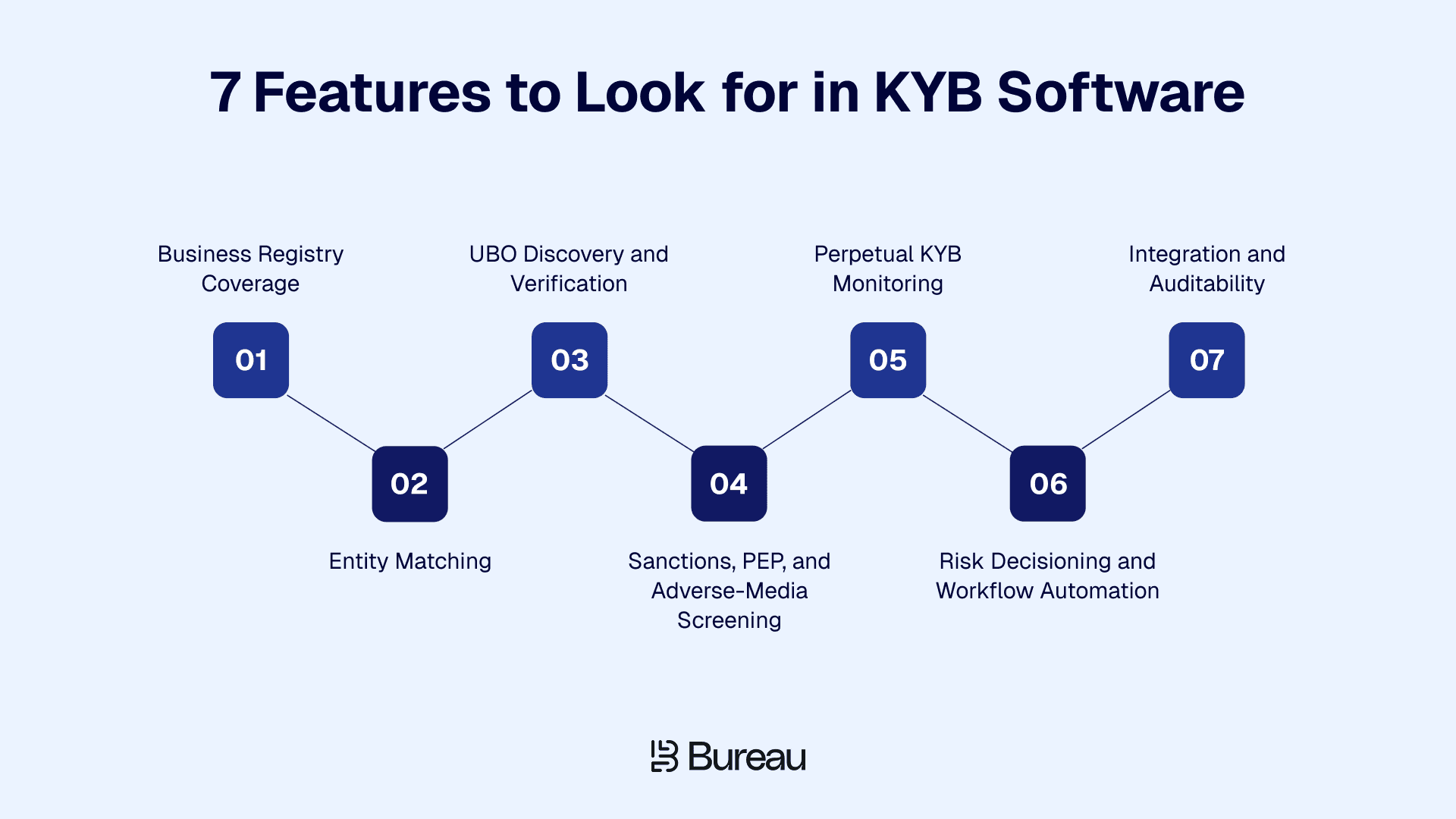
Many KYB providers offer similar features, but weak automation can still leave compliance teams with heavy manual work. In the 2025 Financial Crime Benchmarking Survey, 94% of participating banks cited manual workloads as a major AML/KYC challenge. That makes data quality, ownership resolution, monitoring, and workflow automation critical when comparing providers.
Evaluate each provider against actual markets and business types.
Business registry coverage: Check which official, commercial, submitted, or manually researched sources are available in each market. Strong coverage reduces document requests and improves verification rates.
Entity matching: See how well the platform handles incomplete, inconsistent, or mismatched business details. Accurate matching helps prevent valid businesses from being sent to manual review.
UBO discovery and verification: Look for direct and indirect ownership mapping, control relationships, and KYC checks for directors and beneficial owners. This is essential for identifying who ultimately owns or controls the business.
Sanctions, PEP, and adverse-media screening: Confirm coverage for both businesses and related individuals, with clear match explanations and regular updates. Better screening helps analysts assess risk faster and reduce false-positive reviews.
Perpetual KYB: Check whether the platform monitors ownership, directors, company status, filings, and sanctions exposure after onboarding. Ongoing monitoring helps teams catch material risk changes without waiting for periodic reviews.
Risk decisioning and workflow automation: Look for configurable rules, approval paths, review queues, document collection, and escalations. These features help automate low-risk cases and focus analysts on complex ones.
Integration and auditability: Review APIs, webhooks, exports, source evidence, timestamps, reason codes, and decision histories. Strong integration and audit trails make KYB easier to operate, investigate, and defend during audits.
Coverage and automation can vary widely by market. Testing providers with representative entities can reveal where manual work, incomplete data, or complex ownership may still create operational friction.
7 Best KYB Software Providers in 2026
The providers in this list are organized by buyer relevance rather than a universal performance ranking. Each platform uses a different operating model, so the best fit depends on markets, existing compliance stack, onboarding volumes, and decisioning needs.
1. Bureau
Bureau is an AI-powered Unified Risk Decisioning Platform that includes KYB within a broader onboarding, compliance, and risk workflow. It combines KYB automation and business verification, ownership intelligence, sanctions checks, risk scoring, and ongoing monitoring in one decisioning layer.
Its KYB capabilities bring business verification, ownership checks, compliance screening, risk scoring, and ongoing monitoring into the same decisioning workflow.
Key strengths:
Decision-led KYB: Bureau helps teams approve, review, reject, or escalate a business instead of returning disconnected data points. This gives compliance teams a clearer path from verification to action.
Connected ownership intelligence: It links businesses with directors, UBOs, related parties, and wider risk relationships, helping teams identify hidden ownership risks and suspicious connections earlier.
Unified onboarding and monitoring: Teams can manage onboarding checks and post-approval monitoring from one orchestration layer, reducing handoffs and keeping business risk visible throughout the relationship.
Flexible deployment: Modular APIs and prefilled workflows support both targeted integrations and wider onboarding programs, making it easier to fit KYB into existing systems and processes.
Broader risk coverage: Physical storefront checks, synthetic identity detection, graph analysis, and device intelligence can be added through the same integration, giving teams more context than registry data alone.
Explainable decisions: Supporting signals, decision reasons, and source information can be retained for review and audit, helping analysts investigate cases faster and defend decisions with clearer evidence.
These capabilities are useful when business verification involves more than a registry response. A contractor may have limited formal records, a layered ownership structure, an inconsistent digital footprint, or financial and identity signals that need to be assessed together.
How Bureau helped ProjectHero build trust at scale
ProjectHero needed to verify workers and contractors across India’s informal construction sector. Many users lacked reliable profiles, work histories, and reputation signals. The business also depended on several API providers, which made it difficult to combine identity, financial, and behavioral information into a consistent trust decision.
What Bureau implemented:
Verified workers and contractors using identity and KYB checks
Assessed contractor financial health and payment reliability
Added phone, digital-footprint, and behavioral signals
Powered PH Trust Scores using real-time risk decisioning
Combined fragmented signals within one platform
Results achieved:
More than 10,000 users verified soon after deployment
PH Trust Scores extended to over 500,000 users within two months
Verified users saw a 7x increase in employment probability
Vendor sprawl was reduced, easing work for engineering and product teams
Read the full case study here → Fraud Prevention in India's Construction Sector
This case shows how Bureau can connect KYC checks, KYB, identity, financial, and behavioral signals to support practical onboarding decisions, enabling businesses to look beyond account-level defense to network-level intelligence.
What buyers should consider:
Confirm registry depth, indirect ownership resolution, monitoring triggers, implementation support, and data-retention requirements across each market where Bureau will be used.
Map which existing KYC, AML, and decision-engine tools Bureau will replace, retain, or orchestrate before finalizing the deployment model.
Pricing: Pricing is customized based on verification volume, markets, selected modules, and workflow requirements.
2. Middesk

Middesk is a business identity and verification provider with a strong focus on US company onboarding. It helps teams access primary-source business information, verify formation details, collect ownership data, and run compliance checks within one KYB workflow.
Key strengths:
US business verification: Middesk supports state and secretary-of-state checks across all 50 US states.
Business identity resolution: It helps confirm formation status, registration details, business addresses, and other core company information.
UBO and representative collection: Teams can gather beneficial ownership and authorized representative details during onboarding.
Compliance screening: The platform supports OFAC, PEP, sanctions, and adverse-media checks within a US-focused KYB process.
Reduced manual research: Direct access to fragmented state-level records can reduce time spent searching government sources.
What buyers should consider:
Middesk is strongest for US onboarding, so international teams should confirm registry depth, ownership resolution, and monitoring coverage across each priority market before moving forward.
Complex or cross-border ownership structures may require additional review, and teams should test how Middesk handles layered entities, conflicting records, and uncertain matches during onboarding.
Pricing: Middesk uses quote-led or volume-based pricing. Buyers should confirm minimum commitments, manual research charges, monitoring fees, and any additional costs tied to ownership or screening checks.
3. HyperVerge
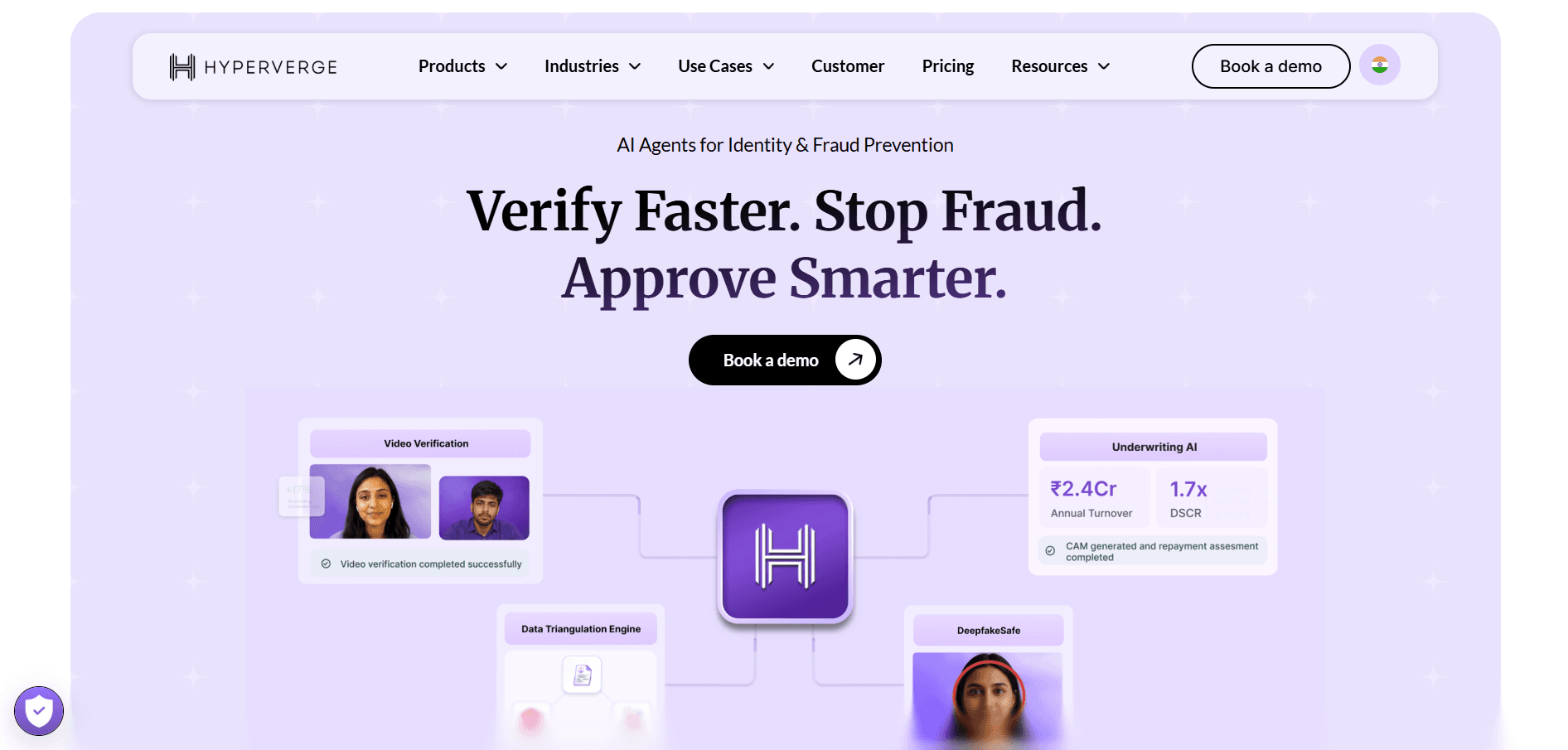
HyperVerge is an identity verification and onboarding platform that extends its KYC capabilities into business verification. Its KYB offering is particularly relevant for organizations onboarding merchants, MSMEs, corporate borrowers, vendors, and other businesses in India.
Key strengths:
India-focused business verification: HyperVerge supports checks across GST, MCA-related records, CIN, DIN, PAN-linked data, and other Indian company and tax sources.
Business-document OCR: The platform can extract information from submitted documents, helping teams reduce manual data entry and speed up document review.
UBO and related-party checks: It can identify beneficial owners and route directors, representatives, and controllers through individual KYC workflows.
Connected screening: Businesses and associated individuals can be screened against sanctions, PEP, watchlist, and adverse-media sources within the same process.
Configurable onboarding flows: No-code workflows and hosted verification links can help teams adjust journeys without rebuilding the entire front-end experience.
HyperVerge may be a strong fit for banks, NBFCs, fintechs, lenders, payment companies, and marketplaces that already need KYC alongside KYB. Its operating model can help teams keep company verification, individual checks, and onboarding decisions within one workflow.
What buyers should consider:
International teams should confirm registry coverage market by market, as HyperVerge’s KYB offering is primarily focused on Indian company and tax-data sources.
Some reviewers recommend validating SDK documentation and manual review workflows, especially when testing edge cases during implementation.
Pricing: Pricing is customized. Buyers should confirm whether document OCR, UBO KYC, AML screening, hosted workflows, manual reviews, and ongoing monitoring are billed separately.
Related Read: HyperVerge Competitors & Alternatives in 2026
4. iDenfy
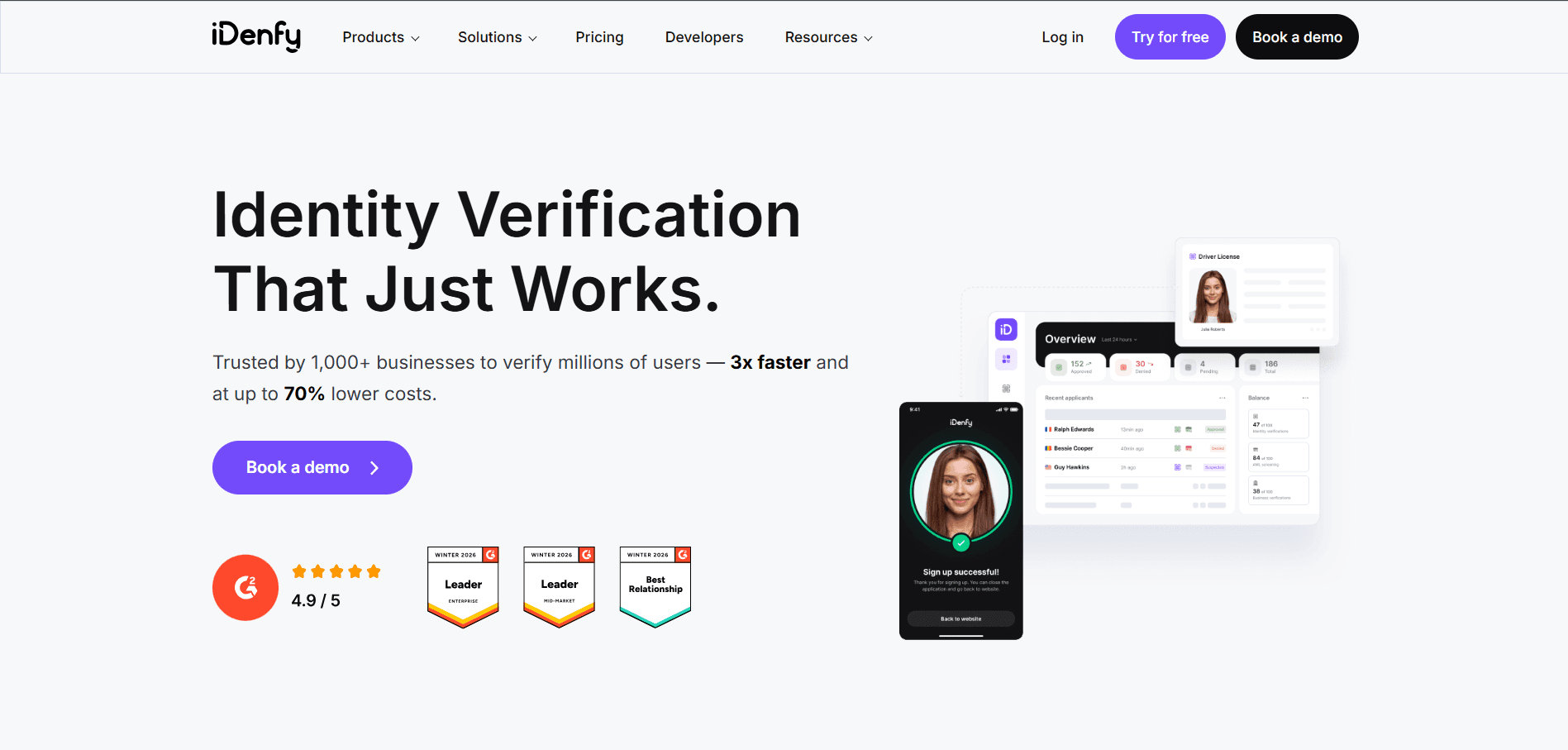
iDenfy combines KYB, KYC, and AML capabilities within one platform. It is designed for businesses that want to verify companies and associated individuals without managing separate workflows for each check.
Key strengths:
Combined compliance stack: KYB, identity verification, AML screening, and ongoing due diligence are available within one product family.
Associated-person verification: Directors, representatives, and UBOs can be moved from a business case into individual identity-verification flows.
Business data coverage: iDenfy describes access to more than 180 registries across 120+ countries, though buyers should confirm depth in each market.
Configurable data collection: Teams can collect company documents, ownership details, and business questionnaires within the onboarding flow.
Ongoing monitoring: Screening updates and due-diligence alerts can support compliance checks after the initial business approval.
iDenfy supports API integration and dashboard-led checks, allowing teams to embed verification into onboarding or manage cases through an analyst interface. Its modular setup can also reduce handoffs and separate integrations across KYB, KYC, AML screening, and monitoring.
What buyers should consider:
Confirm registry depth, refresh intervals, automation levels, and manual-review requirements in each market, especially for indirect or cross-border ownership structures.
Some reviewers want clearer explanations behind automated decisions, so teams should test decision transparency, false-positive handling, and investigation workflows during evaluation.
Pricing: iDenfy uses customized pricing based on selected modules, verification volumes, markets, and monitoring needs. Buyers should confirm whether KYB checks, UBO verification, AML screening, manual reviews, and ongoing monitoring are priced separately.
5. GBG
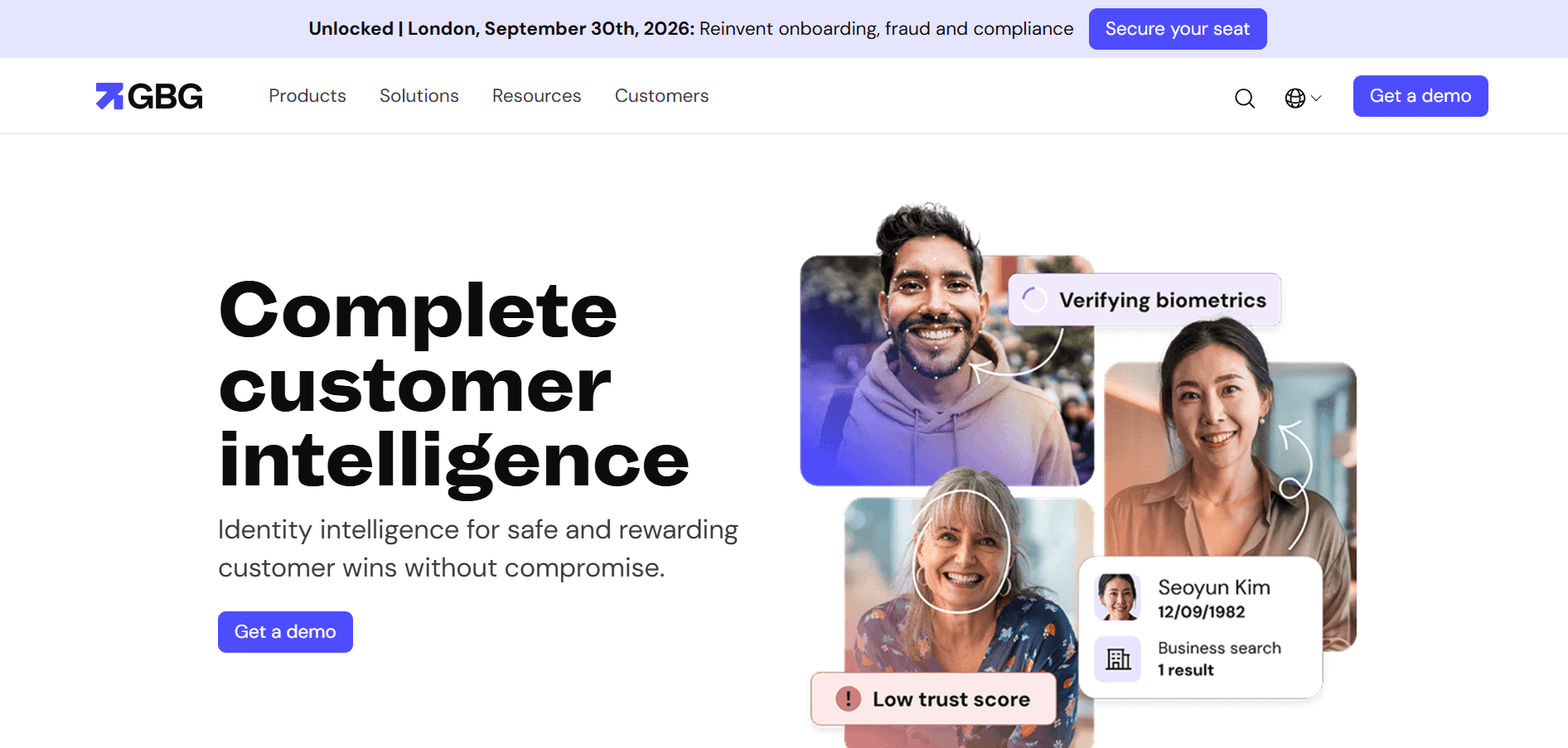
GBG is an established identity and fraud-data company that offers KYB workflows for business verification, beneficial ownership discovery, sanctions screening, and ongoing monitoring. Its broader identity and risk-data ecosystem may appeal to regulated enterprises that want company and individual checks within one provider relationship.
Key strengths:
Broader risk-data ecosystem: GBG combines business verification with identity, fraud, and location-data capabilities.
Ownership discovery: The platform supports UBO identification and relationship visualization across business structures.
Business and individual checks: Teams can verify companies, directors, beneficial owners, and other associated individuals within the same workflow.
Ongoing screening: Sanctions, watchlist, and business-risk monitoring can continue after onboarding.
Enterprise support: GBG is positioned for regulated organizations with complex compliance, integration, and governance requirements.
GBG may be a practical option for enterprises already using its identity, fraud, or location-data services. Extending an existing relationship into KYB can simplify procurement and reduce the number of vendors involved. Teams should still compare the business-case workflow with specialist KYB-first platforms, especially where ownership structures are complex or analyst volumes are high.
What buyers should consider:
Some users note that GBG integrations may require additional software installation, so teams should confirm deployment requirements and ongoing maintenance before implementation.
Confirm which KYB capabilities are native and which depend on connected datasets, including how ownership evidence is sourced, displayed, and retained for audit.
Pricing: GBG uses enterprise or customized pricing. Buyers should request a module-level breakdown covering business verification, ownership checks, screening, monitoring, implementation, and any required customization.
6. Sumsub
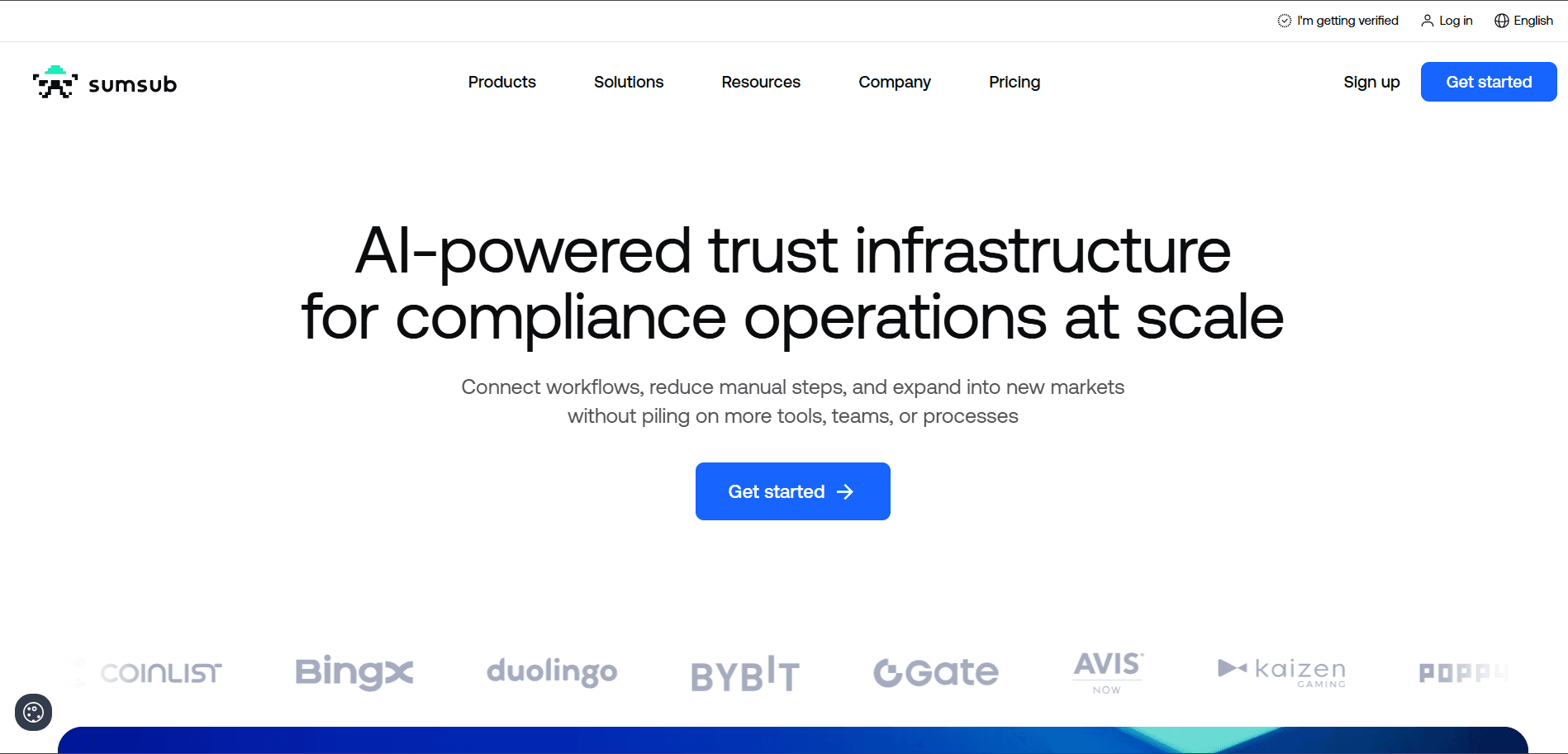
Sumsub is a digital verification and compliance platform that combines consumer identity checks, business verification, AML screening, and ongoing monitoring. Its KYB workflow is designed for organizations that onboard both individuals and companies within the same compliance environment.
Key strengths:
Combined KYC and KYB workflows: Sumsub supports business checks alongside individual verification, which can reduce handoffs between separate systems.
End-to-end business onboarding: Teams can collect company information, verify registry data, review documents, and complete director or UBO checks within one flow.
Integrated AML controls: Sanctions, PEP, and broader risk screening can be applied to both entities and associated individuals.
Configurable risk rules: Businesses can use questionnaires, review logic, and remediation workflows to route cases based on risk.
Ongoing monitoring: The platform supports post-onboarding controls, alerting, and case review as risk information changes.
Sumsub may suit digital-first and cross-border businesses that value one compliance platform across B2C and B2B onboarding. Its workflow extends beyond a basic registry response by connecting company checks, related-person verification, screening, and review processes.
What buyers should consider:
Test UBO mapping for layered ownership structures, compare market-level coverage, and confirm how much workflow customization requires professional services.
Some reviewers say that onboarding can take longer than expected because of agreements, approvals, and production sign-offs, especially for reseller deployments.
Pricing: Sumsub uses customized pricing based on verification volumes, markets, modules, and workflow requirements. Buyers should confirm how costs change when multiple directors, representatives, or UBOs must be verified for each business.
7. Dotfile
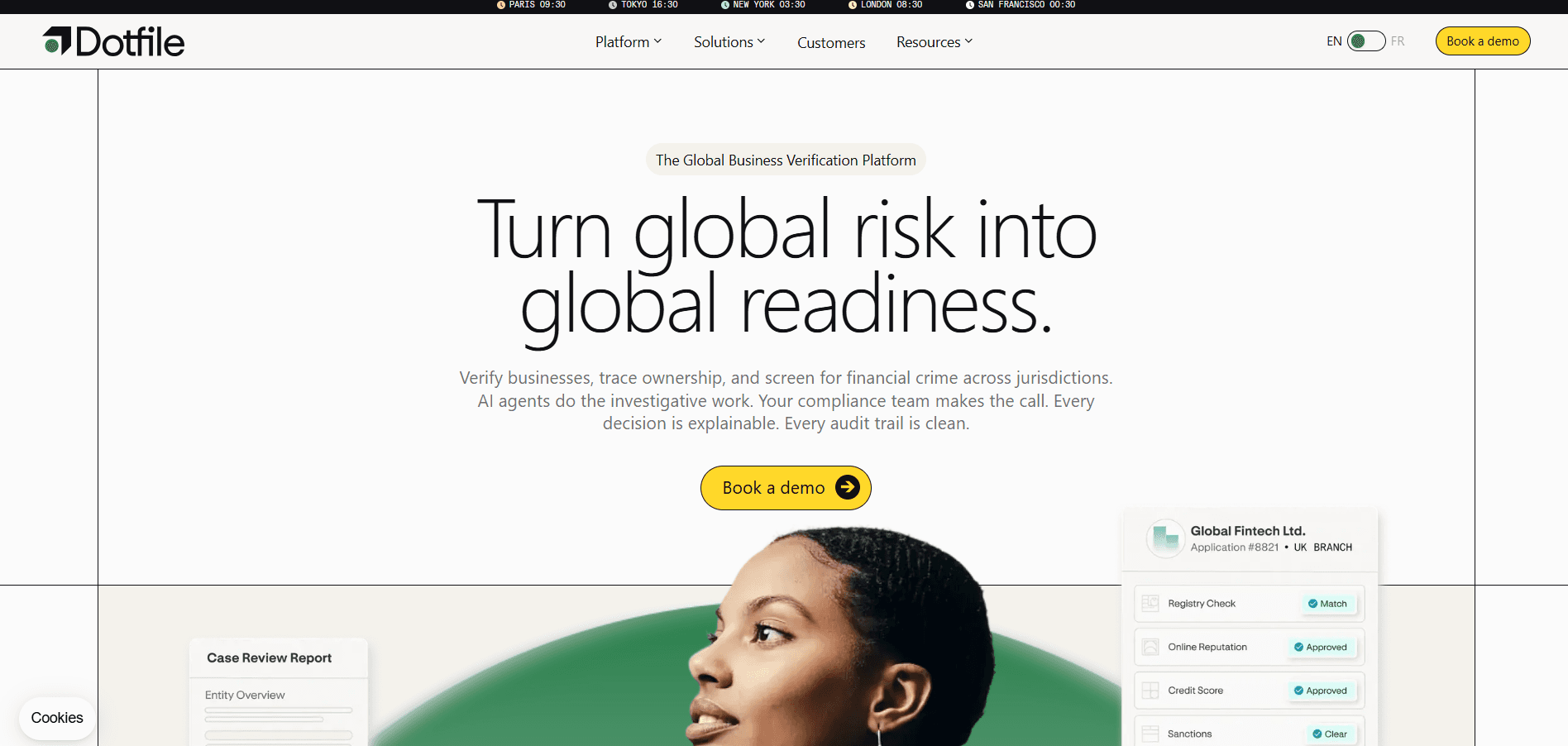
Dotfile is a KYB-first compliance automation platform built around business verification, ownership mapping, AML screening, case management, and ongoing monitoring. Its workflows are designed for teams that want KYB to sit at the center of business onboarding rather than as an extension of a consumer KYC product.
Key strengths:
KYB-first workflow: Business verification, ownership checks, screening, and review are managed within one compliance-focused platform.
Ownership intelligence: Dotfile helps teams map corporate structures and related parties without building ownership trees manually.
Automated information collection: Document requests, questionnaires, and missing-data follow-ups can be handled within the onboarding flow.
Case management and monitoring: Alerts, review queues, and ongoing corporate or compliance events can be managed from the same system.
API-led automation: Well-documented APIs and webhooks can help teams keep internal systems synchronized and reduce manual case handling.
This operating model can reduce the time analysts spend collecting documents, rebuilding ownership structures, chasing applicants, and preparing periodic reviews. It can also help teams focus on cases that genuinely need attention instead of reviewing every business manually.
What buyers should consider:
Verify source coverage, data freshness, and ownership evidence in each target country, especially where registry access and corporate structures vary significantly.
Some reviewers report occasional false positives in AML screening, so teams should test match quality, alert triage, and manual-review effort during evaluation.
Pricing: Dotfile uses customized pricing based on markets, verification volumes, modules, and workflow requirements. Buyers should confirm whether document collection, AML screening, monitoring, manual review, and implementation support are priced separately.
Related Read: Top 9 Identity Verification Solution Providers
Questions to Ask Before You Choose a KYB Software
Feature lists do not show how a KYB platform will perform in a real onboarding workflow. Teams need to compare not only verification coverage, but also data quality, ownership resolution, monitoring, integration effort, manual review requirements, and total operating cost.
This matters because inefficient compliance processes can create a significant financial burden. TheCityUK and PwC’s 2025 Reducing the Risk of Compliance study estimated that regulatory compliance costs exceed £33.9 billion annually across UK financial services, representing more than 13% of firms’ average operating costs.
A platform that adds manual work, fragmented checks, or complex integrations may increase that burden even when its feature list appears comprehensive.
Use the following questions to compare shortlisted providers across coverage, automation, auditability, and cost.
Procurement question | What to evaluate | Top product to assess |
Which registries and data sources are used in our priority markets? | Source type, country-level depth, and access to official records | Bureau for global coverage, Middesk for the US, and HyperVerge for India |
Is data retrieved in real time, refreshed, cached, or manually researched? | Data freshness, refresh frequency, and handling of stale records | Middesk |
How does the platform resolve indirect ownership and cross-border structures? | Ownership depth, relationship mapping, and evidence trails | Dotfile or GBG |
Can it verify directors, representatives, controllers, and UBOs as individuals? | Links between the business case and individual KYC checks | iDenfy or Sumsub |
Which sanctions, PEP, adverse-media, enforcement, and watchlist sources are included? | Screening breadth, source quality, and update frequency | Sumsub or iDenfy |
How are false-positive screening matches explained and resolved? | Match reasoning, analyst workflows, and review effort | Dotfile |
Which ownership, directorship, filing, status, and sanctions changes trigger alerts? | Monitoring scope, alert timing, and event coverage | Bureau or Dotfile |
Can teams configure approval, review, rejection, and enhanced due-diligence rules without engineering support? | Rule flexibility, workflow ownership, and escalation paths | Bureau or HyperVerge |
What evidence, timestamps, reason codes, and decision records are retained for audits? | Audit trails, source evidence, and explainability | GBG or Bureau |
How does the platform integrate with existing KYC, AML, case-management, and onboarding systems? | APIs, webhooks, orchestration, and implementation effort | Bureau, iDenfy, or Sumsub |
What is the total cost after registry charges, related-person checks, screening, monitoring, implementation, and support? | Total cost per approved business, not just per-check pricing | Compare all shortlisted providers |
Test shortlisted KYB tools with real entities from different markets. Include layered ownership structures, incomplete records, and known screening cases. This gives a clearer view of approval quality, review effort, and total operating cost.
Choose Continuous KYB Monitoring with Bureau
KYB does not end once a business is approved. A change in ownership, leadership, sanctions exposure, company status, or business activity can create new risk later. That makes ongoing visibility just as important as the initial verification.
Teams need a way to detect meaningful changes and decide when to approve, review, or escalate a business. Bureau brings verification, ownership intelligence, screening, monitoring, and workflow rules into one decisioning layer. This can help compliance teams reduce fragmented checks and respond faster when a business profile changes.
To see how that model fits existing workflows, schedule a demo with Bureau and evaluate it against real entities from priority markets.
FAQs
1. What is KYB software?
KYB software verifies a business, its ownership, controllers, and compliance risk using registry data, UBO checks, sanctions screening, and ongoing monitoring. Platforms such as Bureau, Middesk, HyperVerge, iDenfy, GBG, Sumsub, and Dotfile support different combinations of these capabilities.
2. What should KYB software check?
KYB software should check the legal name, registration number, status, address, directors, officers, ownership structure, UBOs, controllers, sanctions and PEP exposure, adverse media, relevant licences, and material changes that occur after onboarding.
3. How does KYB software identify beneficial owners?
KYB software identifies beneficial owners by combining registry records, shareholder data, company filings, customer declarations, and ownership calculations. It traces direct and indirect control, then routes identified individuals through KYC, sanctions, PEP, and AML checks.
4. What is the difference between KYB and KYC software?
KYB verifies companies and ownership structures, while KYC verifies individuals. Most business-onboarding flows need both because directors, representatives, and UBOs must be checked personally. Bureau connects KYB with its KYC solution within one workflow.
5. How does Bureau support perpetual KYB?
Bureau supports perpetual KYB by continuously monitoring ownership, directors, company status, sanctions exposure, adverse media, and registry changes. These signals feed into ongoing risk decisioning, helping teams reassess businesses and trigger review when material information changes.
6. How often should a business be reverified?
Reverification frequency depends on jurisdiction, customer risk, business type, and internal policy. Higher-risk entities may need more frequent or event-driven reviews, while lower-risk businesses may follow longer cycles. There is no single schedule that suits every organization.
Business onboarding can become difficult when company records are incomplete, ownership structures are complex, and screening checks create long review queues.
The right KYB software can make this process much easier. It helps teams verify businesses, identify UBOs, screen related individuals, and monitor risk after approval with less manual effort. This is especially useful for banks, fintechs, lenders, marketplaces, and payment companies that onboard legal entities across multiple markets.
This comparison covers the top KYB providers, the features that matter the most during evaluation, and how each platform approaches ownership verification, monitoring, workflows, and integration. It will help buyers build a stronger shortlist based on respective markets, compliance needs, and operating model.
KYB Software Comparison: Top 7 Providers at a Glance
KYB software helps businesses verify companies, identify directors and ultimate beneficial owners, screen for compliance risks, and monitor changes after onboarding. The best choice depends on the markets the buyer operates in, the complexity of the businesses onboarded, and the workflows needed by the team.
Use this comparison as a starting point to shortlist providers.
Provider | UBO and Ownership Approach | Registry and Market Reach | Screening Emphasis | Monitoring Scope | Best-Fit Buyer |
Bureau | Maps ownership structures, directors, related parties, and business-risk relationships | Business verification across 195+ countries and jurisdictions using registry, tax, ownership, and sanctions data | Integrates sanctions and business-risk checks into the KYB workflow | Monitors ownership, filings, company status, and sanctions changes | Fintechs and digital businesses that want KYB connected to broader risk decisioning |
Middesk | Supports UBO collection and verification within business onboarding workflows | Strong coverage of US primary-source and state-level business data | Supports OFAC, PEP, sanctions, and adverse-media checks | Monitors business status and compliance-related changes | US-focused fintechs, lenders, marketplaces, and B2B platforms |
HyperVerge | Identifies UBOs and routes directors, representatives, and beneficial owners through identity-verification checks | Strong India-focused coverage through GST, PAN, CIN, DIN, and NSDL sources | Screens entities and associated individuals against sanctions, PEP, adverse-media, and watchlist sources | Supports automated screening updates | India-focused banks, NBFCs, fintechs, lenders, and platforms seeking connected KYB, KYC, and onboarding |
iDenfy | Combines UBO identification with identity verification for directors and related individuals | Connects with business registries across multiple countries | Supports sanctions, PEP, watchlist, and ongoing due-diligence checks | Provides monitoring, alerts, and workflow triggers | Teams seeking KYB, KYC, and AML capabilities from one provider |
GBG | Supports ownership discovery and the visualization of corporate relationships | Provides multi-jurisdiction business-verification capabilities | Screens entities, UBOs, and related individuals against sanctions and watchlists | Supports ongoing KYB and business-risk monitoring | Financial institutions that need broad identity and compliance coverage |
Sumsub | Combines business verification with checks on UBOs and authorized representatives | Supports global digital-business onboarding | Integrates KYB, KYC, AML, sanctions, and broader risk checks | Provides ongoing AML and business-risk monitoring | Digital businesses seeking a combined KYC and KYB stack |
Dotfile | Automates ownership mapping and related-party verification | Provides business-verification coverage across 200+ jurisdictions | Screens entities and individuals within a KYB-focused workflow | Monitors ownership, sanctions exposure, and material corporate events | Compliance teams prioritizing KYB workflow automation |
KYB providers can look similar at a glance, but data quality, ownership resolution, screening depth, monitoring, and workflow flexibility often vary by market and business type. These are the capabilities that shape how well a platform performs in practice.
Features to Look for When Shortlisting KYB Providers
Many KYB providers offer similar features, but weak automation can still leave compliance teams with heavy manual work. In the 2025 Financial Crime Benchmarking Survey, 94% of participating banks cited manual workloads as a major AML/KYC challenge. That makes data quality, ownership resolution, monitoring, and workflow automation critical when comparing providers.
Evaluate each provider against actual markets and business types.
Business registry coverage: Check which official, commercial, submitted, or manually researched sources are available in each market. Strong coverage reduces document requests and improves verification rates.
Entity matching: See how well the platform handles incomplete, inconsistent, or mismatched business details. Accurate matching helps prevent valid businesses from being sent to manual review.
UBO discovery and verification: Look for direct and indirect ownership mapping, control relationships, and KYC checks for directors and beneficial owners. This is essential for identifying who ultimately owns or controls the business.
Sanctions, PEP, and adverse-media screening: Confirm coverage for both businesses and related individuals, with clear match explanations and regular updates. Better screening helps analysts assess risk faster and reduce false-positive reviews.
Perpetual KYB: Check whether the platform monitors ownership, directors, company status, filings, and sanctions exposure after onboarding. Ongoing monitoring helps teams catch material risk changes without waiting for periodic reviews.
Risk decisioning and workflow automation: Look for configurable rules, approval paths, review queues, document collection, and escalations. These features help automate low-risk cases and focus analysts on complex ones.
Integration and auditability: Review APIs, webhooks, exports, source evidence, timestamps, reason codes, and decision histories. Strong integration and audit trails make KYB easier to operate, investigate, and defend during audits.
Coverage and automation can vary widely by market. Testing providers with representative entities can reveal where manual work, incomplete data, or complex ownership may still create operational friction.
7 Best KYB Software Providers in 2026
The providers in this list are organized by buyer relevance rather than a universal performance ranking. Each platform uses a different operating model, so the best fit depends on markets, existing compliance stack, onboarding volumes, and decisioning needs.
1. Bureau
Bureau is an AI-powered Unified Risk Decisioning Platform that includes KYB within a broader onboarding, compliance, and risk workflow. It combines KYB automation and business verification, ownership intelligence, sanctions checks, risk scoring, and ongoing monitoring in one decisioning layer.
Its KYB capabilities bring business verification, ownership checks, compliance screening, risk scoring, and ongoing monitoring into the same decisioning workflow.
Key strengths:
Decision-led KYB: Bureau helps teams approve, review, reject, or escalate a business instead of returning disconnected data points. This gives compliance teams a clearer path from verification to action.
Connected ownership intelligence: It links businesses with directors, UBOs, related parties, and wider risk relationships, helping teams identify hidden ownership risks and suspicious connections earlier.
Unified onboarding and monitoring: Teams can manage onboarding checks and post-approval monitoring from one orchestration layer, reducing handoffs and keeping business risk visible throughout the relationship.
Flexible deployment: Modular APIs and prefilled workflows support both targeted integrations and wider onboarding programs, making it easier to fit KYB into existing systems and processes.
Broader risk coverage: Physical storefront checks, synthetic identity detection, graph analysis, and device intelligence can be added through the same integration, giving teams more context than registry data alone.
Explainable decisions: Supporting signals, decision reasons, and source information can be retained for review and audit, helping analysts investigate cases faster and defend decisions with clearer evidence.
These capabilities are useful when business verification involves more than a registry response. A contractor may have limited formal records, a layered ownership structure, an inconsistent digital footprint, or financial and identity signals that need to be assessed together.
How Bureau helped ProjectHero build trust at scale
ProjectHero needed to verify workers and contractors across India’s informal construction sector. Many users lacked reliable profiles, work histories, and reputation signals. The business also depended on several API providers, which made it difficult to combine identity, financial, and behavioral information into a consistent trust decision.
What Bureau implemented:
Verified workers and contractors using identity and KYB checks
Assessed contractor financial health and payment reliability
Added phone, digital-footprint, and behavioral signals
Powered PH Trust Scores using real-time risk decisioning
Combined fragmented signals within one platform
Results achieved:
More than 10,000 users verified soon after deployment
PH Trust Scores extended to over 500,000 users within two months
Verified users saw a 7x increase in employment probability
Vendor sprawl was reduced, easing work for engineering and product teams
Read the full case study here → Fraud Prevention in India's Construction Sector
This case shows how Bureau can connect KYC checks, KYB, identity, financial, and behavioral signals to support practical onboarding decisions, enabling businesses to look beyond account-level defense to network-level intelligence.
What buyers should consider:
Confirm registry depth, indirect ownership resolution, monitoring triggers, implementation support, and data-retention requirements across each market where Bureau will be used.
Map which existing KYC, AML, and decision-engine tools Bureau will replace, retain, or orchestrate before finalizing the deployment model.
Pricing: Pricing is customized based on verification volume, markets, selected modules, and workflow requirements.
2. Middesk
Middesk is a business identity and verification provider with a strong focus on US company onboarding. It helps teams access primary-source business information, verify formation details, collect ownership data, and run compliance checks within one KYB workflow.
Key strengths:
US business verification: Middesk supports state and secretary-of-state checks across all 50 US states.
Business identity resolution: It helps confirm formation status, registration details, business addresses, and other core company information.
UBO and representative collection: Teams can gather beneficial ownership and authorized representative details during onboarding.
Compliance screening: The platform supports OFAC, PEP, sanctions, and adverse-media checks within a US-focused KYB process.
Reduced manual research: Direct access to fragmented state-level records can reduce time spent searching government sources.
What buyers should consider:
Middesk is strongest for US onboarding, so international teams should confirm registry depth, ownership resolution, and monitoring coverage across each priority market before moving forward.
Complex or cross-border ownership structures may require additional review, and teams should test how Middesk handles layered entities, conflicting records, and uncertain matches during onboarding.
Pricing: Middesk uses quote-led or volume-based pricing. Buyers should confirm minimum commitments, manual research charges, monitoring fees, and any additional costs tied to ownership or screening checks.
3. HyperVerge
HyperVerge is an identity verification and onboarding platform that extends its KYC capabilities into business verification. Its KYB offering is particularly relevant for organizations onboarding merchants, MSMEs, corporate borrowers, vendors, and other businesses in India.
Key strengths:
India-focused business verification: HyperVerge supports checks across GST, MCA-related records, CIN, DIN, PAN-linked data, and other Indian company and tax sources.
Business-document OCR: The platform can extract information from submitted documents, helping teams reduce manual data entry and speed up document review.
UBO and related-party checks: It can identify beneficial owners and route directors, representatives, and controllers through individual KYC workflows.
Connected screening: Businesses and associated individuals can be screened against sanctions, PEP, watchlist, and adverse-media sources within the same process.
Configurable onboarding flows: No-code workflows and hosted verification links can help teams adjust journeys without rebuilding the entire front-end experience.
HyperVerge may be a strong fit for banks, NBFCs, fintechs, lenders, payment companies, and marketplaces that already need KYC alongside KYB. Its operating model can help teams keep company verification, individual checks, and onboarding decisions within one workflow.
What buyers should consider:
International teams should confirm registry coverage market by market, as HyperVerge’s KYB offering is primarily focused on Indian company and tax-data sources.
Some reviewers recommend validating SDK documentation and manual review workflows, especially when testing edge cases during implementation.
Pricing: Pricing is customized. Buyers should confirm whether document OCR, UBO KYC, AML screening, hosted workflows, manual reviews, and ongoing monitoring are billed separately.
Related Read: HyperVerge Competitors & Alternatives in 2026
4. iDenfy
iDenfy combines KYB, KYC, and AML capabilities within one platform. It is designed for businesses that want to verify companies and associated individuals without managing separate workflows for each check.
Key strengths:
Combined compliance stack: KYB, identity verification, AML screening, and ongoing due diligence are available within one product family.
Associated-person verification: Directors, representatives, and UBOs can be moved from a business case into individual identity-verification flows.
Business data coverage: iDenfy describes access to more than 180 registries across 120+ countries, though buyers should confirm depth in each market.
Configurable data collection: Teams can collect company documents, ownership details, and business questionnaires within the onboarding flow.
Ongoing monitoring: Screening updates and due-diligence alerts can support compliance checks after the initial business approval.
iDenfy supports API integration and dashboard-led checks, allowing teams to embed verification into onboarding or manage cases through an analyst interface. Its modular setup can also reduce handoffs and separate integrations across KYB, KYC, AML screening, and monitoring.
What buyers should consider:
Confirm registry depth, refresh intervals, automation levels, and manual-review requirements in each market, especially for indirect or cross-border ownership structures.
Some reviewers want clearer explanations behind automated decisions, so teams should test decision transparency, false-positive handling, and investigation workflows during evaluation.
Pricing: iDenfy uses customized pricing based on selected modules, verification volumes, markets, and monitoring needs. Buyers should confirm whether KYB checks, UBO verification, AML screening, manual reviews, and ongoing monitoring are priced separately.
5. GBG
GBG is an established identity and fraud-data company that offers KYB workflows for business verification, beneficial ownership discovery, sanctions screening, and ongoing monitoring. Its broader identity and risk-data ecosystem may appeal to regulated enterprises that want company and individual checks within one provider relationship.
Key strengths:
Broader risk-data ecosystem: GBG combines business verification with identity, fraud, and location-data capabilities.
Ownership discovery: The platform supports UBO identification and relationship visualization across business structures.
Business and individual checks: Teams can verify companies, directors, beneficial owners, and other associated individuals within the same workflow.
Ongoing screening: Sanctions, watchlist, and business-risk monitoring can continue after onboarding.
Enterprise support: GBG is positioned for regulated organizations with complex compliance, integration, and governance requirements.
GBG may be a practical option for enterprises already using its identity, fraud, or location-data services. Extending an existing relationship into KYB can simplify procurement and reduce the number of vendors involved. Teams should still compare the business-case workflow with specialist KYB-first platforms, especially where ownership structures are complex or analyst volumes are high.
What buyers should consider:
Some users note that GBG integrations may require additional software installation, so teams should confirm deployment requirements and ongoing maintenance before implementation.
Confirm which KYB capabilities are native and which depend on connected datasets, including how ownership evidence is sourced, displayed, and retained for audit.
Pricing: GBG uses enterprise or customized pricing. Buyers should request a module-level breakdown covering business verification, ownership checks, screening, monitoring, implementation, and any required customization.
6. Sumsub
Sumsub is a digital verification and compliance platform that combines consumer identity checks, business verification, AML screening, and ongoing monitoring. Its KYB workflow is designed for organizations that onboard both individuals and companies within the same compliance environment.
Key strengths:
Combined KYC and KYB workflows: Sumsub supports business checks alongside individual verification, which can reduce handoffs between separate systems.
End-to-end business onboarding: Teams can collect company information, verify registry data, review documents, and complete director or UBO checks within one flow.
Integrated AML controls: Sanctions, PEP, and broader risk screening can be applied to both entities and associated individuals.
Configurable risk rules: Businesses can use questionnaires, review logic, and remediation workflows to route cases based on risk.
Ongoing monitoring: The platform supports post-onboarding controls, alerting, and case review as risk information changes.
Sumsub may suit digital-first and cross-border businesses that value one compliance platform across B2C and B2B onboarding. Its workflow extends beyond a basic registry response by connecting company checks, related-person verification, screening, and review processes.
What buyers should consider:
Test UBO mapping for layered ownership structures, compare market-level coverage, and confirm how much workflow customization requires professional services.
Some reviewers say that onboarding can take longer than expected because of agreements, approvals, and production sign-offs, especially for reseller deployments.
Pricing: Sumsub uses customized pricing based on verification volumes, markets, modules, and workflow requirements. Buyers should confirm how costs change when multiple directors, representatives, or UBOs must be verified for each business.
7. Dotfile
Dotfile is a KYB-first compliance automation platform built around business verification, ownership mapping, AML screening, case management, and ongoing monitoring. Its workflows are designed for teams that want KYB to sit at the center of business onboarding rather than as an extension of a consumer KYC product.
Key strengths:
KYB-first workflow: Business verification, ownership checks, screening, and review are managed within one compliance-focused platform.
Ownership intelligence: Dotfile helps teams map corporate structures and related parties without building ownership trees manually.
Automated information collection: Document requests, questionnaires, and missing-data follow-ups can be handled within the onboarding flow.
Case management and monitoring: Alerts, review queues, and ongoing corporate or compliance events can be managed from the same system.
API-led automation: Well-documented APIs and webhooks can help teams keep internal systems synchronized and reduce manual case handling.
This operating model can reduce the time analysts spend collecting documents, rebuilding ownership structures, chasing applicants, and preparing periodic reviews. It can also help teams focus on cases that genuinely need attention instead of reviewing every business manually.
What buyers should consider:
Verify source coverage, data freshness, and ownership evidence in each target country, especially where registry access and corporate structures vary significantly.
Some reviewers report occasional false positives in AML screening, so teams should test match quality, alert triage, and manual-review effort during evaluation.
Pricing: Dotfile uses customized pricing based on markets, verification volumes, modules, and workflow requirements. Buyers should confirm whether document collection, AML screening, monitoring, manual review, and implementation support are priced separately.
Related Read: Top 9 Identity Verification Solution Providers
Questions to Ask Before You Choose a KYB Software
Feature lists do not show how a KYB platform will perform in a real onboarding workflow. Teams need to compare not only verification coverage, but also data quality, ownership resolution, monitoring, integration effort, manual review requirements, and total operating cost.
This matters because inefficient compliance processes can create a significant financial burden. TheCityUK and PwC’s 2025 Reducing the Risk of Compliance study estimated that regulatory compliance costs exceed £33.9 billion annually across UK financial services, representing more than 13% of firms’ average operating costs.
A platform that adds manual work, fragmented checks, or complex integrations may increase that burden even when its feature list appears comprehensive.
Use the following questions to compare shortlisted providers across coverage, automation, auditability, and cost.
Procurement question | What to evaluate | Top product to assess |
Which registries and data sources are used in our priority markets? | Source type, country-level depth, and access to official records | Bureau for global coverage, Middesk for the US, and HyperVerge for India |
Is data retrieved in real time, refreshed, cached, or manually researched? | Data freshness, refresh frequency, and handling of stale records | Middesk |
How does the platform resolve indirect ownership and cross-border structures? | Ownership depth, relationship mapping, and evidence trails | Dotfile or GBG |
Can it verify directors, representatives, controllers, and UBOs as individuals? | Links between the business case and individual KYC checks | iDenfy or Sumsub |
Which sanctions, PEP, adverse-media, enforcement, and watchlist sources are included? | Screening breadth, source quality, and update frequency | Sumsub or iDenfy |
How are false-positive screening matches explained and resolved? | Match reasoning, analyst workflows, and review effort | Dotfile |
Which ownership, directorship, filing, status, and sanctions changes trigger alerts? | Monitoring scope, alert timing, and event coverage | Bureau or Dotfile |
Can teams configure approval, review, rejection, and enhanced due-diligence rules without engineering support? | Rule flexibility, workflow ownership, and escalation paths | Bureau or HyperVerge |
What evidence, timestamps, reason codes, and decision records are retained for audits? | Audit trails, source evidence, and explainability | GBG or Bureau |
How does the platform integrate with existing KYC, AML, case-management, and onboarding systems? | APIs, webhooks, orchestration, and implementation effort | Bureau, iDenfy, or Sumsub |
What is the total cost after registry charges, related-person checks, screening, monitoring, implementation, and support? | Total cost per approved business, not just per-check pricing | Compare all shortlisted providers |
Test shortlisted KYB tools with real entities from different markets. Include layered ownership structures, incomplete records, and known screening cases. This gives a clearer view of approval quality, review effort, and total operating cost.
Choose Continuous KYB Monitoring with Bureau
KYB does not end once a business is approved. A change in ownership, leadership, sanctions exposure, company status, or business activity can create new risk later. That makes ongoing visibility just as important as the initial verification.
Teams need a way to detect meaningful changes and decide when to approve, review, or escalate a business. Bureau brings verification, ownership intelligence, screening, monitoring, and workflow rules into one decisioning layer. This can help compliance teams reduce fragmented checks and respond faster when a business profile changes.
To see how that model fits existing workflows, schedule a demo with Bureau and evaluate it against real entities from priority markets.
FAQs
1. What is KYB software?
KYB software verifies a business, its ownership, controllers, and compliance risk using registry data, UBO checks, sanctions screening, and ongoing monitoring. Platforms such as Bureau, Middesk, HyperVerge, iDenfy, GBG, Sumsub, and Dotfile support different combinations of these capabilities.
2. What should KYB software check?
KYB software should check the legal name, registration number, status, address, directors, officers, ownership structure, UBOs, controllers, sanctions and PEP exposure, adverse media, relevant licences, and material changes that occur after onboarding.
3. How does KYB software identify beneficial owners?
KYB software identifies beneficial owners by combining registry records, shareholder data, company filings, customer declarations, and ownership calculations. It traces direct and indirect control, then routes identified individuals through KYC, sanctions, PEP, and AML checks.
4. What is the difference between KYB and KYC software?
KYB verifies companies and ownership structures, while KYC verifies individuals. Most business-onboarding flows need both because directors, representatives, and UBOs must be checked personally. Bureau connects KYB with its KYC solution within one workflow.
5. How does Bureau support perpetual KYB?
Bureau supports perpetual KYB by continuously monitoring ownership, directors, company status, sanctions exposure, adverse media, and registry changes. These signals feed into ongoing risk decisioning, helping teams reassess businesses and trigger review when material information changes.
6. How often should a business be reverified?
Reverification frequency depends on jurisdiction, customer risk, business type, and internal policy. Higher-risk entities may need more frequent or event-driven reviews, while lower-risk businesses may follow longer cycles. There is no single schedule that suits every organization.
TABLE OF CONTENTS
See More
Recommended Blogs


Landing Page.
Simple, bold.
Sign Up
Download

Products
Solutions


© 2026 Bureau . All rights reserved.
Solutions
Industries
Resources
Company
Solutions
Industries
Resources
Company
© 2026 Bureau . All rights reserved.
Follow Us
Leave behind fragmented tools. Stop fraud rings, cut false declines, and deliver secure digital journeys at scale
Our Presence








Leave behind fragmented tools. Stop fraud rings, cut false declines, and deliver secure digital journeys at scale
Our Presence
© 2026 Bureau . All rights reserved.