How Face Liveness Detection Stops Deepfakes and Biometric Fraud
How Face Liveness Detection Stops Deepfakes and Biometric Fraud
How Face Liveness Detection Stops Deepfakes and Biometric Fraud
Learn how face liveness detection works, how it prevents spoofing and deepfakes, and how to choose the right solution for secure identity verification.
Author
Team Bureau


See how Bureau has helped industry leaders defend against networked Industrial-scale frauds →
Schedule a Demo
TABLE OF CONTENTS
See Less
A face match alone is no longer enough to trust a biometric check.
Fraudsters use replay videos, deepfakes, printed photos, and injected media to bypass remote onboarding and authentication flows. As these attacks become harder to distinguish from genuine users, face liveness detection has become an essential layer for businesses that rely on biometric verification.
Unlike face recognition, which verifies whether two faces match, face recognition liveness detection verifies whether the person is actually live and physically present during capture.
In this guide, we'll explain how liveness detection for face recognition works, the attacks it is designed to prevent, how passive and active approaches compare, and what to look for when evaluating leading face liveness detection vendors.
What Is Face Liveness Detection?
Face liveness detection is a biometric security technique that verifies whether a face presented during onboarding or authentication belongs to a real, live person who is physically present at the time of capture.
It helps prevent spoofing attempts such as printed photos, replayed videos, masks, deepfakes, and injected media from bypassing face recognition systems.
Face liveness detection helps verify whether:
The submitted face belongs to a live person
The person is physically present during capture
The biometric sample is not a printed photo, replayed video, mask, or deepfake
The biometric check should proceed, trigger step-up verification, or fail
Additional fraud signals are needed before approving the user
Although they're often used together, face recognition and face liveness detection solve different problems:
Face recognition answers, "Does this face match the enrolled user or the photo on an identity document?"
Face liveness detection answers, "Is the person behind the camera actually present right now?"
Face liveness detection doesn't replace KYC, document verification, device intelligence, or ongoing fraud monitoring. Instead, it acts as one layer in a broader identity verification workflow, where biometric results are evaluated alongside identity, device, behavioral, and risk signals before a final trust decision is made.
How Does Face Liveness Detection Work?
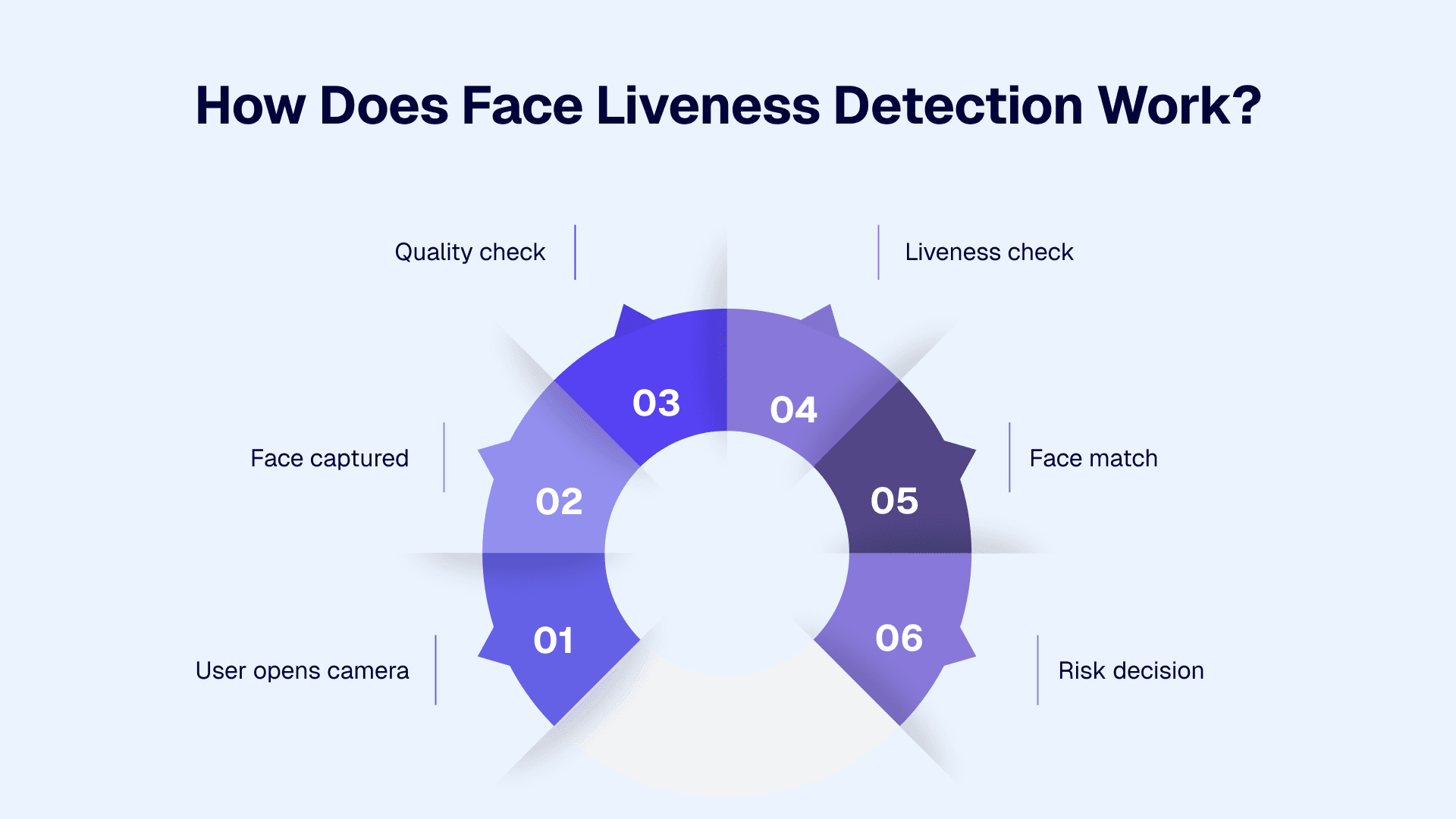
Face liveness detection analyzes visual, behavioral, device, and contextual signals during a selfie or video capture to determine whether the biometric sample comes from a live person or a spoofed source. While the exact approach varies by vendor, most solutions follow a similar workflow.
1. Face Capture and Quality Checks
The user captures a selfie, video, or short face scan. Before checking liveness, the system evaluates factors such as lighting, blur, camera quality, face position, and visibility. Since poor image quality can lead to false rejects, many solutions ask users to recapture their image before continuing.
2. Liveness Signal Analysis
Depending on the vendor and method, the system analyzes signals such as skin texture, depth, facial movement, lighting, replay artifacts, synthetic media inconsistencies, and camera or device indicators. Some solutions also look for signs of virtual cameras, emulators, or injection attacks.
3. Face Matching and Risk Scoring
Once liveness is verified, the captured face may be compared with an ID document, an enrolled biometric template, or an existing account image. Face matching and liveness are separate checks, so a user can pass one and fail the other.
4. Workflow Decisioning
The liveness result becomes one input into the final risk decision. Depending on the outcome, the system can approve the user, request another capture, trigger step-up verification, send the case for manual review, or block confirmed spoofing attempts.
Market Research Future estimates that cloud deployments represented 69.4% of identity verification implementations in 2025, reflecting growing demand for API-driven verification workflows that combine biometric, device, and behavioral signals.
When combined with a unified risk decisioning platform, liveness results can be evaluated alongside identity, device, behavioral, network, and transaction signals to make real-time, explainable decisions across onboarding and authentication.
Related Read: How Device Signals Help Detect Fraud Rings and Spoofed Devices
What Attacks Does Face Liveness Detection Prevent?
Face liveness detection helps reduce the risk of a fake biometric sample being accepted as genuine. When evaluating a solution, these are the attacks that matter most.
Presentation Attacks
A presentation attack occurs when a fraudster presents a fake biometric artifact to the camera instead of a live face. This could be:
Printed photos
Images displayed on another screen
Replayed videos
Paper masks
3D masks
When comparing vendors, ask which presentation attack instruments they tested, under what conditions, and whether they have independent presentation attack detection (PAD) conformance evidence.
Deepfakes and Synthetic Faces
AI-generated faces and manipulated videos are making it much easier for attackers to scale biometric fraud. While deepfake detection and face liveness detection are related, they solve different problems.
A good vendor should clearly explain how their system handles synthetic media, including face swaps, morphs, and AI-generated videos, and provide evidence of how these scenarios are tested and detected in real-world conditions.
A 2025 benchmark evaluating real-world deepfakes created during 2024 found that state-of-the-art open-source detection models experienced performance drops of 45% to 50% compared with older benchmark datasets, suggesting that models trained on historical attacks may struggle against newer AI-generated media.
Replay and Injection Attacks
Replay attacks use prerecorded videos to imitate a legitimate user. But injection attacks go a step further by bypassing the camera altogether and feeding manipulated media directly into the verification flow.
Injection attack detection is particularly important for remote onboarding, account recovery, and high-risk financial workflows. When evaluating vendors, ask whether these attacks are detected through client-side protections, server-side analysis, or a combination of both.
Modern attacks also extend beyond individual identities. Bureau ID's 2026 India Fraud Report found that 48% of Indian enterprises identify mule networks as the most difficult fraud threat to detect, highlighting why identity verification increasingly needs to be combined with device, behavioral, and network intelligence.
Here’s a quick way to think about how each attack works and what to ask vendors.
Attack Type | How It Works | What Buyers Should Ask |
Presentation attack | A fake artifact is shown to the camera. | Has the solution been independently tested for PAD? |
Replay attack | A prerecorded image or video is replayed. | Can it detect replay artifacts and timing anomalies? |
Deepfake attack | AI-generated or manipulated media is used. | How is the model tested against GenAI content? |
Injection attack | Fake media is inserted directly into the verification stream. | Can it detect camera bypass and virtual camera manipulation? |
Active vs Passive Face Liveness Detection
The choice between active and passive face liveness detection comes down to balancing security with user experience.
Passive liveness is often the default for high-volume onboarding because it keeps friction low, while active liveness is better suited to high-risk scenarios where stronger identity assurance is required.
Criteria | Passive Face Liveness Detection | Active Face Liveness Detection |
How it works | The user takes a selfie or short video while liveness is analyzed in the background. | The user completes an action such as blinking, smiling, or turning their head. |
User friction | Low | Medium to high |
Best for | High-volume onboarding, marketplaces, fintechs, and consumer apps | Account recovery, step-up authentication, and high-risk transactions |
Security assurance | Depends on the vendor's attack detection capabilities | Generally, it is higher because user interaction is required |
Conversion impact | Higher completion rates due to fewer user actions | Can increase abandonment if the flow is too complex |
Accessibility | Easier for most users | It may be challenging for some users or devices |
Key buyer question | Can it stop advanced spoofing without adding friction? | Is the added assurance worth the extra user effort? |
The choice between user experience and stronger identity assurance is becoming a bigger priority for fraud teams.
Bureau ID's 2026 UK & EU Fraud Report found that 66% of organizations are prioritizing predictive fraud models, while 50% are investing in behavioral analytics and graph intelligence to improve fraud detection beyond traditional identity checks.
Hybrid Liveness Detection
Many vendors now offer a hybrid approach that combines passive liveness with lightweight user interaction when additional assurance is needed. For example, a trusted user may complete a passive check, while a higher-risk user is asked to recapture their selfie or perform a simple movement.
This works well for:
Crypto onboarding
Medium-risk fintech workflows
Marketplace seller onboarding
Account recovery
Risk-based reverification
Which Method Should We Choose?
The right approach depends on the level of risk in your workflow rather than a single "best" method.
Choose passive liveness if your priority is fast onboarding, low user friction, and higher completion rates. It's often the best fit for customer onboarding, consumer apps, and low-risk re-authentication.
Choose active liveness when you need stronger identity assurance, such as for account recovery, suspicious logins, step-up authentication, or high-value transactions.
Choose hybrid liveness if risk varies across users or journeys. For example, low-risk users can complete a passive check, while higher-risk users are prompted for additional verification only when needed.
For regulated or high-risk businesses, liveness shouldn't be evaluated in isolation. The strongest implementations combine face liveness detection with identity verification, device intelligence, behavioral signals, and real-time risk decisioning to determine whether a user should be approved, challenged, or reviewed.
Now that you know which approach fits your use case, the next step is understanding how different vendors implement liveness detection and what to look for when evaluating them.
Top 5 Face Liveness Detection Vendors Compared
Some face liveness detection vendors focus on standalone biometric verification, while others combine liveness with identity verification, fraud detection, and workflow orchestration.
To help you compare them, we've evaluated the top 5 vendors across the factors that matter most when selecting a face liveness detection solution.
Vendor | Core Strength | Liveness Approach | Deployment Focus | Best Fit |
Bureau ID | Unified risk decisioning across identity, device, behavior, network, and transaction signals | Liveness through identity verification, supported by device ID and behavioral biometrics | End-to-end onboarding, authentication, and fraud decisioning | Businesses that need liveness within a broader onboarding and fraud risk stack |
FaceTec | 3D face verification and biometric security | 3D liveness and face authentication | High-assurance biometric authentication | Organizations prioritizing standalone biometric security |
iProov | Remote biometric verification | Passive, active, or dynamic liveness, depending on the product | Regulated identity verification and authentication | Regulated industries and high-assurance identity verification |
Mitek | Document verification, facial liveness, and face matching | Passive facial liveness and biometric verification | Identity verification workflows | Businesses combining document verification with face authentication |
HyperVerge | OCR, face match, video KYC, and onboarding verification | Passive liveness and face matching | Digital onboarding and KYC | KYC-heavy onboarding and biometric verification workflows |
If you only need a point solution for face liveness detection, a specialized biometric vendor may be enough.
But if you're protecting against onboarding fraud, synthetic identities, account takeover, or coordinated fraud rings, liveness should be just one input into a broader risk decision.
That's where Bureau ID stands apart by combining identity verification, device ID, and behavioral biometrics into a unified risk decisioning platform to make explainable, real-time fraud decisions instead of relying on a biometric check alone.
How Bureau ID Supports Face Liveness Detection in a Broader Risk Stack
Face liveness detection can confirm that a real person is present during biometric verification. But it can't tell you whether the device has been linked to previous fraud, whether the user's behavior looks suspicious, or whether the identity is part of a larger fraud network.
That's why Bureau ID treats face liveness as one signal within a broader risk decision instead of a standalone pass/fail check.
Bureau ID strengthens biometric verification by combining:
Identity Verification: Document authentication, face matching, and liveness detection to establish identity, helping ensure that users are genuine and reducing the risk of impersonation and synthetic identity fraud.
Device ID: Persistent device intelligence that helps identify repeat fraudsters, spoofed devices, emulators, and suspicious device changes, enabling teams to detect and block high-risk devices early.
Behavioral Biometrics: Continuous behavioral signals that detect bots, fraud farms, scripted activity, and compromised sessions, helping distinguish genuine users from automated or malicious activity in real time.
Graph Identity Network: Identity and device link analysis that uncovers hidden relationships across accounts, devices, and transactions, allowing teams to identify coordinated fraud patterns and connected risk signals.
These signals are evaluated together within Bureau ID's unified risk decisioning platform, allowing risk teams to approve, step up, review, recapture, or reject users based on the full context of a verification attempt rather than a single biometric result.
This helps banks, fintechs, lenders, marketplaces, insurers, and gaming platforms reduce fraud while keeping onboarding and authentication friction low.
Case Study: A Leading Insurer Cuts Fraud to Drive 30% Faster Onboarding
A leading private insurer was struggling with fraudulent applications driven by internal agent abuse. Agents were creating unauthorized applications using real customer information and synthetic identities to inflate commissions, leading to customer complaints, verification delays, and higher onboarding drop-offs. Traditional email- and SMS-based verification added friction for genuine applicants but did little to stop the fraud.
What Bureau ID implemented:
Real-time identity verification to validate applicant details and build a risk profile at onboarding.
Device intelligence and behavioral analysis to identify agent abuse and suspicious application patterns.
Risk-based onboarding that allowed low-risk applicants to move through verification with minimal friction while flagging high-risk applications for review.
Results achieved:
100+ fraudulent applications identified and corrected within the first week.
30% faster onboarding, improving both customer experience and conversion.
Fewer customer complaints related to unauthorized applications.
Improved experience for genuine applicants.
Read the full case study here → Insurer Cuts Fraud for 30% Faster Onboarding
The case demonstrates that face liveness detection is only one part of secure onboarding. Stronger outcomes come from combining biometric verification with identity, device, and behavioral signals, allowing fraud to be stopped early while legitimate users move through onboarding with less friction.
Build a Safer Biometric Verification Flow
Face liveness detection has become an essential part of secure digital onboarding and authentication, but it's only one layer of the verification process.
To stop sophisticated fraud without increasing friction for genuine users, businesses need to evaluate biometric signals alongside identity, device, behavioral, and network intelligence before making a risk decision.
Bureau ID brings these capabilities together in a single platform, helping fraud and risk teams strengthen biometric verification, automate risk-based decisions, and deliver faster, more secure onboarding and authentication experiences.
If you're ready to strengthen your biometric verification workflows, schedule a demo with Bureau ID and see how face liveness detection, identity verification, device intelligence, and behavioral biometrics work together to stop fraud in real time.
FAQs
1. What is the difference between face recognition and face liveness detection?
Face recognition verifies whether two faces match, while face liveness detection verifies that the person is physically present during capture. A secure biometric workflow uses both to reduce the risk of spoofing through photos, replay videos, masks, or deepfakes.
2. How does face liveness detection prevent deepfake attacks?
Face liveness detection analyzes visual and behavioral signals to determine whether a biometric sample comes from a live person. Some vendors also evaluate AI-generated media, but deepfake detection capabilities vary, so it's important to understand what attack types each solution supports.
3. Which is better: passive or active face liveness detection?
Neither approach is universally better. Passive liveness offers a smoother user experience and is ideal for high-volume onboarding, while active liveness provides stronger assurance for high-risk workflows such as account recovery, step-up authentication, and transaction approval.
4. What should I look for when choosing a face liveness detection vendor?
Evaluate vendors based on attack coverage, passive and active liveness capabilities, presentation and injection attack detection, user experience, integration flexibility, independent testing, and how well liveness fits into a broader fraud prevention and identity verification workflow.
5. Can face liveness detection stop replay attacks and presentation attacks?
Yes, modern face liveness detection is designed to detect common presentation attacks such as printed photos, replayed videos, and masks. However, detection accuracy depends on the vendor's models, attack coverage, and the quality of its presentation attack detection capabilities.
6. Is face liveness detection enough to prevent identity fraud?
No. Face liveness detection verifies live presence but doesn't assess device risk, behavioral anomalies, or linked fraud activity. Stronger fraud prevention combines liveness with identity verification, device intelligence, behavioral biometrics, and real-time risk decisioning.
A face match alone is no longer enough to trust a biometric check.
Fraudsters use replay videos, deepfakes, printed photos, and injected media to bypass remote onboarding and authentication flows. As these attacks become harder to distinguish from genuine users, face liveness detection has become an essential layer for businesses that rely on biometric verification.
Unlike face recognition, which verifies whether two faces match, face recognition liveness detection verifies whether the person is actually live and physically present during capture.
In this guide, we'll explain how liveness detection for face recognition works, the attacks it is designed to prevent, how passive and active approaches compare, and what to look for when evaluating leading face liveness detection vendors.
What Is Face Liveness Detection?
Face liveness detection is a biometric security technique that verifies whether a face presented during onboarding or authentication belongs to a real, live person who is physically present at the time of capture.
It helps prevent spoofing attempts such as printed photos, replayed videos, masks, deepfakes, and injected media from bypassing face recognition systems.
Face liveness detection helps verify whether:
The submitted face belongs to a live person
The person is physically present during capture
The biometric sample is not a printed photo, replayed video, mask, or deepfake
The biometric check should proceed, trigger step-up verification, or fail
Additional fraud signals are needed before approving the user
Although they're often used together, face recognition and face liveness detection solve different problems:
Face recognition answers, "Does this face match the enrolled user or the photo on an identity document?"
Face liveness detection answers, "Is the person behind the camera actually present right now?"
Face liveness detection doesn't replace KYC, document verification, device intelligence, or ongoing fraud monitoring. Instead, it acts as one layer in a broader identity verification workflow, where biometric results are evaluated alongside identity, device, behavioral, and risk signals before a final trust decision is made.
How Does Face Liveness Detection Work?
Face liveness detection analyzes visual, behavioral, device, and contextual signals during a selfie or video capture to determine whether the biometric sample comes from a live person or a spoofed source. While the exact approach varies by vendor, most solutions follow a similar workflow.
1. Face Capture and Quality Checks
The user captures a selfie, video, or short face scan. Before checking liveness, the system evaluates factors such as lighting, blur, camera quality, face position, and visibility. Since poor image quality can lead to false rejects, many solutions ask users to recapture their image before continuing.
2. Liveness Signal Analysis
Depending on the vendor and method, the system analyzes signals such as skin texture, depth, facial movement, lighting, replay artifacts, synthetic media inconsistencies, and camera or device indicators. Some solutions also look for signs of virtual cameras, emulators, or injection attacks.
3. Face Matching and Risk Scoring
Once liveness is verified, the captured face may be compared with an ID document, an enrolled biometric template, or an existing account image. Face matching and liveness are separate checks, so a user can pass one and fail the other.
4. Workflow Decisioning
The liveness result becomes one input into the final risk decision. Depending on the outcome, the system can approve the user, request another capture, trigger step-up verification, send the case for manual review, or block confirmed spoofing attempts.
Market Research Future estimates that cloud deployments represented 69.4% of identity verification implementations in 2025, reflecting growing demand for API-driven verification workflows that combine biometric, device, and behavioral signals.
When combined with a unified risk decisioning platform, liveness results can be evaluated alongside identity, device, behavioral, network, and transaction signals to make real-time, explainable decisions across onboarding and authentication.
Related Read: How Device Signals Help Detect Fraud Rings and Spoofed Devices
What Attacks Does Face Liveness Detection Prevent?
Face liveness detection helps reduce the risk of a fake biometric sample being accepted as genuine. When evaluating a solution, these are the attacks that matter most.
Presentation Attacks
A presentation attack occurs when a fraudster presents a fake biometric artifact to the camera instead of a live face. This could be:
Printed photos
Images displayed on another screen
Replayed videos
Paper masks
3D masks
When comparing vendors, ask which presentation attack instruments they tested, under what conditions, and whether they have independent presentation attack detection (PAD) conformance evidence.
Deepfakes and Synthetic Faces
AI-generated faces and manipulated videos are making it much easier for attackers to scale biometric fraud. While deepfake detection and face liveness detection are related, they solve different problems.
A good vendor should clearly explain how their system handles synthetic media, including face swaps, morphs, and AI-generated videos, and provide evidence of how these scenarios are tested and detected in real-world conditions.
A 2025 benchmark evaluating real-world deepfakes created during 2024 found that state-of-the-art open-source detection models experienced performance drops of 45% to 50% compared with older benchmark datasets, suggesting that models trained on historical attacks may struggle against newer AI-generated media.
Replay and Injection Attacks
Replay attacks use prerecorded videos to imitate a legitimate user. But injection attacks go a step further by bypassing the camera altogether and feeding manipulated media directly into the verification flow.
Injection attack detection is particularly important for remote onboarding, account recovery, and high-risk financial workflows. When evaluating vendors, ask whether these attacks are detected through client-side protections, server-side analysis, or a combination of both.
Modern attacks also extend beyond individual identities. Bureau ID's 2026 India Fraud Report found that 48% of Indian enterprises identify mule networks as the most difficult fraud threat to detect, highlighting why identity verification increasingly needs to be combined with device, behavioral, and network intelligence.
Here’s a quick way to think about how each attack works and what to ask vendors.
Attack Type | How It Works | What Buyers Should Ask |
Presentation attack | A fake artifact is shown to the camera. | Has the solution been independently tested for PAD? |
Replay attack | A prerecorded image or video is replayed. | Can it detect replay artifacts and timing anomalies? |
Deepfake attack | AI-generated or manipulated media is used. | How is the model tested against GenAI content? |
Injection attack | Fake media is inserted directly into the verification stream. | Can it detect camera bypass and virtual camera manipulation? |
Active vs Passive Face Liveness Detection
The choice between active and passive face liveness detection comes down to balancing security with user experience.
Passive liveness is often the default for high-volume onboarding because it keeps friction low, while active liveness is better suited to high-risk scenarios where stronger identity assurance is required.
Criteria | Passive Face Liveness Detection | Active Face Liveness Detection |
How it works | The user takes a selfie or short video while liveness is analyzed in the background. | The user completes an action such as blinking, smiling, or turning their head. |
User friction | Low | Medium to high |
Best for | High-volume onboarding, marketplaces, fintechs, and consumer apps | Account recovery, step-up authentication, and high-risk transactions |
Security assurance | Depends on the vendor's attack detection capabilities | Generally, it is higher because user interaction is required |
Conversion impact | Higher completion rates due to fewer user actions | Can increase abandonment if the flow is too complex |
Accessibility | Easier for most users | It may be challenging for some users or devices |
Key buyer question | Can it stop advanced spoofing without adding friction? | Is the added assurance worth the extra user effort? |
The choice between user experience and stronger identity assurance is becoming a bigger priority for fraud teams.
Bureau ID's 2026 UK & EU Fraud Report found that 66% of organizations are prioritizing predictive fraud models, while 50% are investing in behavioral analytics and graph intelligence to improve fraud detection beyond traditional identity checks.
Hybrid Liveness Detection
Many vendors now offer a hybrid approach that combines passive liveness with lightweight user interaction when additional assurance is needed. For example, a trusted user may complete a passive check, while a higher-risk user is asked to recapture their selfie or perform a simple movement.
This works well for:
Crypto onboarding
Medium-risk fintech workflows
Marketplace seller onboarding
Account recovery
Risk-based reverification
Which Method Should We Choose?
The right approach depends on the level of risk in your workflow rather than a single "best" method.
Choose passive liveness if your priority is fast onboarding, low user friction, and higher completion rates. It's often the best fit for customer onboarding, consumer apps, and low-risk re-authentication.
Choose active liveness when you need stronger identity assurance, such as for account recovery, suspicious logins, step-up authentication, or high-value transactions.
Choose hybrid liveness if risk varies across users or journeys. For example, low-risk users can complete a passive check, while higher-risk users are prompted for additional verification only when needed.
For regulated or high-risk businesses, liveness shouldn't be evaluated in isolation. The strongest implementations combine face liveness detection with identity verification, device intelligence, behavioral signals, and real-time risk decisioning to determine whether a user should be approved, challenged, or reviewed.
Now that you know which approach fits your use case, the next step is understanding how different vendors implement liveness detection and what to look for when evaluating them.
Top 5 Face Liveness Detection Vendors Compared
Some face liveness detection vendors focus on standalone biometric verification, while others combine liveness with identity verification, fraud detection, and workflow orchestration.
To help you compare them, we've evaluated the top 5 vendors across the factors that matter most when selecting a face liveness detection solution.
Vendor | Core Strength | Liveness Approach | Deployment Focus | Best Fit |
Bureau ID | Unified risk decisioning across identity, device, behavior, network, and transaction signals | Liveness through identity verification, supported by device ID and behavioral biometrics | End-to-end onboarding, authentication, and fraud decisioning | Businesses that need liveness within a broader onboarding and fraud risk stack |
FaceTec | 3D face verification and biometric security | 3D liveness and face authentication | High-assurance biometric authentication | Organizations prioritizing standalone biometric security |
iProov | Remote biometric verification | Passive, active, or dynamic liveness, depending on the product | Regulated identity verification and authentication | Regulated industries and high-assurance identity verification |
Mitek | Document verification, facial liveness, and face matching | Passive facial liveness and biometric verification | Identity verification workflows | Businesses combining document verification with face authentication |
HyperVerge | OCR, face match, video KYC, and onboarding verification | Passive liveness and face matching | Digital onboarding and KYC | KYC-heavy onboarding and biometric verification workflows |
If you only need a point solution for face liveness detection, a specialized biometric vendor may be enough.
But if you're protecting against onboarding fraud, synthetic identities, account takeover, or coordinated fraud rings, liveness should be just one input into a broader risk decision.
That's where Bureau ID stands apart by combining identity verification, device ID, and behavioral biometrics into a unified risk decisioning platform to make explainable, real-time fraud decisions instead of relying on a biometric check alone.
How Bureau ID Supports Face Liveness Detection in a Broader Risk Stack
Face liveness detection can confirm that a real person is present during biometric verification. But it can't tell you whether the device has been linked to previous fraud, whether the user's behavior looks suspicious, or whether the identity is part of a larger fraud network.
That's why Bureau ID treats face liveness as one signal within a broader risk decision instead of a standalone pass/fail check.
Bureau ID strengthens biometric verification by combining:
Identity Verification: Document authentication, face matching, and liveness detection to establish identity, helping ensure that users are genuine and reducing the risk of impersonation and synthetic identity fraud.
Device ID: Persistent device intelligence that helps identify repeat fraudsters, spoofed devices, emulators, and suspicious device changes, enabling teams to detect and block high-risk devices early.
Behavioral Biometrics: Continuous behavioral signals that detect bots, fraud farms, scripted activity, and compromised sessions, helping distinguish genuine users from automated or malicious activity in real time.
Graph Identity Network: Identity and device link analysis that uncovers hidden relationships across accounts, devices, and transactions, allowing teams to identify coordinated fraud patterns and connected risk signals.
These signals are evaluated together within Bureau ID's unified risk decisioning platform, allowing risk teams to approve, step up, review, recapture, or reject users based on the full context of a verification attempt rather than a single biometric result.
This helps banks, fintechs, lenders, marketplaces, insurers, and gaming platforms reduce fraud while keeping onboarding and authentication friction low.
Case Study: A Leading Insurer Cuts Fraud to Drive 30% Faster Onboarding
A leading private insurer was struggling with fraudulent applications driven by internal agent abuse. Agents were creating unauthorized applications using real customer information and synthetic identities to inflate commissions, leading to customer complaints, verification delays, and higher onboarding drop-offs. Traditional email- and SMS-based verification added friction for genuine applicants but did little to stop the fraud.
What Bureau ID implemented:
Real-time identity verification to validate applicant details and build a risk profile at onboarding.
Device intelligence and behavioral analysis to identify agent abuse and suspicious application patterns.
Risk-based onboarding that allowed low-risk applicants to move through verification with minimal friction while flagging high-risk applications for review.
Results achieved:
100+ fraudulent applications identified and corrected within the first week.
30% faster onboarding, improving both customer experience and conversion.
Fewer customer complaints related to unauthorized applications.
Improved experience for genuine applicants.
Read the full case study here → Insurer Cuts Fraud for 30% Faster Onboarding
The case demonstrates that face liveness detection is only one part of secure onboarding. Stronger outcomes come from combining biometric verification with identity, device, and behavioral signals, allowing fraud to be stopped early while legitimate users move through onboarding with less friction.
Build a Safer Biometric Verification Flow
Face liveness detection has become an essential part of secure digital onboarding and authentication, but it's only one layer of the verification process.
To stop sophisticated fraud without increasing friction for genuine users, businesses need to evaluate biometric signals alongside identity, device, behavioral, and network intelligence before making a risk decision.
Bureau ID brings these capabilities together in a single platform, helping fraud and risk teams strengthen biometric verification, automate risk-based decisions, and deliver faster, more secure onboarding and authentication experiences.
If you're ready to strengthen your biometric verification workflows, schedule a demo with Bureau ID and see how face liveness detection, identity verification, device intelligence, and behavioral biometrics work together to stop fraud in real time.
FAQs
1. What is the difference between face recognition and face liveness detection?
Face recognition verifies whether two faces match, while face liveness detection verifies that the person is physically present during capture. A secure biometric workflow uses both to reduce the risk of spoofing through photos, replay videos, masks, or deepfakes.
2. How does face liveness detection prevent deepfake attacks?
Face liveness detection analyzes visual and behavioral signals to determine whether a biometric sample comes from a live person. Some vendors also evaluate AI-generated media, but deepfake detection capabilities vary, so it's important to understand what attack types each solution supports.
3. Which is better: passive or active face liveness detection?
Neither approach is universally better. Passive liveness offers a smoother user experience and is ideal for high-volume onboarding, while active liveness provides stronger assurance for high-risk workflows such as account recovery, step-up authentication, and transaction approval.
4. What should I look for when choosing a face liveness detection vendor?
Evaluate vendors based on attack coverage, passive and active liveness capabilities, presentation and injection attack detection, user experience, integration flexibility, independent testing, and how well liveness fits into a broader fraud prevention and identity verification workflow.
5. Can face liveness detection stop replay attacks and presentation attacks?
Yes, modern face liveness detection is designed to detect common presentation attacks such as printed photos, replayed videos, and masks. However, detection accuracy depends on the vendor's models, attack coverage, and the quality of its presentation attack detection capabilities.
6. Is face liveness detection enough to prevent identity fraud?
No. Face liveness detection verifies live presence but doesn't assess device risk, behavioral anomalies, or linked fraud activity. Stronger fraud prevention combines liveness with identity verification, device intelligence, behavioral biometrics, and real-time risk decisioning.
TABLE OF CONTENTS
See More
Recommended Blogs


Landing Page.
Simple, bold.
Sign Up
Download

Products
Solutions


© 2026 Bureau . All rights reserved.
Solutions
Industries
Resources
Company
Solutions
Industries
Resources
Company
© 2026 Bureau . All rights reserved.
Follow Us
Leave behind fragmented tools. Stop fraud rings, cut false declines, and deliver secure digital journeys at scale
Our Presence








Leave behind fragmented tools. Stop fraud rings, cut false declines, and deliver secure digital journeys at scale
Our Presence
© 2026 Bureau . All rights reserved.