How Food Delivery Fraud Happens and What Platforms Can Do About It
How Food Delivery Fraud Happens and What Platforms Can Do About It
How Food Delivery Fraud Happens and What Platforms Can Do About It
Learn how food delivery fraud can hit accounts, payments, refunds, couriers, and payouts. Explore the 7 common types and the controls to stop them early.
Author
Team Bureau


See how Bureau has helped industry leaders defend against networked Industrial-scale frauds →
Schedule a Demo
TABLE OF CONTENTS
See Less
Food delivery fraud can affect any platform that manages fast orders, valuable promotions, stored payments, courier incentives, and refunds.
It may begin with a customer creating multiple accounts for discounts, a courier spoofing their location, or an attacker taking over a genuine account. Each incident can look small on its own, especially when account, device, payment, location, and refund data are reviewed separately.
That is what makes food delivery fraud difficult to spot early. The risk often becomes clear only after platforms connect activity across customers, couriers, restaurants, and transactions.
This blog explains how food delivery app fraud happens, the most common schemes, and the controls platforms can use to reduce exposure without disrupting genuine users.
What Is Food Delivery Fraud and Why Is It Increasing?
Food delivery fraud is the deliberate misuse of a food ordering or delivery platform for financial gain. It includes fake accounts, promo abuse, account takeover, courier account sharing, GPS spoofing, and ghost orders.
This risk extends well beyond unauthorized payments. Fraudsters may manipulate customer or courier accounts, promotional programs, delivery locations, and payout workflows. Food delivery fraud is also different from supply-chain food fraud, which generally involves counterfeit, adulterated, or incorrectly labeled food products.
Food delivery fraud is increasing for several reasons:
Rising digital order volumes: More customers, couriers, restaurants, payments, and delivery events create a larger attack surface for fraud.
Fast transaction and fulfillment cycles: Platforms must approve accounts, payments, promotions, and delivery actions within seconds, leaving little time for manual review.
Promotion-heavy growth models: First-order discounts, referral credits, cashback, courier bonuses, and completion incentives create immediate value that fraudsters can exploit.
Fraud can be repeated at scale: App cloning, emulators, automation, disposable contact details, and device farms allow low-value abuse to spread across thousands of accounts.
Multi-sided platform complexity: A single order may connect a customer, courier, restaurant, device, payment method, address, and payout account, making coordinated fraud harder to detect.
Fragmented risk controls: Login, payment, location, refund, promotion, and payout signals often sit in separate systems, preventing platforms from identifying connected activity early.
Abuse after order completion is increasingly difficult to treat as an edge case. The MRC's 2026 Global Payments and Fraud Report found that 57% of merchants had seen refund or policy abuse increase, while 64% reported rising first-party misuse.
Although the research covers e-commerce broadly, the findings are relevant to food delivery platforms. Claims involving missing items, damaged meals, incorrect orders, or failed deliveries can be difficult to verify before a refund is issued.
These conditions allow fraudsters to use several recurring schemes, ranging from fake accounts and account takeover to GPS spoofing and coordinated ghost-order networks.
What Are the Most Common Types of Food Delivery Fraud?
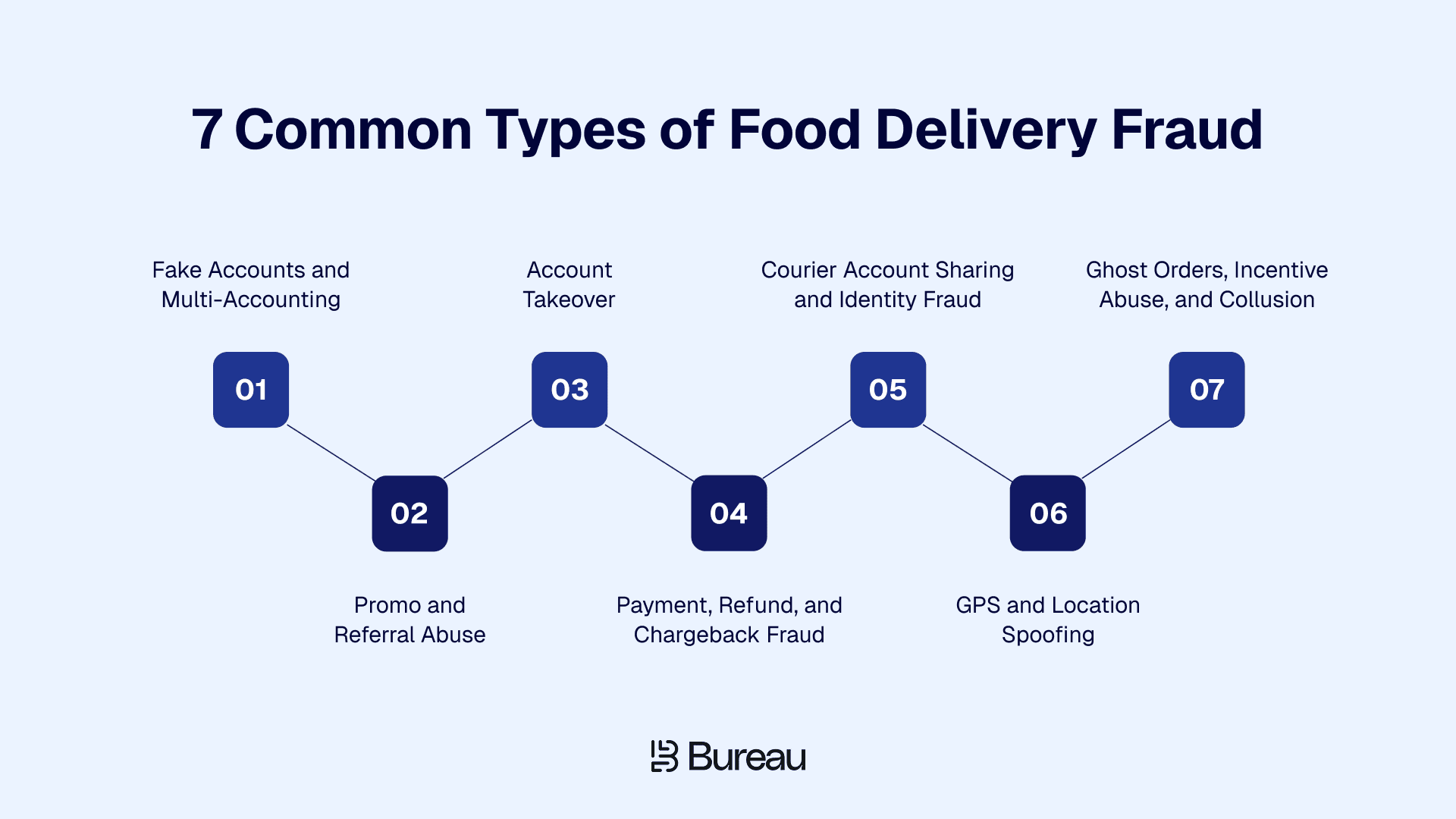
Food delivery scams can involve customers, couriers, restaurants, external attackers, or coordinated networks. Although each scheme works differently, most depend on manipulated accounts, compromised credentials, shared devices, fraudulent payments, false locations, or gaps between fraud controls.
1. Fake Accounts and Multi-Accounting
Fake-account fraud occurs when one person or group creates multiple customer or courier profiles using false, stolen, or repeatedly changed information.
Fraudsters use these accounts to claim new-user offers more than once, build circular referral networks, submit repeated refund requests, operate several courier profiles, or return after an earlier account was blocked. Spreading activity across many profiles also helps them remain below account-level velocity limits.
Common warning signs include:
Multiple accounts associated with the same device
Shared cards, phone numbers, IP addresses, or delivery addresses
Several accounts created within a short period
Repeated app reinstallation or device resets
Emulator, virtual-device, or app-cloning activity
Similar behavioral patterns across supposedly unrelated users
A delivery driver described people operating several courier accounts across multiple phones while also manipulating location data. The practical takeaway is to connect account, device, identity, and route signals rather than reviewing each profile separately.
Account details alone rarely reveal the full pattern. Persistent device intelligence can help platforms determine whether multiple profiles are being controlled through the same underlying device or app environment.
2. Promo and Referral Abuse
Promo abuse occurs when users deliberately manipulate eligibility rules to claim discounts, credits, cashback, or referral rewards more often than permitted.
Common tactics include creating multiple accounts, self-referring, resetting or cloning devices, and using disposable contact details or payment methods. Some fraudsters also coordinate customer and courier accounts to extract value from both sides of a campaign.
The loss goes beyond the discount. Abusive orders can increase payment fees, delivery subsidies, restaurant compensation, and support costs. They also distort conversion, retention, and referral metrics.
Effective promo abuse prevention therefore depends on identifying links between accounts, devices, payment methods, addresses, referral relationships, and previous reward activity before an incentive is released.
3. Account Takeover
Account takeover happens when a fraudster gains access to a legitimate customer, courier, or restaurant account. They may use credential stuffing, phishing, OTP interception, SIM swaps, session theft, or password-reset abuse.
Once inside, they can use stored cards, redeem loyalty credits, change delivery details, or redirect payouts. They may also sell access to an established account.
Detection is difficult because trusted account history can make fraudulent activity appear legitimate.
A compromised account may expose payment details, addresses, phone numbers, order history, and payout information.
Account takeover prevention should assess device changes, session behavior, authentication activity, and sensitive account actions. A correct password or OTP should not be treated as proof that the real account owner is in control.
4. Payment, Refund, and Chargeback Fraud
Payment, refund, and chargeback fraud occur at different stages of an order.
Payment fraud involves stolen or unauthorized payment methods. Warning signs include multiple cards used from one device, repeated payment failures, or a new card used immediately on a high-value order.
Refund fraud occurs when customers falsely claim that an order was missing, damaged, delayed, incorrect, or never delivered. Repeated complaints across linked accounts can indicate organized abuse.
Chargeback fraud happens when a delivered order is disputed through the card issuer. Friendly fraud may involve an authorized purchase that the cardholder later denies or does not recognize.
The platform may lose the order value, refund amount, chargeback fees, delivery costs, restaurant compensation, and investigation time. These losses grow quickly when the same user repeats the behavior across multiple accounts, devices, or payment methods.
5. Courier Account Sharing and Identity Fraud
Courier account sharing occurs when someone other than the verified courier operates an approved profile. It may involve stolen identities, borrowed accounts, or legitimate couriers renting access to others.
In July 2025, the UK Home Office reported that identity and right-to-work checks by major food delivery platforms had led to thousands of couriers being removed from their platforms. This means that a courier may pass verification during registration and hand over the account later.
Platforms therefore need ongoing device, behavioral, session, and identity checks to confirm who is actually completing deliveries.
6. GPS and Location Spoofing
GPS spoofing happens when a courier manipulates location data so the platform believes they are somewhere else.
Fraudsters may use it to access higher-value orders, claim arrival, mark incomplete deliveries as finished, inflate distance-based earnings, or qualify for location-based incentives. Common methods include fake GPS apps, emulators, VPNs, app cloning, and modified applications.
The result can be false payouts, incorrect delivery records, incentive leakage, customer complaints, and unfair order allocation. Reliable location spoofing detection should compare GPS with IP location, route progression, travel speed, device integrity, app environment, and account history rather than relying on one coordinate.
7. Ghost Orders, Incentive Abuse, and Collusion
Ghost-order fraud occurs when connected customer, courier, or restaurant accounts create and complete a delivery that never happened to collect incentives or payouts.
In February 2026, the U.S. Department of Justice reported that five people had been sentenced for a phantom-order scheme that generated more than $2.5 million in fraudulent payments. The group used fake customer and driver accounts to make nonexistent deliveries appear complete.
Other schemes involve customer-courier coordination, restaurant collusion, inflated distances, false delivery evidence, and manipulated completion bonuses. Each account may appear legitimate alone, allowing the wider network to remain hidden.
Detection improves when platforms connect accounts, devices, payment methods, addresses, locations, behaviors, and transactions.
How Can Bureau Help Food Delivery Platforms Detect and Prevent Fraud?
Food delivery fraud prevention depends on connecting identity, device, behavior, location, payment, delivery, and account relationships before value leaves the platform. Bureau’s Unified Risk Decisioning Platform brings these signals into one workflow, helping teams act on risk without adding the same friction to every customer, courier, or restaurant.
Here’s how Bureau helps you prevent food delivery fraud:
Stop repeat-account abuse: Device ID and Graph Identity Network link new profiles to previously used devices, accounts, payment methods, and referral activity.
Detecting bots and account sharing: Behavioral biometrics flags scripted actions, unusual navigation, rapid account switching, and activity that differs from a genuine user’s normal pattern.
Identify location manipulation: Location spoofing detection compares GPS, IP, route, device, and app-integrity signals before approving incentives, deliveries, or payouts.
Prevent account takeover: Device, identity, behavior, and session signals help detect suspicious logins, payout changes, stored-card use, and password-reset abuse.
Reduce losses before money moves: Unified Risk Decisioning Platform assesses payments, promotions, refunds, delivery events, and payouts in real time.
Uncover coordinated fraud rings: Graph intelligence connects customers, couriers, restaurants, devices, addresses, payments, and transactions that appear unrelated when reviewed separately.
This gives fraud teams one place to detect risk, make decisions, and take action across the food delivery journey.
Case Study: Stopping a 2,700-User Food Delivery Fraud Ring
A global food delivery company was losing revenue to coordinated promo abuse and multi-accounting. Fraudsters used rooted devices, emulators, cloned app environments, shared networks, and modified applications to operate thousands of connected accounts. Its existing controls assessed activity separately and could not expose the wider user-device network.
Bureau combined device intelligence, graph analysis, and behavioral signals to:
Detect rooted, virtualized, and emulator-driven devices
Identify cloned environments, modified applications, and unauthorized installs
Connect accounts through shared devices, IP addresses, and other identifiers
Map high-risk user clusters and uncover coordinated fraud rings
Apply real-time risk scores to block suspicious activity before further abuse
The implementation produced measurable results within days:
A fraud ring involving more than 2,700 users and 150 devices was mapped and blocked
Over 1,750 accounts connected to three devices were removed
97% of collusive users received high-risk flags for investigation
Repeat offenders were prevented from returning through new accounts
Read the full case study here → Food Delivery Company Eliminates a 2,700+ User Fraud Ring
Bureau is well suited to food delivery platforms, digital marketplaces, and high-volume consumer applications that need to detect multi-accounting and collusion across the full user journey. Its connected approach helps teams move beyond isolated account rules and uncover how users, devices, behaviors, and networks work together.
Build a Safer Food Delivery Platform
Food delivery fraud becomes harder to stop when connected activity is reviewed through separate accounts, orders, and tools.
Bureau brings customer, courier, restaurant, device, payment, location, and transaction signals into one decisioning layer. This helps risk teams identify trusted users faster, uncover linked fraud, reduce manual review, and apply friction only where risk is higher.
Instead of relying on isolated rules, Bureau gives platforms the context needed to respond to repeat and coordinated abuse without disrupting legitimate orders, onboarding, or payouts.
When fraud signals remain split across tools, organized abuse stays hidden. Schedule a demo with Bureau to see how unified risk decisioning can help your team act sooner.
FAQs
1. What is food delivery fraud?
Food delivery fraud is the intentional misuse of food ordering or delivery platforms for financial gain. It includes fake accounts, promotion abuse, unauthorized payments, false refund claims, courier misconduct, location manipulation, account takeover, and coordinated schemes involving multiple participants.
2. Why is food delivery fraud increasing?
Food delivery fraud is increasing because platforms process more digital transactions through promotion-heavy, multi-sided workflows. Automated fraud tools, stolen credentials, GPS spoofing, and fragmented controls make abuse easier to scale and harder to connect across users, orders, and payouts.
3. What are the most common types of food delivery fraud?
The most common types are fake accounts, promo abuse, account takeover, payment and refund fraud, courier identity fraud, GPS spoofing, and ghost orders or collusion. These schemes can affect customers, couriers, restaurants, payments, incentives, deliveries, and payouts.
4. How do fake accounts affect food delivery platforms?
Fake accounts enable repeated promotion claims, self-referral networks, fraudulent refunds, unauthorized courier profiles, ghost orders, and re-entry after suspension. Bureau helps platforms connect identity, device, behavioral, and transaction signals to uncover linked accounts and coordinated abuse.
5. What is food delivery chargeback fraud?
Food delivery chargeback fraud occurs when an authorized or completed order is disputed through the card issuer. Platforms may lose the order value, delivery costs, chargeback fees, and investigation time. Bureau can help assess transaction risk and connect account, device, payment, and behavioral signals before losses escalate.
6. What is GPS spoofing in food delivery?
GPS spoofing in food delivery involves manipulating location data so a courier appears somewhere else. Fraudsters may falsely report restaurant arrival, delivery completion, travel distance, or eligibility for location-based incentives, leading to inaccurate payouts, complaints, and operational data.
Food delivery fraud can affect any platform that manages fast orders, valuable promotions, stored payments, courier incentives, and refunds.
It may begin with a customer creating multiple accounts for discounts, a courier spoofing their location, or an attacker taking over a genuine account. Each incident can look small on its own, especially when account, device, payment, location, and refund data are reviewed separately.
That is what makes food delivery fraud difficult to spot early. The risk often becomes clear only after platforms connect activity across customers, couriers, restaurants, and transactions.
This blog explains how food delivery app fraud happens, the most common schemes, and the controls platforms can use to reduce exposure without disrupting genuine users.
What Is Food Delivery Fraud and Why Is It Increasing?
Food delivery fraud is the deliberate misuse of a food ordering or delivery platform for financial gain. It includes fake accounts, promo abuse, account takeover, courier account sharing, GPS spoofing, and ghost orders.
This risk extends well beyond unauthorized payments. Fraudsters may manipulate customer or courier accounts, promotional programs, delivery locations, and payout workflows. Food delivery fraud is also different from supply-chain food fraud, which generally involves counterfeit, adulterated, or incorrectly labeled food products.
Food delivery fraud is increasing for several reasons:
Rising digital order volumes: More customers, couriers, restaurants, payments, and delivery events create a larger attack surface for fraud.
Fast transaction and fulfillment cycles: Platforms must approve accounts, payments, promotions, and delivery actions within seconds, leaving little time for manual review.
Promotion-heavy growth models: First-order discounts, referral credits, cashback, courier bonuses, and completion incentives create immediate value that fraudsters can exploit.
Fraud can be repeated at scale: App cloning, emulators, automation, disposable contact details, and device farms allow low-value abuse to spread across thousands of accounts.
Multi-sided platform complexity: A single order may connect a customer, courier, restaurant, device, payment method, address, and payout account, making coordinated fraud harder to detect.
Fragmented risk controls: Login, payment, location, refund, promotion, and payout signals often sit in separate systems, preventing platforms from identifying connected activity early.
Abuse after order completion is increasingly difficult to treat as an edge case. The MRC's 2026 Global Payments and Fraud Report found that 57% of merchants had seen refund or policy abuse increase, while 64% reported rising first-party misuse.
Although the research covers e-commerce broadly, the findings are relevant to food delivery platforms. Claims involving missing items, damaged meals, incorrect orders, or failed deliveries can be difficult to verify before a refund is issued.
These conditions allow fraudsters to use several recurring schemes, ranging from fake accounts and account takeover to GPS spoofing and coordinated ghost-order networks.
What Are the Most Common Types of Food Delivery Fraud?
Food delivery scams can involve customers, couriers, restaurants, external attackers, or coordinated networks. Although each scheme works differently, most depend on manipulated accounts, compromised credentials, shared devices, fraudulent payments, false locations, or gaps between fraud controls.
1. Fake Accounts and Multi-Accounting
Fake-account fraud occurs when one person or group creates multiple customer or courier profiles using false, stolen, or repeatedly changed information.
Fraudsters use these accounts to claim new-user offers more than once, build circular referral networks, submit repeated refund requests, operate several courier profiles, or return after an earlier account was blocked. Spreading activity across many profiles also helps them remain below account-level velocity limits.
Common warning signs include:
Multiple accounts associated with the same device
Shared cards, phone numbers, IP addresses, or delivery addresses
Several accounts created within a short period
Repeated app reinstallation or device resets
Emulator, virtual-device, or app-cloning activity
Similar behavioral patterns across supposedly unrelated users
A delivery driver described people operating several courier accounts across multiple phones while also manipulating location data. The practical takeaway is to connect account, device, identity, and route signals rather than reviewing each profile separately.
Account details alone rarely reveal the full pattern. Persistent device intelligence can help platforms determine whether multiple profiles are being controlled through the same underlying device or app environment.
2. Promo and Referral Abuse
Promo abuse occurs when users deliberately manipulate eligibility rules to claim discounts, credits, cashback, or referral rewards more often than permitted.
Common tactics include creating multiple accounts, self-referring, resetting or cloning devices, and using disposable contact details or payment methods. Some fraudsters also coordinate customer and courier accounts to extract value from both sides of a campaign.
The loss goes beyond the discount. Abusive orders can increase payment fees, delivery subsidies, restaurant compensation, and support costs. They also distort conversion, retention, and referral metrics.
Effective promo abuse prevention therefore depends on identifying links between accounts, devices, payment methods, addresses, referral relationships, and previous reward activity before an incentive is released.
3. Account Takeover
Account takeover happens when a fraudster gains access to a legitimate customer, courier, or restaurant account. They may use credential stuffing, phishing, OTP interception, SIM swaps, session theft, or password-reset abuse.
Once inside, they can use stored cards, redeem loyalty credits, change delivery details, or redirect payouts. They may also sell access to an established account.
Detection is difficult because trusted account history can make fraudulent activity appear legitimate.
A compromised account may expose payment details, addresses, phone numbers, order history, and payout information.
Account takeover prevention should assess device changes, session behavior, authentication activity, and sensitive account actions. A correct password or OTP should not be treated as proof that the real account owner is in control.
4. Payment, Refund, and Chargeback Fraud
Payment, refund, and chargeback fraud occur at different stages of an order.
Payment fraud involves stolen or unauthorized payment methods. Warning signs include multiple cards used from one device, repeated payment failures, or a new card used immediately on a high-value order.
Refund fraud occurs when customers falsely claim that an order was missing, damaged, delayed, incorrect, or never delivered. Repeated complaints across linked accounts can indicate organized abuse.
Chargeback fraud happens when a delivered order is disputed through the card issuer. Friendly fraud may involve an authorized purchase that the cardholder later denies or does not recognize.
The platform may lose the order value, refund amount, chargeback fees, delivery costs, restaurant compensation, and investigation time. These losses grow quickly when the same user repeats the behavior across multiple accounts, devices, or payment methods.
5. Courier Account Sharing and Identity Fraud
Courier account sharing occurs when someone other than the verified courier operates an approved profile. It may involve stolen identities, borrowed accounts, or legitimate couriers renting access to others.
In July 2025, the UK Home Office reported that identity and right-to-work checks by major food delivery platforms had led to thousands of couriers being removed from their platforms. This means that a courier may pass verification during registration and hand over the account later.
Platforms therefore need ongoing device, behavioral, session, and identity checks to confirm who is actually completing deliveries.
6. GPS and Location Spoofing
GPS spoofing happens when a courier manipulates location data so the platform believes they are somewhere else.
Fraudsters may use it to access higher-value orders, claim arrival, mark incomplete deliveries as finished, inflate distance-based earnings, or qualify for location-based incentives. Common methods include fake GPS apps, emulators, VPNs, app cloning, and modified applications.
The result can be false payouts, incorrect delivery records, incentive leakage, customer complaints, and unfair order allocation. Reliable location spoofing detection should compare GPS with IP location, route progression, travel speed, device integrity, app environment, and account history rather than relying on one coordinate.
7. Ghost Orders, Incentive Abuse, and Collusion
Ghost-order fraud occurs when connected customer, courier, or restaurant accounts create and complete a delivery that never happened to collect incentives or payouts.
In February 2026, the U.S. Department of Justice reported that five people had been sentenced for a phantom-order scheme that generated more than $2.5 million in fraudulent payments. The group used fake customer and driver accounts to make nonexistent deliveries appear complete.
Other schemes involve customer-courier coordination, restaurant collusion, inflated distances, false delivery evidence, and manipulated completion bonuses. Each account may appear legitimate alone, allowing the wider network to remain hidden.
Detection improves when platforms connect accounts, devices, payment methods, addresses, locations, behaviors, and transactions.
How Can Bureau Help Food Delivery Platforms Detect and Prevent Fraud?
Food delivery fraud prevention depends on connecting identity, device, behavior, location, payment, delivery, and account relationships before value leaves the platform. Bureau’s Unified Risk Decisioning Platform brings these signals into one workflow, helping teams act on risk without adding the same friction to every customer, courier, or restaurant.
Here’s how Bureau helps you prevent food delivery fraud:
Stop repeat-account abuse: Device ID and Graph Identity Network link new profiles to previously used devices, accounts, payment methods, and referral activity.
Detecting bots and account sharing: Behavioral biometrics flags scripted actions, unusual navigation, rapid account switching, and activity that differs from a genuine user’s normal pattern.
Identify location manipulation: Location spoofing detection compares GPS, IP, route, device, and app-integrity signals before approving incentives, deliveries, or payouts.
Prevent account takeover: Device, identity, behavior, and session signals help detect suspicious logins, payout changes, stored-card use, and password-reset abuse.
Reduce losses before money moves: Unified Risk Decisioning Platform assesses payments, promotions, refunds, delivery events, and payouts in real time.
Uncover coordinated fraud rings: Graph intelligence connects customers, couriers, restaurants, devices, addresses, payments, and transactions that appear unrelated when reviewed separately.
This gives fraud teams one place to detect risk, make decisions, and take action across the food delivery journey.
Case Study: Stopping a 2,700-User Food Delivery Fraud Ring
A global food delivery company was losing revenue to coordinated promo abuse and multi-accounting. Fraudsters used rooted devices, emulators, cloned app environments, shared networks, and modified applications to operate thousands of connected accounts. Its existing controls assessed activity separately and could not expose the wider user-device network.
Bureau combined device intelligence, graph analysis, and behavioral signals to:
Detect rooted, virtualized, and emulator-driven devices
Identify cloned environments, modified applications, and unauthorized installs
Connect accounts through shared devices, IP addresses, and other identifiers
Map high-risk user clusters and uncover coordinated fraud rings
Apply real-time risk scores to block suspicious activity before further abuse
The implementation produced measurable results within days:
A fraud ring involving more than 2,700 users and 150 devices was mapped and blocked
Over 1,750 accounts connected to three devices were removed
97% of collusive users received high-risk flags for investigation
Repeat offenders were prevented from returning through new accounts
Read the full case study here → Food Delivery Company Eliminates a 2,700+ User Fraud Ring
Bureau is well suited to food delivery platforms, digital marketplaces, and high-volume consumer applications that need to detect multi-accounting and collusion across the full user journey. Its connected approach helps teams move beyond isolated account rules and uncover how users, devices, behaviors, and networks work together.
Build a Safer Food Delivery Platform
Food delivery fraud becomes harder to stop when connected activity is reviewed through separate accounts, orders, and tools.
Bureau brings customer, courier, restaurant, device, payment, location, and transaction signals into one decisioning layer. This helps risk teams identify trusted users faster, uncover linked fraud, reduce manual review, and apply friction only where risk is higher.
Instead of relying on isolated rules, Bureau gives platforms the context needed to respond to repeat and coordinated abuse without disrupting legitimate orders, onboarding, or payouts.
When fraud signals remain split across tools, organized abuse stays hidden. Schedule a demo with Bureau to see how unified risk decisioning can help your team act sooner.
FAQs
1. What is food delivery fraud?
Food delivery fraud is the intentional misuse of food ordering or delivery platforms for financial gain. It includes fake accounts, promotion abuse, unauthorized payments, false refund claims, courier misconduct, location manipulation, account takeover, and coordinated schemes involving multiple participants.
2. Why is food delivery fraud increasing?
Food delivery fraud is increasing because platforms process more digital transactions through promotion-heavy, multi-sided workflows. Automated fraud tools, stolen credentials, GPS spoofing, and fragmented controls make abuse easier to scale and harder to connect across users, orders, and payouts.
3. What are the most common types of food delivery fraud?
The most common types are fake accounts, promo abuse, account takeover, payment and refund fraud, courier identity fraud, GPS spoofing, and ghost orders or collusion. These schemes can affect customers, couriers, restaurants, payments, incentives, deliveries, and payouts.
4. How do fake accounts affect food delivery platforms?
Fake accounts enable repeated promotion claims, self-referral networks, fraudulent refunds, unauthorized courier profiles, ghost orders, and re-entry after suspension. Bureau helps platforms connect identity, device, behavioral, and transaction signals to uncover linked accounts and coordinated abuse.
5. What is food delivery chargeback fraud?
Food delivery chargeback fraud occurs when an authorized or completed order is disputed through the card issuer. Platforms may lose the order value, delivery costs, chargeback fees, and investigation time. Bureau can help assess transaction risk and connect account, device, payment, and behavioral signals before losses escalate.
6. What is GPS spoofing in food delivery?
GPS spoofing in food delivery involves manipulating location data so a courier appears somewhere else. Fraudsters may falsely report restaurant arrival, delivery completion, travel distance, or eligibility for location-based incentives, leading to inaccurate payouts, complaints, and operational data.
TABLE OF CONTENTS
See More
Recommended Blogs


Landing Page.
Simple, bold.
Sign Up
Download

Products
Solutions


© 2026 Bureau . All rights reserved.
Solutions
Industries
Resources
Company
Solutions
Industries
Resources
Company
© 2026 Bureau . All rights reserved.
Follow Us
Leave behind fragmented tools. Stop fraud rings, cut false declines, and deliver secure digital journeys at scale
Our Presence








Leave behind fragmented tools. Stop fraud rings, cut false declines, and deliver secure digital journeys at scale
Our Presence
© 2026 Bureau . All rights reserved.