A Fraud Team’s Guide to Detecting GPS and Location Spoofing
A Fraud Team’s Guide to Detecting GPS and Location Spoofing
A Fraud Team’s Guide to Detecting GPS and Location Spoofing
Build a GPS spoofing detection strategy with risk signals, adaptive rules, step-up checks, and real-time location fraud review.
Author
Team Bureau

See how Bureau has helped industry leaders defend against networked Industrial-scale frauds →
Schedule a Demo
TABLE OF CONTENTS
See Less
A fake location can look harmless until it becomes the reason a risky user gets approved, a bonus gets abused, or a restricted transaction goes through.
Fraudsters use GPS spoofing, VPNs, proxies, emulators, and device tampering to make their location look legitimate. For fraud teams, it gets difficult to understand whether that location mismatch is connected to account takeover, promo abuse, mule activity, or unauthorized access.
This is why fraud teams need to validate location as a risk signal instead of a standalone data point.
GPS spoofing detection helps businesses detect fake GPS location signals by comparing GPS data with IP, network, device, behavioral, and transaction context. Instead of relying on one location signal, fraud teams can assess whether the user, device, location, and action make sense together.
In this guide, we’ll break down what GPS spoofing detection means, how it differs from broader location spoofing detection, how fraudsters fake location data, which signals matter most, and how fraud teams can build a practical strategy to detect location spoofing without adding unnecessary friction for genuine users.
What Is GPS Spoofing Detection?
GPS spoofing detection identifies fake or manipulated location data before it becomes fraud. It checks GPS coordinates against IP address, network signals, device integrity, mock-location settings, emulator use, velocity patterns, and user behavior. Fraud teams use GPS spoofing detection to verify real location, flag suspicious activity, reduce false positives, and stop location spoofing across onboarding, login, payments, delivery, and workforce workflows.
This means fraud teams do not treat GPS as a standalone source of truth. A coordinate may look valid on its own, but it becomes more meaningful when checked against the user’s device, network, behavior, account history, and action.
GPS spoofing detection usually checks for:
Fake GPS coordinates: Manipulated location data.
Mock-location tools: Apps or settings that override GPS.
VPNs, proxies, or TOR: Tools that mask IP-based location.
GPS-IP mismatches: Conflicting GPS and IP locations.
Device tampering: Emulators, rooted devices, or manipulated environments.
Sudden location jumps: Movement that does not match realistic travel.
High-risk behavior: Spoofing linked to onboarding, login, payments, or withdrawals.
Fake-location tools are also easy to find. For example, one Fake GPS Location app listed on Google Play shows 50 million+ downloads, while another GPS Emulator app shows 10 million+ downloads. That does not mean every user of these apps is committing fraud, but it does show why businesses should not assume device-reported GPS is always reliable.
This is where the distinction between GPS spoofing and broader location spoofing matters. GPS spoofing focuses on manipulated GPS coordinates, while location spoofing includes every way a fraudster can mask or manipulate where they appear to be.
GPS Spoofing vs Location Spoofing: What Fraud Teams Need to Know
GPS spoofing and location spoofing are closely related, but they are not the same. GPS spoofing refers specifically to manipulated GPS coordinates. Location spoofing is broader and can include GPS manipulation, VPNs, proxies, TOR, IP masking, emulator use, device tampering, and inconsistent location behavior across a user journey.
Term | What It Means | Why It Matters for Fraud Teams |
GPS spoofing | Manipulating device-reported GPS coordinates | Helps fraudsters fake physical presence |
IP masking | Using VPNs, proxies, TOR, or anonymizers to hide IP-based location | Helps users bypass geography-based controls |
Location spoofing | Manipulating or masking location through GPS, IP, device, network, or behavior signals | Creates risk across onboarding, login, transactions, and geo-restricted access |
For fraud teams, the question is whether location manipulation supports a larger fraud pattern.
A spoofed location can help fraudsters access restricted products, hide account takeover activity, exploit sign-up bonuses, create multiple accounts, bypass jurisdiction-based compliance checks, or manipulate fintech, gaming, marketplace, and transaction workflows.
This is also where the difference between GPS jamming and spoofing matters. Jamming disrupts or blocks GPS signals, while spoofing manipulates location information to make a receiver or application trust a false position.
How Fraudsters Fake GPS and Location Data
Fraudsters often combine fake GPS data with VPNs, proxies, emulators, device resets, and scripted behavior to make a risky user, session, or transaction look legitimate.
Common methods include:
GPS spoofing apps and mock-location tools can be used to change device-reported coordinates.
VPNs, proxies, and TOR can hide or manipulate IP-based location.
Emulators and virtual devices create accounts, automate activity, or run fraud at scale.
Rooted or jailbroken devices can bypass device-level restrictions or manipulate app signals.
Device resets and environment changes are used to appear as a new user after being blocked.
Manipulated request data can be used to send false or inconsistent location information to a platform.
These methods matter because many fraud journeys do not look suspicious from one signal alone. For instance, a VPN user may be genuine, a new device may be legitimate, and a location mismatch may come from travel. But when these signals appear together around onboarding, login, promo redemption, or withdrawal, they deserve closer review.
Because these methods often overlap, fraud teams need to validate location using multiple signals instead of trusting GPS or IP data in isolation.
How Do Fraudsters Spoof Their Location?
Fraudsters deploy several tactics to fake their location. The choice of tactic varies based on their end goal: to bypass security measures, to commit fraud, or to exploit location-based services.
Here is a detailed breakdown of the most common techniques they use.
GPS Spoofing Apps
One of the most common methods is GPS spoofing apps, which allow users to modify their real location with a few taps. These apps trick any service relying on GPS data, making it appear as though the user is in a completely different region.
For instance, scammers use GPS spoofing to access banking or stock trading platforms restricted to certain locations. A fraudster sitting in one country can manipulate their phone’s GPS to show they are in the U.S., gaining access to financial services meant only for domestic users.
One of the giveaways? Suddenly, unnatural location changes like jumping from New York to London within seconds.
VPNs & Proxy Servers
Rerouting traffic using VPN and proxy servers is a widespread tactic that online fraudsters and scammers use. By masking the user’s actual IP address, scammers bypass regional restrictions and trick systems into treating them as trusted users. Imagine an online banking platform that flags logins from high-risk countries. It can be a variation of any such security measure.
A fraudster can use a VPN to appear as if they are logging in from a whitelisted region, effectively bypassing the security check. While VPN detection tools exist, fraudsters often cycle through different servers, making it harder to pinpoint suspicious activity.
Wi-Fi & Cell Tower Spoofing
For even more precise manipulation, some attackers turn to Wi-Fi and cell tower spoofing. Since many security systems use network-based triangulation for location tracking, fraudsters exploit this by setting up rogue Wi-Fi hotspots or mimicking cell towers.
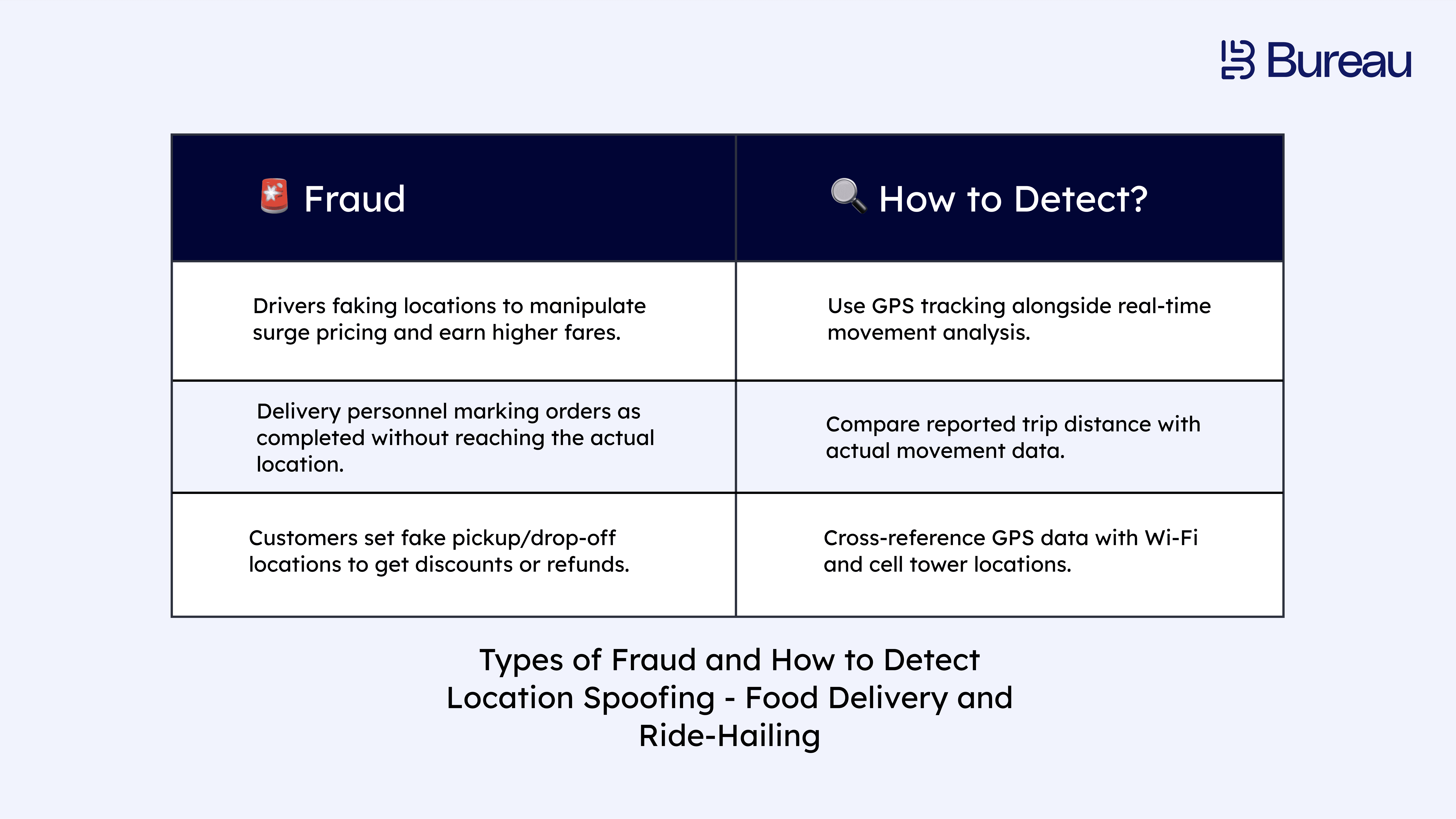
This is particularly useful in ride-hailing and delivery scams. A food delivery driver, for example, may trick an app into thinking they are near a restaurant when they are actually miles away, allowing them to game the system and collect orders unfairly.
The best way to counter this? Cross-check location data using GPS, IP, and Wi-Fi networks rather than relying on a single source.
Using Remote Desktop Software
Some fraudsters don’t even need to manipulate their location; they rely on remote desktop software like TeamViewer or AnyDesk to take control of devices that are legitimately in the desired location.
This is particularly common in financial scams. A fraudster operating from a restricted country may remotely access a computer in the U.S. to make transactions that would otherwise be blocked.
Because the login appears to come from a trusted device and location, the fraud goes undetected unless security teams monitor remote access attempts and flag unusual device logins.
The fight against location spoofing requires a multi-layered approach. Simply relying on GPS or IP-based tracking is no longer enough. Organizations must integrate multiple location verification methods, monitor for inconsistencies, and stay ahead of evolving fraud tactics.
If they don’t, they risk opening the door to a new wave of location-based fraud that is becoming harder to detect.
Related Read: The Overlooked Behavioral Red Flags Behind Fraudulent Transactions
Who Spoofs Location or GPS and Why?
Location spoofing isn’t just a trick used for fun; it’s a powerful tool for fraudsters looking to exploit systems and gain financial benefits. Different industries are targeted for different reasons, whether it’s financial fraud, taking unfair advantage of location-based offers, or bypassing restrictions.
Here’s how location spoofing plays a role in various scams.
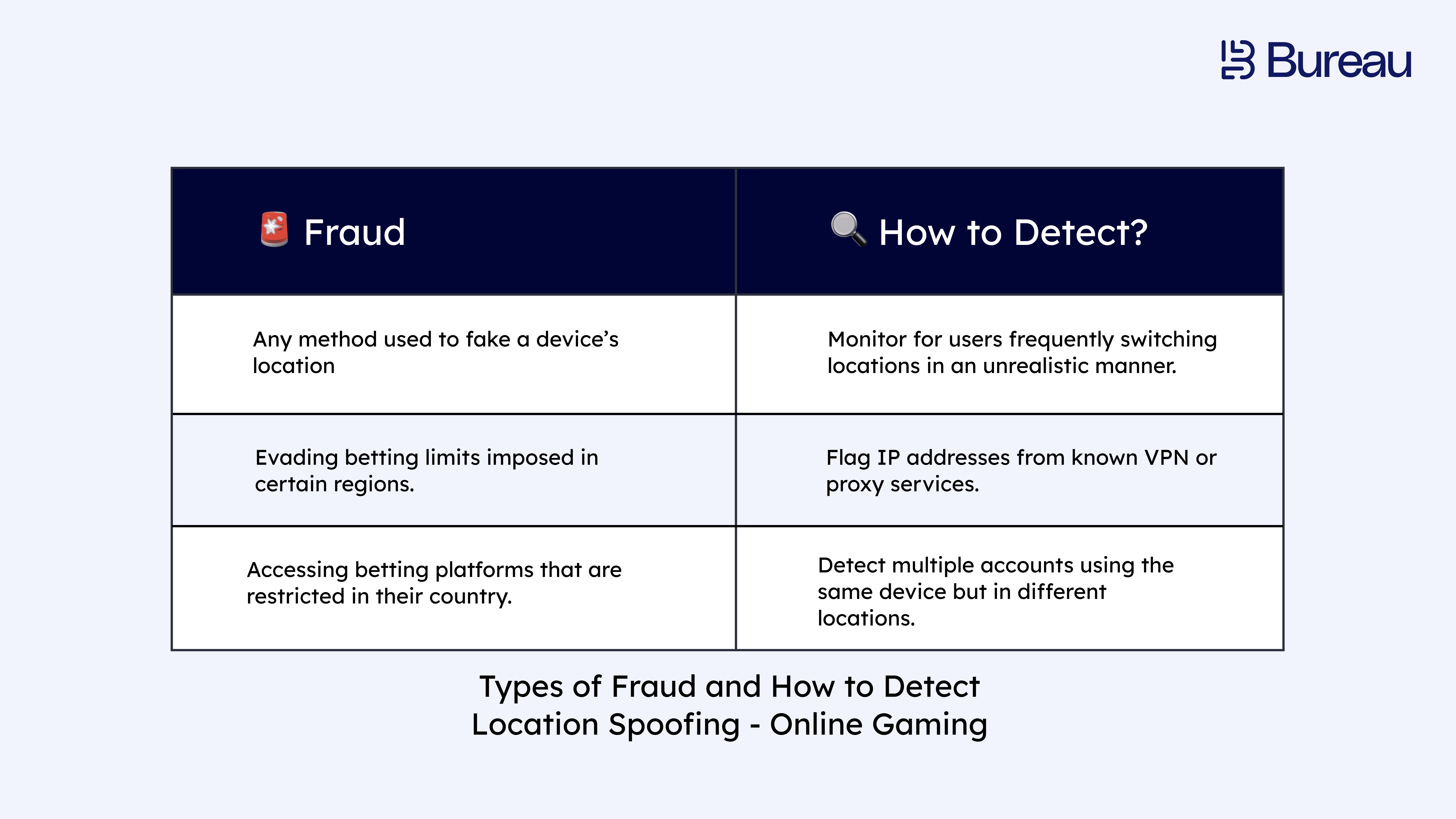
Online Betting and Gaming Apps
Many online betting platforms restrict access based on geographic location due to gambling laws. Fraudsters use GPS spoofing and VPNs to bypass these restrictions and place bets in regions where the service isn’t allowed. Similar types of gaming fraud are seen outside betting apps.
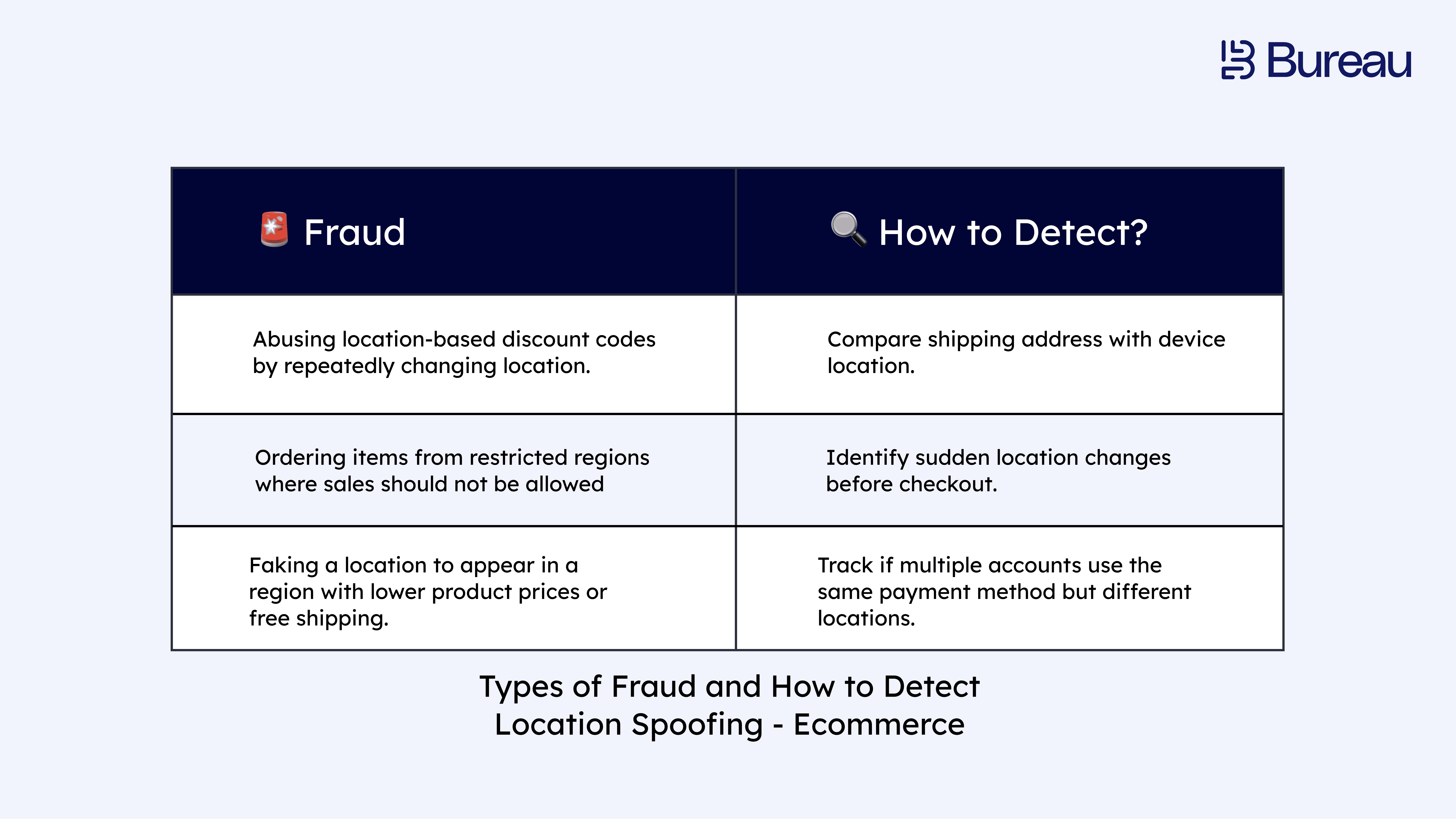
Online Shopping & Promo Abuse
Many e-commerce platforms offer region-based discounts and exclusive promotions. Fraudsters manipulate their location to take advantage of these offers, causing businesses to lose money.
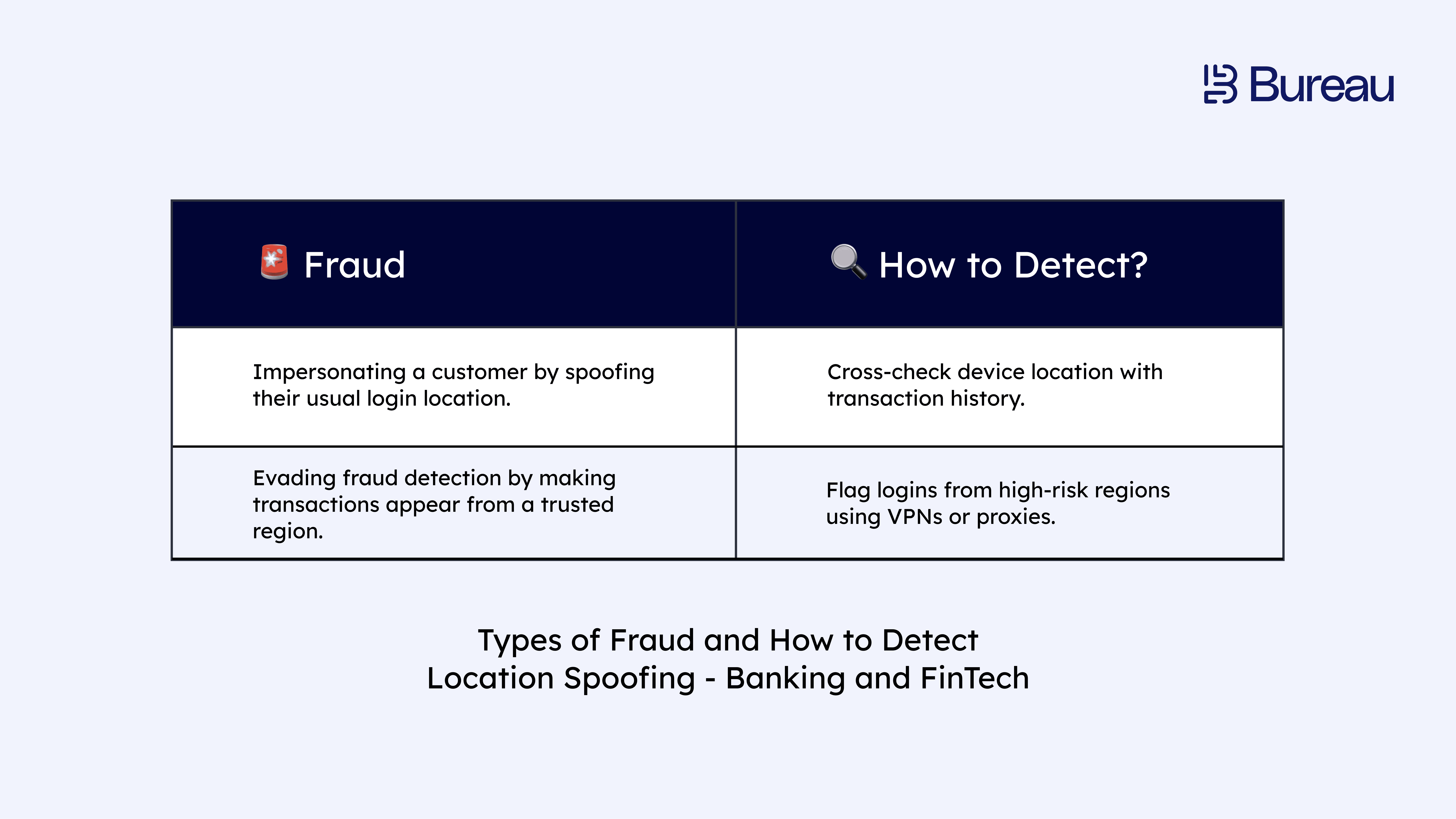
Fake GPS Fraud in Banking
Banks and financial institutions use location data as part of fraud detection. Scammers spoof their location to trick security systems and bypass account restrictions.
Location Spoofing Detection in Ride-Hailing and Food Delivery
Gig economy apps like Uber and Lyft and food delivery platforms rely on location tracking to assign jobs and calculate payments. Fraudsters use GPS spoofing to manipulate earnings.
Common GPS Spoofing Detection Signals Fraud Teams Should Track
Fraud teams need to track GPS spoofing signals across multiple layers. Location data becomes more reliable when it is evaluated alongside device, network, behavior, account, and transaction context.
Key signals to track include:
Device signals: Device ID, emulator use, rooting, jailbreaking, SDK tampering, spoofing apps
Network signals: IP location, VPN, proxy, TOR, ASN, IP reputation
Location signals: GPS coordinates, Wi-Fi, cell tower, elevation, pressure, accuracy, sensor consistency
Behavioral signals: Typing rhythm, swipe patterns, session speed, navigation behavior, bot-like activity
Account signals: New account creation, repeated signups, shared devices, linked identities
Transaction signals: Unusual payment activity, promo redemption, withdrawals, high-risk transfers, region mismatch
The most useful signals are the ones that help fraud teams understand intent. A location mismatch during casual browsing may not matter, but the same mismatch during KYC, bonus redemption, password reset, or withdrawal can tell a very different risk story.
When one team asked how to track whether remote laptops were being used outside an approved province or state, IT professionals pointed out that IP-based location can be imprecise and difficult to operationalize on its own. For fraud teams, the lesson is similar: IP, GPS, Wi-Fi, device, and behavior signals are more useful when evaluated together instead of treated as standalone proof.
Once these signals are clear, the next step is deciding where and how to apply them. That is where a structured location spoofing detection strategy helps fraud teams move from signal collection to real-time action.
How to Build a Location Spoofing Detection Strategy?
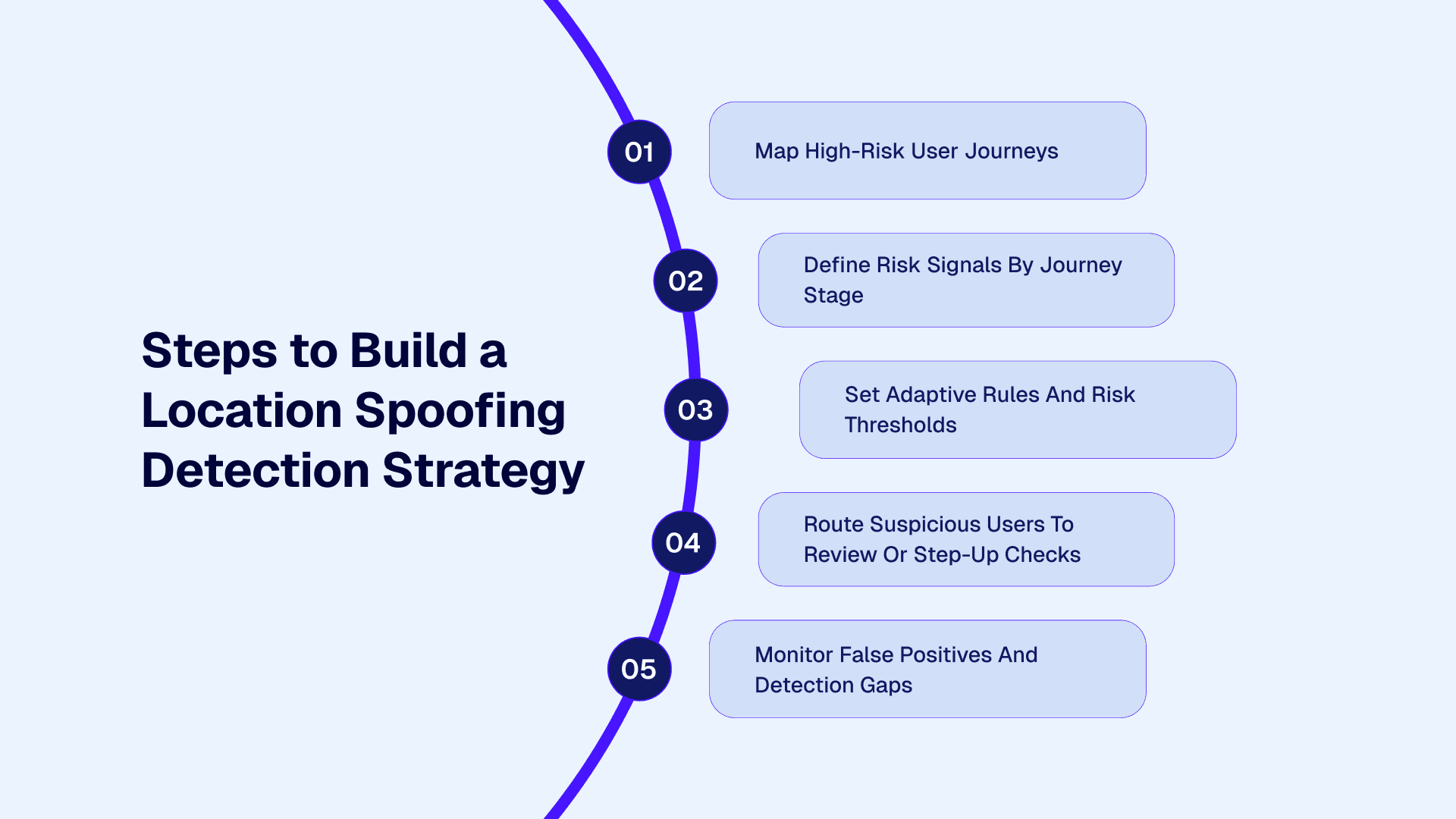
A strong location spoofing detection strategy starts with the user journey. Fraud teams need to understand which moments carry real risk, then apply the right combination of GPS, IP, device, behavioral, and transaction checks at those points.
Step 1: Map High-Risk User Journeys
Start by identifying where a fake location can directly create business or fraud risk. These are usually the points where a user can access something valuable, bypass a rule, or complete a sensitive action.
Common high-risk journeys include signup, login, promo redemption, withdrawals, high-value transactions, password resets, and geo-restricted access.
The goal is not to add strict checks everywhere, because a user browsing a page does not need the same level of scrutiny as someone redeeming a bonus, opening an account, changing credentials, or initiating a withdrawal.
Step 2: Define Risk Signals by Journey Stage
Once the risky journeys are clear, map the signals that matter most at each stage. This keeps the detection logic practical instead of applying the same rules to every user action.
Journey Stage | Signals to Prioritize |
Signup | Device ID, IP risk, emulator checks, identity signals |
Login | Device continuity, behavioral biometrics |
Promo redemption | Device-account links, repeated signups, location mismatch |
Transaction | GPS-IP mismatch, payment behavior, account history, and impossible travel |
Withdrawal | Device trust, behavioral consistency, network masking, risk score |
This helps fraud teams apply friction only where it is justified. It also makes detection more accurate because the same signal can mean different things depending on the action. A VPN during casual login may be low risk, but a VPN combined with a new device and withdrawal request should be treated differently.
Step 3: Set Adaptive Rules and Risk Thresholds
After mapping the signals, define what each risk level should trigger. Some signals may only increase the risk score, while others may require step-up verification, manual review, temporary holds, or blocking.
For example, VPN use alone may not justify a block. But VPN use combined with a new device, impossible travel, and promo redemption should increase the risk level.
This is where configurable decisioning matters. Bureau ID’s Unified Risk Decisioning Platform combines device, behavior, identity, network, and transaction signals, then lets teams define rules, thresholds, and approval logic without relying on engineering for every fraud-pattern change.
Step 4: Route Suspicious Users to Review or Step-Up Checks
Not every risky session should be blocked immediately. A better approach is to match the response to the level of risk.
Fraud teams can route users based on clear risk bands:
Low risk: Approve the action without added friction.
Medium risk: Add lightweight checks, such as OTP or device confirmation.
High risk: Trigger step-up verification or manual review.
Known repeat risk: Block the action or restrict the account.
Unclear risk: Hold the action until more context is available.
This structure helps teams protect the business without creating unnecessary drop-offs. It is especially important for fintech, gaming, marketplaces, and e-commerce platforms, where aggressive blocking can also hurt genuine users.
Step 5: Monitor False Positives and Detection Gaps
A location spoofing strategy should improve as fraud patterns change. Fraud teams need to review whether their rules are catching real abuse, missing new tactics, or adding friction where it is not needed.
Useful metrics include spoofing attempts detected, false-positive rate, manual-review volume, step-up completion rate, repeat offender detection, fraud loss prevented, and conversion impact on genuine users.
The best strategies use real fraud outcomes to tune rules, adjust thresholds, and improve detection accuracy over time.
Related Read: Device Intelligence and Data Sovereignty: What You Need to Know
How Bureau ID Detects Location Spoofing
If your fraud detection system is using one signal as your source of truth for location spoofing detection, you may have already lost millions of dollars! Bureau ID believes that companies must take a multi-faceted approach to detect location spoofing effectively.
Bureau ID employs a combination of fused location intelligence from telecom, GPS, and IP. To enhance accuracy further, our system analyzes multiple sessions (10 or more) of a user to identify consistencies and spot inconsistencies.
Bureau ID takes pride in the depth and accuracy of signals. In Location Spoofing detection, for instance, we use frequency and triangulation to establish:
Elevation: How high a user is from ground level (for example, which floor)
Signal Strength: How far a user is from the intel source (for example, distance from the router)
This is why our rate of false positives is the lowest in the industry. Here’s an example. If you are seeing multiple accounts from the same location, our technology can differentiate whether it’s a corporate tech park or a syndicate of fraudsters.
To keep updating our technology to the latest standards, we use open source intelligence like OpenCelliD, Wigle, etc.
And before we forget? We do all these in the lightest fashion possible (read: light SDK, easy integration) without hurting the customer experience.
Curious to know more? Drop us an email at sales@bureau.id or use this form to schedule a demo.
GPS Spoofing Detection Checklist for Fraud Teams
GPS spoofing detection can quickly become too narrow, which makes this checklist useful. If your setup only checks GPS accuracy or IP location, it may miss the broader context that shows whether the user is actually risky.
Use these questions to evaluate whether your current detection setup can identify fake GPS location signals and connect them to fraud risk:
Are GPS, IP, Wi-Fi, and network signals checked together?
Can you detect mock-location tools or spoofing apps?
Can you identify VPN, proxy, TOR, and anonymizer usage?
Can you detect emulators, rooted devices, and tampered environments?
Can you identify impossible travel or suspicious location switching?
Can you link suspicious devices to multiple accounts?
Can you combine location signals with behavioral signals?
Can you apply step-up checks instead of blocking every suspicious session?
Can fraud teams tune rules without waiting on engineering?
Can you explain why a session was flagged?
If most answers are yes, your team has a stronger foundation for location spoofing detection. But if more than four answers are no, the gap is likely not just in GPS detection, but in how well your fraud system connects context signals before taking action.
In that case, the practical next step is to move from isolated checks to unified risk decisioning. That means bringing GPS, IP, device, behavioral, identity, and transaction signals into one risk view so fraud teams can approve genuine users faster, step up suspicious users, and block high-risk activity with more confidence.
Stop Location Spoofing Before It Becomes Fraud
A fake location is usually a signal that something else may be happening underneath, such as account abuse, promo fraud, fake onboarding, unauthorized access, or suspicious transaction activity.
If your team relies only on GPS or IP checks, you may miss attempts that involve emulators, VPNs, device tampering, multi-accounting, or suspicious transaction behavior.
Bureau ID helps fraud teams connect location signals with device intelligence, behavioral patterns, identity context, network risk, and transaction activity so teams can approve genuine users faster, step up suspicious users, and block high-risk activity before it turns into fraud.
Schedule a demo with Bureau ID to see how a unified approach to location spoofing detection can fit into your fraud decisioning workflow.
FAQs
1. What is GPS spoofing detection?
GPS spoofing detection identifies fake or manipulated location data. It helps fraud teams verify whether a user, device, driver, or app session is showing a real location or a spoofed one. It is used to reduce location fraud across onboarding, login, payments, delivery, and workforce workflows.
2. How does GPS spoofing detection work?
GPS spoofing detection works by comparing GPS coordinates with IP address, network signals, device integrity, velocity patterns, and user behavior. It can flag mock locations, emulators, device tampering, sudden location jumps, and mismatched location signals before they turn into fraud risk.
3. What is the difference between GPS spoofing and location spoofing?
GPS spoofing means manipulating GPS-based location data. Location spoofing is broader and can include GPS spoofing, VPNs, proxies, IP manipulation, emulators, mock-location apps, and app-level tampering. GPS spoofing is one type of location spoofing.
4. What signals help detect GPS spoofing in mobile apps?
Mobile apps can detect GPS spoofing by tracking GPS and IP mismatches, mock-location settings, emulator use, rooted or jailbroken devices, app tampering, impossible travel speed, repeated coordinates, and abnormal user behavior. These signals help fraud teams build a more reliable location-risk score.
5. How can businesses reduce false positives in location spoofing detection?
Businesses can reduce false positives by using multiple signals instead of relying only on GPS. They should compare GPS, IP, Wi-Fi, cellular, device, and behavior signals. They should also review weak GPS signals, indoor usage, VPN use, poor satellite visibility, and legitimate travel before blocking users.
6. What industries need GPS spoofing detection most?
GPS spoofing detection is useful for fintech, banking, delivery, ride-sharing, gaming, aviation, drones, and geofenced services. These industries use location signals for onboarding, login, payments, delivery validation, clock-ins, navigation, compliance, or fraud prevention.
A fake location can look harmless until it becomes the reason a risky user gets approved, a bonus gets abused, or a restricted transaction goes through.
Fraudsters use GPS spoofing, VPNs, proxies, emulators, and device tampering to make their location look legitimate. For fraud teams, it gets difficult to understand whether that location mismatch is connected to account takeover, promo abuse, mule activity, or unauthorized access.
This is why fraud teams need to validate location as a risk signal instead of a standalone data point.
GPS spoofing detection helps businesses detect fake GPS location signals by comparing GPS data with IP, network, device, behavioral, and transaction context. Instead of relying on one location signal, fraud teams can assess whether the user, device, location, and action make sense together.
In this guide, we’ll break down what GPS spoofing detection means, how it differs from broader location spoofing detection, how fraudsters fake location data, which signals matter most, and how fraud teams can build a practical strategy to detect location spoofing without adding unnecessary friction for genuine users.
What Is GPS Spoofing Detection?
GPS spoofing detection identifies fake or manipulated location data before it becomes fraud. It checks GPS coordinates against IP address, network signals, device integrity, mock-location settings, emulator use, velocity patterns, and user behavior. Fraud teams use GPS spoofing detection to verify real location, flag suspicious activity, reduce false positives, and stop location spoofing across onboarding, login, payments, delivery, and workforce workflows.
This means fraud teams do not treat GPS as a standalone source of truth. A coordinate may look valid on its own, but it becomes more meaningful when checked against the user’s device, network, behavior, account history, and action.
GPS spoofing detection usually checks for:
Fake GPS coordinates: Manipulated location data.
Mock-location tools: Apps or settings that override GPS.
VPNs, proxies, or TOR: Tools that mask IP-based location.
GPS-IP mismatches: Conflicting GPS and IP locations.
Device tampering: Emulators, rooted devices, or manipulated environments.
Sudden location jumps: Movement that does not match realistic travel.
High-risk behavior: Spoofing linked to onboarding, login, payments, or withdrawals.
Fake-location tools are also easy to find. For example, one Fake GPS Location app listed on Google Play shows 50 million+ downloads, while another GPS Emulator app shows 10 million+ downloads. That does not mean every user of these apps is committing fraud, but it does show why businesses should not assume device-reported GPS is always reliable.
This is where the distinction between GPS spoofing and broader location spoofing matters. GPS spoofing focuses on manipulated GPS coordinates, while location spoofing includes every way a fraudster can mask or manipulate where they appear to be.
GPS Spoofing vs Location Spoofing: What Fraud Teams Need to Know
GPS spoofing and location spoofing are closely related, but they are not the same. GPS spoofing refers specifically to manipulated GPS coordinates. Location spoofing is broader and can include GPS manipulation, VPNs, proxies, TOR, IP masking, emulator use, device tampering, and inconsistent location behavior across a user journey.
Term | What It Means | Why It Matters for Fraud Teams |
GPS spoofing | Manipulating device-reported GPS coordinates | Helps fraudsters fake physical presence |
IP masking | Using VPNs, proxies, TOR, or anonymizers to hide IP-based location | Helps users bypass geography-based controls |
Location spoofing | Manipulating or masking location through GPS, IP, device, network, or behavior signals | Creates risk across onboarding, login, transactions, and geo-restricted access |
For fraud teams, the question is whether location manipulation supports a larger fraud pattern.
A spoofed location can help fraudsters access restricted products, hide account takeover activity, exploit sign-up bonuses, create multiple accounts, bypass jurisdiction-based compliance checks, or manipulate fintech, gaming, marketplace, and transaction workflows.
This is also where the difference between GPS jamming and spoofing matters. Jamming disrupts or blocks GPS signals, while spoofing manipulates location information to make a receiver or application trust a false position.
How Fraudsters Fake GPS and Location Data
Fraudsters often combine fake GPS data with VPNs, proxies, emulators, device resets, and scripted behavior to make a risky user, session, or transaction look legitimate.
Common methods include:
GPS spoofing apps and mock-location tools can be used to change device-reported coordinates.
VPNs, proxies, and TOR can hide or manipulate IP-based location.
Emulators and virtual devices create accounts, automate activity, or run fraud at scale.
Rooted or jailbroken devices can bypass device-level restrictions or manipulate app signals.
Device resets and environment changes are used to appear as a new user after being blocked.
Manipulated request data can be used to send false or inconsistent location information to a platform.
These methods matter because many fraud journeys do not look suspicious from one signal alone. For instance, a VPN user may be genuine, a new device may be legitimate, and a location mismatch may come from travel. But when these signals appear together around onboarding, login, promo redemption, or withdrawal, they deserve closer review.
Because these methods often overlap, fraud teams need to validate location using multiple signals instead of trusting GPS or IP data in isolation.
How Do Fraudsters Spoof Their Location?
Fraudsters deploy several tactics to fake their location. The choice of tactic varies based on their end goal: to bypass security measures, to commit fraud, or to exploit location-based services.
Here is a detailed breakdown of the most common techniques they use.
GPS Spoofing Apps
One of the most common methods is GPS spoofing apps, which allow users to modify their real location with a few taps. These apps trick any service relying on GPS data, making it appear as though the user is in a completely different region.
For instance, scammers use GPS spoofing to access banking or stock trading platforms restricted to certain locations. A fraudster sitting in one country can manipulate their phone’s GPS to show they are in the U.S., gaining access to financial services meant only for domestic users.
One of the giveaways? Suddenly, unnatural location changes like jumping from New York to London within seconds.
VPNs & Proxy Servers
Rerouting traffic using VPN and proxy servers is a widespread tactic that online fraudsters and scammers use. By masking the user’s actual IP address, scammers bypass regional restrictions and trick systems into treating them as trusted users. Imagine an online banking platform that flags logins from high-risk countries. It can be a variation of any such security measure.
A fraudster can use a VPN to appear as if they are logging in from a whitelisted region, effectively bypassing the security check. While VPN detection tools exist, fraudsters often cycle through different servers, making it harder to pinpoint suspicious activity.
Wi-Fi & Cell Tower Spoofing
For even more precise manipulation, some attackers turn to Wi-Fi and cell tower spoofing. Since many security systems use network-based triangulation for location tracking, fraudsters exploit this by setting up rogue Wi-Fi hotspots or mimicking cell towers.
This is particularly useful in ride-hailing and delivery scams. A food delivery driver, for example, may trick an app into thinking they are near a restaurant when they are actually miles away, allowing them to game the system and collect orders unfairly.
The best way to counter this? Cross-check location data using GPS, IP, and Wi-Fi networks rather than relying on a single source.
Using Remote Desktop Software
Some fraudsters don’t even need to manipulate their location; they rely on remote desktop software like TeamViewer or AnyDesk to take control of devices that are legitimately in the desired location.
This is particularly common in financial scams. A fraudster operating from a restricted country may remotely access a computer in the U.S. to make transactions that would otherwise be blocked.
Because the login appears to come from a trusted device and location, the fraud goes undetected unless security teams monitor remote access attempts and flag unusual device logins.
The fight against location spoofing requires a multi-layered approach. Simply relying on GPS or IP-based tracking is no longer enough. Organizations must integrate multiple location verification methods, monitor for inconsistencies, and stay ahead of evolving fraud tactics.
If they don’t, they risk opening the door to a new wave of location-based fraud that is becoming harder to detect.
Related Read: The Overlooked Behavioral Red Flags Behind Fraudulent Transactions
Who Spoofs Location or GPS and Why?
Location spoofing isn’t just a trick used for fun; it’s a powerful tool for fraudsters looking to exploit systems and gain financial benefits. Different industries are targeted for different reasons, whether it’s financial fraud, taking unfair advantage of location-based offers, or bypassing restrictions.
Here’s how location spoofing plays a role in various scams.
Online Betting and Gaming Apps
Many online betting platforms restrict access based on geographic location due to gambling laws. Fraudsters use GPS spoofing and VPNs to bypass these restrictions and place bets in regions where the service isn’t allowed. Similar types of gaming fraud are seen outside betting apps.
Online Shopping & Promo Abuse
Many e-commerce platforms offer region-based discounts and exclusive promotions. Fraudsters manipulate their location to take advantage of these offers, causing businesses to lose money.
Fake GPS Fraud in Banking
Banks and financial institutions use location data as part of fraud detection. Scammers spoof their location to trick security systems and bypass account restrictions.
Location Spoofing Detection in Ride-Hailing and Food Delivery
Gig economy apps like Uber and Lyft and food delivery platforms rely on location tracking to assign jobs and calculate payments. Fraudsters use GPS spoofing to manipulate earnings.
Common GPS Spoofing Detection Signals Fraud Teams Should Track
Fraud teams need to track GPS spoofing signals across multiple layers. Location data becomes more reliable when it is evaluated alongside device, network, behavior, account, and transaction context.
Key signals to track include:
Device signals: Device ID, emulator use, rooting, jailbreaking, SDK tampering, spoofing apps
Network signals: IP location, VPN, proxy, TOR, ASN, IP reputation
Location signals: GPS coordinates, Wi-Fi, cell tower, elevation, pressure, accuracy, sensor consistency
Behavioral signals: Typing rhythm, swipe patterns, session speed, navigation behavior, bot-like activity
Account signals: New account creation, repeated signups, shared devices, linked identities
Transaction signals: Unusual payment activity, promo redemption, withdrawals, high-risk transfers, region mismatch
The most useful signals are the ones that help fraud teams understand intent. A location mismatch during casual browsing may not matter, but the same mismatch during KYC, bonus redemption, password reset, or withdrawal can tell a very different risk story.
When one team asked how to track whether remote laptops were being used outside an approved province or state, IT professionals pointed out that IP-based location can be imprecise and difficult to operationalize on its own. For fraud teams, the lesson is similar: IP, GPS, Wi-Fi, device, and behavior signals are more useful when evaluated together instead of treated as standalone proof.
Once these signals are clear, the next step is deciding where and how to apply them. That is where a structured location spoofing detection strategy helps fraud teams move from signal collection to real-time action.
How to Build a Location Spoofing Detection Strategy?
A strong location spoofing detection strategy starts with the user journey. Fraud teams need to understand which moments carry real risk, then apply the right combination of GPS, IP, device, behavioral, and transaction checks at those points.
Step 1: Map High-Risk User Journeys
Start by identifying where a fake location can directly create business or fraud risk. These are usually the points where a user can access something valuable, bypass a rule, or complete a sensitive action.
Common high-risk journeys include signup, login, promo redemption, withdrawals, high-value transactions, password resets, and geo-restricted access.
The goal is not to add strict checks everywhere, because a user browsing a page does not need the same level of scrutiny as someone redeeming a bonus, opening an account, changing credentials, or initiating a withdrawal.
Step 2: Define Risk Signals by Journey Stage
Once the risky journeys are clear, map the signals that matter most at each stage. This keeps the detection logic practical instead of applying the same rules to every user action.
Journey Stage | Signals to Prioritize |
Signup | Device ID, IP risk, emulator checks, identity signals |
Login | Device continuity, behavioral biometrics |
Promo redemption | Device-account links, repeated signups, location mismatch |
Transaction | GPS-IP mismatch, payment behavior, account history, and impossible travel |
Withdrawal | Device trust, behavioral consistency, network masking, risk score |
This helps fraud teams apply friction only where it is justified. It also makes detection more accurate because the same signal can mean different things depending on the action. A VPN during casual login may be low risk, but a VPN combined with a new device and withdrawal request should be treated differently.
Step 3: Set Adaptive Rules and Risk Thresholds
After mapping the signals, define what each risk level should trigger. Some signals may only increase the risk score, while others may require step-up verification, manual review, temporary holds, or blocking.
For example, VPN use alone may not justify a block. But VPN use combined with a new device, impossible travel, and promo redemption should increase the risk level.
This is where configurable decisioning matters. Bureau ID’s Unified Risk Decisioning Platform combines device, behavior, identity, network, and transaction signals, then lets teams define rules, thresholds, and approval logic without relying on engineering for every fraud-pattern change.
Step 4: Route Suspicious Users to Review or Step-Up Checks
Not every risky session should be blocked immediately. A better approach is to match the response to the level of risk.
Fraud teams can route users based on clear risk bands:
Low risk: Approve the action without added friction.
Medium risk: Add lightweight checks, such as OTP or device confirmation.
High risk: Trigger step-up verification or manual review.
Known repeat risk: Block the action or restrict the account.
Unclear risk: Hold the action until more context is available.
This structure helps teams protect the business without creating unnecessary drop-offs. It is especially important for fintech, gaming, marketplaces, and e-commerce platforms, where aggressive blocking can also hurt genuine users.
Step 5: Monitor False Positives and Detection Gaps
A location spoofing strategy should improve as fraud patterns change. Fraud teams need to review whether their rules are catching real abuse, missing new tactics, or adding friction where it is not needed.
Useful metrics include spoofing attempts detected, false-positive rate, manual-review volume, step-up completion rate, repeat offender detection, fraud loss prevented, and conversion impact on genuine users.
The best strategies use real fraud outcomes to tune rules, adjust thresholds, and improve detection accuracy over time.
Related Read: Device Intelligence and Data Sovereignty: What You Need to Know
How Bureau ID Detects Location Spoofing
If your fraud detection system is using one signal as your source of truth for location spoofing detection, you may have already lost millions of dollars! Bureau ID believes that companies must take a multi-faceted approach to detect location spoofing effectively.
Bureau ID employs a combination of fused location intelligence from telecom, GPS, and IP. To enhance accuracy further, our system analyzes multiple sessions (10 or more) of a user to identify consistencies and spot inconsistencies.
Bureau ID takes pride in the depth and accuracy of signals. In Location Spoofing detection, for instance, we use frequency and triangulation to establish:
Elevation: How high a user is from ground level (for example, which floor)
Signal Strength: How far a user is from the intel source (for example, distance from the router)
This is why our rate of false positives is the lowest in the industry. Here’s an example. If you are seeing multiple accounts from the same location, our technology can differentiate whether it’s a corporate tech park or a syndicate of fraudsters.
To keep updating our technology to the latest standards, we use open source intelligence like OpenCelliD, Wigle, etc.
And before we forget? We do all these in the lightest fashion possible (read: light SDK, easy integration) without hurting the customer experience.
Curious to know more? Drop us an email at sales@bureau.id or use this form to schedule a demo.
GPS Spoofing Detection Checklist for Fraud Teams
GPS spoofing detection can quickly become too narrow, which makes this checklist useful. If your setup only checks GPS accuracy or IP location, it may miss the broader context that shows whether the user is actually risky.
Use these questions to evaluate whether your current detection setup can identify fake GPS location signals and connect them to fraud risk:
Are GPS, IP, Wi-Fi, and network signals checked together?
Can you detect mock-location tools or spoofing apps?
Can you identify VPN, proxy, TOR, and anonymizer usage?
Can you detect emulators, rooted devices, and tampered environments?
Can you identify impossible travel or suspicious location switching?
Can you link suspicious devices to multiple accounts?
Can you combine location signals with behavioral signals?
Can you apply step-up checks instead of blocking every suspicious session?
Can fraud teams tune rules without waiting on engineering?
Can you explain why a session was flagged?
If most answers are yes, your team has a stronger foundation for location spoofing detection. But if more than four answers are no, the gap is likely not just in GPS detection, but in how well your fraud system connects context signals before taking action.
In that case, the practical next step is to move from isolated checks to unified risk decisioning. That means bringing GPS, IP, device, behavioral, identity, and transaction signals into one risk view so fraud teams can approve genuine users faster, step up suspicious users, and block high-risk activity with more confidence.
Stop Location Spoofing Before It Becomes Fraud
A fake location is usually a signal that something else may be happening underneath, such as account abuse, promo fraud, fake onboarding, unauthorized access, or suspicious transaction activity.
If your team relies only on GPS or IP checks, you may miss attempts that involve emulators, VPNs, device tampering, multi-accounting, or suspicious transaction behavior.
Bureau ID helps fraud teams connect location signals with device intelligence, behavioral patterns, identity context, network risk, and transaction activity so teams can approve genuine users faster, step up suspicious users, and block high-risk activity before it turns into fraud.
Schedule a demo with Bureau ID to see how a unified approach to location spoofing detection can fit into your fraud decisioning workflow.
FAQs
1. What is GPS spoofing detection?
GPS spoofing detection identifies fake or manipulated location data. It helps fraud teams verify whether a user, device, driver, or app session is showing a real location or a spoofed one. It is used to reduce location fraud across onboarding, login, payments, delivery, and workforce workflows.
2. How does GPS spoofing detection work?
GPS spoofing detection works by comparing GPS coordinates with IP address, network signals, device integrity, velocity patterns, and user behavior. It can flag mock locations, emulators, device tampering, sudden location jumps, and mismatched location signals before they turn into fraud risk.
3. What is the difference between GPS spoofing and location spoofing?
GPS spoofing means manipulating GPS-based location data. Location spoofing is broader and can include GPS spoofing, VPNs, proxies, IP manipulation, emulators, mock-location apps, and app-level tampering. GPS spoofing is one type of location spoofing.
4. What signals help detect GPS spoofing in mobile apps?
Mobile apps can detect GPS spoofing by tracking GPS and IP mismatches, mock-location settings, emulator use, rooted or jailbroken devices, app tampering, impossible travel speed, repeated coordinates, and abnormal user behavior. These signals help fraud teams build a more reliable location-risk score.
5. How can businesses reduce false positives in location spoofing detection?
Businesses can reduce false positives by using multiple signals instead of relying only on GPS. They should compare GPS, IP, Wi-Fi, cellular, device, and behavior signals. They should also review weak GPS signals, indoor usage, VPN use, poor satellite visibility, and legitimate travel before blocking users.
6. What industries need GPS spoofing detection most?
GPS spoofing detection is useful for fintech, banking, delivery, ride-sharing, gaming, aviation, drones, and geofenced services. These industries use location signals for onboarding, login, payments, delivery validation, clock-ins, navigation, compliance, or fraud prevention.
TABLE OF CONTENTS
See More
Recommended Blogs


Landing Page.
Simple, bold.
Sign Up
Download

Products
Solutions


© 2026 Bureau . All rights reserved.
Solutions
Industries
Resources
Company
Solutions
Industries
Resources
Company
© 2026 Bureau . All rights reserved.
Follow Us
Leave behind fragmented tools. Stop fraud rings, cut false declines, and deliver secure digital journeys at scale
Our Presence








Leave behind fragmented tools. Stop fraud rings, cut false declines, and deliver secure digital journeys at scale
Our Presence
© 2026 Bureau . All rights reserved.