The Key Reasons Fraud Continues to Outpace Defenses in the UK and EU
The Key Reasons Fraud Continues to Outpace Defenses in the UK and EU
The Key Reasons Fraud Continues to Outpace Defenses in the UK and EU
Across the UK and European Union, fraud is being reshaped by forces beyond traditional controls. Real-time payments compress decisions, digital onboarding.
Author
Team Bureau

See how Bureau has helped industry leaders defend against networked Industrial-scale frauds →
Schedule a Demo
TABLE OF CONTENTS
See Less
Most fraud investigations start at the same place where the money started moving. A suspicious transfer. A declined card. A customer calling up to say something went wrong. And every time, the question is: how did the transaction get through despite all counter-measures?
The answer, more often than not, is that fraud didn't start there. The fraudulent transaction was just the final act. The real action was planned and executed a lot earlier spanning identity layers, device signals, behavioral patterns. It was active in places nobody was watching closely enough.
That's the central argument in Bureau's latest report, Why Fraud Still Wins: Lessons for Finance, Fintech, and Marketplaces in the UK and EU. And the numbers back it up.
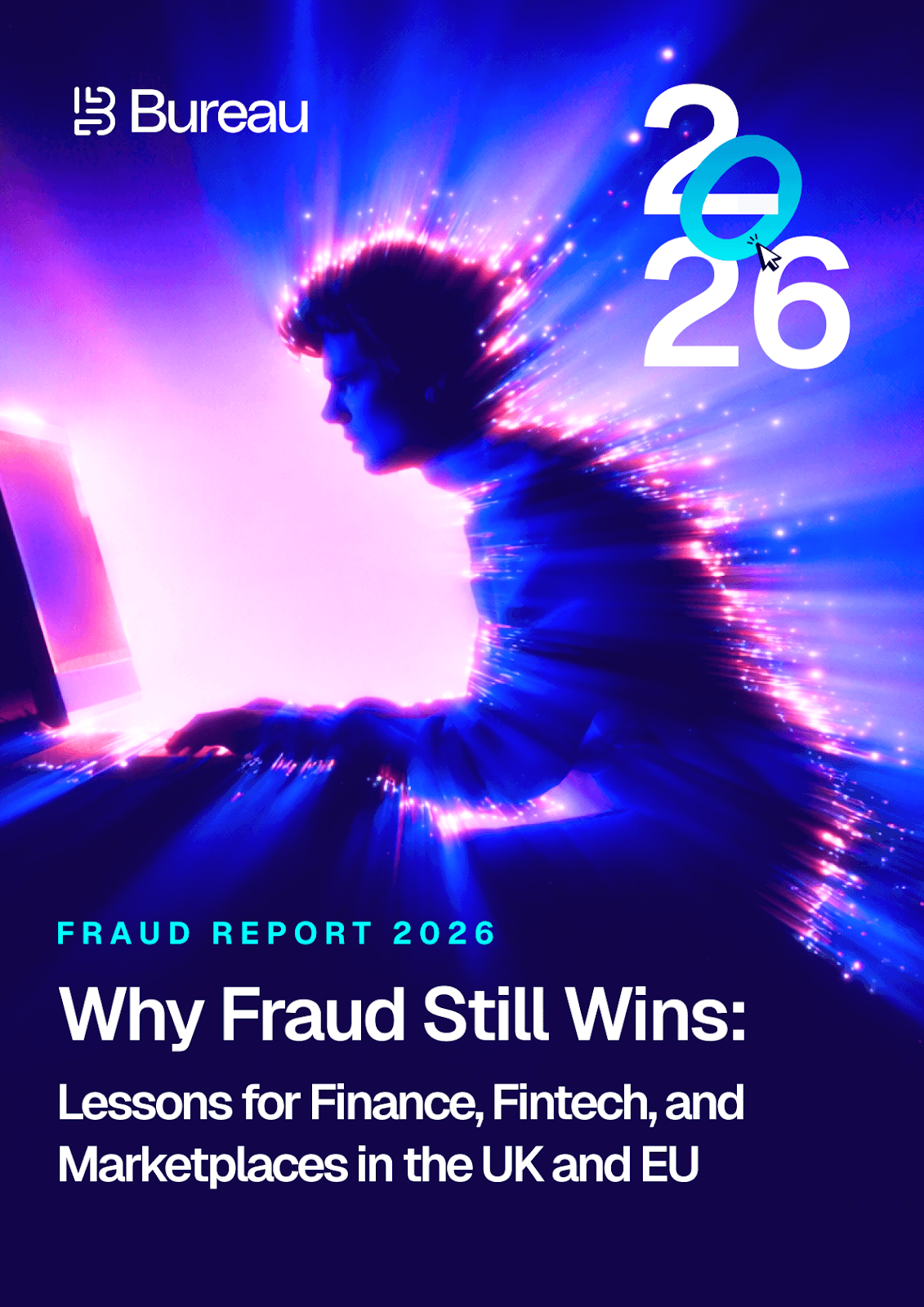
What looks like a single suspicious payment is almost always the final step in a chain of signals nobody connected in time. Bureau's latest report asks why and tells what to do about it.
The Scale of the Problem Across the UK and Europe
Fraud volumes across the UK and EU didn't just creep up in 2025, they surged within a short span of time. They were largely driven by real-time payments, which compressed the fraud detection window. Further, identity manipulation replaced transaction abuse as the dominant tactic. And yet, most organizations are still evaluating risk the same way they did five years ago.
Here are some numbers that show the scale the crisis has reached in the UK and Europe.
£629MUK fraud losses in H1 2025 | 2.1MUK fraud cases up 17% | +50%Spike in synthetic identity fraud | +43%Digital fraud attempts in the EU |
|---|
These aren't just statistics. They represent a fundamental shift in how fraud operates. They are no longer isolated incidents. Attackers are running multi-stage, multi-channel operations that move through onboarding, account access, and payment layers before anyone connects the dots.
Within this environment, fraud broadly falls into two categories that are rising at alarming levels: authorized fraud and unauthorized fraud. Both keep bypassing modern controls and continue to exploit very different weaknesses.
The Two Dominant Attack Types: Authorized vs. Unauthorized Fraud
Every fraud attack in the current landscape can be attributed to one of two categories: authorized and unauthorized fraud. They exploit completely different weaknesses and they both keep winning.
Authorized fraudWhere the victim approves the crime
| Unauthorized fraudWhere the attacker bypasses the victim
|
Authorized fraud statistics | Unauthorized fraud statistics | ||
|---|---|---|---|
+12%App fraud losses in UK | 50%Orgs cite social engineering as top threat | 65%Increase in card-not-present fraud | 67%Companies impacted by mule networks |
Why Both Fraud Types Keep Winning
The reason fraud keeps succeeding isn't a lack of security tools. Most organizations have plenty of those. The problem is how those tools are deployed.
Fragmented fraud stacks
First, fraud stacks are fragmented. Identity verification, device intelligence, and payment monitoring typically operate in separate systems. An attacker can trigger warning signs across different platforms without any single system seeing the full picture.
67% of respondents in Bureau's survey said that siloed systems prevented them from correlating signals in real time.
Attackers scale faster
AI-powered fraud operations can launch mass attacks by executing credential stuffing at scale, automated account probing, synthetic identity creation. All these transactions happen at a pace that is faster for human analysts to review and raise alerts.
Regulatory complexity
Regulatory complexity is not easy to tackle and often creates more friction than guardrails. Cross-border enforcement gaps and data-sharing barriers between financial institutions don’t facilitate real-time sharing of threat intelligence. In a region where transactions cross borders constantly, that's a significant structural disadvantage.
Industrialized fraud infrastructure
Money mule networks are organized. Fraud toolkits get reused. Infrastructure ranging from fake identity packages to SIM farms can be rented and resold.
Fraud works across systems while the counter-measures operate within silos. That mismatch is the core problem.
Related Read: What are Money Mules |
The Blind Spots Most Tools Are Missing
Most security tools protect the login. They do almost nothing to monitor what happens after. That gap is where attackers live.
A trusted device can be compromised and reused. 50% of the respondents faced device spoofing and emulator-based attacks during 2025.
Valid credentials don't prove intent.
A real user's behavioral profile can be mimicked by a RAT with enough observation time.
ATO attacks look legitimate because the login is legitimate.
CNP fraud spreads across multiple merchants before patterns emerge.
RAT-assisted transactions mirror genuine user behavior closely enough to pass real-time checks.
The signal is always there but they are disconnected. Fraud becomes visible only when you connect signals across time and context, not just at the moment of the transaction, but before it.
Related Read: A Complete Guide to Device ID |
The 2026 Playbook: Detect Earlier, Not Just Faster
The shift that's happening and needs to gain momentum is from reactive detection to predictive fraud intelligence.
It means three proactive steps must be taken at three stages:
Before login
Before payment
Across systems
Before loginDetect early signals Monitor bot activity, credential testing, and suspicious infrastructure before an attacker finds a working account. | Before paymentCatch behavioral anomalies Identify account probing, permission testing, and session anomalies before any money moves. | Across systemsConnect the signals Link identity, device, and behavioral intelligence into a single view. Fraud doesn't silo itself; defenses shouldn't either. |
|---|
Bureau's research shows that 66% of companies are now prioritizing predictive fraud models, 50% are investing in behavioral analytics and graph intelligence, and 33% are focusing specifically on device intelligence.
That's a meaningful shift. But it's not happening fast enough.
Fraud Prevention Must Start Earlier
Fraud is not a transaction problem. It never was.
Authorized fraud manipulates human trust over days or weeks. Unauthorized fraud exploits fragmented security across login, device, and payment layers. Both succeed for the same underlying reason that signals remain disconnected until it's too late.
Businesses that connect identity, device, and behavioral intelligence are better positioned to detect fraud before money moves. The ones still waiting for a confirmed fraudulent transaction to trigger a review will keep asking the same question after every incident: how did this get through?
The real competitive advantage in fraud prevention isn't detecting fraud faster. It's seeing it earlier.
Read the full reportBureau's report “Why Fraud Still Wins: Lessons for Finance, Fintech, and Marketplaces in the UK and EU” dives deeper on attack patterns, regional data, and the strategies that are actually working. It is specifically built for risk leaders and decision-makers across UK and EU financial services. For leaders building a fraud prevention roadmap for 2026, this is the research they need. |
Most fraud investigations start at the same place where the money started moving. A suspicious transfer. A declined card. A customer calling up to say something went wrong. And every time, the question is: how did the transaction get through despite all counter-measures?
The answer, more often than not, is that fraud didn't start there. The fraudulent transaction was just the final act. The real action was planned and executed a lot earlier spanning identity layers, device signals, behavioral patterns. It was active in places nobody was watching closely enough.
That's the central argument in Bureau's latest report, Why Fraud Still Wins: Lessons for Finance, Fintech, and Marketplaces in the UK and EU. And the numbers back it up.
What looks like a single suspicious payment is almost always the final step in a chain of signals nobody connected in time. Bureau's latest report asks why and tells what to do about it.
The Scale of the Problem Across the UK and Europe
Fraud volumes across the UK and EU didn't just creep up in 2025, they surged within a short span of time. They were largely driven by real-time payments, which compressed the fraud detection window. Further, identity manipulation replaced transaction abuse as the dominant tactic. And yet, most organizations are still evaluating risk the same way they did five years ago.
Here are some numbers that show the scale the crisis has reached in the UK and Europe.
£629MUK fraud losses in H1 2025 | 2.1MUK fraud cases up 17% | +50%Spike in synthetic identity fraud | +43%Digital fraud attempts in the EU |
|---|
These aren't just statistics. They represent a fundamental shift in how fraud operates. They are no longer isolated incidents. Attackers are running multi-stage, multi-channel operations that move through onboarding, account access, and payment layers before anyone connects the dots.
Within this environment, fraud broadly falls into two categories that are rising at alarming levels: authorized fraud and unauthorized fraud. Both keep bypassing modern controls and continue to exploit very different weaknesses.
The Two Dominant Attack Types: Authorized vs. Unauthorized Fraud
Every fraud attack in the current landscape can be attributed to one of two categories: authorized and unauthorized fraud. They exploit completely different weaknesses and they both keep winning.
Authorized fraudWhere the victim approves the crime
| Unauthorized fraudWhere the attacker bypasses the victim
|
Authorized fraud statistics | Unauthorized fraud statistics | ||
|---|---|---|---|
+12%App fraud losses in UK | 50%Orgs cite social engineering as top threat | 65%Increase in card-not-present fraud | 67%Companies impacted by mule networks |
Why Both Fraud Types Keep Winning
The reason fraud keeps succeeding isn't a lack of security tools. Most organizations have plenty of those. The problem is how those tools are deployed.
Fragmented fraud stacks
First, fraud stacks are fragmented. Identity verification, device intelligence, and payment monitoring typically operate in separate systems. An attacker can trigger warning signs across different platforms without any single system seeing the full picture.
67% of respondents in Bureau's survey said that siloed systems prevented them from correlating signals in real time.
Attackers scale faster
AI-powered fraud operations can launch mass attacks by executing credential stuffing at scale, automated account probing, synthetic identity creation. All these transactions happen at a pace that is faster for human analysts to review and raise alerts.
Regulatory complexity
Regulatory complexity is not easy to tackle and often creates more friction than guardrails. Cross-border enforcement gaps and data-sharing barriers between financial institutions don’t facilitate real-time sharing of threat intelligence. In a region where transactions cross borders constantly, that's a significant structural disadvantage.
Industrialized fraud infrastructure
Money mule networks are organized. Fraud toolkits get reused. Infrastructure ranging from fake identity packages to SIM farms can be rented and resold.
Fraud works across systems while the counter-measures operate within silos. That mismatch is the core problem.
Related Read: What are Money Mules |
The Blind Spots Most Tools Are Missing
Most security tools protect the login. They do almost nothing to monitor what happens after. That gap is where attackers live.
A trusted device can be compromised and reused. 50% of the respondents faced device spoofing and emulator-based attacks during 2025.
Valid credentials don't prove intent.
A real user's behavioral profile can be mimicked by a RAT with enough observation time.
ATO attacks look legitimate because the login is legitimate.
CNP fraud spreads across multiple merchants before patterns emerge.
RAT-assisted transactions mirror genuine user behavior closely enough to pass real-time checks.
The signal is always there but they are disconnected. Fraud becomes visible only when you connect signals across time and context, not just at the moment of the transaction, but before it.
Related Read: A Complete Guide to Device ID |
The 2026 Playbook: Detect Earlier, Not Just Faster
The shift that's happening and needs to gain momentum is from reactive detection to predictive fraud intelligence.
It means three proactive steps must be taken at three stages:
Before login
Before payment
Across systems
Before loginDetect early signals Monitor bot activity, credential testing, and suspicious infrastructure before an attacker finds a working account. | Before paymentCatch behavioral anomalies Identify account probing, permission testing, and session anomalies before any money moves. | Across systemsConnect the signals Link identity, device, and behavioral intelligence into a single view. Fraud doesn't silo itself; defenses shouldn't either. |
|---|
Bureau's research shows that 66% of companies are now prioritizing predictive fraud models, 50% are investing in behavioral analytics and graph intelligence, and 33% are focusing specifically on device intelligence.
That's a meaningful shift. But it's not happening fast enough.
Fraud Prevention Must Start Earlier
Fraud is not a transaction problem. It never was.
Authorized fraud manipulates human trust over days or weeks. Unauthorized fraud exploits fragmented security across login, device, and payment layers. Both succeed for the same underlying reason that signals remain disconnected until it's too late.
Businesses that connect identity, device, and behavioral intelligence are better positioned to detect fraud before money moves. The ones still waiting for a confirmed fraudulent transaction to trigger a review will keep asking the same question after every incident: how did this get through?
The real competitive advantage in fraud prevention isn't detecting fraud faster. It's seeing it earlier.
Read the full reportBureau's report “Why Fraud Still Wins: Lessons for Finance, Fintech, and Marketplaces in the UK and EU” dives deeper on attack patterns, regional data, and the strategies that are actually working. It is specifically built for risk leaders and decision-makers across UK and EU financial services. For leaders building a fraud prevention roadmap for 2026, this is the research they need. |
TABLE OF CONTENTS
See More
Recommended Blogs


Landing Page.
Simple, bold.
Sign Up
Download

Products
Solutions


© 2026 Bureau . All rights reserved.
Solutions
Industries
Resources
Company
Solutions
Industries
Resources
Company
© 2026 Bureau . All rights reserved.
Follow Us
Leave behind fragmented tools. Stop fraud rings, cut false declines, and deliver secure digital journeys at scale
Our Presence








Leave behind fragmented tools. Stop fraud rings, cut false declines, and deliver secure digital journeys at scale
Our Presence
© 2026 Bureau . All rights reserved.