7 Promo Abuse Prevention Software for Stopping Coupon, Referral, and Bonus Abuse
7 Promo Abuse Prevention Software for Stopping Coupon, Referral, and Bonus Abuse
7 Promo Abuse Prevention Software for Stopping Coupon, Referral, and Bonus Abuse
Find the best promo abuse prevention software for your promotion type, risk signals, integrations, and real-time fraud controls.
Author
Team Bureau

See how Bureau has helped industry leaders defend against networked Industrial-scale frauds →
Schedule a Demo
TABLE OF CONTENTS
See Less
Promo abuse can quietly drain acquisition budgets long before teams realize what is happening. Fake accounts, referral loops, coupon stacking, and repeat sign-up claims often look like legitimate growth until rewards start leaking at scale.
This has led to promo abuse prevention becoming a critical part of fraud prevention for ecommerce, fintech, marketplaces, gaming, and other digital businesses.
The best promo abuse prevention software helps teams detect coupon abuse, referral fraud, sign-up bonus abuse, cashback fraud, fake account creation, and multi-accounting before rewards are issued, while still keeping the experience smooth for genuine users.
In this guide, we compare the top promo abuse prevention platforms based on detection capabilities, signal depth, fraud-ops flexibility, and real-world use cases. We also break down what features matter most when choosing a solution for your business.
Quick Comparison: Top Promo Abuse Prevention Software
The best promo abuse prevention software helps businesses detect and stop fake accounts, coupon abuse, referral fraud, bonus misuse, and repeat reward claims before they scale. The right tool uses device intelligence, risk scoring, identity signals, velocity checks, and real-time decisioning to protect promotions without blocking genuine customers.
Leading options include Bureau ID, Sift, Ravelin, SEON, Forter, Incognia, and Arkose Labs.
Tool | Key promo abuse coverage | Core signals | Fraud ops independence | Best for |
Bureau ID | Multi-accounting, referral fraud, sign-up bonus abuse, fake accounts, fraud rings, device farms | Device ID, behavioral biometrics, Graph Identity Network, identity, network, and transaction signals | High, with no-code and low-code workflows, rule tuning, risk thresholds, and explainable decisions | Ecommerce, fintech, marketplaces, and gaming teams that need unified decisioning |
Sift | Account abuse, payment fraud, first-party abuse, policy abuse | Global data network, machine learning, behavioral, and transaction signals | Medium to high, based on workflow maturity | Digital businesses that need broad fraud prevention |
Ravelin | Promo abuse, voucher abuse, payment fraud, account security, refund abuse | Machine learning, payment signals, account behavior, graph network signals | Medium to high | Ecommerce, delivery, and marketplace teams |
SEON | Multi-accounting, bonus abuse, fake accounts, onboarding abuse | Email, phone, IP, device, digital footprint, velocity, and risk signals | High, with flexible rules and fraud scoring | Fintech, iGaming, and digital platforms |
Forter | Promotion abuse, coupon abuse, returns abuse, INR abuse, reseller abuse, policy abuse | Identity decisioning, customer behavior, checkout, and post-purchase signals | Medium to high | Enterprise ecommerce and retail teams |
Incognia | Multi-accounting, promo abuse, voucher fraud, ban evasion, location manipulation | Device intelligence, device integrity, location signals, network behavior | Medium | Mobile-first apps, delivery, rideshare, marketplaces, and fintech |
Arkose Labs | Bonus abuse, fake registrations, bot-driven promo abuse, automated incentive exploitation | Bot detection, adaptive challenges, device, and attack intelligence | Medium | Gaming, fintech, ecommerce, and platforms facing automated abuse |
A quick comparison can help narrow the shortlist, but the right choice depends on how each platform handles real-world abuse patterns in your industry.
VAS’s 2026 Global eCommerce Payments & Fraud Report found that more than 80% of merchants named technological infrastructure as their biggest fraud challenge, which is exactly why promo abuse prevention tools need to connect data across accounts, devices, transactions, and rewards instead of relying on isolated rules.
The tools in this list vary widely in how they approach promo abuse prevention. Some focus heavily on device intelligence and multi-accounting detection, while others are stronger in bot mitigation, payment fraud, or policy abuse.
Before comparing them individually, it helps to understand the evaluation criteria that matter most when assessing promo abuse prevention software.
Factors We Considered While Comparing These Tools
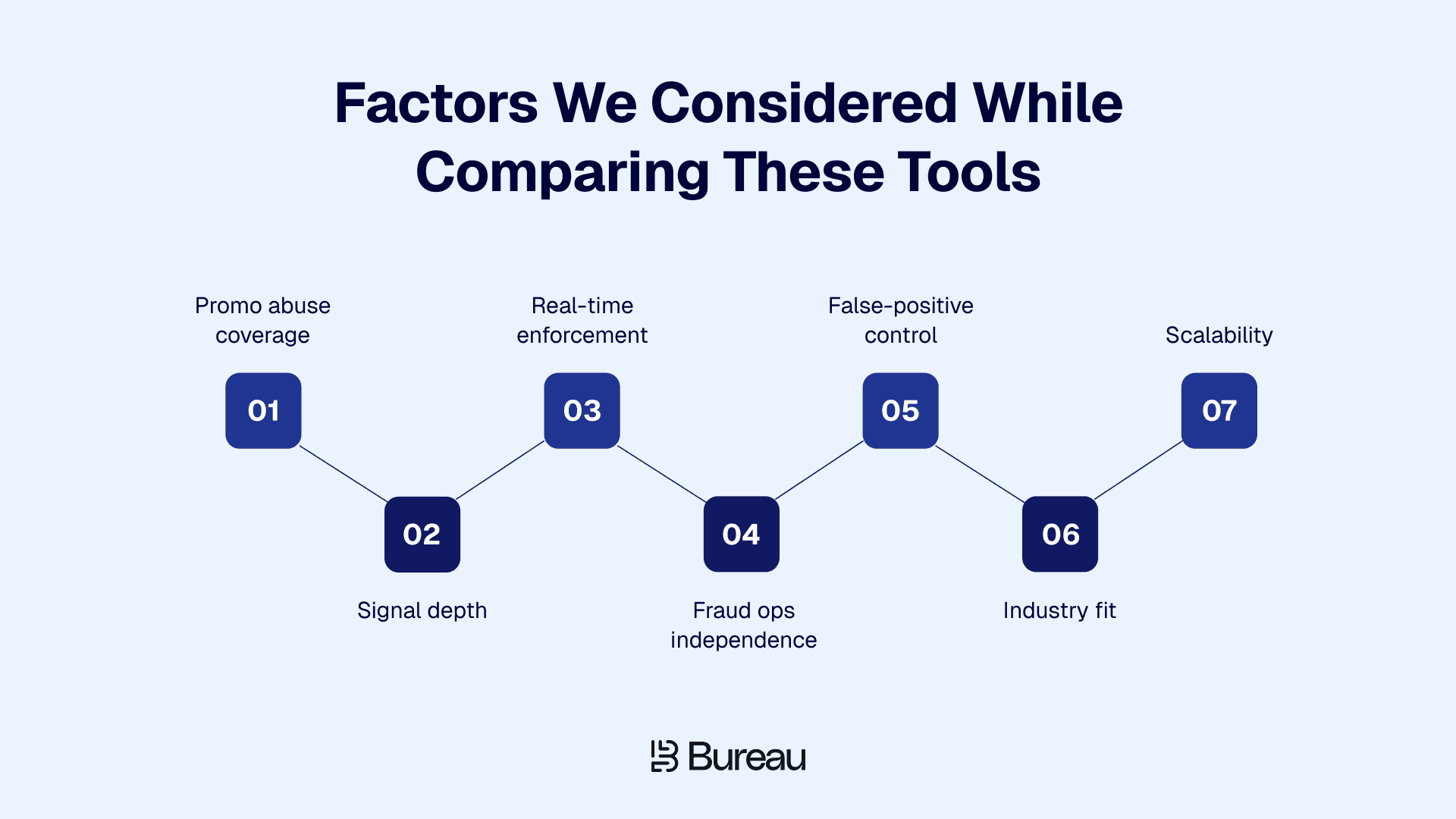
We selected these tools based on how well they support real promo abuse prevention. A useful platform should help teams detect repeat users, fake accounts, device farms, referral loops, coupon exploitation, and bonus abuse before rewards leave the business.
For this comparison, we looked at seven practical factors.
Promo abuse coverage: The tool should support more than one abuse pattern. Strong coverage includes coupon abuse, referral fraud, sign-up bonus abuse, cashback fraud, multi-accounting, and fake account creation.
Signal depth: Promo abuse often looks normal at the account level. Better tools combine device, behavior, identity, IP, email, phone, transaction, and network-level signals.
Real-time enforcement: A fraud team needs to approve, block, step up, or review users before a coupon, cashback, or reward payout is released.
Fraud ops independence: Teams move faster when they can tune workflows, risk thresholds, and rules without waiting on engineering for every campaign change.
False-positive control: The goal is not to block every unusual user. The goal is to stop repeat abusers while allowing genuine customers to redeem valid offers.
Industry fit: Ecommerce, fintech, marketplaces, iGaming, delivery, and mobile apps face different types of promotion exploitation.
Scalability: The strongest tools detect both individual abuse and coordinated fraud rings.
According to the MRC's 2025 Global eCommerce Payments and Fraud Report, 57% of merchants reported an increase in refund and policy abuse, making it the most prevalent fraud type for the second consecutive year.
In many cases, promo abuse patterns only become visible when teams connect activity across accounts, devices, identities, and behaviors.
That is why the tools in this comparison vary beyond features in how deeply they analyze relationships between users, transactions, and devices before making a decision.
The 7 Best Promo Abuse Prevention Software Tools
1. Bureau ID
Bureau ID is an AI-powered Unified Risk Decisioning Platform designed for high-risk digital businesses across ecommerce, fintech, marketplaces, gaming, and financial services. Instead of treating promo abuse as a simple coupon misuse problem, it connects identity, device, behavioral, and network-level signals to detect suspicious users before rewards are issued.
This makes it especially useful for businesses dealing with referral fraud, fake accounts, sign-up bonus abuse, and coordinated fraud rings.
How it detects promo abuse:
Device intelligence: Bureau ID uses a persistent Device ID to identify returning users even if they reset devices, switch browsers, use incognito mode, or modify firmware
Graph analysis: It connects users, devices, emails, phone numbers, IPs, and transactions through its Graph Identity Network to uncover hidden account relationships
Behavioral biometrics: The platform applies behavioral biometrics to detect bots, scripted actions, fraud farms, and suspicious interaction patterns
Real-time decisioning: It combines identity, device, network, and transaction signals into real-time risk scoring for reward approval or rejection
Workflow orchestration: It also supports no-code and low-code orchestration so fraud teams can quickly adjust workflows, thresholds, and rules for new campaigns
One of Bureau ID’s strongest examples comes from its food delivery fraud-ring case study. The platform helped a food delivery company investigate large-scale promo abuse tied to fake accounts and coordinated reward exploitation.
The challenge was that individual accounts appeared legitimate in isolation. Bureau ID connected shared devices, phone numbers, and behavioral patterns across thousands of accounts to expose the larger fraud network.
Results:
Identified an organized fraud ring operating across more than 2,700 user accounts
Detected over 1,750 accounts linked to just three devices
Uncovered hidden relationships between accounts using graph-based identity analysis
Helped the platform detect coordinated abuse patterns before additional rewards were issued
Read the full case study → Food Delivery Company Eliminates a 2,700+ User Fraud Ring
These capabilities make Bureau ID particularly effective for businesses where promo abuse overlaps with identity fraud, multi-accounting, and fraud-ring activity rather than isolated coupon misuse.
The graph-based approach also aligns with recent promotion-abuse research. A 2025 study on real-world Meituan data found that graph-based promo abuse detection achieved 93.15% precision, detected 2.1x to 5.0x more fraudsters, and prevented 1.5x to 8.8x more financial losses in production environments.
Where it wins:
Strong device intelligence helps detect repeat users and prevent multi-accounting abuse
Graph-based identity linking helps expose coordinated fraud networks and hidden account relationships
Behavioral biometrics improve detection of bots, scripted actions, and suspicious user behavior
Unified decisioning across identity, device, transaction, and behavioral signals helps teams make faster and more accurate risk decisions
Flexible no-code orchestration improves fraud operations efficiency by reducing engineering dependency
Limitations:
May be more comprehensive for businesses only needing basic coupon-rule enforcement
Best suited for teams with broader fraud prevention needs beyond simple promo-code restrictions
Ideal team type: Bureau ID is best suited for ecommerce, fintech, marketplace, gaming, and other high-risk digital businesses that need unified fraud decisioning across promo abuse, fake accounts, device risk, and coordinated fraud activity.
If your team is trying to understand why coupon abuse, referral fraud, or sign-up bonus abuse keeps slipping through, a quick 30-minute demo with Bureau ID can help you identify the weak points in your journey and the risk signals needed to stop abuse earlier.
2. Sift
Sift is a digital fraud prevention platform that supports account security, payment fraud prevention, and abuse decisioning. It is commonly used by ecommerce companies, marketplaces, and digital platforms that want broader fraud coverage beyond promo abuse. Its strength lies in connecting account activity, payment behavior, and abuse signals into a unified fraud decisioning workflow.
How it detects promo abuse:
Account behavior analysis: Sift tracks suspicious signup, login, and redemption patterns linked to repeat abuse.
Machine learning risk scoring: The platform uses behavioral and transaction-level signals to identify abnormal promotion usage.
Network-scale intelligence: The software evaluates users against signals gathered across Sift’s broader fraud network.
Payment and account linkage: It connects suspicious payment methods, accounts, and redemption activity.
Policy abuse monitoring: It also detects patterns tied to refund abuse, account misuse, and promotion exploitation.
For teams already managing multiple fraud workflows, Sift can act as a broader fraud prevention layer rather than a narrow coupon abuse detection tool.
Where it wins:
Strong cross-functional fraud coverage across payments, accounts, and abuse prevention.
Useful for businesses where promo abuse overlaps with payment fraud or account takeover.
Supports real-time fraud decisioning across customer journeys.
Well-suited for scaling digital businesses with large transaction volumes.
Limitations:
Some users note that SEON can involve a learning curve for advanced features, so teams should plan enough setup time for complex fraud and promo abuse workflows.
Teams focused heavily on referral fraud or device-level multi-accounting may need additional tooling for deeper identity linkage.
Ideal team type: Best for ecommerce companies, marketplaces, and digital businesses that want broad fraud prevention coverage beyond standalone promo abuse detection.
3. Ravelin
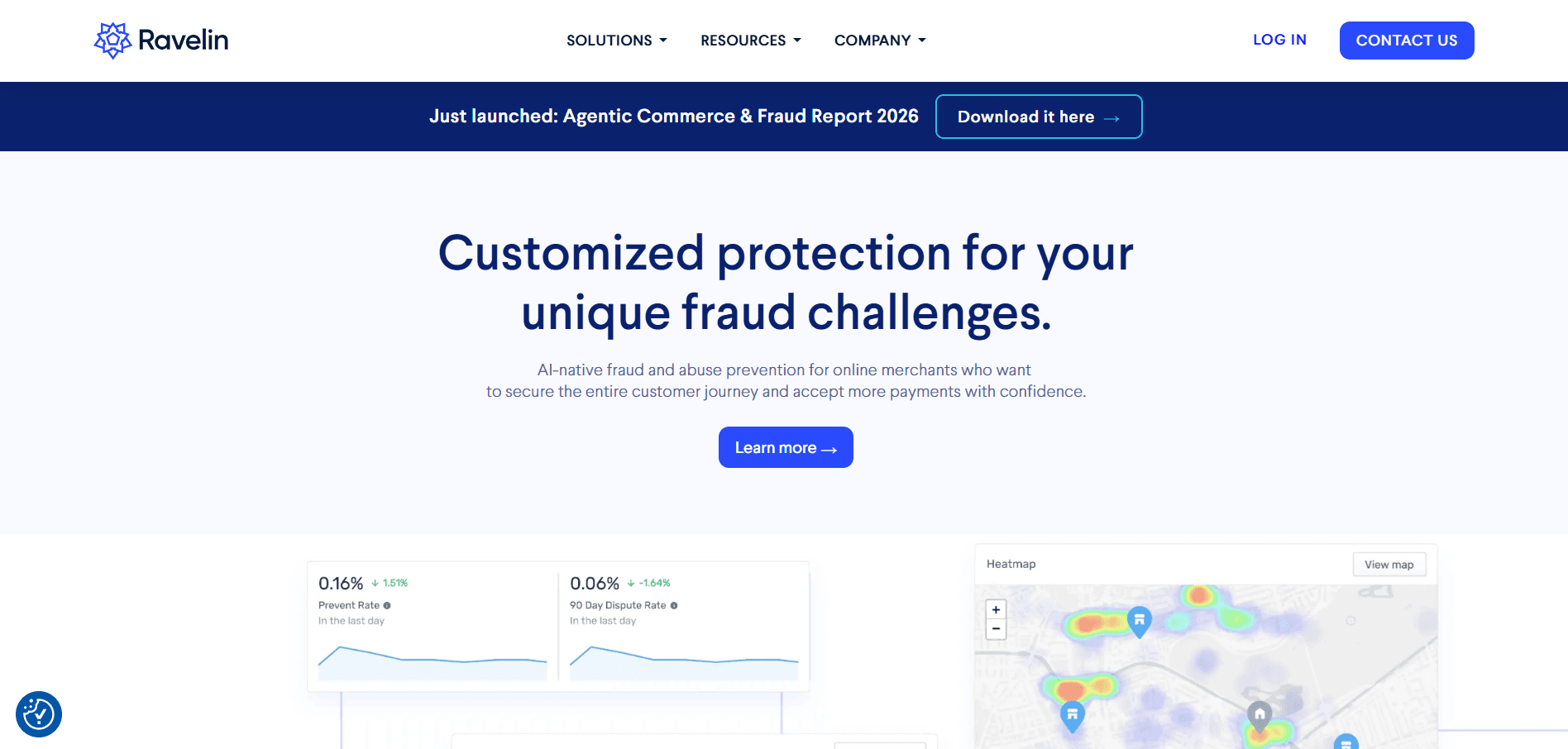
Ravelin provides fraud prevention for ecommerce, delivery, marketplace, and online payment environments. Its platform combines payment fraud prevention, account security, refund abuse detection, and promo abuse controls. It is especially relevant for businesses where voucher abuse, payment fraud, and repeat customer abuse often appear together within the same customer journey.
How it detects promo abuse:
Voucher abuse monitoring: The platform detects repeated misuse of discounts, vouchers, and first-order promotions.
Graph network analysis: Ravelin links suspicious accounts, payment methods, and customer behaviors.
Behavioral risk scoring: The software evaluates unusual redemption patterns and transaction anomalies.
Payment intelligence: It connects promo abuse with suspicious payment activity and refund behavior.
Account activity monitoring: It also flags repeat users attempting to exploit onboarding or promotional offers.
Ravelin works particularly well when fraud teams need to connect promotion abuse with broader payment and customer-risk workflows.
Where it wins:
Strong fit for ecommerce, delivery, and marketplace businesses.
Combines payment fraud and promo abuse detection in one platform.
Useful for identifying repeat customer abuse tied to refunds and vouchers.
Supports graph-based fraud analysis across accounts and transactions.
Limitations:
Teams needing deeper identity verification or persistent device intelligence may require additional integrations.
Some use cases may require complementary onboarding or identity checks.
Ideal team type: Best for ecommerce, delivery, and marketplace teams where promo abuse overlaps heavily with payment fraud and customer policy abuse.
4. SEON
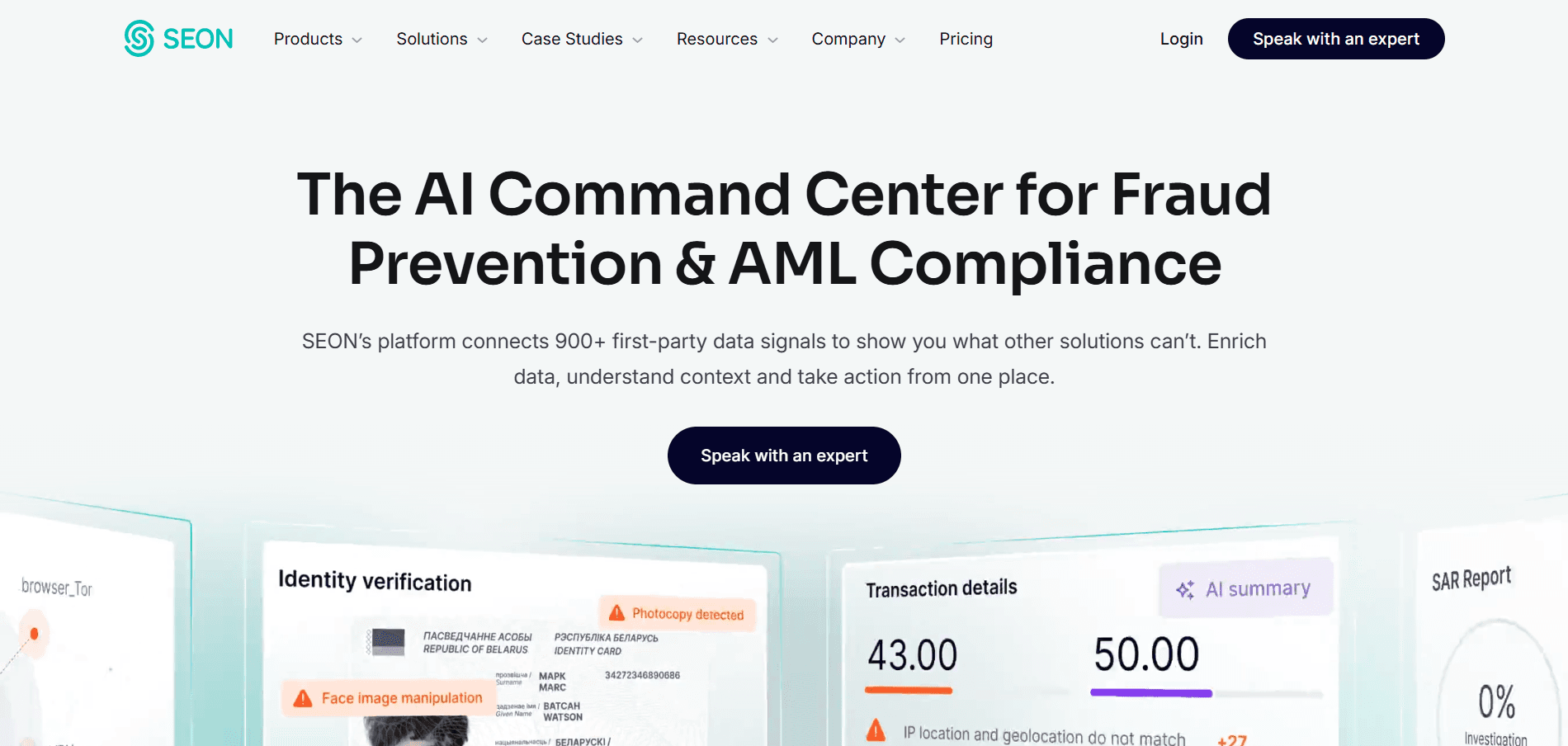
SEON is a fraud prevention and AML platform built around digital footprint analysis, device intelligence, email, phone, IP, and real-time risk scoring. It is widely used by fintech, iGaming, and digital-first businesses that need flexible fraud rules and configurable onboarding risk controls for detecting fake accounts and bonus abuse.
How it detects promo abuse:
Digital footprint analysis: SEON evaluates email, phone, social, and online identity signals for suspicious users.
Device and IP intelligence: The software detects repeat devices, VPN usage, and suspicious signup environments.
Velocity checks: It flags users creating multiple accounts or redeeming offers too quickly.
Risk scoring engine: It also combines onboarding, behavioral, and identity signals into configurable fraud scores.
Multi-accounting detection: The platform identifies linked accounts attempting to exploit signup or referral incentives.
SEON’s flexibility makes it attractive for fraud teams that want direct control over rules, scoring, and workflows.
Where it wins:
Highly configurable fraud scoring and rule-building workflows.
Strong onboarding fraud and fake-account detection capabilities.
Useful for fintech and iGaming bonus abuse prevention.
Combines AML and fraud prevention workflows in one platform.
Limitations:
Teams should evaluate whether SEON’s signal set is enough for advanced fraud-ring detection.
Outcomes can depend heavily on setup quality and rule configuration.
Some users note that SEON’s customer success support could be more consultative for complex fraud cases, especially when teams need deeper strategic input beyond platform features.
Ideal team type: Best for fintech, iGaming, and digital-first fraud teams that want flexible risk scoring and configurable onboarding abuse controls.
5. Forter
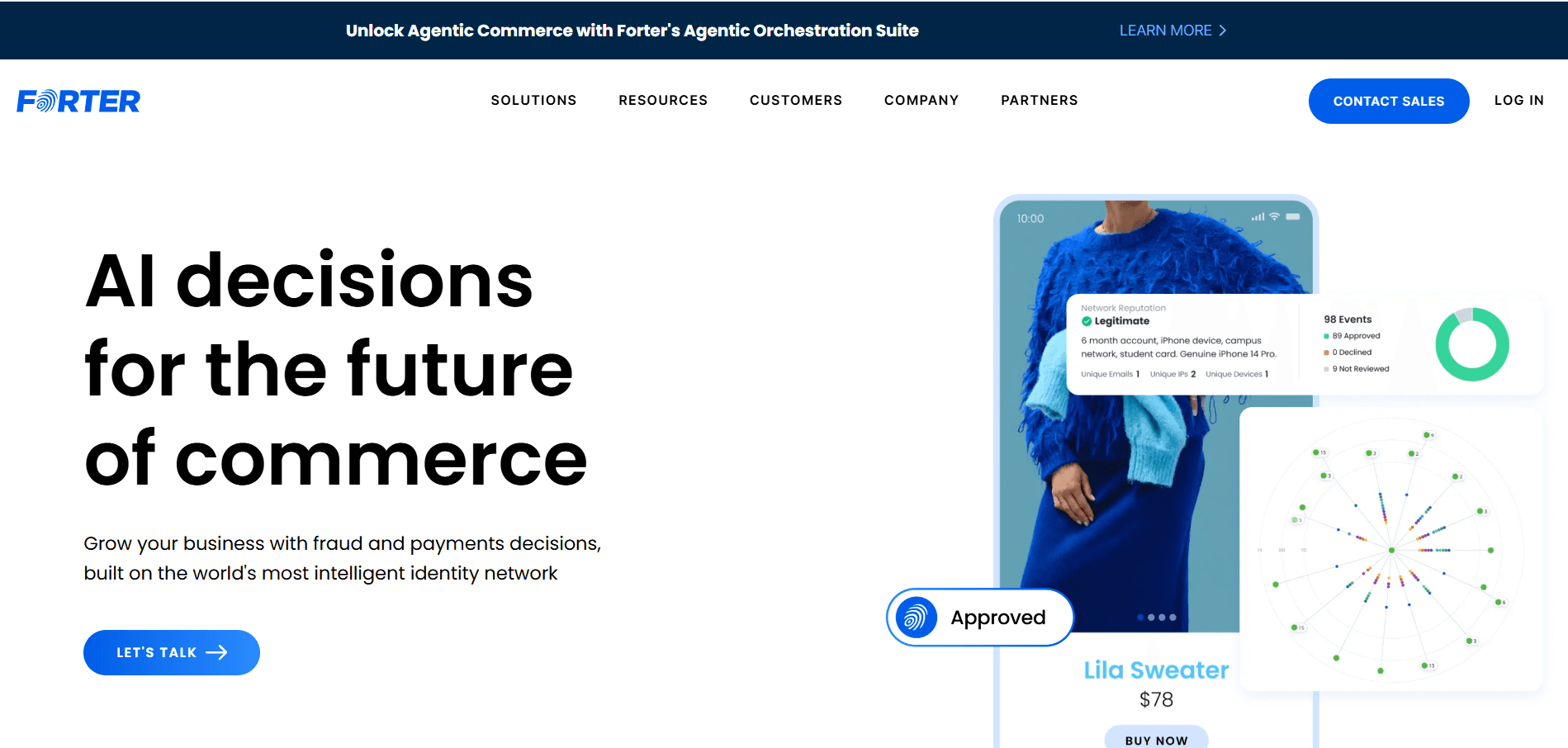
Forter’s Abuse Prevention platform focuses on policy abuse across ecommerce and retail customer journeys. It covers promotion abuse, coupon abuse, returns abuse, reseller abuse, and item-not-received fraud. The platform is designed for enterprise retail environments where promo abuse often overlaps with post-purchase fraud and customer policy exploitation.
How it detects promo abuse:
Customer identity analysis: Forter evaluates customer trust and abuse risk across transactions and accounts.
Promotion misuse detection: The software flags repeated coupon abuse, discount exploitation, and reseller behavior.
Behavioral monitoring: It tracks suspicious post-purchase activity tied to refunds and returns.
Cross-journey fraud analysis: It also connects checkout, returns, and account activity into unified decisions.
Policy abuse detection: The platform identifies repeat offenders exploiting customer-friendly policies.
Forter is particularly useful for retailers that want to balance fraud prevention with low-friction customer experiences.
Where it wins:
Strong enterprise ecommerce and retail focus.
Covers both pre-purchase and post-purchase abuse workflows.
Useful for detecting repeat customer policy abuse.
Helps reduce friction for legitimate customers through trust-based decisioning.
Limitations:
Less specialized for fintech or iGaming-specific bonus abuse workflows.
Users note that teams with highly specific approval, rejection, or review logic should assess how well Forter’s decisioning approach fits their promo abuse and policy abuse workflows.
Ideal team type: Best for enterprise ecommerce and retail teams managing promotion abuse alongside returns, refunds, and broader customer policy abuse.
6. Incognia
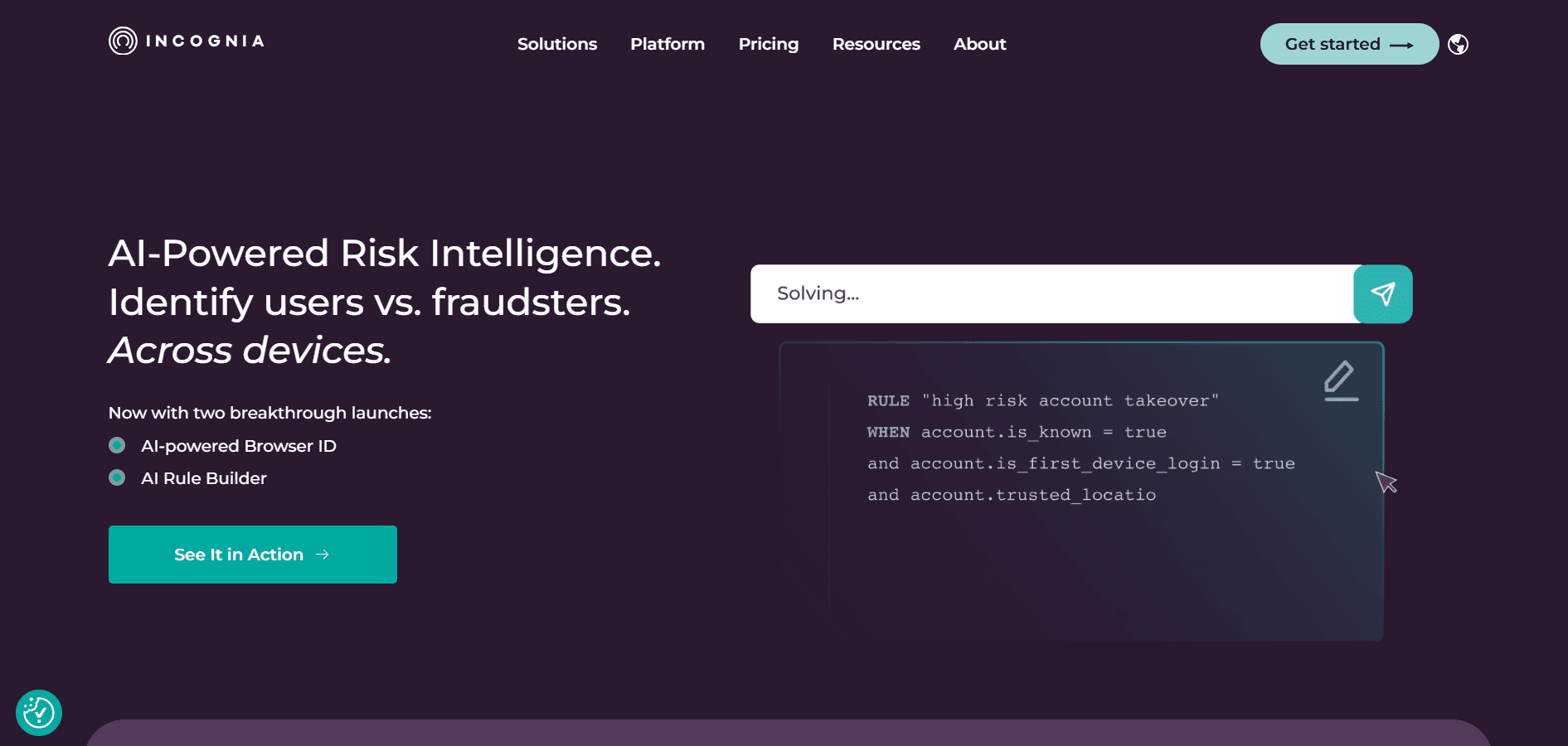
Incognia focuses on device intelligence and location-based fraud prevention for mobile-first businesses. Its promo abuse prevention capabilities center on detecting multi-accounting, location manipulation, and repeat-device abuse. The platform is especially relevant for delivery apps, rideshare platforms, marketplaces, fintech apps, and other businesses where mobile-device trust is critical.
How it detects promo abuse:
Persistent device recognition: The platform identifies repeat users even after device resets or app reinstalls.
Location intelligence: It detects suspicious location spoofing and manipulated GPS behavior.
Device-to-identity linking: The software connects devices with historical account activity and abuse patterns.
Emulator and app-cloner detection: It also flags suspicious mobile environments used for fake accounts.
Multi-accounting analysis: Incognia detects users operating multiple accounts from related device environments.
Incognia performs best when device and location intelligence are central to the abuse pattern.
Where it wins:
Strong mobile-device intelligence capabilities.
Useful for delivery, rideshare, and mobile-first marketplace apps.
Effective against repeat-device abuse and location spoofing.
Helps reduce friction for legitimate mobile users.
Limitations:
Teams may still require additional orchestration or identity verification layers for broader fraud workflows.
Some businesses with web-heavy environments may find mobile-centric coverage less relevant.
Ideal team type: Best for mobile-first apps and platforms where promo abuse is closely tied to device reuse, location spoofing, or multi-accounting.
7. Arkose Labs
Arkose Labs focuses on bot mitigation, account security, and automated abuse prevention. Its bonus abuse solution is designed to stop fake registrations, scripted account creation, and automated incentive exploitation. The platform is especially useful for gaming, fintech, ecommerce, and digital businesses facing large-scale bot-driven promo abuse attacks.
How it detects promo abuse:
Bot detection engine: The platform identifies automated account creation and scripted redemption activity.
Adaptive challenges: Arkose Labs increases friction dynamically for suspicious users and bots.
Device and attack intelligence: It detects suspicious environments tied to automated abuse campaigns.
Registration abuse prevention: The software blocks fake accounts attempting to claim signup incentives.
Threat intelligence analysis: It also monitors evolving attack patterns across automated abuse networks.
Arkose Labs is strongest when promo abuse originates from automation rather than human-led collusion.
Where it wins:
Strong bot mitigation and automated abuse prevention capabilities.
Useful for protecting signup bonuses and referral campaigns from scripted attacks.
Adaptive challenge system helps reduce automated account creation.
Effective for gaming and high-volume digital platforms facing bot abuse.
Limitations:
Users note that Arkose Labs can require careful initial tuning when traffic patterns are complex, especially to balance challenge sensitivity with a smooth experience for genuine users.
Less focused on human-led fraud rings or deep identity graph analysis.
Teams may require additional fraud tooling for transaction monitoring and account-linkage analysis.
Ideal team type: Best for gaming, fintech, ecommerce, and digital platforms dealing with large-scale automated promo abuse and fake account attacks.
How to Choose the Right Promo Abuse Prevention Software?
Choosing the right promo abuse prevention software starts with understanding where your losses actually happen, because not every tool solves the same problem. A platform built for coupon abuse may not help much with referral fraud, while a bot mitigation tool may stop automated attacks but miss coordinated human-led abuse rings.
Before shortlisting vendors, break the problem down into a few practical questions:
Where does the abuse start?
Signup flow
Referral creation
Promo code redemption
Checkout
Cashback claims
Reward payouts
What does the fraud pattern look like?
Fake account creation
Multi-accounting
Device reuse
Referral loops
Coupon stacking
Bot-driven abuse
Fraud rings or collusion
Once you know the pattern, look at signal coverage. Different businesses need different combinations of fraud signals. For example:
Ecommerce teams may prioritize:
Coupon abuse detection
Checkout risk scoring
Repeat-user detection
Fintech and gaming platforms often need:
Device intelligence
Behavioral biometrics
Identity verification
Emulator and VPN detection
Marketplaces and delivery apps may care more about:
Graph-based account linking
Shared-device detection
Referral network analysis
Another important factor is operational flexibility. Fraud teams move faster when they can adjust rules, thresholds, and workflows without depending heavily on engineering support every time a campaign changes.
Bureau ID is a strong fit for teams that want these capabilities in one platform instead of stitching together multiple tools. Its unified orchestration layer combines device intelligence, identity checks, behavioral risk signals, graph analysis, and transaction context to support real-time, explainable fraud decisions.
Related Read: 6 Strategies Modern Platforms Use to Stop ATO Attacks
Map Tools to Your Highest-Risk Promotion Type
Different types of promo abuse require different detection approaches. Before choosing a platform, it helps to identify which promotion flows are most vulnerable in your business and what signals are needed to stop abuse effectively.
Highest-risk promotion type | What to look for |
Coupon abuse | Promo rules, account history, device recognition, repeat-user detection |
Referral fraud | Identity graph, device linking, referrer-referee relationship analysis, fake account prevention |
Sign-up bonus abuse | Onboarding risk checks, fake account detection, device fingerprinting, behavioral signals |
Multi-accounting | Persistent device ID, emulator detection, VPN detection, graph-based user linking |
Cashback fraud | Transaction monitoring, velocity checks, user-risk scoring, refund and redemption controls |
iGaming bonus abuse | Bot detection, device intelligence, collusion detection, location checks, behavioral analysis |
Bot-driven promo abuse | Bot mitigation, adaptive challenges, registration abuse detection, automation defense |
Fraud-ring-driven abuse | Graph intelligence, shared-device detection, behavioral clustering, linked identity signals |
The right solution ultimately depends on how abuse appears across your customer journey, how much operational flexibility your fraud team needs, and whether you require isolated controls or a broader risk decisioning layer that can adapt as abuse patterns evolve.
Stop Promo Abuse Before It Scales
By the time promo abuse appears in campaign reports, the damage is usually already done. Fake accounts have claimed rewards, referral loops have paid out, and repeat offenders have learned which controls are easy to bypass.
For teams evaluating their next step, the priority should be understanding where promo abuse enters the customer journey and which signals are currently missing from detection workflows. Reviewing onboarding, referrals, coupon redemption, and reward payouts helps teams spot gaps before abuse scales.
Bureau ID helps businesses move beyond isolated fraud checks by connecting device intelligence, behavioral biometrics, identity signals, network relationships, and transaction context in one decisioning layer. This helps fraud teams detect repeat abusers, suspicious account clusters, bot-driven activity, and coordinated fraud rings before rewards or payouts are processed.
If your promotions are driving growth but also leaking revenue through fake accounts, referral fraud, coupon abuse, or sign-up bonus abuse, schedule a demo with Bureau ID to see how unified risk decisioning can help stop promo abuse before it scales.
FAQs
1. What is the best promo abuse prevention software?
The best promo abuse prevention software helps businesses detect fake accounts, coupon abuse, referral fraud, bonus misuse, and repeat reward claims before they scale. Tools like Bureau ID, Sift, Ravelin, SEON, Forter, Incognia, and Arkose Labs support different use cases across ecommerce, fintech, marketplaces, gaming, and mobile apps.
2. How can Bureau ID stop coupon abuse in real time?
Bureau ID uses real-time risk scoring, velocity checks, device intelligence, and coupon rule enforcement to detect suspicious activity before checkout or reward redemption. It helps businesses block repeat redemptions, unauthorized promo code use, coupon stacking, and coordinated abuse before discounts are applied.
3. How can businesses prevent customers from creating multiple accounts to claim discounts?
Businesses can prevent multi-accounting by using device intelligence, identity signals, phone number checks, payment data, shipping address patterns, behavioral signals, and velocity rules. These signals help link accounts that appear separate but share the same device, user behavior, referral path, or redemption pattern.
4. What features should promo abuse prevention software include?
Promo abuse prevention software should include real-time risk scoring, device fingerprinting, velocity checks, referral fraud detection, coupon abuse controls, behavioral analysis, graph-based account linking, bot detection, and step-up verification. It should also integrate with checkout systems, KYC tools, fraud decisioning engines, mobile apps, and data warehouses.
5. How can businesses reduce false positives when blocking promo abuse?
Businesses can reduce false positives by using risk-based controls instead of blanket blocking. A strong promo abuse prevention tool should combine device, identity, transaction, behavior, and promotion-specific signals before making a decision. High-risk users can face step-up verification or manual review, while genuine customers can still redeem valid promotions smoothly.
6. Can promo abuse prevention software help stop referral fraud?
Yes. Promo abuse prevention software can detect referral fraud by identifying fake referrals, self-referrals, coordinated referral rings, and repeat reward claims across linked accounts. Many tools use device intelligence, behavioral analysis, IP monitoring, and account-linking signals to detect suspicious referral activity before rewards are issued.
Promo abuse can quietly drain acquisition budgets long before teams realize what is happening. Fake accounts, referral loops, coupon stacking, and repeat sign-up claims often look like legitimate growth until rewards start leaking at scale.
This has led to promo abuse prevention becoming a critical part of fraud prevention for ecommerce, fintech, marketplaces, gaming, and other digital businesses.
The best promo abuse prevention software helps teams detect coupon abuse, referral fraud, sign-up bonus abuse, cashback fraud, fake account creation, and multi-accounting before rewards are issued, while still keeping the experience smooth for genuine users.
In this guide, we compare the top promo abuse prevention platforms based on detection capabilities, signal depth, fraud-ops flexibility, and real-world use cases. We also break down what features matter most when choosing a solution for your business.
Quick Comparison: Top Promo Abuse Prevention Software
The best promo abuse prevention software helps businesses detect and stop fake accounts, coupon abuse, referral fraud, bonus misuse, and repeat reward claims before they scale. The right tool uses device intelligence, risk scoring, identity signals, velocity checks, and real-time decisioning to protect promotions without blocking genuine customers.
Leading options include Bureau ID, Sift, Ravelin, SEON, Forter, Incognia, and Arkose Labs.
Tool | Key promo abuse coverage | Core signals | Fraud ops independence | Best for |
Bureau ID | Multi-accounting, referral fraud, sign-up bonus abuse, fake accounts, fraud rings, device farms | Device ID, behavioral biometrics, Graph Identity Network, identity, network, and transaction signals | High, with no-code and low-code workflows, rule tuning, risk thresholds, and explainable decisions | Ecommerce, fintech, marketplaces, and gaming teams that need unified decisioning |
Sift | Account abuse, payment fraud, first-party abuse, policy abuse | Global data network, machine learning, behavioral, and transaction signals | Medium to high, based on workflow maturity | Digital businesses that need broad fraud prevention |
Ravelin | Promo abuse, voucher abuse, payment fraud, account security, refund abuse | Machine learning, payment signals, account behavior, graph network signals | Medium to high | Ecommerce, delivery, and marketplace teams |
SEON | Multi-accounting, bonus abuse, fake accounts, onboarding abuse | Email, phone, IP, device, digital footprint, velocity, and risk signals | High, with flexible rules and fraud scoring | Fintech, iGaming, and digital platforms |
Forter | Promotion abuse, coupon abuse, returns abuse, INR abuse, reseller abuse, policy abuse | Identity decisioning, customer behavior, checkout, and post-purchase signals | Medium to high | Enterprise ecommerce and retail teams |
Incognia | Multi-accounting, promo abuse, voucher fraud, ban evasion, location manipulation | Device intelligence, device integrity, location signals, network behavior | Medium | Mobile-first apps, delivery, rideshare, marketplaces, and fintech |
Arkose Labs | Bonus abuse, fake registrations, bot-driven promo abuse, automated incentive exploitation | Bot detection, adaptive challenges, device, and attack intelligence | Medium | Gaming, fintech, ecommerce, and platforms facing automated abuse |
A quick comparison can help narrow the shortlist, but the right choice depends on how each platform handles real-world abuse patterns in your industry.
VAS’s 2026 Global eCommerce Payments & Fraud Report found that more than 80% of merchants named technological infrastructure as their biggest fraud challenge, which is exactly why promo abuse prevention tools need to connect data across accounts, devices, transactions, and rewards instead of relying on isolated rules.
The tools in this list vary widely in how they approach promo abuse prevention. Some focus heavily on device intelligence and multi-accounting detection, while others are stronger in bot mitigation, payment fraud, or policy abuse.
Before comparing them individually, it helps to understand the evaluation criteria that matter most when assessing promo abuse prevention software.
Factors We Considered While Comparing These Tools
We selected these tools based on how well they support real promo abuse prevention. A useful platform should help teams detect repeat users, fake accounts, device farms, referral loops, coupon exploitation, and bonus abuse before rewards leave the business.
For this comparison, we looked at seven practical factors.
Promo abuse coverage: The tool should support more than one abuse pattern. Strong coverage includes coupon abuse, referral fraud, sign-up bonus abuse, cashback fraud, multi-accounting, and fake account creation.
Signal depth: Promo abuse often looks normal at the account level. Better tools combine device, behavior, identity, IP, email, phone, transaction, and network-level signals.
Real-time enforcement: A fraud team needs to approve, block, step up, or review users before a coupon, cashback, or reward payout is released.
Fraud ops independence: Teams move faster when they can tune workflows, risk thresholds, and rules without waiting on engineering for every campaign change.
False-positive control: The goal is not to block every unusual user. The goal is to stop repeat abusers while allowing genuine customers to redeem valid offers.
Industry fit: Ecommerce, fintech, marketplaces, iGaming, delivery, and mobile apps face different types of promotion exploitation.
Scalability: The strongest tools detect both individual abuse and coordinated fraud rings.
According to the MRC's 2025 Global eCommerce Payments and Fraud Report, 57% of merchants reported an increase in refund and policy abuse, making it the most prevalent fraud type for the second consecutive year.
In many cases, promo abuse patterns only become visible when teams connect activity across accounts, devices, identities, and behaviors.
That is why the tools in this comparison vary beyond features in how deeply they analyze relationships between users, transactions, and devices before making a decision.
The 7 Best Promo Abuse Prevention Software Tools
1. Bureau ID
Bureau ID is an AI-powered Unified Risk Decisioning Platform designed for high-risk digital businesses across ecommerce, fintech, marketplaces, gaming, and financial services. Instead of treating promo abuse as a simple coupon misuse problem, it connects identity, device, behavioral, and network-level signals to detect suspicious users before rewards are issued.
This makes it especially useful for businesses dealing with referral fraud, fake accounts, sign-up bonus abuse, and coordinated fraud rings.
How it detects promo abuse:
Device intelligence: Bureau ID uses a persistent Device ID to identify returning users even if they reset devices, switch browsers, use incognito mode, or modify firmware
Graph analysis: It connects users, devices, emails, phone numbers, IPs, and transactions through its Graph Identity Network to uncover hidden account relationships
Behavioral biometrics: The platform applies behavioral biometrics to detect bots, scripted actions, fraud farms, and suspicious interaction patterns
Real-time decisioning: It combines identity, device, network, and transaction signals into real-time risk scoring for reward approval or rejection
Workflow orchestration: It also supports no-code and low-code orchestration so fraud teams can quickly adjust workflows, thresholds, and rules for new campaigns
One of Bureau ID’s strongest examples comes from its food delivery fraud-ring case study. The platform helped a food delivery company investigate large-scale promo abuse tied to fake accounts and coordinated reward exploitation.
The challenge was that individual accounts appeared legitimate in isolation. Bureau ID connected shared devices, phone numbers, and behavioral patterns across thousands of accounts to expose the larger fraud network.
Results:
Identified an organized fraud ring operating across more than 2,700 user accounts
Detected over 1,750 accounts linked to just three devices
Uncovered hidden relationships between accounts using graph-based identity analysis
Helped the platform detect coordinated abuse patterns before additional rewards were issued
Read the full case study → Food Delivery Company Eliminates a 2,700+ User Fraud Ring
These capabilities make Bureau ID particularly effective for businesses where promo abuse overlaps with identity fraud, multi-accounting, and fraud-ring activity rather than isolated coupon misuse.
The graph-based approach also aligns with recent promotion-abuse research. A 2025 study on real-world Meituan data found that graph-based promo abuse detection achieved 93.15% precision, detected 2.1x to 5.0x more fraudsters, and prevented 1.5x to 8.8x more financial losses in production environments.
Where it wins:
Strong device intelligence helps detect repeat users and prevent multi-accounting abuse
Graph-based identity linking helps expose coordinated fraud networks and hidden account relationships
Behavioral biometrics improve detection of bots, scripted actions, and suspicious user behavior
Unified decisioning across identity, device, transaction, and behavioral signals helps teams make faster and more accurate risk decisions
Flexible no-code orchestration improves fraud operations efficiency by reducing engineering dependency
Limitations:
May be more comprehensive for businesses only needing basic coupon-rule enforcement
Best suited for teams with broader fraud prevention needs beyond simple promo-code restrictions
Ideal team type: Bureau ID is best suited for ecommerce, fintech, marketplace, gaming, and other high-risk digital businesses that need unified fraud decisioning across promo abuse, fake accounts, device risk, and coordinated fraud activity.
If your team is trying to understand why coupon abuse, referral fraud, or sign-up bonus abuse keeps slipping through, a quick 30-minute demo with Bureau ID can help you identify the weak points in your journey and the risk signals needed to stop abuse earlier.
2. Sift
Sift is a digital fraud prevention platform that supports account security, payment fraud prevention, and abuse decisioning. It is commonly used by ecommerce companies, marketplaces, and digital platforms that want broader fraud coverage beyond promo abuse. Its strength lies in connecting account activity, payment behavior, and abuse signals into a unified fraud decisioning workflow.
How it detects promo abuse:
Account behavior analysis: Sift tracks suspicious signup, login, and redemption patterns linked to repeat abuse.
Machine learning risk scoring: The platform uses behavioral and transaction-level signals to identify abnormal promotion usage.
Network-scale intelligence: The software evaluates users against signals gathered across Sift’s broader fraud network.
Payment and account linkage: It connects suspicious payment methods, accounts, and redemption activity.
Policy abuse monitoring: It also detects patterns tied to refund abuse, account misuse, and promotion exploitation.
For teams already managing multiple fraud workflows, Sift can act as a broader fraud prevention layer rather than a narrow coupon abuse detection tool.
Where it wins:
Strong cross-functional fraud coverage across payments, accounts, and abuse prevention.
Useful for businesses where promo abuse overlaps with payment fraud or account takeover.
Supports real-time fraud decisioning across customer journeys.
Well-suited for scaling digital businesses with large transaction volumes.
Limitations:
Some users note that SEON can involve a learning curve for advanced features, so teams should plan enough setup time for complex fraud and promo abuse workflows.
Teams focused heavily on referral fraud or device-level multi-accounting may need additional tooling for deeper identity linkage.
Ideal team type: Best for ecommerce companies, marketplaces, and digital businesses that want broad fraud prevention coverage beyond standalone promo abuse detection.
3. Ravelin
Ravelin provides fraud prevention for ecommerce, delivery, marketplace, and online payment environments. Its platform combines payment fraud prevention, account security, refund abuse detection, and promo abuse controls. It is especially relevant for businesses where voucher abuse, payment fraud, and repeat customer abuse often appear together within the same customer journey.
How it detects promo abuse:
Voucher abuse monitoring: The platform detects repeated misuse of discounts, vouchers, and first-order promotions.
Graph network analysis: Ravelin links suspicious accounts, payment methods, and customer behaviors.
Behavioral risk scoring: The software evaluates unusual redemption patterns and transaction anomalies.
Payment intelligence: It connects promo abuse with suspicious payment activity and refund behavior.
Account activity monitoring: It also flags repeat users attempting to exploit onboarding or promotional offers.
Ravelin works particularly well when fraud teams need to connect promotion abuse with broader payment and customer-risk workflows.
Where it wins:
Strong fit for ecommerce, delivery, and marketplace businesses.
Combines payment fraud and promo abuse detection in one platform.
Useful for identifying repeat customer abuse tied to refunds and vouchers.
Supports graph-based fraud analysis across accounts and transactions.
Limitations:
Teams needing deeper identity verification or persistent device intelligence may require additional integrations.
Some use cases may require complementary onboarding or identity checks.
Ideal team type: Best for ecommerce, delivery, and marketplace teams where promo abuse overlaps heavily with payment fraud and customer policy abuse.
4. SEON
SEON is a fraud prevention and AML platform built around digital footprint analysis, device intelligence, email, phone, IP, and real-time risk scoring. It is widely used by fintech, iGaming, and digital-first businesses that need flexible fraud rules and configurable onboarding risk controls for detecting fake accounts and bonus abuse.
How it detects promo abuse:
Digital footprint analysis: SEON evaluates email, phone, social, and online identity signals for suspicious users.
Device and IP intelligence: The software detects repeat devices, VPN usage, and suspicious signup environments.
Velocity checks: It flags users creating multiple accounts or redeeming offers too quickly.
Risk scoring engine: It also combines onboarding, behavioral, and identity signals into configurable fraud scores.
Multi-accounting detection: The platform identifies linked accounts attempting to exploit signup or referral incentives.
SEON’s flexibility makes it attractive for fraud teams that want direct control over rules, scoring, and workflows.
Where it wins:
Highly configurable fraud scoring and rule-building workflows.
Strong onboarding fraud and fake-account detection capabilities.
Useful for fintech and iGaming bonus abuse prevention.
Combines AML and fraud prevention workflows in one platform.
Limitations:
Teams should evaluate whether SEON’s signal set is enough for advanced fraud-ring detection.
Outcomes can depend heavily on setup quality and rule configuration.
Some users note that SEON’s customer success support could be more consultative for complex fraud cases, especially when teams need deeper strategic input beyond platform features.
Ideal team type: Best for fintech, iGaming, and digital-first fraud teams that want flexible risk scoring and configurable onboarding abuse controls.
5. Forter
Forter’s Abuse Prevention platform focuses on policy abuse across ecommerce and retail customer journeys. It covers promotion abuse, coupon abuse, returns abuse, reseller abuse, and item-not-received fraud. The platform is designed for enterprise retail environments where promo abuse often overlaps with post-purchase fraud and customer policy exploitation.
How it detects promo abuse:
Customer identity analysis: Forter evaluates customer trust and abuse risk across transactions and accounts.
Promotion misuse detection: The software flags repeated coupon abuse, discount exploitation, and reseller behavior.
Behavioral monitoring: It tracks suspicious post-purchase activity tied to refunds and returns.
Cross-journey fraud analysis: It also connects checkout, returns, and account activity into unified decisions.
Policy abuse detection: The platform identifies repeat offenders exploiting customer-friendly policies.
Forter is particularly useful for retailers that want to balance fraud prevention with low-friction customer experiences.
Where it wins:
Strong enterprise ecommerce and retail focus.
Covers both pre-purchase and post-purchase abuse workflows.
Useful for detecting repeat customer policy abuse.
Helps reduce friction for legitimate customers through trust-based decisioning.
Limitations:
Less specialized for fintech or iGaming-specific bonus abuse workflows.
Users note that teams with highly specific approval, rejection, or review logic should assess how well Forter’s decisioning approach fits their promo abuse and policy abuse workflows.
Ideal team type: Best for enterprise ecommerce and retail teams managing promotion abuse alongside returns, refunds, and broader customer policy abuse.
6. Incognia
Incognia focuses on device intelligence and location-based fraud prevention for mobile-first businesses. Its promo abuse prevention capabilities center on detecting multi-accounting, location manipulation, and repeat-device abuse. The platform is especially relevant for delivery apps, rideshare platforms, marketplaces, fintech apps, and other businesses where mobile-device trust is critical.
How it detects promo abuse:
Persistent device recognition: The platform identifies repeat users even after device resets or app reinstalls.
Location intelligence: It detects suspicious location spoofing and manipulated GPS behavior.
Device-to-identity linking: The software connects devices with historical account activity and abuse patterns.
Emulator and app-cloner detection: It also flags suspicious mobile environments used for fake accounts.
Multi-accounting analysis: Incognia detects users operating multiple accounts from related device environments.
Incognia performs best when device and location intelligence are central to the abuse pattern.
Where it wins:
Strong mobile-device intelligence capabilities.
Useful for delivery, rideshare, and mobile-first marketplace apps.
Effective against repeat-device abuse and location spoofing.
Helps reduce friction for legitimate mobile users.
Limitations:
Teams may still require additional orchestration or identity verification layers for broader fraud workflows.
Some businesses with web-heavy environments may find mobile-centric coverage less relevant.
Ideal team type: Best for mobile-first apps and platforms where promo abuse is closely tied to device reuse, location spoofing, or multi-accounting.
7. Arkose Labs
Arkose Labs focuses on bot mitigation, account security, and automated abuse prevention. Its bonus abuse solution is designed to stop fake registrations, scripted account creation, and automated incentive exploitation. The platform is especially useful for gaming, fintech, ecommerce, and digital businesses facing large-scale bot-driven promo abuse attacks.
How it detects promo abuse:
Bot detection engine: The platform identifies automated account creation and scripted redemption activity.
Adaptive challenges: Arkose Labs increases friction dynamically for suspicious users and bots.
Device and attack intelligence: It detects suspicious environments tied to automated abuse campaigns.
Registration abuse prevention: The software blocks fake accounts attempting to claim signup incentives.
Threat intelligence analysis: It also monitors evolving attack patterns across automated abuse networks.
Arkose Labs is strongest when promo abuse originates from automation rather than human-led collusion.
Where it wins:
Strong bot mitigation and automated abuse prevention capabilities.
Useful for protecting signup bonuses and referral campaigns from scripted attacks.
Adaptive challenge system helps reduce automated account creation.
Effective for gaming and high-volume digital platforms facing bot abuse.
Limitations:
Users note that Arkose Labs can require careful initial tuning when traffic patterns are complex, especially to balance challenge sensitivity with a smooth experience for genuine users.
Less focused on human-led fraud rings or deep identity graph analysis.
Teams may require additional fraud tooling for transaction monitoring and account-linkage analysis.
Ideal team type: Best for gaming, fintech, ecommerce, and digital platforms dealing with large-scale automated promo abuse and fake account attacks.
How to Choose the Right Promo Abuse Prevention Software?
Choosing the right promo abuse prevention software starts with understanding where your losses actually happen, because not every tool solves the same problem. A platform built for coupon abuse may not help much with referral fraud, while a bot mitigation tool may stop automated attacks but miss coordinated human-led abuse rings.
Before shortlisting vendors, break the problem down into a few practical questions:
Where does the abuse start?
Signup flow
Referral creation
Promo code redemption
Checkout
Cashback claims
Reward payouts
What does the fraud pattern look like?
Fake account creation
Multi-accounting
Device reuse
Referral loops
Coupon stacking
Bot-driven abuse
Fraud rings or collusion
Once you know the pattern, look at signal coverage. Different businesses need different combinations of fraud signals. For example:
Ecommerce teams may prioritize:
Coupon abuse detection
Checkout risk scoring
Repeat-user detection
Fintech and gaming platforms often need:
Device intelligence
Behavioral biometrics
Identity verification
Emulator and VPN detection
Marketplaces and delivery apps may care more about:
Graph-based account linking
Shared-device detection
Referral network analysis
Another important factor is operational flexibility. Fraud teams move faster when they can adjust rules, thresholds, and workflows without depending heavily on engineering support every time a campaign changes.
Bureau ID is a strong fit for teams that want these capabilities in one platform instead of stitching together multiple tools. Its unified orchestration layer combines device intelligence, identity checks, behavioral risk signals, graph analysis, and transaction context to support real-time, explainable fraud decisions.
Related Read: 6 Strategies Modern Platforms Use to Stop ATO Attacks
Map Tools to Your Highest-Risk Promotion Type
Different types of promo abuse require different detection approaches. Before choosing a platform, it helps to identify which promotion flows are most vulnerable in your business and what signals are needed to stop abuse effectively.
Highest-risk promotion type | What to look for |
Coupon abuse | Promo rules, account history, device recognition, repeat-user detection |
Referral fraud | Identity graph, device linking, referrer-referee relationship analysis, fake account prevention |
Sign-up bonus abuse | Onboarding risk checks, fake account detection, device fingerprinting, behavioral signals |
Multi-accounting | Persistent device ID, emulator detection, VPN detection, graph-based user linking |
Cashback fraud | Transaction monitoring, velocity checks, user-risk scoring, refund and redemption controls |
iGaming bonus abuse | Bot detection, device intelligence, collusion detection, location checks, behavioral analysis |
Bot-driven promo abuse | Bot mitigation, adaptive challenges, registration abuse detection, automation defense |
Fraud-ring-driven abuse | Graph intelligence, shared-device detection, behavioral clustering, linked identity signals |
The right solution ultimately depends on how abuse appears across your customer journey, how much operational flexibility your fraud team needs, and whether you require isolated controls or a broader risk decisioning layer that can adapt as abuse patterns evolve.
Stop Promo Abuse Before It Scales
By the time promo abuse appears in campaign reports, the damage is usually already done. Fake accounts have claimed rewards, referral loops have paid out, and repeat offenders have learned which controls are easy to bypass.
For teams evaluating their next step, the priority should be understanding where promo abuse enters the customer journey and which signals are currently missing from detection workflows. Reviewing onboarding, referrals, coupon redemption, and reward payouts helps teams spot gaps before abuse scales.
Bureau ID helps businesses move beyond isolated fraud checks by connecting device intelligence, behavioral biometrics, identity signals, network relationships, and transaction context in one decisioning layer. This helps fraud teams detect repeat abusers, suspicious account clusters, bot-driven activity, and coordinated fraud rings before rewards or payouts are processed.
If your promotions are driving growth but also leaking revenue through fake accounts, referral fraud, coupon abuse, or sign-up bonus abuse, schedule a demo with Bureau ID to see how unified risk decisioning can help stop promo abuse before it scales.
FAQs
1. What is the best promo abuse prevention software?
The best promo abuse prevention software helps businesses detect fake accounts, coupon abuse, referral fraud, bonus misuse, and repeat reward claims before they scale. Tools like Bureau ID, Sift, Ravelin, SEON, Forter, Incognia, and Arkose Labs support different use cases across ecommerce, fintech, marketplaces, gaming, and mobile apps.
2. How can Bureau ID stop coupon abuse in real time?
Bureau ID uses real-time risk scoring, velocity checks, device intelligence, and coupon rule enforcement to detect suspicious activity before checkout or reward redemption. It helps businesses block repeat redemptions, unauthorized promo code use, coupon stacking, and coordinated abuse before discounts are applied.
3. How can businesses prevent customers from creating multiple accounts to claim discounts?
Businesses can prevent multi-accounting by using device intelligence, identity signals, phone number checks, payment data, shipping address patterns, behavioral signals, and velocity rules. These signals help link accounts that appear separate but share the same device, user behavior, referral path, or redemption pattern.
4. What features should promo abuse prevention software include?
Promo abuse prevention software should include real-time risk scoring, device fingerprinting, velocity checks, referral fraud detection, coupon abuse controls, behavioral analysis, graph-based account linking, bot detection, and step-up verification. It should also integrate with checkout systems, KYC tools, fraud decisioning engines, mobile apps, and data warehouses.
5. How can businesses reduce false positives when blocking promo abuse?
Businesses can reduce false positives by using risk-based controls instead of blanket blocking. A strong promo abuse prevention tool should combine device, identity, transaction, behavior, and promotion-specific signals before making a decision. High-risk users can face step-up verification or manual review, while genuine customers can still redeem valid promotions smoothly.
6. Can promo abuse prevention software help stop referral fraud?
Yes. Promo abuse prevention software can detect referral fraud by identifying fake referrals, self-referrals, coordinated referral rings, and repeat reward claims across linked accounts. Many tools use device intelligence, behavioral analysis, IP monitoring, and account-linking signals to detect suspicious referral activity before rewards are issued.
TABLE OF CONTENTS
See More
Recommended Blogs


Landing Page.
Simple, bold.
Sign Up
Download

Products
Solutions


© 2026 Bureau . All rights reserved.
Solutions
Industries
Resources
Company
Solutions
Industries
Resources
Company
© 2026 Bureau . All rights reserved.
Follow Us
Leave behind fragmented tools. Stop fraud rings, cut false declines, and deliver secure digital journeys at scale
Our Presence








Leave behind fragmented tools. Stop fraud rings, cut false declines, and deliver secure digital journeys at scale
Our Presence
© 2026 Bureau . All rights reserved.