Compare the 7 Best Sardine Competitors & Alternatives for Fraud Teams
Compare the 7 Best Sardine Competitors & Alternatives for Fraud Teams
Compare the 7 Best Sardine Competitors & Alternatives for Fraud Teams
Compare the top Sardine competitors, including Bureau ID, SEON, Sift, and Feedzai. Find the best platform for fraud prevention, AML, and risk decisioning.
Author
Team Bureau


See how Bureau has helped industry leaders defend against networked Industrial-scale frauds →
Schedule a Demo
TABLE OF CONTENTS
See Less
As fraud programs mature, many banks, fintechs, payment companies, crypto businesses, and digital platforms begin comparing Sardine competitors to find a solution that better matches their operational needs.
Sardine is a well-known platform for fraud prevention, AML compliance, transaction monitoring, device intelligence, behavioral signals, case management, and workflow automation.
But some teams need stronger protection against onboarding fraud or account takeover, while others prioritize device intelligence, behavioral biometrics, or full-lifecycle financial crime risk management.
This guide compares the top Sardine competitors, highlights where each platform stands out, and helps you identify the right fit based on your fraud detection software, identity verification, AML, and risk decisioning requirements.
Top 7 Sardine Competitors & Alternatives At a Glance
Sardine competitors include Bureau ID, SEON, Sift, Feedzai, Unit21, BioCatch, and Fingerprint.
These Sardine alternatives address different needs across fraud detection software, AML compliance, identity verification, device intelligence, behavioral biometrics, transaction monitoring, and real-time risk decisioning.
The right platform depends on your fraud workflows, compliance requirements, and the level of operational complexity your team needs to manage.
Sardine Competitor | Best For | Core Strength | Fraud and AML Coverage | Key Difference vs. Sardine |
Bureau ID | Unified risk decisioning | Identity, device, behavior, network, transaction, and orchestration | High | Strong fit for teams replacing fragmented fraud, identity, device, and compliance tools |
SEON | Fraud data enrichment and flexible rules | Email, phone, IP, device, digital footprint, and risk scoring | Moderate to High | Stronger for teams prioritizing enrichment, transparent rules, and fast fraud checks |
Sift | Digital fraud operations | Payment fraud, account takeover, chargebacks, and abuse prevention | Moderate to High | Stronger for e-commerce, marketplaces, and digital platforms with account and payment fraud |
Feedzai | Enterprise financial crime prevention | AI-powered transaction monitoring, scam detection, and fraud operations | High | Stronger for large banks, payment networks, and enterprise financial institutions |
Unit21 | Fraud and AML operations | No-code rules, transaction monitoring, case management, and compliance workflows | High | Stronger for analyst-led fraud and AML operations |
BioCatch | Behavioral biometrics | Session behavior, scam detection, mule behavior, and account takeover detection | Moderate | Stronger as a specialized behavioral intelligence layer |
Fingerprint | Device intelligence | Visitor identification, device fingerprinting, and repeat-user detection | Low to Moderate | Stronger as a device intelligence layer rather than a complete fraud and AML platform |
No Sardine alternative is a direct one-to-one replacement. Some platforms are built for AML operations and transaction monitoring, while others specialize in behavioral intelligence, device intelligence, or unified risk decisioning.
Capabilities to Look for in Sardine Competitors
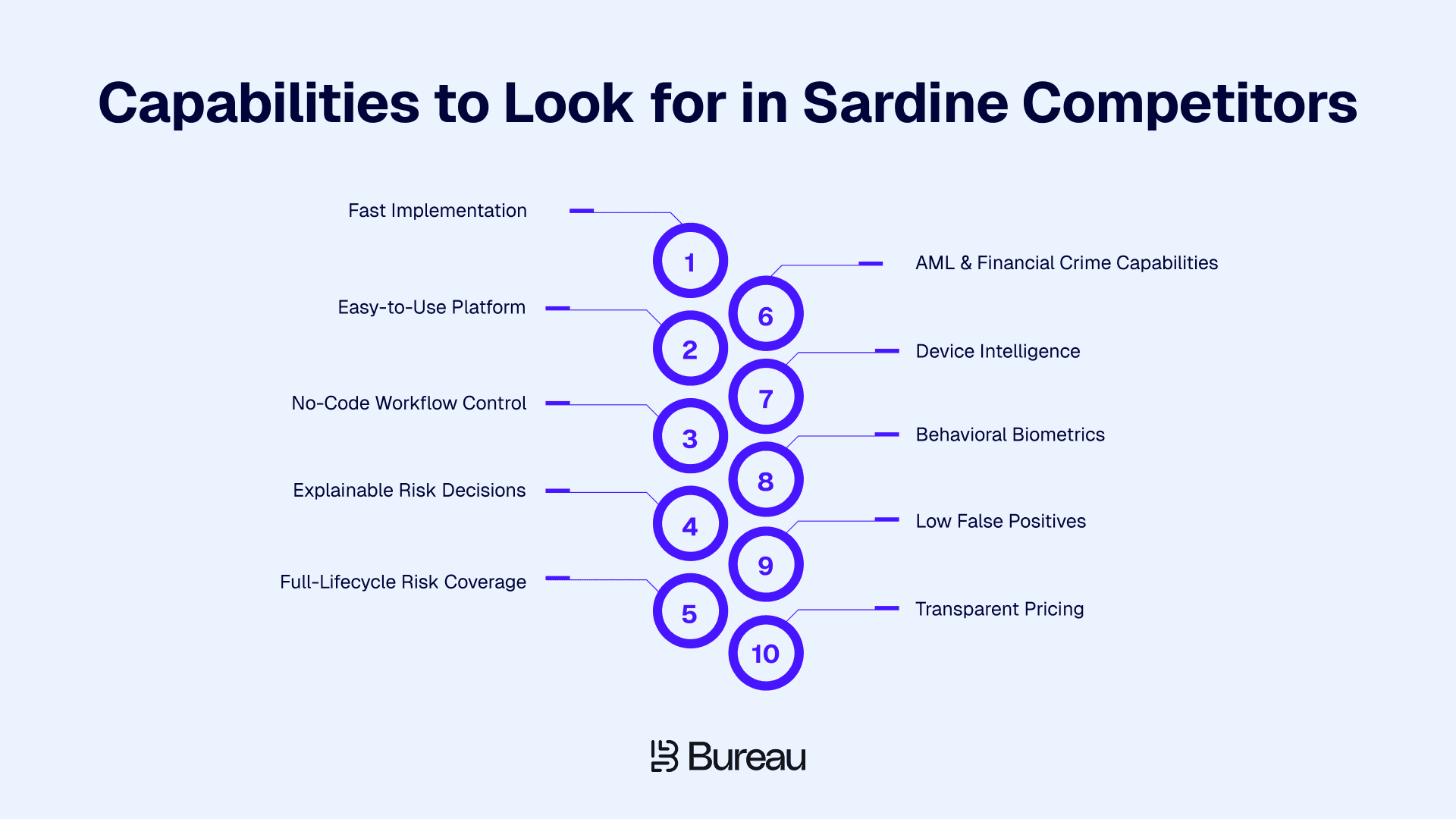
Sardine combines fraud prevention, AML compliance, transaction monitoring, device intelligence, and workflow automation, so evaluating alternatives requires looking beyond feature lists.
Focus on how well each platform performs in real-world operations, especially around usability, flexibility, and total cost.
Key capabilities to prioritize:
Fast implementation with strong APIs, SDKs, and onboarding support
Intuitive tools for fraud and compliance teams, including clear dashboards and case management
No-code or low-code workflow control so risk teams can adjust rules without engineering support
Transparent risk decisions with clear explanations behind alerts and scores
Coverage across the full customer lifecycle, from onboarding to transactions and ongoing monitoring
Device intelligence that can identify repeat fraud even when users attempt to mask their identity
Built-in AML capabilities such as transaction monitoring, sanctions screening, and audit trails
Behavioral biometrics to detect bots, account takeovers, and suspicious user behavior
Strong false-positive control to reduce unnecessary friction and manual reviews
Clear, predictable pricing that scales with usage without hidden costs
Nasdaq Verafin's 2026 Global Financial Crime Report found that 89% of financial crime professionals are already using or actively evaluating AI, yet 74% identify implementation as their biggest AML hurdle, which is exactly why no-code workflow control and fast deployment top the evaluation criteria for any Sardine alternative.
Using these capabilities as the evaluation framework, we shortlisted 7 platforms that consistently appear in buyer comparisons and competitor research.
7 Best Sardine Competitors and Alternatives in 2026
The platforms below represent different approaches to fraud prevention, identity verification, and financial crime risk management. While some specialize in behavioral intelligence or device fingerprinting, others provide broader fraud and AML capabilities.
1. Bureau ID

Bureau ID is an AI-powered Unified Risk Decisioning Platform built for businesses that need to evaluate trust across onboarding, authentication, account activity, and transactions.
Rather than operating as a standalone identity verification or fraud detection tool, it combines identity, device, behavioral, network, and transaction signals into a single decisioning layer, allowing fraud and risk teams to make consistent, real-time decisions throughout the customer lifecycle.
Why it's a strong Sardine alternative:
Bureau ID is a strong Sardine alternative for organizations that want connected risk decisions instead of managing separate tools for onboarding, fraud detection, device intelligence, and transaction monitoring.
Key strengths:
Unified risk intelligence: Make faster, more accurate decisions by combining identity, device, behavior, network, and transaction signals into a single view
Explainable risk scoring: Understand and trust every decision with real-time insights that reduce uncertainty and manual review
Flexible workflows: Adapt quickly to evolving fraud patterns using no-code and low-code tools that empower your team without engineering support
Persistent device identity: Recognize returning users with confidence and detect suspicious activity across sessions with a persistent Device ID
Behavioral biometrics: Detect hidden threats in real time by analyzing user interactions to uncover bots and account takeovers
Graph network insights: Uncover fraud rings and mule networks early by revealing risky connections across users and devices
These capabilities translate into measurable fraud prevention outcomes across real-world deployments. One example comes from a leading food delivery platform that uncovered a coordinated fraud ring using connected identity, device, and behavioral signals.
How Bureau ID helped eliminate a large-scale networked fraud ring
A leading food delivery company was facing a sophisticated fraud operation involving thousands of coordinated fake accounts exploiting promotional offers and referral incentives. Traditional rule-based systems failed to detect the scale and interconnected nature of the fraud, allowing the network to grow undetected.
Bureau ID implemented its Graph Identity Network along with device intelligence and behavioral signals to map relationships between accounts, devices, and activity patterns, enabling the identification of hidden links across the fraud ring.
Results achieved:
Identified and dismantled a fraud ring of 2,700+ users across 150 devices
Removed 1,750+ accounts tied to just 3 devices, eliminating concentrated abuse
Flagged 97% of collusive high-risk users for deeper investigation and action
Blocked repeat offenders to prevent recurrence and improve long-term fraud resilience
Read the full case study here → Food Delivery Firm Stops a 2,700-User Fraud Ring
Things to consider:
Bureau ID is best suited for teams looking for a broader risk decisioning layer rather than a single fraud signal.
The platform delivers the most value when businesses want to consolidate multiple fraud and compliance workflows.
Best for: Banks, fintechs, lenders, NBFCs, payment companies, marketplaces, ecommerce businesses, gaming platforms, and other digital-first organizations that need unified risk decisioning across the customer lifecycle.
2. SEON
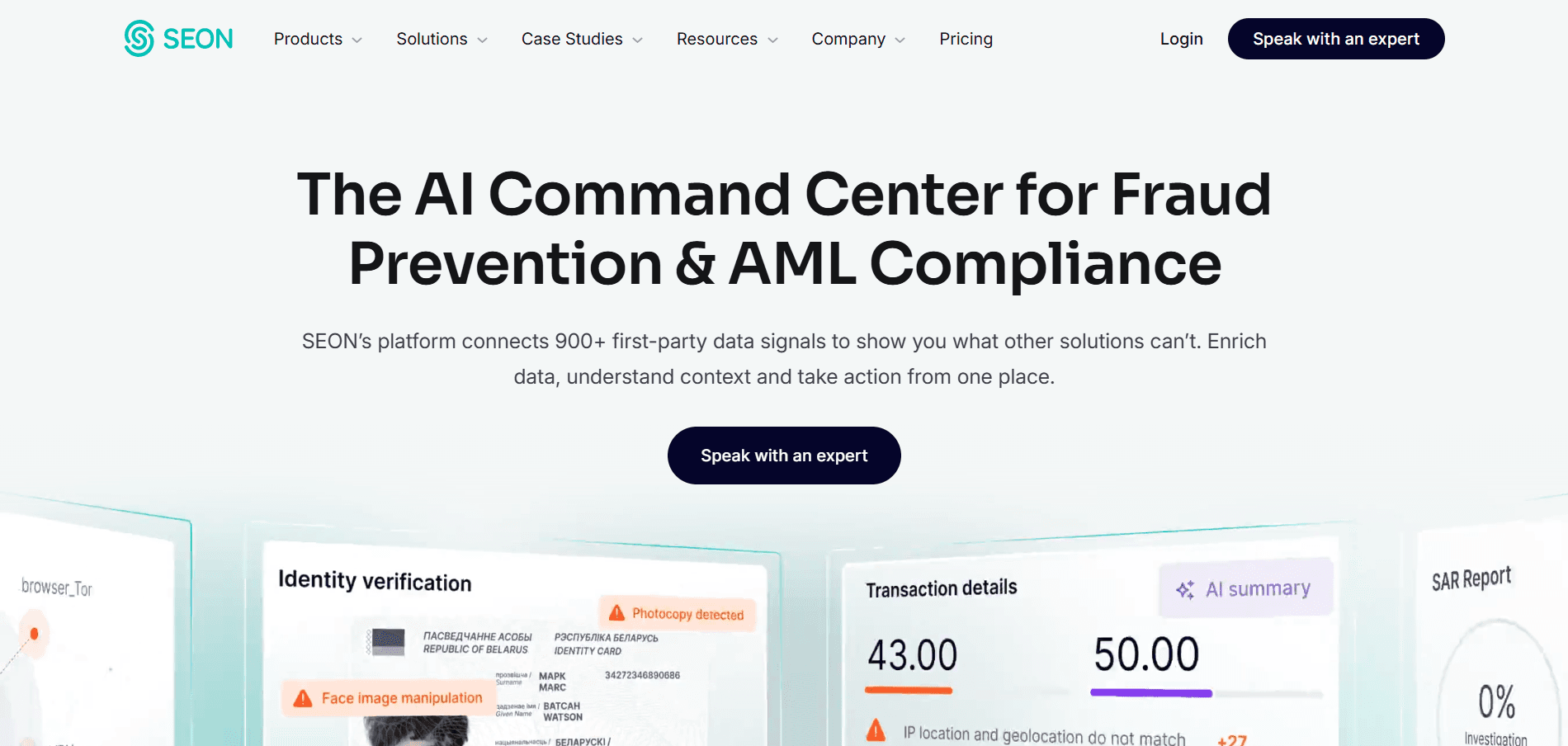
SEON is a fraud prevention and AML platform that combines digital footprint analysis, device intelligence, data enrichment, and configurable risk rules to help businesses detect fraud across onboarding, login, and transactions. Its flexible approach makes it a popular choice for organizations that want greater visibility into user risk while maintaining control over fraud decisioning.
Why it's a strong Sardine alternative:
SEON is a strong Sardine competitor for teams that want enrichment-led fraud detection, flexible rule building, and fast deployment. It’s well-suited for businesses combining email, phone, IP, device, and behavioral signals into customizable risk scoring.
Key strengths:
Enrich customer risk instantly: Build richer fraud profiles by combining email, phone, IP, device, and digital footprint intelligence into every decision.
Customize fraud workflows: Create and adjust fraud rules quickly with a flexible rule engine that adapts as attack patterns evolve.
Improve analyst efficiency: Give fraud teams clear visibility into risk signals through intuitive dashboards and explainable decision logic.
Deploy faster: Accelerate implementation with developer-friendly APIs and a platform designed for quick integration into existing fraud stacks.
Support fraud and AML operations together: Extend fraud detection with AML capabilities for organizations managing both financial crime and operational risk.
Things to consider:
SEON is best suited for organizations looking for enrichment-led fraud prevention rather than a unified risk decisioning platform spanning every stage of the customer lifecycle.
Some reviewers mention that advanced users may want greater customization in certain workflows, while others report occasional inconsistencies in some enrichment signals depending on available data sources.
Best for: Fintechs, marketplaces, ecommerce businesses, payment platforms, and digital-first companies looking for flexible fraud prevention built around data enrichment and configurable risk rules.
3. Sift
Sift is a digital fraud prevention platform designed for e-commerce, marketplaces, SaaS companies, and other digital businesses that need to manage fraud across the customer journey. It combines machine learning, account intelligence, and real-time risk scoring to help detect payment fraud, account takeover, policy abuse, and other forms of digital fraud.
Why it's a strong Sardine alternative:
Sift is a strong Sardine alternative for businesses focused on digital commerce fraud, account abuse, and payment risk. It performs particularly well for organizations that need continuous fraud monitoring across accounts, payments, promotions, and user activity rather than compliance-heavy AML workflows.
Key strengths:
Reduce payment fraud with confidence: Detect suspicious transactions in real time using machine learning and identity-based risk analysis.
Protect customer accounts: Identify account takeover attempts, fake accounts, and abusive users before they impact legitimate customers.
Automate fraud operations: Streamline investigations with configurable workflows, automated decisions, and centralized fraud management.
Improve approval rates: Reduce false declines by evaluating customer behavior and historical trust signals instead of relying solely on static rules.
Scale across digital businesses: Support ecommerce, marketplaces, subscriptions, and SaaS platforms with fraud detection that adapts to high transaction volumes.
Things to consider:
Sift is primarily designed for digital fraud prevention and may require complementary solutions for organizations with complex AML compliance or regulatory reporting requirements.
Some users note that some integrations and reporting workflows could offer greater flexibility depending on business requirements and existing technology stacks.
Best for: E-commerce businesses, marketplaces, SaaS companies, subscription platforms, and digital services looking to reduce payment fraud, account abuse, and manual review workloads.
4. Feedzai

Feedzai is an AI-powered financial crime prevention platform built for banks, payment providers, and large financial institutions managing high transaction volumes. It combines fraud detection, transaction monitoring, scam prevention, and AML capabilities to help organizations identify financial crime across multiple payment channels and customer touchpoints.
Why it's a strong Sardine alternative:
Feedzai is a strong Sardine alternative for enterprises that need AI-driven financial crime prevention at scale. It offers advanced transaction monitoring, cross-channel risk detection, and enterprise-grade AML capabilities.
Key strengths:
Strengthen financial crime defenses: Detect fraud, scams, and suspicious transactions across cards, payments, and digital banking channels using AI-driven risk models.
Monitor transactions at scale: Analyze high transaction volumes in real time without compromising detection accuracy or operational performance.
Unify fraud and AML operations: Combine transaction monitoring, case management, and financial crime workflows within a single platform.
Improve investigator productivity: Prioritize high-risk alerts with AI-assisted decisioning that helps reduce manual investigation effort.
Support enterprise growth: Scale fraud prevention across multiple geographies, payment channels, and regulatory environments with enterprise-ready infrastructure.
Things to consider:
Feedzai is designed primarily for enterprise financial institutions, so smaller fintechs or businesses with less complex fraud operations may find it more extensive than their requirements.
Implementation and onboarding can require significant planning and technical resources, particularly for large deployments.
Best for: Large banks, payment processors, enterprise fintechs, and financial institutions managing high-volume fraud prevention and AML operations.
5. Unit21

Unit21 is a fraud and AML operations platform built for fintechs, banks, and compliance teams that need greater control over fraud investigations and regulatory workflows. It combines transaction monitoring, sanctions screening, case management, and no-code rule configuration to help teams detect, investigate, and respond to financial crime more efficiently.
Why it's a strong Sardine alternative:
Unit21 is a strong Sardine competitor for organizations that want analyst-driven fraud and AML operations with flexible rule management. It is good for teams that tune detection logic, investigate alerts, and manage compliance workflows without relying heavily on engineering resources.
Key strengths:
Give analysts greater control: Enable fraud and compliance teams to build, adjust, and deploy rules without waiting for engineering support.
Streamline investigations: Manage alerts, investigations, and case workflows from a centralized platform that improves operational efficiency.
Strengthen AML compliance: Support transaction monitoring, sanctions screening, customer risk scoring, and regulatory reporting within a unified workflow.
Adapt to evolving threats: Update thresholds and detection rules quickly as fraud patterns and regulatory requirements change.
Improve operational visibility: Track fraud and compliance activity with audit-ready workflows that simplify investigations and internal governance.
Things to consider:
Unit21 is primarily focused on fraud operations and AML workflows, so buyers should evaluate whether they also need dedicated capabilities for device intelligence, behavioral biometrics, or identity verification.
Some reviewers mention that configuring workflows and rule logic can take time, particularly for teams implementing more complex use cases.
Best for: Fintechs, crypto businesses, sponsor banks, financial institutions, and compliance teams looking for flexible fraud operations, transaction monitoring, and AML workflow management.
6. BioCatch

BioCatch is a behavioral biometrics platform that helps financial institutions detect fraud by analyzing how users interact with applications and devices. Rather than relying on static identity or transaction data alone, it continuously evaluates behavioral patterns to identify account takeover, scams, mule activity, and other forms of sophisticated fraud.
Why it's a strong Sardine alternative:
BioCatch is a strong Sardine alternative for organizations where behavioral intelligence is a priority. It helps uncover fraud that may not be visible through credentials, identity verification, or transaction monitoring alone by continuously evaluating user behavior throughout a session.
Key strengths:
Detect hidden fraud behaviors: Identify account takeover attempts, scams, and social engineering attacks by analyzing how users interact with devices in real time.
Reduce customer friction: Distinguish legitimate users from fraudsters using passive behavioral signals without adding unnecessary authentication steps.
Strengthen fraud investigations: Give analysts deeper behavioral context that complements existing identity, transaction, and fraud detection systems.
Identify evolving attack patterns: Detect suspicious behavior that changes over time, helping organizations respond to new fraud techniques more effectively.
Enhance existing fraud stacks: Add continuous behavioral intelligence to existing fraud prevention and AML platforms without replacing current infrastructure.
Things to consider:
BioCatch is a specialized behavioral biometrics platform, so organizations typically pair it with separate solutions for identity verification, device intelligence, transaction monitoring, and AML compliance.
Buyers should evaluate implementation effort and integration requirements, particularly when deploying BioCatch alongside existing fraud systems.
Best for: Banks, financial institutions, payment providers, and fraud teams focused on behavioral biometrics, account takeover prevention, scam detection, and mule activity.
7. Fingerprint
Fingerprint is a device intelligence platform that helps businesses identify visitors, recognize repeat users, and detect suspicious devices across web and mobile applications. It specializes in persistent device identification, making it a strong choice for organizations looking to strengthen fraud prevention through reliable device-level intelligence.
Why it's a strong Sardine alternative:
Fingerprint is a strong Sardine competitor for teams whose primary requirement is device intelligence. It helps identify repeat fraudsters, detect multi-accounting, and uncover suspicious activity even when users attempt to mask their identity through VPNs, browser resets, or device changes.
Key strengths:
Recognize repeat fraudsters: Identify returning users with persistent device intelligence that remains effective even when traditional identifiers change.
Reduce multi-account abuse: Detect linked accounts and coordinated abuse by connecting activity across devices and sessions.
Strengthen bot detection: Identify automated traffic, scripted behavior, and suspicious browsers before they impact your platform.
Support smarter authentication: Trigger step-up verification based on device risk instead of applying friction to every user.
Integrate into existing fraud stacks: Add device intelligence alongside existing fraud, identity, and authentication solutions without replacing them.
Things to consider:
Fingerprint is a specialized device intelligence platform, so organizations typically need additional solutions for identity verification, AML compliance, transaction monitoring, and broader fraud decisioning.
Some reviewers explain that understanding device confidence scores and tuning them for specific fraud use cases can take time during implementation.
Best for: Product-led companies, marketplaces, fintechs, ecommerce businesses, SaaS platforms, and fraud teams looking to strengthen device intelligence and detect repeat offenders.
Bureau ID vs Sardine: Side-by-Side Comparison
Sardine and Bureau ID both help businesses manage fraud and financial risk, but they solve different problems.
Sardine is primarily positioned as a fraud prevention, AML, and financial crime platform, while Bureau ID is built as a Unified Risk Decisioning Platform that connects identity, device, behavioral, network, and transaction intelligence into a single decisioning layer across the customer lifecycle.
Evaluation Area | Bureau ID | Sardine |
Core Positioning | Unified Risk Decisioning Platform | Fraud, AML, and financial crime platform |
Best Fit | Full-lifecycle risk decisioning across onboarding, authentication, account activity, and transactions | Fintech fraud, AML, transaction monitoring, and sponsor-bank workflows |
Signal Coverage | Identity, device, behavioral, network, transaction, and orchestration signals | Device, behavioral, transaction, graph, consortium, AML, and case management signals |
Device Intelligence | Persistent Device ID that links devices, accounts, and behaviors across the customer lifecycle | Device and behavioral risk signals |
Behavioral Biometrics | Behavioral biometrics for bots, account takeover, fraud farms, and suspicious sessions | Behavioral signals for fraud detection and compliance |
Network Intelligence | Graph Identity Network for linked identities, devices, fraud rings, and mule networks | Connections graph and consortium data |
Workflow Control | No-code and low-code workflows for rules, thresholds, and verification logic | Rules and workflow automation |
Explainability | Explainable risk scores with signal-level context for every decision | Risk scoring with investigation workflows |
Key Buyer Question | Do we need one decisioning layer across fraud, identity, device, behavior, network, and transactions? | Do we need a fraud and AML platform for financial crime operations? |
Choose Sardine If
Sardine is likely the better fit if your evaluation is centered on fraud prevention and AML operations. It works well for organizations that prioritize transaction monitoring, financial crime workflows, and compliance across fintech, banking, crypto, payment, or sponsor-bank environments.
If your primary objective is consolidating fraud and AML capabilities into a single operational platform, Sardine is a strong option to evaluate.
Choose Bureau ID If
Bureau ID is the stronger choice when fraud extends beyond individual transactions and requires connected risk decisions across the entire customer journey. It's designed for organizations that want to consolidate identity verification, device intelligence, behavioral biometrics, network intelligence, and transaction risk into a single decisioning layer instead of managing multiple point solutions.
Choose Bureau ID if you need to:
Evaluate risk consistently across onboarding, login, account recovery, transactions, and ongoing account activity.
Reduce vendor sprawl by replacing fragmented fraud and compliance tools with a unified decisioning platform.
Give fraud teams no-code and low-code control over rules, thresholds, and verification workflows.
Detect fraud rings, mule networks, and repeat bad actors using persistent device intelligence and graph-based risk analysis.
Reduce fraud while minimizing unnecessary customer friction through explainable, real-time risk decisions.
The platform you pick should help your team make better risk decisions across the entire customer lifecycle, not just improve one stage of it.
As fraud grows more sophisticated, connected intelligence and flexible decisioning become increasingly important for protecting customers while maintaining a seamless user experience.
Related Read: Best Fraud Detection Software in 2026 for Unified Risk Decisions
Choose a Platform Built for Full-Lifecycle Risk Decisions
When fraud, identity, device intelligence, behavioral signals, and transaction risk are handled separately, teams lose context. A unified decisioning approach helps reduce complexity while improving detection accuracy.
Bureau ID brings these signals together in one platform. By combining identity verification, device intelligence, behavioral biometrics, graph intelligence, transaction signals, and no-code workflow orchestration, it enables faster decisions, reduces false positives, and uncovers linked fraud that isolated tools often miss.
Schedule a demo with Bureau ID to see how a unified risk decisioning platform can help your team reduce fraud, streamline onboarding, and make faster, more confident decisions across the customer lifecycle.
FAQs
1. What are the best Sardine competitors?
The best Sardine competitors include Bureau ID, SEON, Sift, Feedzai, Unit21, BioCatch, and Fingerprint. Each platform focuses on different areas, such as unified risk decisioning, fraud prevention, AML compliance, behavioral biometrics, or device intelligence, so the right choice depends on your business requirements.
2. Which Sardine alternative is best for fintechs?
Fintechs should choose a platform based on their fraud and compliance priorities. Bureau ID, Feedzai, Unit21, and SEON are strong options for fintechs, with Bureau ID standing out for organizations that need connected risk decisions across onboarding, authentication, transactions, and ongoing account activity.
3. What should I look for when comparing Sardine alternatives?
Beyond feature lists, compare implementation effort, workflow flexibility, explainable risk decisions, device intelligence, behavioral biometrics, AML capabilities, and the ability to evaluate risk consistently across the customer lifecycle. These factors have a greater impact on long-term operational efficiency than individual features alone.
4. How does Bureau ID compare to Sardine?
Bureau ID differentiates itself from Sardine through its unified risk decisioning approach. Instead of evaluating signals in isolation, it connects identity, device, behavioral, network, and transaction data in one platform, enabling more consistent, explainable, and accurate fraud decisions across the entire customer lifecycle.
5. Which Sardine competitor offers the best device intelligence?
Bureau ID and Fingerprint are strong options for device intelligence. Fingerprint focuses on persistent visitor identification, while Bureau ID combines persistent device identity with behavioral biometrics, graph intelligence, and transaction signals to support broader fraud and risk decisions.
6. How do I choose the right Sardine alternative?
Start by identifying where fraud occurs in your customer journey and whether your current tools provide enough visibility across those workflows. If fraud spans onboarding, login, account recovery, and transactions, a unified risk decisioning platform may provide greater long-term value than separate point solutions.
As fraud programs mature, many banks, fintechs, payment companies, crypto businesses, and digital platforms begin comparing Sardine competitors to find a solution that better matches their operational needs.
Sardine is a well-known platform for fraud prevention, AML compliance, transaction monitoring, device intelligence, behavioral signals, case management, and workflow automation.
But some teams need stronger protection against onboarding fraud or account takeover, while others prioritize device intelligence, behavioral biometrics, or full-lifecycle financial crime risk management.
This guide compares the top Sardine competitors, highlights where each platform stands out, and helps you identify the right fit based on your fraud detection software, identity verification, AML, and risk decisioning requirements.
Top 7 Sardine Competitors & Alternatives At a Glance
Sardine competitors include Bureau ID, SEON, Sift, Feedzai, Unit21, BioCatch, and Fingerprint.
These Sardine alternatives address different needs across fraud detection software, AML compliance, identity verification, device intelligence, behavioral biometrics, transaction monitoring, and real-time risk decisioning.
The right platform depends on your fraud workflows, compliance requirements, and the level of operational complexity your team needs to manage.
Sardine Competitor | Best For | Core Strength | Fraud and AML Coverage | Key Difference vs. Sardine |
Bureau ID | Unified risk decisioning | Identity, device, behavior, network, transaction, and orchestration | High | Strong fit for teams replacing fragmented fraud, identity, device, and compliance tools |
SEON | Fraud data enrichment and flexible rules | Email, phone, IP, device, digital footprint, and risk scoring | Moderate to High | Stronger for teams prioritizing enrichment, transparent rules, and fast fraud checks |
Sift | Digital fraud operations | Payment fraud, account takeover, chargebacks, and abuse prevention | Moderate to High | Stronger for e-commerce, marketplaces, and digital platforms with account and payment fraud |
Feedzai | Enterprise financial crime prevention | AI-powered transaction monitoring, scam detection, and fraud operations | High | Stronger for large banks, payment networks, and enterprise financial institutions |
Unit21 | Fraud and AML operations | No-code rules, transaction monitoring, case management, and compliance workflows | High | Stronger for analyst-led fraud and AML operations |
BioCatch | Behavioral biometrics | Session behavior, scam detection, mule behavior, and account takeover detection | Moderate | Stronger as a specialized behavioral intelligence layer |
Fingerprint | Device intelligence | Visitor identification, device fingerprinting, and repeat-user detection | Low to Moderate | Stronger as a device intelligence layer rather than a complete fraud and AML platform |
No Sardine alternative is a direct one-to-one replacement. Some platforms are built for AML operations and transaction monitoring, while others specialize in behavioral intelligence, device intelligence, or unified risk decisioning.
Capabilities to Look for in Sardine Competitors
Sardine combines fraud prevention, AML compliance, transaction monitoring, device intelligence, and workflow automation, so evaluating alternatives requires looking beyond feature lists.
Focus on how well each platform performs in real-world operations, especially around usability, flexibility, and total cost.
Key capabilities to prioritize:
Fast implementation with strong APIs, SDKs, and onboarding support
Intuitive tools for fraud and compliance teams, including clear dashboards and case management
No-code or low-code workflow control so risk teams can adjust rules without engineering support
Transparent risk decisions with clear explanations behind alerts and scores
Coverage across the full customer lifecycle, from onboarding to transactions and ongoing monitoring
Device intelligence that can identify repeat fraud even when users attempt to mask their identity
Built-in AML capabilities such as transaction monitoring, sanctions screening, and audit trails
Behavioral biometrics to detect bots, account takeovers, and suspicious user behavior
Strong false-positive control to reduce unnecessary friction and manual reviews
Clear, predictable pricing that scales with usage without hidden costs
Nasdaq Verafin's 2026 Global Financial Crime Report found that 89% of financial crime professionals are already using or actively evaluating AI, yet 74% identify implementation as their biggest AML hurdle, which is exactly why no-code workflow control and fast deployment top the evaluation criteria for any Sardine alternative.
Using these capabilities as the evaluation framework, we shortlisted 7 platforms that consistently appear in buyer comparisons and competitor research.
7 Best Sardine Competitors and Alternatives in 2026
The platforms below represent different approaches to fraud prevention, identity verification, and financial crime risk management. While some specialize in behavioral intelligence or device fingerprinting, others provide broader fraud and AML capabilities.
1. Bureau ID
Bureau ID is an AI-powered Unified Risk Decisioning Platform built for businesses that need to evaluate trust across onboarding, authentication, account activity, and transactions.
Rather than operating as a standalone identity verification or fraud detection tool, it combines identity, device, behavioral, network, and transaction signals into a single decisioning layer, allowing fraud and risk teams to make consistent, real-time decisions throughout the customer lifecycle.
Why it's a strong Sardine alternative:
Bureau ID is a strong Sardine alternative for organizations that want connected risk decisions instead of managing separate tools for onboarding, fraud detection, device intelligence, and transaction monitoring.
Key strengths:
Unified risk intelligence: Make faster, more accurate decisions by combining identity, device, behavior, network, and transaction signals into a single view
Explainable risk scoring: Understand and trust every decision with real-time insights that reduce uncertainty and manual review
Flexible workflows: Adapt quickly to evolving fraud patterns using no-code and low-code tools that empower your team without engineering support
Persistent device identity: Recognize returning users with confidence and detect suspicious activity across sessions with a persistent Device ID
Behavioral biometrics: Detect hidden threats in real time by analyzing user interactions to uncover bots and account takeovers
Graph network insights: Uncover fraud rings and mule networks early by revealing risky connections across users and devices
These capabilities translate into measurable fraud prevention outcomes across real-world deployments. One example comes from a leading food delivery platform that uncovered a coordinated fraud ring using connected identity, device, and behavioral signals.
How Bureau ID helped eliminate a large-scale networked fraud ring
A leading food delivery company was facing a sophisticated fraud operation involving thousands of coordinated fake accounts exploiting promotional offers and referral incentives. Traditional rule-based systems failed to detect the scale and interconnected nature of the fraud, allowing the network to grow undetected.
Bureau ID implemented its Graph Identity Network along with device intelligence and behavioral signals to map relationships between accounts, devices, and activity patterns, enabling the identification of hidden links across the fraud ring.
Results achieved:
Identified and dismantled a fraud ring of 2,700+ users across 150 devices
Removed 1,750+ accounts tied to just 3 devices, eliminating concentrated abuse
Flagged 97% of collusive high-risk users for deeper investigation and action
Blocked repeat offenders to prevent recurrence and improve long-term fraud resilience
Read the full case study here → Food Delivery Firm Stops a 2,700-User Fraud Ring
Things to consider:
Bureau ID is best suited for teams looking for a broader risk decisioning layer rather than a single fraud signal.
The platform delivers the most value when businesses want to consolidate multiple fraud and compliance workflows.
Best for: Banks, fintechs, lenders, NBFCs, payment companies, marketplaces, ecommerce businesses, gaming platforms, and other digital-first organizations that need unified risk decisioning across the customer lifecycle.
2. SEON
SEON is a fraud prevention and AML platform that combines digital footprint analysis, device intelligence, data enrichment, and configurable risk rules to help businesses detect fraud across onboarding, login, and transactions. Its flexible approach makes it a popular choice for organizations that want greater visibility into user risk while maintaining control over fraud decisioning.
Why it's a strong Sardine alternative:
SEON is a strong Sardine competitor for teams that want enrichment-led fraud detection, flexible rule building, and fast deployment. It’s well-suited for businesses combining email, phone, IP, device, and behavioral signals into customizable risk scoring.
Key strengths:
Enrich customer risk instantly: Build richer fraud profiles by combining email, phone, IP, device, and digital footprint intelligence into every decision.
Customize fraud workflows: Create and adjust fraud rules quickly with a flexible rule engine that adapts as attack patterns evolve.
Improve analyst efficiency: Give fraud teams clear visibility into risk signals through intuitive dashboards and explainable decision logic.
Deploy faster: Accelerate implementation with developer-friendly APIs and a platform designed for quick integration into existing fraud stacks.
Support fraud and AML operations together: Extend fraud detection with AML capabilities for organizations managing both financial crime and operational risk.
Things to consider:
SEON is best suited for organizations looking for enrichment-led fraud prevention rather than a unified risk decisioning platform spanning every stage of the customer lifecycle.
Some reviewers mention that advanced users may want greater customization in certain workflows, while others report occasional inconsistencies in some enrichment signals depending on available data sources.
Best for: Fintechs, marketplaces, ecommerce businesses, payment platforms, and digital-first companies looking for flexible fraud prevention built around data enrichment and configurable risk rules.
3. Sift
Sift is a digital fraud prevention platform designed for e-commerce, marketplaces, SaaS companies, and other digital businesses that need to manage fraud across the customer journey. It combines machine learning, account intelligence, and real-time risk scoring to help detect payment fraud, account takeover, policy abuse, and other forms of digital fraud.
Why it's a strong Sardine alternative:
Sift is a strong Sardine alternative for businesses focused on digital commerce fraud, account abuse, and payment risk. It performs particularly well for organizations that need continuous fraud monitoring across accounts, payments, promotions, and user activity rather than compliance-heavy AML workflows.
Key strengths:
Reduce payment fraud with confidence: Detect suspicious transactions in real time using machine learning and identity-based risk analysis.
Protect customer accounts: Identify account takeover attempts, fake accounts, and abusive users before they impact legitimate customers.
Automate fraud operations: Streamline investigations with configurable workflows, automated decisions, and centralized fraud management.
Improve approval rates: Reduce false declines by evaluating customer behavior and historical trust signals instead of relying solely on static rules.
Scale across digital businesses: Support ecommerce, marketplaces, subscriptions, and SaaS platforms with fraud detection that adapts to high transaction volumes.
Things to consider:
Sift is primarily designed for digital fraud prevention and may require complementary solutions for organizations with complex AML compliance or regulatory reporting requirements.
Some users note that some integrations and reporting workflows could offer greater flexibility depending on business requirements and existing technology stacks.
Best for: E-commerce businesses, marketplaces, SaaS companies, subscription platforms, and digital services looking to reduce payment fraud, account abuse, and manual review workloads.
4. Feedzai
Feedzai is an AI-powered financial crime prevention platform built for banks, payment providers, and large financial institutions managing high transaction volumes. It combines fraud detection, transaction monitoring, scam prevention, and AML capabilities to help organizations identify financial crime across multiple payment channels and customer touchpoints.
Why it's a strong Sardine alternative:
Feedzai is a strong Sardine alternative for enterprises that need AI-driven financial crime prevention at scale. It offers advanced transaction monitoring, cross-channel risk detection, and enterprise-grade AML capabilities.
Key strengths:
Strengthen financial crime defenses: Detect fraud, scams, and suspicious transactions across cards, payments, and digital banking channels using AI-driven risk models.
Monitor transactions at scale: Analyze high transaction volumes in real time without compromising detection accuracy or operational performance.
Unify fraud and AML operations: Combine transaction monitoring, case management, and financial crime workflows within a single platform.
Improve investigator productivity: Prioritize high-risk alerts with AI-assisted decisioning that helps reduce manual investigation effort.
Support enterprise growth: Scale fraud prevention across multiple geographies, payment channels, and regulatory environments with enterprise-ready infrastructure.
Things to consider:
Feedzai is designed primarily for enterprise financial institutions, so smaller fintechs or businesses with less complex fraud operations may find it more extensive than their requirements.
Implementation and onboarding can require significant planning and technical resources, particularly for large deployments.
Best for: Large banks, payment processors, enterprise fintechs, and financial institutions managing high-volume fraud prevention and AML operations.
5. Unit21
Unit21 is a fraud and AML operations platform built for fintechs, banks, and compliance teams that need greater control over fraud investigations and regulatory workflows. It combines transaction monitoring, sanctions screening, case management, and no-code rule configuration to help teams detect, investigate, and respond to financial crime more efficiently.
Why it's a strong Sardine alternative:
Unit21 is a strong Sardine competitor for organizations that want analyst-driven fraud and AML operations with flexible rule management. It is good for teams that tune detection logic, investigate alerts, and manage compliance workflows without relying heavily on engineering resources.
Key strengths:
Give analysts greater control: Enable fraud and compliance teams to build, adjust, and deploy rules without waiting for engineering support.
Streamline investigations: Manage alerts, investigations, and case workflows from a centralized platform that improves operational efficiency.
Strengthen AML compliance: Support transaction monitoring, sanctions screening, customer risk scoring, and regulatory reporting within a unified workflow.
Adapt to evolving threats: Update thresholds and detection rules quickly as fraud patterns and regulatory requirements change.
Improve operational visibility: Track fraud and compliance activity with audit-ready workflows that simplify investigations and internal governance.
Things to consider:
Unit21 is primarily focused on fraud operations and AML workflows, so buyers should evaluate whether they also need dedicated capabilities for device intelligence, behavioral biometrics, or identity verification.
Some reviewers mention that configuring workflows and rule logic can take time, particularly for teams implementing more complex use cases.
Best for: Fintechs, crypto businesses, sponsor banks, financial institutions, and compliance teams looking for flexible fraud operations, transaction monitoring, and AML workflow management.
6. BioCatch
BioCatch is a behavioral biometrics platform that helps financial institutions detect fraud by analyzing how users interact with applications and devices. Rather than relying on static identity or transaction data alone, it continuously evaluates behavioral patterns to identify account takeover, scams, mule activity, and other forms of sophisticated fraud.
Why it's a strong Sardine alternative:
BioCatch is a strong Sardine alternative for organizations where behavioral intelligence is a priority. It helps uncover fraud that may not be visible through credentials, identity verification, or transaction monitoring alone by continuously evaluating user behavior throughout a session.
Key strengths:
Detect hidden fraud behaviors: Identify account takeover attempts, scams, and social engineering attacks by analyzing how users interact with devices in real time.
Reduce customer friction: Distinguish legitimate users from fraudsters using passive behavioral signals without adding unnecessary authentication steps.
Strengthen fraud investigations: Give analysts deeper behavioral context that complements existing identity, transaction, and fraud detection systems.
Identify evolving attack patterns: Detect suspicious behavior that changes over time, helping organizations respond to new fraud techniques more effectively.
Enhance existing fraud stacks: Add continuous behavioral intelligence to existing fraud prevention and AML platforms without replacing current infrastructure.
Things to consider:
BioCatch is a specialized behavioral biometrics platform, so organizations typically pair it with separate solutions for identity verification, device intelligence, transaction monitoring, and AML compliance.
Buyers should evaluate implementation effort and integration requirements, particularly when deploying BioCatch alongside existing fraud systems.
Best for: Banks, financial institutions, payment providers, and fraud teams focused on behavioral biometrics, account takeover prevention, scam detection, and mule activity.
7. Fingerprint
Fingerprint is a device intelligence platform that helps businesses identify visitors, recognize repeat users, and detect suspicious devices across web and mobile applications. It specializes in persistent device identification, making it a strong choice for organizations looking to strengthen fraud prevention through reliable device-level intelligence.
Why it's a strong Sardine alternative:
Fingerprint is a strong Sardine competitor for teams whose primary requirement is device intelligence. It helps identify repeat fraudsters, detect multi-accounting, and uncover suspicious activity even when users attempt to mask their identity through VPNs, browser resets, or device changes.
Key strengths:
Recognize repeat fraudsters: Identify returning users with persistent device intelligence that remains effective even when traditional identifiers change.
Reduce multi-account abuse: Detect linked accounts and coordinated abuse by connecting activity across devices and sessions.
Strengthen bot detection: Identify automated traffic, scripted behavior, and suspicious browsers before they impact your platform.
Support smarter authentication: Trigger step-up verification based on device risk instead of applying friction to every user.
Integrate into existing fraud stacks: Add device intelligence alongside existing fraud, identity, and authentication solutions without replacing them.
Things to consider:
Fingerprint is a specialized device intelligence platform, so organizations typically need additional solutions for identity verification, AML compliance, transaction monitoring, and broader fraud decisioning.
Some reviewers explain that understanding device confidence scores and tuning them for specific fraud use cases can take time during implementation.
Best for: Product-led companies, marketplaces, fintechs, ecommerce businesses, SaaS platforms, and fraud teams looking to strengthen device intelligence and detect repeat offenders.
Bureau ID vs Sardine: Side-by-Side Comparison
Sardine and Bureau ID both help businesses manage fraud and financial risk, but they solve different problems.
Sardine is primarily positioned as a fraud prevention, AML, and financial crime platform, while Bureau ID is built as a Unified Risk Decisioning Platform that connects identity, device, behavioral, network, and transaction intelligence into a single decisioning layer across the customer lifecycle.
Evaluation Area | Bureau ID | Sardine |
Core Positioning | Unified Risk Decisioning Platform | Fraud, AML, and financial crime platform |
Best Fit | Full-lifecycle risk decisioning across onboarding, authentication, account activity, and transactions | Fintech fraud, AML, transaction monitoring, and sponsor-bank workflows |
Signal Coverage | Identity, device, behavioral, network, transaction, and orchestration signals | Device, behavioral, transaction, graph, consortium, AML, and case management signals |
Device Intelligence | Persistent Device ID that links devices, accounts, and behaviors across the customer lifecycle | Device and behavioral risk signals |
Behavioral Biometrics | Behavioral biometrics for bots, account takeover, fraud farms, and suspicious sessions | Behavioral signals for fraud detection and compliance |
Network Intelligence | Graph Identity Network for linked identities, devices, fraud rings, and mule networks | Connections graph and consortium data |
Workflow Control | No-code and low-code workflows for rules, thresholds, and verification logic | Rules and workflow automation |
Explainability | Explainable risk scores with signal-level context for every decision | Risk scoring with investigation workflows |
Key Buyer Question | Do we need one decisioning layer across fraud, identity, device, behavior, network, and transactions? | Do we need a fraud and AML platform for financial crime operations? |
Choose Sardine If
Sardine is likely the better fit if your evaluation is centered on fraud prevention and AML operations. It works well for organizations that prioritize transaction monitoring, financial crime workflows, and compliance across fintech, banking, crypto, payment, or sponsor-bank environments.
If your primary objective is consolidating fraud and AML capabilities into a single operational platform, Sardine is a strong option to evaluate.
Choose Bureau ID If
Bureau ID is the stronger choice when fraud extends beyond individual transactions and requires connected risk decisions across the entire customer journey. It's designed for organizations that want to consolidate identity verification, device intelligence, behavioral biometrics, network intelligence, and transaction risk into a single decisioning layer instead of managing multiple point solutions.
Choose Bureau ID if you need to:
Evaluate risk consistently across onboarding, login, account recovery, transactions, and ongoing account activity.
Reduce vendor sprawl by replacing fragmented fraud and compliance tools with a unified decisioning platform.
Give fraud teams no-code and low-code control over rules, thresholds, and verification workflows.
Detect fraud rings, mule networks, and repeat bad actors using persistent device intelligence and graph-based risk analysis.
Reduce fraud while minimizing unnecessary customer friction through explainable, real-time risk decisions.
The platform you pick should help your team make better risk decisions across the entire customer lifecycle, not just improve one stage of it.
As fraud grows more sophisticated, connected intelligence and flexible decisioning become increasingly important for protecting customers while maintaining a seamless user experience.
Related Read: Best Fraud Detection Software in 2026 for Unified Risk Decisions
Choose a Platform Built for Full-Lifecycle Risk Decisions
When fraud, identity, device intelligence, behavioral signals, and transaction risk are handled separately, teams lose context. A unified decisioning approach helps reduce complexity while improving detection accuracy.
Bureau ID brings these signals together in one platform. By combining identity verification, device intelligence, behavioral biometrics, graph intelligence, transaction signals, and no-code workflow orchestration, it enables faster decisions, reduces false positives, and uncovers linked fraud that isolated tools often miss.
Schedule a demo with Bureau ID to see how a unified risk decisioning platform can help your team reduce fraud, streamline onboarding, and make faster, more confident decisions across the customer lifecycle.
FAQs
1. What are the best Sardine competitors?
The best Sardine competitors include Bureau ID, SEON, Sift, Feedzai, Unit21, BioCatch, and Fingerprint. Each platform focuses on different areas, such as unified risk decisioning, fraud prevention, AML compliance, behavioral biometrics, or device intelligence, so the right choice depends on your business requirements.
2. Which Sardine alternative is best for fintechs?
Fintechs should choose a platform based on their fraud and compliance priorities. Bureau ID, Feedzai, Unit21, and SEON are strong options for fintechs, with Bureau ID standing out for organizations that need connected risk decisions across onboarding, authentication, transactions, and ongoing account activity.
3. What should I look for when comparing Sardine alternatives?
Beyond feature lists, compare implementation effort, workflow flexibility, explainable risk decisions, device intelligence, behavioral biometrics, AML capabilities, and the ability to evaluate risk consistently across the customer lifecycle. These factors have a greater impact on long-term operational efficiency than individual features alone.
4. How does Bureau ID compare to Sardine?
Bureau ID differentiates itself from Sardine through its unified risk decisioning approach. Instead of evaluating signals in isolation, it connects identity, device, behavioral, network, and transaction data in one platform, enabling more consistent, explainable, and accurate fraud decisions across the entire customer lifecycle.
5. Which Sardine competitor offers the best device intelligence?
Bureau ID and Fingerprint are strong options for device intelligence. Fingerprint focuses on persistent visitor identification, while Bureau ID combines persistent device identity with behavioral biometrics, graph intelligence, and transaction signals to support broader fraud and risk decisions.
6. How do I choose the right Sardine alternative?
Start by identifying where fraud occurs in your customer journey and whether your current tools provide enough visibility across those workflows. If fraud spans onboarding, login, account recovery, and transactions, a unified risk decisioning platform may provide greater long-term value than separate point solutions.
TABLE OF CONTENTS
See More
Recommended Blogs


Landing Page.
Simple, bold.
Sign Up
Download

Products
Solutions


© 2026 Bureau . All rights reserved.
Solutions
Industries
Resources
Company
Solutions
Industries
Resources
Company
© 2026 Bureau . All rights reserved.
Follow Us
Leave behind fragmented tools. Stop fraud rings, cut false declines, and deliver secure digital journeys at scale
Our Presence








Leave behind fragmented tools. Stop fraud rings, cut false declines, and deliver secure digital journeys at scale
Our Presence
© 2026 Bureau . All rights reserved.