How Fraud Detection and Prevention Works Across the Customer Journey
How Fraud Detection and Prevention Works Across the Customer Journey
How Fraud Detection and Prevention Works Across the Customer Journey
Learn how fraud detection and prevention work, including key fraud types, detection methods, prevention strategies, monitoring, and risk controls.
Author
Team Bureau


See how Bureau has helped industry leaders defend against networked Industrial-scale frauds →
Schedule a Demo
TABLE OF CONTENTS
See Less
Fraud can begin with a synthetic identity during onboarding, surface as account takeover at login, or appear later through suspicious transactions, withdrawals, and account recovery attempts.
Because fraud can take so many forms, individual events like stolen identities, compromised credentials, or manipulated devices rarely look suspicious in isolation and cannot be reliably evaluated using one-time checks or standalone rules.
Effective fraud detection and prevention depends on connecting signals across the customer journey, identifying risk as it develops, and taking the right action before suspicious activity turns into a loss.
What Is Fraud Detection and Prevention?
Fraud detection and prevention is the combined process of identifying suspicious activity and acting on it before it causes financial, operational, or customer harm.
What Is Fraud Detection?
Fraud detection is the process of identifying activity that may indicate fraud across users, accounts, devices, sessions, and transactions.
A fraud detection system evaluates multiple signals to surface potential risk, including:
Known fraud patterns and historical attack behaviors
Device and session signals (e.g., IP changes, device fingerprint anomalies)
Unusual transaction activity such as spikes, velocity changes, or atypical amounts
Shifts in user behavior that deviate from established baselines
These inputs are combined to generate risk scores, alerts, or automated decisions that help teams determine whether an interaction requires further action.
Increasingly, fraud detection happens while the activity is still in progress. Real-time fraud monitoring enables teams to intervene during a suspicious login, account change, or transaction, rather than discovering fraud only after a loss has already occurred.
What Is Fraud Prevention?
Fraud prevention refers to the controls and actions used to stop, restrict, or reduce fraudulent activity once risk has been identified.
Depending on the level and type of risk, the response may vary based on severity and context. Common fraud prevention actions include:
Identity verification
Authentication
Device checks
Transaction limits
Step-up verification
Account restrictions
Manual review
Automated blocking
The effectiveness of any fraud prevention strategy, therefore, depends on the quality of the detection behind it. Before a system can decide whether to allow, challenge, review, or block an action, it needs enough context to understand the risk accurately.
Fraud detection and fraud prevention serve different roles within the same risk process:
Fraud Detection | Fraud Prevention |
Identifies suspicious activity | Acts on identified risk |
Focuses on signals, anomalies, and patterns | Focuses on verification, controls, and intervention |
Produces alerts, scores, or risk indicators | Produces actions such as allow, verify, review, limit, or block |
Can operate before, during, or after an event | Primarily acts before or during a fraudulent event |
In simple words, fraud detection identifies the risk, while fraud prevention determines what should happen next.
What Types of Fraud Should Businesses Detect and Prevent?
The MRC’s 2026 Global eCommerce Payments and Fraud Report found that merchants encountered an average of 3.7 different types of fraud attacks in 2025, reinforcing why fraud controls need to account for multiple attack patterns rather than a single dominant threat.
Common fraud types businesses need to detect and prevent include:
Identity and synthetic identity fraud: Fraudsters may use stolen identity data, fabricated profiles, forged documents, manipulated information, or deepfake-assisted verification attempts to pass onboarding checks.
Account takeover and credential fraud: Stolen passwords, credential stuffing, phishing, SIM swaps, session hijacking, and account recovery abuse can give attackers control of legitimate customer accounts.
Payment and transaction fraud: This includes unauthorized transactions, card-not-present fraud, suspicious transfers, refund and chargeback abuse, and misuse of payment instruments.
Social engineering fraud: Phishing, vishing, impersonation, and customer-support manipulation can convince genuine users or employees to disclose information or authorize fraudulent actions.
Bot and automated fraud: Bots and headless browsers can scale fake account creation, credential testing, card testing, promo abuse, scraping, and other repetitive attacks.
Fraud rings and mule activity: Coordinated networks may connect multiple accounts, identities, devices, beneficiaries, and transactions. Individual accounts can appear legitimate even when the broader network indicates organized fraud.
Mobile and app-based fraud: Fraudsters can manipulate the environment in which an app runs through device spoofing, app cloning, malware, rooted or jailbroken devices, location spoofing, session attacks, and other runtime manipulation.
Because these fraud types often overlap, effective fraud monitoring needs visibility across identity, account, device, session, and transaction activity rather than treating each event as a separate risk.
What Are the Key Fraud Detection Techniques?
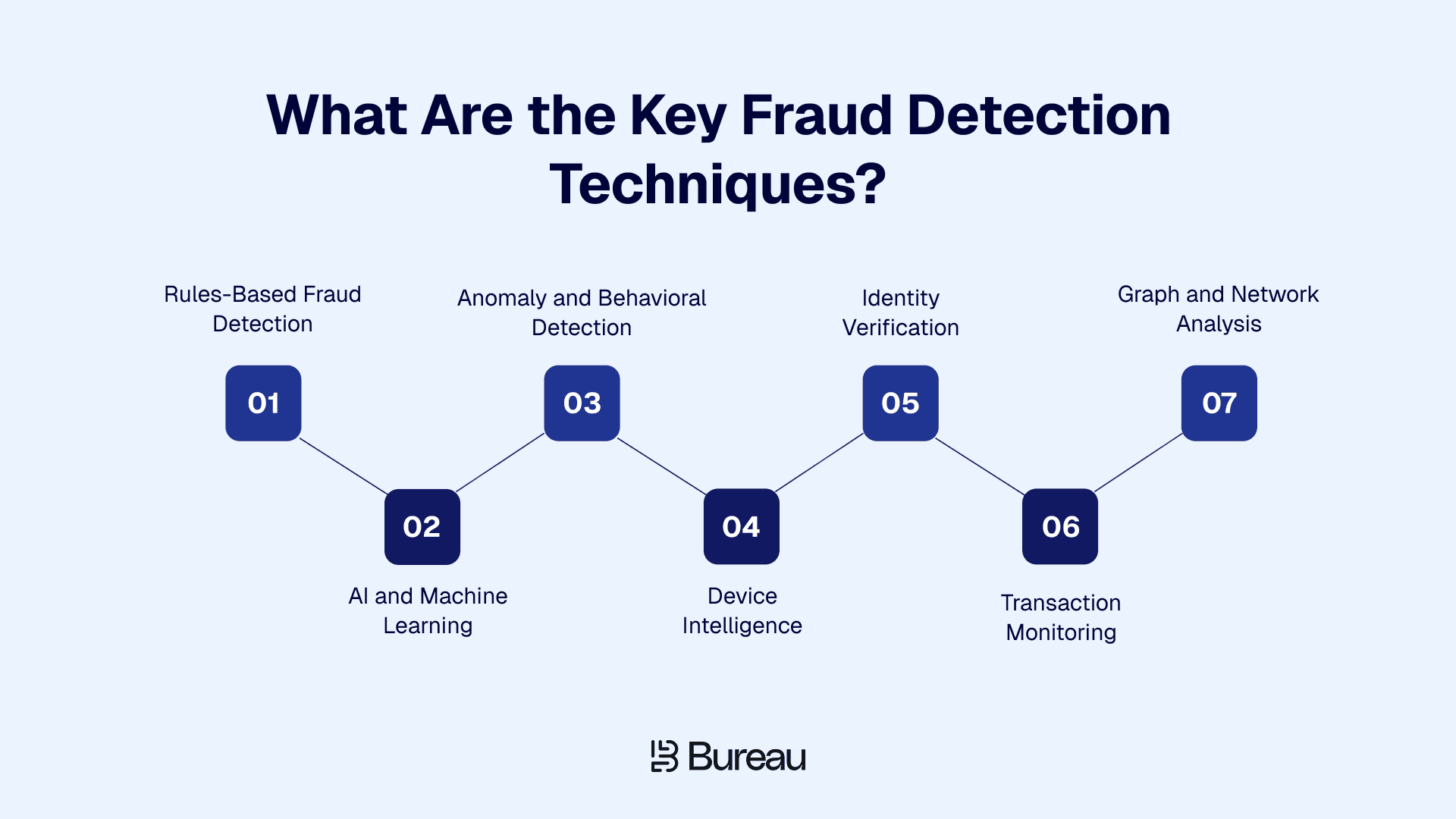
Fraud detection systems typically combine rules with identity, device, behavioral, transaction, and network intelligence to identify both known fraud patterns and suspicious activity that does not match historical behavior.
1. Rules-Based Fraud Detection
Rules-based fraud detection uses predefined conditions to flag activity that matches known risk patterns. For example, a business might flag:
Too many transactions within a short period
Multiple accounts associated with the same device
Repeated identity verification failures
Transactions above an unusual value
High-risk IP and location combinations
Rules are useful when the fraud pattern is understood and can be expressed as a clear condition or threshold. Their limitation is adaptability, because fraudsters can change their behavior to stay below known thresholds, making rules less effective when used alone.
2. AI and Machine Learning
AI and machine learning models analyze large volumes of historical and real-time data to identify patterns that may be difficult to capture through predefined rules.
The WEF's 2026 Global Cybersecurity Outlook found that 77% of organizations surveyed use AI for cybersecurity, including 46% for intrusion and anomaly response and 40% for user-behavior analytics. For fraud teams, this reflects how AI is most useful processing large volumes of signals quickly.
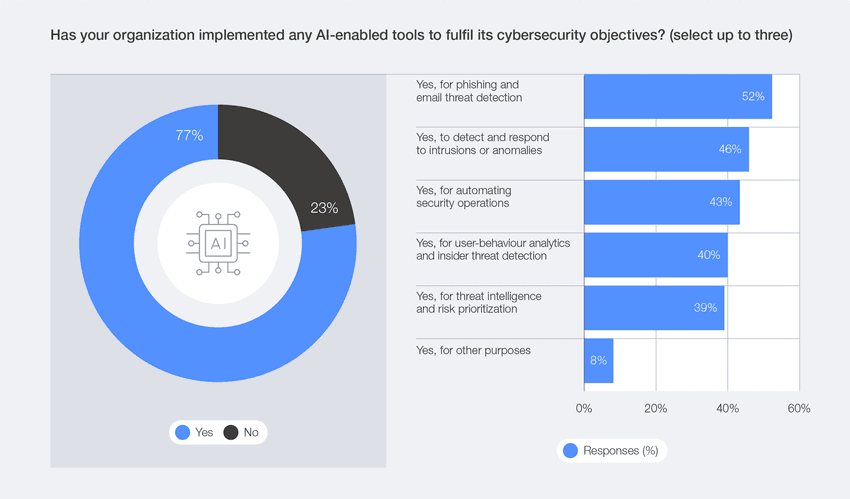
Image Source: WEF's 2026 Global Cybersecurity Outlook
Models can classify activity by risk, recognize relationships between multiple signals, and generate predictive risk scores based on patterns learned from previous outcomes. As confirmed fraud and legitimate activity feed back into the system, models can also become better at recognizing emerging patterns that do not exactly match previously defined attacks.
The value of machine learning depends heavily on the quality of the signals and outcomes used to train and update those models.
3. Anomaly and Behavioral Detection
Anomaly detection looks for activity that deviates from an established baseline, while behavioral analysis examines how a user interacts with a device or application.
Signals can include:
Typing rhythm
Mouse movement
Touchscreen gestures
Navigation patterns
Session behavior
Sudden changes in how an established user interacts with an account
These fraud detection methods become particularly useful when traditional trust signals look valid. A fraudster may have the correct credentials and access a legitimate account, for example, while behaving very differently from its genuine owner.
4. Device Intelligence
Device intelligence evaluates the device and environment behind an interaction to determine whether they carry signs of risk.
A fraud detection system can assess device fingerprints, repeat devices, emulators, VPN or TOR usage, spoofing attempts, device tampering, and relationships between a device and multiple accounts.
Persistent device identification is particularly useful for detecting repeat offenders. Changing an email address, phone number, or account does not necessarily make a fraudster a new user if the underlying device can still be recognized.
5. Identity Verification
Identity verification assesses whether a user is genuinely who they claim to be. Depending on the use case, this can include document verification, facial matching, liveness checks, identity data validation, and KYC or KYB checks.
These controls are particularly important during onboarding and other high-risk identity events. However, a successful identity check does not establish that every subsequent interaction is trustworthy.
Combining identity verification with device and behavioral signals provides additional context around who is completing the verification and how they are interacting with the platform.
6. Transaction Monitoring
Transaction monitoring continuously evaluates financial activity for patterns that may indicate fraud or financial crime. A fraud monitoring system may assess:
transaction velocity
unusual amounts
new beneficiaries
location changes
sudden withdrawals
rapid movement of funds
activity inconsistent with the user's previous transaction history
Risk can change after onboarding. For instance, a customer who passed identity checks can later have their account compromised, become involved in mule activity, or begin exhibiting transaction patterns that require intervention.
7. Graph and Network Analysis
Graph and network analysis detects fraud by examining relationships between entities rather than evaluating each account or transaction independently.
It can connect identities, accounts, devices, phone numbers, emails, transactions, and beneficiaries to reveal shared infrastructure or coordinated activity. These relationships can expose mule networks, fraud rings, repeat offenders, and other attacks where individual accounts appear legitimate when viewed alone.
Bureau's Graph Identity Network applies this approach by connecting identities, devices, behaviors, accounts, and transactions. This gives risk teams visibility into coordinated fraud patterns that may remain hidden when each event is scored independently.
5 Fraud Prevention Strategies and Best Practices
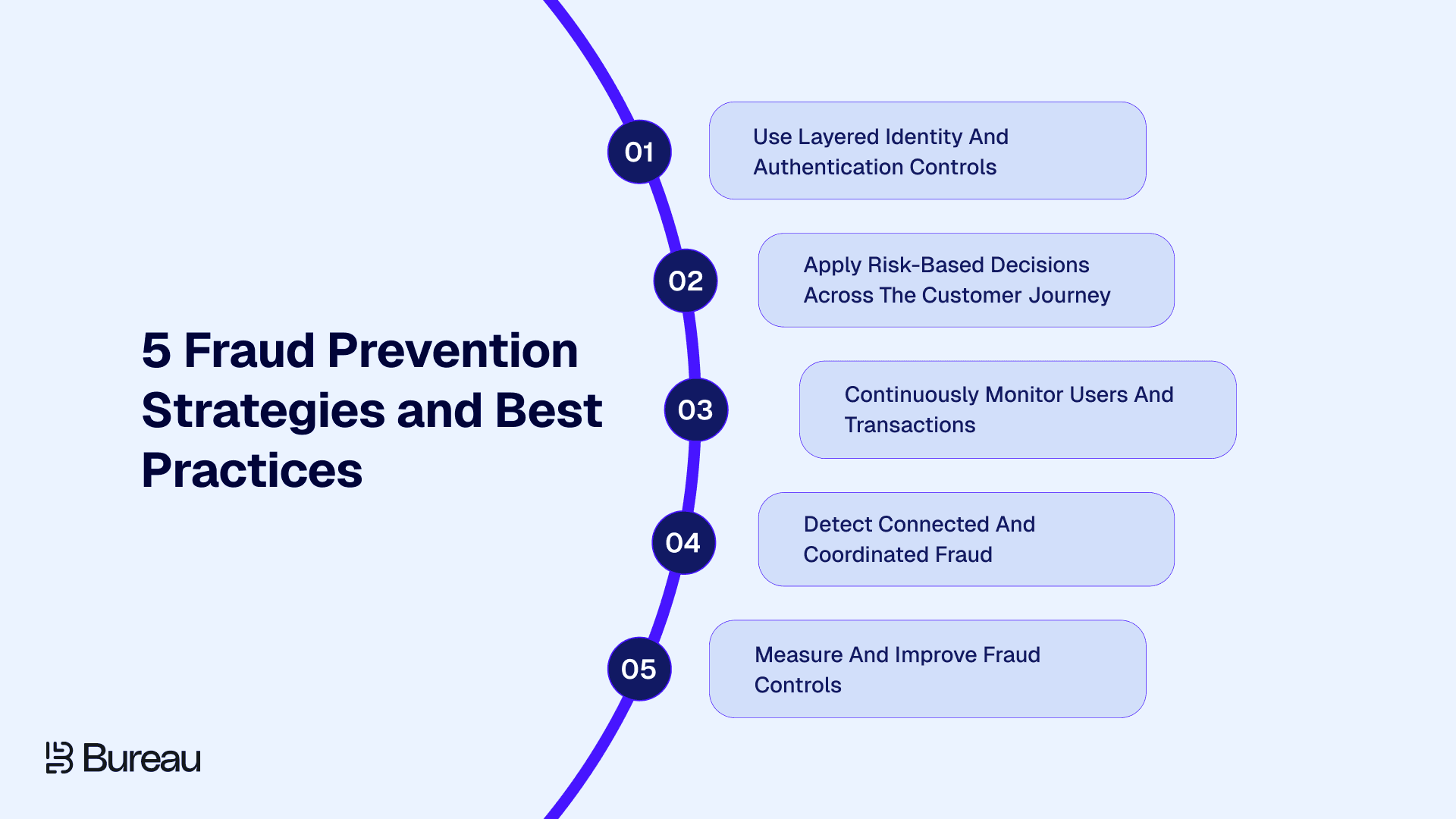
Effective fraud prevention is about deciding what to do once risk is identified. The following fraud prevention strategies help businesses turn risk signals into proportionate actions while limiting unnecessary friction for genuine users.
1. Use Layered Identity and Authentication Controls
Avoid making a single control, such as a password or MFA challenge, responsible for establishing trust. Fraudsters may have valid credentials, intercept authentication codes, or manipulate individual verification steps.
Verizon’s 2025 DBIR found that credential abuse accounted for 22% of known initial access vectors in breaches, making it the most common entry point analyzed.
A layered approach can combine identity verification, device recognition, password-less authentication, MFA, liveness checks, and step-up verification.
The controls applied should reflect the risk of the action: changing a password or adding a new beneficiary, for example, may warrant stronger verification than routine activity from a trusted user.
2. Apply Risk-Based Decisions Across the Customer Journey
Fraud prevention should extend across the customer lifecycle:
Onboarding → Login → Account recovery → Transactions → Withdrawals → Ongoing activity
Instead of applying the same controls to every interaction, businesses can match the response to the level of risk:
Low risk: Allow
Medium risk: Monitor or step up verification
High risk: Review or restrict
Critical risk: Reject or block
This gives higher-risk activity more scrutiny without forcing trusted users through unnecessary verification.
3. Continuously Monitor Users and Transactions
Passing onboarding or authentication should not make an account permanently trusted. Risk can change as user behavior, devices, locations, account activity, transaction patterns, and beneficiary relationships change.
Continuous fraud monitoring allows businesses to reassess risk as these changes occur and intervene when previously normal activity becomes suspicious.
4. Detect Connected and Coordinated Fraud
Fraud prevention strategies should account for relationships between users and events, not just the risk of an individual account or transaction.
Shared devices, linked identities, mule networks, coordinated transaction patterns, repeat offenders, and fraud rings can reveal risk that isolated reviews miss. Once these connections are identified, teams can respond to the wider network rather than repeatedly blocking individual accounts.
5. Measure and Improve Fraud Controls
Fraud controls need to improve as attack patterns and customer behavior change. Teams should track metrics such as:
Fraud loss rate
Detection rate
False-positive and false-negative rates
Approval rate
Manual-review rate
Customer friction
Alert-to-action time
Bureau’s 2026 India Fraud Report found that 58% of surveyed organizations identified higher false positives as their primary risk, highlighting the operational cost of controls that flag too much legitimate activity.
Confirmed fraud, false positives, and genuine-user outcomes should then feed back into rules, thresholds, workflows, and models. This creates a feedback loop where fraud prevention systems improve based on what actually happened, rather than relying indefinitely on the assumptions they started with.
Related Read: 6 Strategies Modern Platforms Use to Stop ATO Attacks
What Should a Modern Fraud Detection and Prevention System Include?
A modern fraud detection and prevention system should do more than generate alerts. It should collect relevant signals, assess risk in context, make or support decisions, trigger the appropriate intervention, and learn from confirmed outcomes.
When evaluating a fraud prevention solution, these are the core capabilities to look for:
Capability | Why It Matters |
Real-time fraud monitoring | Detects and responds to suspicious activity while it is happening |
Identity intelligence | Helps establish whether a user is genuine and whether identity signals are consistent |
Device intelligence | Identifies risky, spoofed, manipulated, or repeat devices |
Behavioral analytics | Detects unusual behavior even when credentials and identity details appear valid |
AI and machine learning | Identifies complex patterns and adapts detection to emerging fraud behaviors |
Transaction monitoring | Detects suspicious financial activity throughout the customer lifecycle |
Graph and network intelligence | Finds relationships between linked accounts, fraud rings, and mule networks |
Rules and workflow orchestration | Converts risk signals into actions such as allow, verify, review, restrict, or block |
Explainable risk scoring | Shows analysts which signals contributed to a risk decision |
Feedback loops | Uses confirmed outcomes to improve models, rules, and thresholds |
API and SDK flexibility | Extends fraud controls across onboarding, login, transactions, and other customer touchpoints |
The strongest fraud prevention systems bring these signals and decisions together. In fact, Bureau’s UK & EU Fraud Report found that 67% of surveyed organizations said siloed systems prevent them from correlating early fraud signals.
When identity, device, behavioral, and transaction risk sit across disconnected tools, teams have to reconstruct the context themselves. Connecting them within the decisioning layer makes it easier to understand the broader risk and act while the interaction is still in progress.
How Bureau Supports Fraud Detection and Prevention
Bureau is an AI-powered unified risk decisioning platform that brings device, behavioral, identity, network, and transaction signals into a single decisioning layer. As a result, this allows risk teams to evaluate signals in context and act on them across onboarding, authentication, and transaction monitoring, enabling them to move from account-level defense to network-level intelligence.
Key capabilities include:
Unified risk signals: Bureau connects identity, device, behavioral, network, and transaction intelligence so risk can be evaluated using the broader context of an interaction.
Real-time decisioning: Risk signals can be translated into actions such as allow, verify, review, limit, or reject while an interaction is taking place.
Device intelligence: Bureau's Device ID uses persistent device identification to surface repeat devices, spoofing attempts, emulators, suspicious device environments, and multiple accounts associated with the same device.
Behavioral biometrics: Behavioral Biometrics evaluates how users interact with their devices to identify anomalous sessions, compromised accounts, bots, automated scripts, and fraud-farm activity.
Graph intelligence: Bureau's Graph Identity Network connects identities, devices, accounts, behaviors, and transactions to uncover relationships associated with fraud rings and mule activity.
Workflow orchestration: Risk teams can configure rules, thresholds, approval logic, and fraud workflows through a single orchestration layer, reducing the need to manage decision logic across separate point systems.
Explainable decisions: Risk scores include the signals and context contributing to the decision, giving fraud teams more information to investigate alerts, tune controls, and support audit trails.
Effective fraud detection and prevention ultimately depends on how quickly a business can move from identifying risk to taking the appropriate action.
Connecting these signals within one decisioning layer helps teams intervene based on the level of risk without adding the same friction to every genuine user.
Move Toward Continuous Fraud Prevention
By the time a risky account, device, or transaction is investigated in isolation, the attacker may already have moved to the next step.
The priority is to assess whether the existing fraud stack can connect identity, device, behavioral, network, and transaction risk in real time, and turn that context into the right decision without adding unnecessary friction for genuine users.
Bureau helps fraud and risk teams connect these signals through a unified risk decisioning platform. Teams can evaluate risk across onboarding, authentication, and transactions, configure proportionate responses, and investigate suspicious activity with the context behind each decision.
If disconnected signals or slow intervention are creating gaps in the fraud prevention strategy, schedule a demo with Bureau to see how connected, real-time risk decisioning can fit into existing workflows.
FAQs
1. What is fraud detection and prevention?
Fraud detection and prevention is the process of identifying suspicious activity and taking action before it causes harm. Detection identifies risk using rules, analytics, behavioral signals, and monitoring, while prevention applies controls such as verification, review, restriction, or blocking.
2. What is the difference between fraud detection and fraud prevention?
Fraud detection identifies suspicious activity, anomalies, and risk patterns. Fraud prevention determines how to respond to that risk through actions such as authentication, step-up verification, transaction limits, manual review, account restrictions, or automated blocking.
3. How does a fraud detection system work?
A fraud detection system collects signals from users, devices, accounts, sessions, and transactions, analyzes them for known or unusual patterns, calculates risk, and triggers an alert or decision. Confirmed outcomes can then improve future rules, thresholds, and models.
4. What are the most common fraud detection methods?
Common fraud detection methods include rules-based detection, AI and machine learning, behavioral analytics, device intelligence, identity verification, transaction monitoring, and graph analysis. Fraud detection systems typically combine several methods because individual techniques provide only part of the risk context.
5. How is AI used in fraud detection and prevention?
AI helps fraud detection systems recognize complex patterns, classify activity by risk, identify anomalies, and generate predictive risk scores across large datasets. Effective prevention still depends on reliable signals, appropriate controls, workflows, feedback loops, and human oversight for higher-risk decisions.
6. How can businesses reduce false positives in fraud detection?
Businesses can reduce false positives by combining multiple risk signals, establishing behavioral baselines, applying segment-specific thresholds, and using risk-based decisions instead of broad rules. Confirmed fraud and legitimate-user outcomes should continuously feed back into detection models and fraud workflows.
Fraud can begin with a synthetic identity during onboarding, surface as account takeover at login, or appear later through suspicious transactions, withdrawals, and account recovery attempts.
Because fraud can take so many forms, individual events like stolen identities, compromised credentials, or manipulated devices rarely look suspicious in isolation and cannot be reliably evaluated using one-time checks or standalone rules.
Effective fraud detection and prevention depends on connecting signals across the customer journey, identifying risk as it develops, and taking the right action before suspicious activity turns into a loss.
What Is Fraud Detection and Prevention?
Fraud detection and prevention is the combined process of identifying suspicious activity and acting on it before it causes financial, operational, or customer harm.
What Is Fraud Detection?
Fraud detection is the process of identifying activity that may indicate fraud across users, accounts, devices, sessions, and transactions.
A fraud detection system evaluates multiple signals to surface potential risk, including:
Known fraud patterns and historical attack behaviors
Device and session signals (e.g., IP changes, device fingerprint anomalies)
Unusual transaction activity such as spikes, velocity changes, or atypical amounts
Shifts in user behavior that deviate from established baselines
These inputs are combined to generate risk scores, alerts, or automated decisions that help teams determine whether an interaction requires further action.
Increasingly, fraud detection happens while the activity is still in progress. Real-time fraud monitoring enables teams to intervene during a suspicious login, account change, or transaction, rather than discovering fraud only after a loss has already occurred.
What Is Fraud Prevention?
Fraud prevention refers to the controls and actions used to stop, restrict, or reduce fraudulent activity once risk has been identified.
Depending on the level and type of risk, the response may vary based on severity and context. Common fraud prevention actions include:
Identity verification
Authentication
Device checks
Transaction limits
Step-up verification
Account restrictions
Manual review
Automated blocking
The effectiveness of any fraud prevention strategy, therefore, depends on the quality of the detection behind it. Before a system can decide whether to allow, challenge, review, or block an action, it needs enough context to understand the risk accurately.
Fraud detection and fraud prevention serve different roles within the same risk process:
Fraud Detection | Fraud Prevention |
Identifies suspicious activity | Acts on identified risk |
Focuses on signals, anomalies, and patterns | Focuses on verification, controls, and intervention |
Produces alerts, scores, or risk indicators | Produces actions such as allow, verify, review, limit, or block |
Can operate before, during, or after an event | Primarily acts before or during a fraudulent event |
In simple words, fraud detection identifies the risk, while fraud prevention determines what should happen next.
What Types of Fraud Should Businesses Detect and Prevent?
The MRC’s 2026 Global eCommerce Payments and Fraud Report found that merchants encountered an average of 3.7 different types of fraud attacks in 2025, reinforcing why fraud controls need to account for multiple attack patterns rather than a single dominant threat.
Common fraud types businesses need to detect and prevent include:
Identity and synthetic identity fraud: Fraudsters may use stolen identity data, fabricated profiles, forged documents, manipulated information, or deepfake-assisted verification attempts to pass onboarding checks.
Account takeover and credential fraud: Stolen passwords, credential stuffing, phishing, SIM swaps, session hijacking, and account recovery abuse can give attackers control of legitimate customer accounts.
Payment and transaction fraud: This includes unauthorized transactions, card-not-present fraud, suspicious transfers, refund and chargeback abuse, and misuse of payment instruments.
Social engineering fraud: Phishing, vishing, impersonation, and customer-support manipulation can convince genuine users or employees to disclose information or authorize fraudulent actions.
Bot and automated fraud: Bots and headless browsers can scale fake account creation, credential testing, card testing, promo abuse, scraping, and other repetitive attacks.
Fraud rings and mule activity: Coordinated networks may connect multiple accounts, identities, devices, beneficiaries, and transactions. Individual accounts can appear legitimate even when the broader network indicates organized fraud.
Mobile and app-based fraud: Fraudsters can manipulate the environment in which an app runs through device spoofing, app cloning, malware, rooted or jailbroken devices, location spoofing, session attacks, and other runtime manipulation.
Because these fraud types often overlap, effective fraud monitoring needs visibility across identity, account, device, session, and transaction activity rather than treating each event as a separate risk.
What Are the Key Fraud Detection Techniques?
Fraud detection systems typically combine rules with identity, device, behavioral, transaction, and network intelligence to identify both known fraud patterns and suspicious activity that does not match historical behavior.
1. Rules-Based Fraud Detection
Rules-based fraud detection uses predefined conditions to flag activity that matches known risk patterns. For example, a business might flag:
Too many transactions within a short period
Multiple accounts associated with the same device
Repeated identity verification failures
Transactions above an unusual value
High-risk IP and location combinations
Rules are useful when the fraud pattern is understood and can be expressed as a clear condition or threshold. Their limitation is adaptability, because fraudsters can change their behavior to stay below known thresholds, making rules less effective when used alone.
2. AI and Machine Learning
AI and machine learning models analyze large volumes of historical and real-time data to identify patterns that may be difficult to capture through predefined rules.
The WEF's 2026 Global Cybersecurity Outlook found that 77% of organizations surveyed use AI for cybersecurity, including 46% for intrusion and anomaly response and 40% for user-behavior analytics. For fraud teams, this reflects how AI is most useful processing large volumes of signals quickly.
Image Source: WEF's 2026 Global Cybersecurity Outlook
Models can classify activity by risk, recognize relationships between multiple signals, and generate predictive risk scores based on patterns learned from previous outcomes. As confirmed fraud and legitimate activity feed back into the system, models can also become better at recognizing emerging patterns that do not exactly match previously defined attacks.
The value of machine learning depends heavily on the quality of the signals and outcomes used to train and update those models.
3. Anomaly and Behavioral Detection
Anomaly detection looks for activity that deviates from an established baseline, while behavioral analysis examines how a user interacts with a device or application.
Signals can include:
Typing rhythm
Mouse movement
Touchscreen gestures
Navigation patterns
Session behavior
Sudden changes in how an established user interacts with an account
These fraud detection methods become particularly useful when traditional trust signals look valid. A fraudster may have the correct credentials and access a legitimate account, for example, while behaving very differently from its genuine owner.
4. Device Intelligence
Device intelligence evaluates the device and environment behind an interaction to determine whether they carry signs of risk.
A fraud detection system can assess device fingerprints, repeat devices, emulators, VPN or TOR usage, spoofing attempts, device tampering, and relationships between a device and multiple accounts.
Persistent device identification is particularly useful for detecting repeat offenders. Changing an email address, phone number, or account does not necessarily make a fraudster a new user if the underlying device can still be recognized.
5. Identity Verification
Identity verification assesses whether a user is genuinely who they claim to be. Depending on the use case, this can include document verification, facial matching, liveness checks, identity data validation, and KYC or KYB checks.
These controls are particularly important during onboarding and other high-risk identity events. However, a successful identity check does not establish that every subsequent interaction is trustworthy.
Combining identity verification with device and behavioral signals provides additional context around who is completing the verification and how they are interacting with the platform.
6. Transaction Monitoring
Transaction monitoring continuously evaluates financial activity for patterns that may indicate fraud or financial crime. A fraud monitoring system may assess:
transaction velocity
unusual amounts
new beneficiaries
location changes
sudden withdrawals
rapid movement of funds
activity inconsistent with the user's previous transaction history
Risk can change after onboarding. For instance, a customer who passed identity checks can later have their account compromised, become involved in mule activity, or begin exhibiting transaction patterns that require intervention.
7. Graph and Network Analysis
Graph and network analysis detects fraud by examining relationships between entities rather than evaluating each account or transaction independently.
It can connect identities, accounts, devices, phone numbers, emails, transactions, and beneficiaries to reveal shared infrastructure or coordinated activity. These relationships can expose mule networks, fraud rings, repeat offenders, and other attacks where individual accounts appear legitimate when viewed alone.
Bureau's Graph Identity Network applies this approach by connecting identities, devices, behaviors, accounts, and transactions. This gives risk teams visibility into coordinated fraud patterns that may remain hidden when each event is scored independently.
5 Fraud Prevention Strategies and Best Practices
Effective fraud prevention is about deciding what to do once risk is identified. The following fraud prevention strategies help businesses turn risk signals into proportionate actions while limiting unnecessary friction for genuine users.
1. Use Layered Identity and Authentication Controls
Avoid making a single control, such as a password or MFA challenge, responsible for establishing trust. Fraudsters may have valid credentials, intercept authentication codes, or manipulate individual verification steps.
Verizon’s 2025 DBIR found that credential abuse accounted for 22% of known initial access vectors in breaches, making it the most common entry point analyzed.
A layered approach can combine identity verification, device recognition, password-less authentication, MFA, liveness checks, and step-up verification.
The controls applied should reflect the risk of the action: changing a password or adding a new beneficiary, for example, may warrant stronger verification than routine activity from a trusted user.
2. Apply Risk-Based Decisions Across the Customer Journey
Fraud prevention should extend across the customer lifecycle:
Onboarding → Login → Account recovery → Transactions → Withdrawals → Ongoing activity
Instead of applying the same controls to every interaction, businesses can match the response to the level of risk:
Low risk: Allow
Medium risk: Monitor or step up verification
High risk: Review or restrict
Critical risk: Reject or block
This gives higher-risk activity more scrutiny without forcing trusted users through unnecessary verification.
3. Continuously Monitor Users and Transactions
Passing onboarding or authentication should not make an account permanently trusted. Risk can change as user behavior, devices, locations, account activity, transaction patterns, and beneficiary relationships change.
Continuous fraud monitoring allows businesses to reassess risk as these changes occur and intervene when previously normal activity becomes suspicious.
4. Detect Connected and Coordinated Fraud
Fraud prevention strategies should account for relationships between users and events, not just the risk of an individual account or transaction.
Shared devices, linked identities, mule networks, coordinated transaction patterns, repeat offenders, and fraud rings can reveal risk that isolated reviews miss. Once these connections are identified, teams can respond to the wider network rather than repeatedly blocking individual accounts.
5. Measure and Improve Fraud Controls
Fraud controls need to improve as attack patterns and customer behavior change. Teams should track metrics such as:
Fraud loss rate
Detection rate
False-positive and false-negative rates
Approval rate
Manual-review rate
Customer friction
Alert-to-action time
Bureau’s 2026 India Fraud Report found that 58% of surveyed organizations identified higher false positives as their primary risk, highlighting the operational cost of controls that flag too much legitimate activity.
Confirmed fraud, false positives, and genuine-user outcomes should then feed back into rules, thresholds, workflows, and models. This creates a feedback loop where fraud prevention systems improve based on what actually happened, rather than relying indefinitely on the assumptions they started with.
Related Read: 6 Strategies Modern Platforms Use to Stop ATO Attacks
What Should a Modern Fraud Detection and Prevention System Include?
A modern fraud detection and prevention system should do more than generate alerts. It should collect relevant signals, assess risk in context, make or support decisions, trigger the appropriate intervention, and learn from confirmed outcomes.
When evaluating a fraud prevention solution, these are the core capabilities to look for:
Capability | Why It Matters |
Real-time fraud monitoring | Detects and responds to suspicious activity while it is happening |
Identity intelligence | Helps establish whether a user is genuine and whether identity signals are consistent |
Device intelligence | Identifies risky, spoofed, manipulated, or repeat devices |
Behavioral analytics | Detects unusual behavior even when credentials and identity details appear valid |
AI and machine learning | Identifies complex patterns and adapts detection to emerging fraud behaviors |
Transaction monitoring | Detects suspicious financial activity throughout the customer lifecycle |
Graph and network intelligence | Finds relationships between linked accounts, fraud rings, and mule networks |
Rules and workflow orchestration | Converts risk signals into actions such as allow, verify, review, restrict, or block |
Explainable risk scoring | Shows analysts which signals contributed to a risk decision |
Feedback loops | Uses confirmed outcomes to improve models, rules, and thresholds |
API and SDK flexibility | Extends fraud controls across onboarding, login, transactions, and other customer touchpoints |
The strongest fraud prevention systems bring these signals and decisions together. In fact, Bureau’s UK & EU Fraud Report found that 67% of surveyed organizations said siloed systems prevent them from correlating early fraud signals.
When identity, device, behavioral, and transaction risk sit across disconnected tools, teams have to reconstruct the context themselves. Connecting them within the decisioning layer makes it easier to understand the broader risk and act while the interaction is still in progress.
How Bureau Supports Fraud Detection and Prevention
Bureau is an AI-powered unified risk decisioning platform that brings device, behavioral, identity, network, and transaction signals into a single decisioning layer. As a result, this allows risk teams to evaluate signals in context and act on them across onboarding, authentication, and transaction monitoring, enabling them to move from account-level defense to network-level intelligence.
Key capabilities include:
Unified risk signals: Bureau connects identity, device, behavioral, network, and transaction intelligence so risk can be evaluated using the broader context of an interaction.
Real-time decisioning: Risk signals can be translated into actions such as allow, verify, review, limit, or reject while an interaction is taking place.
Device intelligence: Bureau's Device ID uses persistent device identification to surface repeat devices, spoofing attempts, emulators, suspicious device environments, and multiple accounts associated with the same device.
Behavioral biometrics: Behavioral Biometrics evaluates how users interact with their devices to identify anomalous sessions, compromised accounts, bots, automated scripts, and fraud-farm activity.
Graph intelligence: Bureau's Graph Identity Network connects identities, devices, accounts, behaviors, and transactions to uncover relationships associated with fraud rings and mule activity.
Workflow orchestration: Risk teams can configure rules, thresholds, approval logic, and fraud workflows through a single orchestration layer, reducing the need to manage decision logic across separate point systems.
Explainable decisions: Risk scores include the signals and context contributing to the decision, giving fraud teams more information to investigate alerts, tune controls, and support audit trails.
Effective fraud detection and prevention ultimately depends on how quickly a business can move from identifying risk to taking the appropriate action.
Connecting these signals within one decisioning layer helps teams intervene based on the level of risk without adding the same friction to every genuine user.
Move Toward Continuous Fraud Prevention
By the time a risky account, device, or transaction is investigated in isolation, the attacker may already have moved to the next step.
The priority is to assess whether the existing fraud stack can connect identity, device, behavioral, network, and transaction risk in real time, and turn that context into the right decision without adding unnecessary friction for genuine users.
Bureau helps fraud and risk teams connect these signals through a unified risk decisioning platform. Teams can evaluate risk across onboarding, authentication, and transactions, configure proportionate responses, and investigate suspicious activity with the context behind each decision.
If disconnected signals or slow intervention are creating gaps in the fraud prevention strategy, schedule a demo with Bureau to see how connected, real-time risk decisioning can fit into existing workflows.
FAQs
1. What is fraud detection and prevention?
Fraud detection and prevention is the process of identifying suspicious activity and taking action before it causes harm. Detection identifies risk using rules, analytics, behavioral signals, and monitoring, while prevention applies controls such as verification, review, restriction, or blocking.
2. What is the difference between fraud detection and fraud prevention?
Fraud detection identifies suspicious activity, anomalies, and risk patterns. Fraud prevention determines how to respond to that risk through actions such as authentication, step-up verification, transaction limits, manual review, account restrictions, or automated blocking.
3. How does a fraud detection system work?
A fraud detection system collects signals from users, devices, accounts, sessions, and transactions, analyzes them for known or unusual patterns, calculates risk, and triggers an alert or decision. Confirmed outcomes can then improve future rules, thresholds, and models.
4. What are the most common fraud detection methods?
Common fraud detection methods include rules-based detection, AI and machine learning, behavioral analytics, device intelligence, identity verification, transaction monitoring, and graph analysis. Fraud detection systems typically combine several methods because individual techniques provide only part of the risk context.
5. How is AI used in fraud detection and prevention?
AI helps fraud detection systems recognize complex patterns, classify activity by risk, identify anomalies, and generate predictive risk scores across large datasets. Effective prevention still depends on reliable signals, appropriate controls, workflows, feedback loops, and human oversight for higher-risk decisions.
6. How can businesses reduce false positives in fraud detection?
Businesses can reduce false positives by combining multiple risk signals, establishing behavioral baselines, applying segment-specific thresholds, and using risk-based decisions instead of broad rules. Confirmed fraud and legitimate-user outcomes should continuously feed back into detection models and fraud workflows.
TABLE OF CONTENTS
See More
Recommended Blogs



Landing Page.
Simple, bold.
Sign Up
Download

Products
Solutions


© 2026 Bureau . All rights reserved.
Solutions
Industries
Resources
Company
Solutions
Industries
Resources
Company
© 2026 Bureau . All rights reserved.
Follow Us
Leave behind fragmented tools. Stop fraud rings, cut false declines, and deliver secure digital journeys at scale
Our Presence








Leave behind fragmented tools. Stop fraud rings, cut false declines, and deliver secure digital journeys at scale
Our Presence
© 2026 Bureau . All rights reserved.