How Authorized Push Payment Fraud Works and How to Prevent It
How Authorized Push Payment Fraud Works and How to Prevent It
How Authorized Push Payment Fraud Works and How to Prevent It
Learn how authorized push payment fraud works, why real-time payments increase risk, and how banks detect scams, mule accounts, and risky payees.
Author
Team Bureau


See how Bureau has helped industry leaders defend against networked Industrial-scale frauds →
Schedule a Demo
TABLE OF CONTENTS
See Less
Authorized push payment fraud can drain customer funds in minutes, even when every login, authentication step, and payment approval appears legitimate.
In one FOS UK case, a caller impersonating a bank employee appeared to use the bank’s phone number and persuaded the victim to transfer £9,225 to a “safe account.” Following the caller’s instructions, she ignored the payment warnings and only discovered the fraud the next day.
APP fraud is difficult to detect because the customer authorizes the transfer while acting under deception or pressure. By the time the scam is discovered, the funds may be unrecoverable. Detection must therefore extend beyond authentication to assess customer behavior, recipient risk, mule-network links, and fund movement in real time.
What Is Authorized Push Payment Fraud and How Does It Work?
Authorized push payment fraud occurs when a fraudster manipulates a legitimate account holder into approving a transfer to a fraud-controlled or mule account. Because the customer authorizes the payment, APP fraud can appear legitimate to standard controls. Fraudsters might obtain approval through impersonation, deception, social engineering, or account manipulation.
Most APP fraud follows a similar sequence:
The fraudster approaches the victim: The contact may begin through a phishing message, phone call, social media conversation, fake marketplace listing, compromised email account, or impersonation of a trusted organization.
The fraudster creates urgency or credibility: The victim may be told that their account is at risk, an invoice must be paid immediately, an investment opportunity is about to close, or a trusted contact has changed their bank details.
The victim initiates the payment: The genuine customer logs in and approves the transfer using their own credentials and authentication method. This is what separates APP fraud from unauthorized transaction fraud.
The transaction passes familiar checks: The payment may come from a recognized device, authenticated session, and legitimate account. Credential checks and static transaction rules may therefore see little reason to intervene.
The money reaches a mule or fraud-controlled account: The recipient may be a newly opened account, a compromised account, or part of a wider money-mule network.
The funds move again: Fraudsters may split, withdraw, or transfer the money through several connected accounts before the victim or financial institution recognizes the scam.
At each step, the payment can still appear legitimate because the customer initiated it through a valid account and authenticated session. Real-time payment systems make that detection challenge harder by reducing the time available to act.
Related Read: How Businesses Detect and Prevent Payment Fraud
Why Do Real-Time Payments Increase APP Fraud Risk?
Real-time payments make funds available to the recipient almost immediately, and that limits opportunities for recalls, manual review, and receiving-bank intervention.
Their continuous availability also allows scam payments to move outside traditional banking hours, while investigations may still depend on manual escalation. Faster Payments, FedNow, Pix, and Zelle are examples of this shift toward immediate account-to-account transfers.
Here’s why common payment controls can still miss APP fraud:
Traditional control | What it confirms | Why the gap remains |
Password or biometric login | The account holder has authenticated | The genuine user may still be manipulated |
MFA or OTP | The payer approved the session or action | Approval does not confirm informed intent |
Transaction limit | The payment is within a defined threshold | Fraudsters may coach victims to stay below limits |
New-payee warning | The recipient is unfamiliar | Generic warnings may be ignored |
Confirmation of Payee | The name and account details correspond | A correctly named account may still be a mule |
These controls still play an important role, but each addresses only one part of the payment risk. Authorized push payment fraud becomes harder to detect when authorization, recipient legitimacy, and payment intent are evaluated separately.
What Are the Most Common Types of APP Fraud?
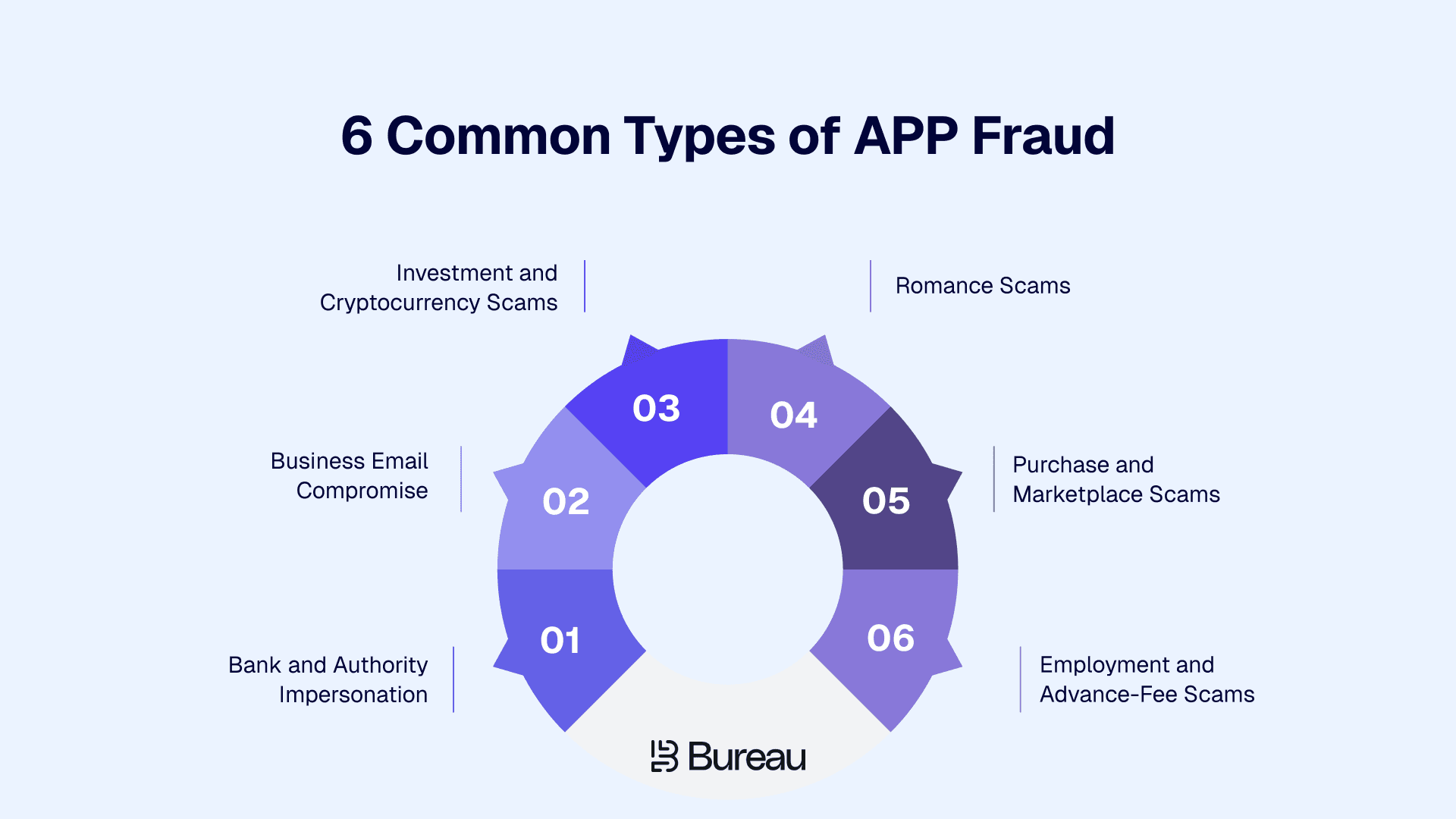
The most common forms of authorized push payment fraud include impersonation, invoice redirection, investment, romance, purchase, and employment scams. Each relies on the victim approving the payment, but the differences lie in how fraudsters build trust, create urgency, and justify the transfer.
Recognizing these methods helps fraud teams identify where manipulation may be influencing the payment.
1. Bank and Authority Impersonation Scams
Fraudsters may impersonate banks, regulators, law enforcement agencies, tax authorities, or government departments. They often claim that an account has been compromised and instruct the victim to move money into a “safe” or “secure” account.
Caller ID spoofing, cloned websites, official-looking messages, and urgent phone calls make the request appear credible. Some fraudsters also coach victims to ignore warnings or mislead bank employees if the transfer is questioned.
The Hong Kong Police Force reported 4,440 cases involving customer-service impersonation, making this the most common type of fraud in the region. Unusual hesitation, repeated app switching, or copied payment details may indicate that the customer is being directed.
2. Business Email Compromise and Invoice Redirection
Business email compromise involves criminals impersonating executives, suppliers, employees, or business partners. They may:
Spoof a domain
Compromise a genuine inbox
Alter an invoice
Request an urgent change to bank details
For example, an accounts-payable employee may receive what appears to be a legitimate supplier email. The invoice and contact name could look familiar, but the beneficiary may have changed.
Europol’s 2025 SOCTA identifies business email compromise as a prolific online fraud scheme affecting European organizations. Independent supplier verification, dual approval, payee-risk analysis, and beneficiary-change monitoring can help prevent payment diversion.
3. Investment and Cryptocurrency Scams
Investment scams often begin through social media, messaging apps, online ads, or fake advisers promising guaranteed returns.
For instance, victims may start with a small payment, then send larger amounts after seeing fabricated profits on a fake dashboard. When they try to withdraw, the fraudster may demand additional fees or move the funds into cryptocurrency to speed up transfers and obscure the destination.
UK 2026 Finance’s Annual Fraud Report found that investment fraud caused the highest APP fraud losses in 2025. Losses reached £221.5 million, up 40% year over year, making the UK a major hotspot for investment-related APP fraud.
In these scams, the payments may still match the victim’s stated purpose, which makes intent and recipient-risk analysis especially important.
4. Romance Scams
Romance scams begin with long-term trust building through online dating platforms, social media, or messaging apps.
The fraudster may later request money for medical costs, travel, personal emergencies, or an investment opportunity. Payments often start small and increase over time, and victims may also send money to several recipients or continue paying despite warnings.
Romance scams are a significant fraud category in the US. The FBI’s 2025 Internet Crime Report recorded 23,159 confidence and romance scam complaints, with about $929.3 million in reported losses. The risk in such scams often becomes visible through unfamiliar beneficiaries, repeated transfers, and changes in the customer’s normal payment behavior.
5. Purchase and Marketplace Scams
Purchase scams involve fake goods, rentals, tickets, vehicles, or marketplace listings. Fraudsters create urgency, request deposits, or push buyers outside protected checkout flows.
The seller may use a newly created or mule account and never intend to deliver the product. MRC’s 2026 Global eCommerce Payments & Fraud Report found that North America accounted for 42% of global e-commerce fraud by value.
Effective marketplace fraud prevention combines seller verification, device intelligence, and transaction monitoring.
6. Employment and Advance-Fee Scams
Employment scams use fake job offers, remote-work roles, or task-based schemes to extract fees for equipment, training, or registration.
Some victims are also recruited as money mules and told to receive, convert, or forward payments as part of the role. A 2026 study on employment scams identified Southeast Asia as a major hub linked to scam compounds and labor trafficking.
The narrative may change, but the APP fraud pattern remains similar: build trust, create urgency, direct the payment, and move the funds quickly.
Why Is APP Fraud Difficult for Banks to Detect?
APP fraud is difficult to detect because no single signal reliably identifies it. While the payer may look genuine and the transaction may stay within normal limits, risk becomes clearer only when behavior, recipient activity, account relationships, and fund movement are viewed together.
Banks often see only part of that picture at the moment they need to make a decision, creating control gaps. These include:
Valid customer signals mask the scam: The customer logs in, passes MFA, and approves the transfer from a familiar device. Controls built for account compromise may therefore allow the payment through without escalation.
Manipulation appears as normal activity: Hesitation, copied instructions, or an unfamiliar beneficiary may look harmless in isolation. Without behavioral context, the warning signs can disappear inside an otherwise valid session.
Risk is split across institutions: The sending bank sees payer behavior, while the receiving bank sees recipient inflows and onward movement. Fraud can progress because neither side has the complete pattern in time.
Mule accounts look clean until connected: A recipient may pass KYC and show little suspicious activity on its own. The risk often becomes visible only through shared devices, repeat senders, linked accounts, or rapid transfers.
Simple rules create alert overload: New beneficiaries, large payments, and unusual purchases are common in legitimate activity. Broad thresholds increase false positives and make genuinely high-risk payments harder to prioritize.
Effective APP fraud detection requires payer, payee, behavioral, device, transaction, and network signals to be assessed together. Bureau's unified risk decisioning platform helps institutions evaluate these signals within a single risk decision, giving fraud teams the context to intervene before suspicious payments are completed.
How Do Regulatory Frameworks Address APP Fraud?
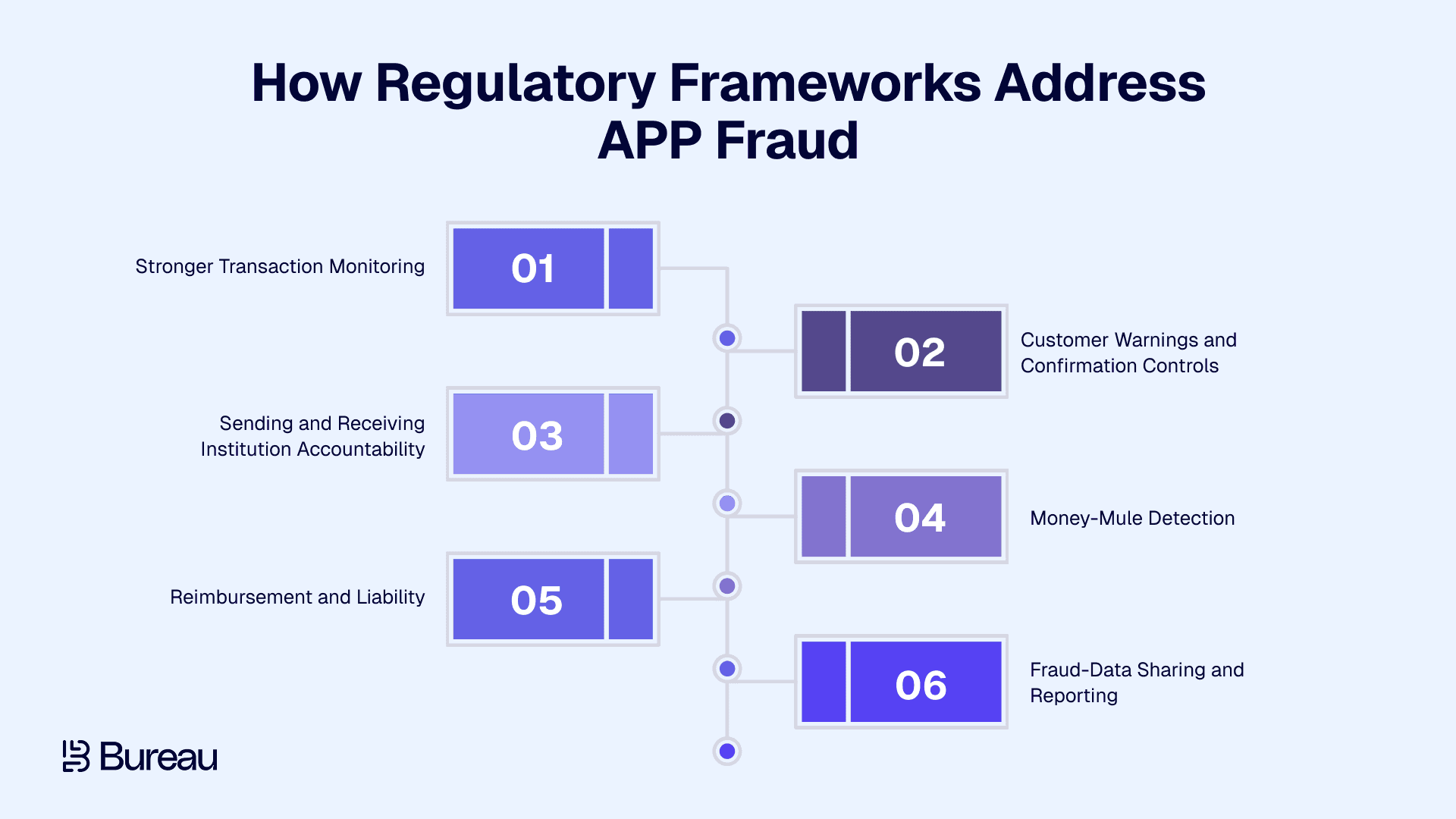
Regulatory frameworks address APP fraud by setting responsibilities across the payment chain. This includes expectations for earlier intervention, stronger recipient monitoring, better fraud-data sharing, and clearer reimbursement duties. The exact requirements vary by jurisdiction, but the practical aim is to reduce the time between detecting risk and acting on it.
1. Stronger Transaction Monitoring
Transaction monitoring assesses payments for signs that they fall outside expected customer or account activity. Providers can compare payment value, beneficiary history, customer behavior, and recipient risk before deciding how to respond.
In India, the RBI's Master Directions on Fraud Risk Management require banks to conduct real-time transaction monitoring for the prevention and detection of potential fraud. Banks must also monitor unusual activity, including activity involving suspected money-mule accounts, and use analytics to identify patterns that may require intervention.
India’s Financial Fraud Risk Indicator helped banks and payment providers prevent INR 660 crore in cyberfraud losses within six months by flagging high-risk mobile numbers during transactions.
2. Customer Warnings and Confirmation Controls
Customer warnings and confirmation controls introduce additional checks when a transfer appears risky. These may include scam-specific prompts, payee-name verification, beneficiary checks, payment holds, or additional review before authorization.
The EU's Instant Payments Regulation requires payment service providers to offer Verification of Payee before a payer authorizes a credit transfer. The service checks whether the payee name provided by the customer matches the account identifier and alerts the payer to discrepancies.
France introduced a similar control through SEPAmail DIAMOND, which verifies the reliability of a payee’s IBAN before a credit transfer. Such controls give customers additional information when a fraudulent payment may still be stopped.
3. Sending and Receiving Institution Accountability
Shared accountability distributes responsibility across both sides of a payment. The sending institution can assess the payer and transaction, while the receiving institution has visibility into the beneficiary account and subsequent activity.
Under the UK's PSR APP scam reimbursement framework, payment providers must reimburse most eligible victims of APP fraud. The reimbursement cost is generally divided 50:50 between the sending and receiving payment providers.
The model gives both institutions a financial reason to strengthen prevention, recipient monitoring, intervention, and recovery.
4. Money-Mule Detection
Money-mule detection identifies accounts used to receive and move scam proceeds. It combines onboarding checks with ongoing analysis of account behavior, linked identities, inbound payment patterns, and rapid transfers or cash-outs.
The Philippines directly addresses mule activity through Republic Act No. 12010, the Anti-Financial Account Scamming Act. The law defines money-muling activities as prohibited financial account scamming, including lending, renting, selling, buying, or allowing the use of financial accounts to move proceeds known to come from crimes or social-engineering schemes.
This act helps in preventing fraud from accounts that may appear legitimate when opened but later be used to receive, transfer, or cash out scam proceeds.
5. Reimbursement and Liability
Reimbursement and liability rules set the conditions under which victims may recover losses. They define eligibility, reporting deadlines, compensation limits, exclusions, and how responsibility is allocated between the institutions involved.
Under the EU’s proposed Payment Services Regulation, providers would refund qualifying losses caused by fraudsters impersonating the provider through apparent official channels. Liability may also arise when failures in payee verification or other required controls contribute to the loss. Prevention quality therefore becomes part of the liability assessment.
The Netherlands already provides a practical example, with major Dutch banks generally reimbursing qualifying bank-impersonation losses under a voluntary framework applied since 2021. Prevention quality therefore becomes part of the liability assessment.
6. Fraud-Data Sharing and Reporting
Fraud-data sharing allows institutions and public agencies to exchange suspicious account details, phone numbers, and confirmed scam indicators. That intelligence can support payment delays, account restrictions, investigations, and faster disruption of connected activity.
Australia's Scams Prevention Framework requires regulated businesses to maintain scam-prevention controls and take reasonable steps to detect, investigate, disrupt, and respond to suspected scams. It also establishes reporting requirements for actionable scam intelligence.
This framework helps organizations share scam intelligence faster, identify connected threats, and act before the same fraud infrastructure is used against more victims.
Taken together, these frameworks are moving APP fraud controls beyond the sending bank. Prevention now depends more on what institutions can see about the recipient, how quickly they can share risk signals, and whether they can intervene before funds move further.
How Can Banks and Payment Providers Prevent APP Fraud?
Banks and payment providers can prevent APP fraud by matching the response to the level of risk. Low-risk payments can proceed normally, while higher-risk activity may require warnings, step-up checks, payment holds, or investigation.
Here’s how banks can identify risk levels.
Risk level | What the bank may see | Appropriate response |
Low risk | Familiar device, known payee, normal payment behavior | Allow the payment with standard monitoring |
Medium risk | New payee, unusual amount, behavioral changes, or weaker recipient signals | Show a targeted warning or trigger step-up verification |
High risk | Multiple risk signals, suspected mule links, major behavioral deviation, or suspicious fund movement | Hold or delay the payment and escalate for investigation |
The specific controls will vary by institution, but the following measures show how those responses can be applied in practice:
Assess risk early: Strengthen identity verification, device checks, and account-opening controls. Continue monitoring dormant or newly active accounts for signs of mule activity.
Detect possible coercion: Behavioral biometrics can surface unusual hesitation, app switching, typing changes, or copy-and-paste activity. These signals should support a wider risk decision, not trigger a block on their own.
Evaluate the payment and payee together: Review beneficiary age, account history, recent detail changes, payment value, customer history, payee-name results, and links to known fraud. A new beneficiary becomes more concerning when combined with abnormal behavior or a risky recipient account.
Disrupt mule networks: Look for shared devices, sudden inbound activity, rapid cash-outs, and connected accounts. Fraud, AML, and investigation teams should assess these patterns together.
Use graph intelligence: Connect accounts, devices, phone numbers, emails, IPs, and transactions to reveal coordinated activity that appears harmless when each account is reviewed alone.
Apply contextual interventions: Replace generic warnings with prompts tied to the suspected scam. Higher-risk cases may require payee confirmation, independent verification, temporary holds where permitted, or specialist review.
Build recovery workflows: Make reporting immediate, notify the receiving institution quickly, and feed confirmed fraud into rules, mule lists, and risk models.
Fraud prevention, AML, customer protection, and payment operations need to work from the same risk context. That helps teams act on suspicious payments faster, avoid conflicting decisions, and carry confirmed fraud signals into future onboarding, monitoring, and recovery decisions.
Related Read: How to Detect Loan Application Fraud Before Disbursement
How Bureau Supports APP Fraud Prevention
APP fraud controls need to adapt as scam patterns, payment behavior, and regulatory expectations evolve.
Bureau gives fraud and risk teams the ability to adjust decision logic, thresholds, and interventions without rebuilding workflows for every new threat. Its no-code orchestration and explainable risk decisions help teams move from detection to action more quickly.
The platform supports APP fraud prevention through:
Earlier recipient-risk detection: Identity verification, device intelligence, and mule score help identify stolen identities, suspicious devices, and elevated mule risk during onboarding. This reduces the chance of high-risk recipient accounts becoming active payment channels.
Behavioral context before authorization: Behavioral biometrics can surface changes in typing, gestures, navigation, app switching, and session rhythm. These signals may indicate coaching or external direction when assessed alongside payment and recipient risk.
Mule-network and transaction monitoring: Bureau monitors sudden inbound activity, rapid cash-outs, pass-through behavior, and unusual transaction velocity. Its Graph Identity Network connects accounts, devices, identities, and transactions to expose mule relationships that may look legitimate when reviewed individually.
Explainable decisioning and workflow control: Teams can configure outcomes such as approve, warn, step up, review, limit, or reject. The signals behind each decision remain visible, supporting investigations, audit trails, policy tuning, and feedback into future rules and scores.
Lifecycle risk re-evaluation: Bureau can reassess an account when its risk profile changes after onboarding, such as new beneficiary relationships, device changes, or links to newly identified risky accounts. This helps teams avoid treating an initial clean decision as permanent trust.
For banks and payment providers, Bureau offers one operating layer for assessing payer behavior, recipient risk, mule activity, and transaction context across the APP fraud lifecycle. This means that risk teams can intervene earlier, tune responses with more confidence, and investigate suspicious activity with clearer evidence.
Build Trust Into Every Real-Time Payment
Authorized push payment fraud becomes easier to manage when prevention, intervention, and recovery are treated as one operating process in payment verification.
That means setting clear thresholds for when to warn, step up, review, or hold a payment, then continuing to watch recipient activity after settlement. Confirmed fraud should feed back into future rules and risk models, so each case improves the next decision.
Bureau helps teams put that model into practice with identity, device, behavior, network, and transaction intelligence. Fraud and risk teams get the context to act with more confidence across onboarding, authorization, recipient monitoring, and investigation.
Schedule a demo with Bureau to see how connected risk signals help identify suspicious payments in real time.
FAQs
1. What is authorized push payment fraud?
Authorized push payment fraud occurs when a fraudster deceives a legitimate account holder into approving a transfer. The genuine payer uses their own account and authentication method, which can make the transaction appear legitimate to standard payment controls.
2. What is the difference between authorized and unauthorized payment fraud?
In authorized payment fraud, the genuine customer initiates the transfer after being manipulated. In unauthorized fraud, someone else accesses or uses the account without permission. Authentication may succeed during authorized push payment fraud because the legitimate customer completes the payment.
3. What is an example of an authorized push payment scam?
A fraudster impersonates a bank and claims the customer’s account is at risk. The customer is instructed to transfer money into a supposed safe account, but the recipient is controlled by the fraudster or a money mule.
4. Why is it called push payment fraud?
It is called push payment fraud because the payer instructs their bank or payment provider to push funds to the beneficiary. Bureau helps institutions assess the behavior, recipient risk, and network context surrounding that transfer.
5. Can an authorized push payment be reversed?
An authorized push payment may be difficult to reverse once it has settled and moved through other accounts. The victim should report the scam immediately so the sending and receiving providers can attempt recall, freezing, or recovery.
6. Are APP fraud victims entitled to compensation?
Compensation depends on the jurisdiction, payment system, provider policy, claim circumstances, and the customer’s obligations. Some markets like the UK require reimbursement for eligible claims, while Australia may assess whether the provider breached its duties or contributed to the loss.
Authorized push payment fraud can drain customer funds in minutes, even when every login, authentication step, and payment approval appears legitimate.
In one FOS UK case, a caller impersonating a bank employee appeared to use the bank’s phone number and persuaded the victim to transfer £9,225 to a “safe account.” Following the caller’s instructions, she ignored the payment warnings and only discovered the fraud the next day.
APP fraud is difficult to detect because the customer authorizes the transfer while acting under deception or pressure. By the time the scam is discovered, the funds may be unrecoverable. Detection must therefore extend beyond authentication to assess customer behavior, recipient risk, mule-network links, and fund movement in real time.
What Is Authorized Push Payment Fraud and How Does It Work?
Authorized push payment fraud occurs when a fraudster manipulates a legitimate account holder into approving a transfer to a fraud-controlled or mule account. Because the customer authorizes the payment, APP fraud can appear legitimate to standard controls. Fraudsters might obtain approval through impersonation, deception, social engineering, or account manipulation.
Most APP fraud follows a similar sequence:
The fraudster approaches the victim: The contact may begin through a phishing message, phone call, social media conversation, fake marketplace listing, compromised email account, or impersonation of a trusted organization.
The fraudster creates urgency or credibility: The victim may be told that their account is at risk, an invoice must be paid immediately, an investment opportunity is about to close, or a trusted contact has changed their bank details.
The victim initiates the payment: The genuine customer logs in and approves the transfer using their own credentials and authentication method. This is what separates APP fraud from unauthorized transaction fraud.
The transaction passes familiar checks: The payment may come from a recognized device, authenticated session, and legitimate account. Credential checks and static transaction rules may therefore see little reason to intervene.
The money reaches a mule or fraud-controlled account: The recipient may be a newly opened account, a compromised account, or part of a wider money-mule network.
The funds move again: Fraudsters may split, withdraw, or transfer the money through several connected accounts before the victim or financial institution recognizes the scam.
At each step, the payment can still appear legitimate because the customer initiated it through a valid account and authenticated session. Real-time payment systems make that detection challenge harder by reducing the time available to act.
Related Read: How Businesses Detect and Prevent Payment Fraud
Why Do Real-Time Payments Increase APP Fraud Risk?
Real-time payments make funds available to the recipient almost immediately, and that limits opportunities for recalls, manual review, and receiving-bank intervention.
Their continuous availability also allows scam payments to move outside traditional banking hours, while investigations may still depend on manual escalation. Faster Payments, FedNow, Pix, and Zelle are examples of this shift toward immediate account-to-account transfers.
Here’s why common payment controls can still miss APP fraud:
Traditional control | What it confirms | Why the gap remains |
Password or biometric login | The account holder has authenticated | The genuine user may still be manipulated |
MFA or OTP | The payer approved the session or action | Approval does not confirm informed intent |
Transaction limit | The payment is within a defined threshold | Fraudsters may coach victims to stay below limits |
New-payee warning | The recipient is unfamiliar | Generic warnings may be ignored |
Confirmation of Payee | The name and account details correspond | A correctly named account may still be a mule |
These controls still play an important role, but each addresses only one part of the payment risk. Authorized push payment fraud becomes harder to detect when authorization, recipient legitimacy, and payment intent are evaluated separately.
What Are the Most Common Types of APP Fraud?
The most common forms of authorized push payment fraud include impersonation, invoice redirection, investment, romance, purchase, and employment scams. Each relies on the victim approving the payment, but the differences lie in how fraudsters build trust, create urgency, and justify the transfer.
Recognizing these methods helps fraud teams identify where manipulation may be influencing the payment.
1. Bank and Authority Impersonation Scams
Fraudsters may impersonate banks, regulators, law enforcement agencies, tax authorities, or government departments. They often claim that an account has been compromised and instruct the victim to move money into a “safe” or “secure” account.
Caller ID spoofing, cloned websites, official-looking messages, and urgent phone calls make the request appear credible. Some fraudsters also coach victims to ignore warnings or mislead bank employees if the transfer is questioned.
The Hong Kong Police Force reported 4,440 cases involving customer-service impersonation, making this the most common type of fraud in the region. Unusual hesitation, repeated app switching, or copied payment details may indicate that the customer is being directed.
2. Business Email Compromise and Invoice Redirection
Business email compromise involves criminals impersonating executives, suppliers, employees, or business partners. They may:
Spoof a domain
Compromise a genuine inbox
Alter an invoice
Request an urgent change to bank details
For example, an accounts-payable employee may receive what appears to be a legitimate supplier email. The invoice and contact name could look familiar, but the beneficiary may have changed.
Europol’s 2025 SOCTA identifies business email compromise as a prolific online fraud scheme affecting European organizations. Independent supplier verification, dual approval, payee-risk analysis, and beneficiary-change monitoring can help prevent payment diversion.
3. Investment and Cryptocurrency Scams
Investment scams often begin through social media, messaging apps, online ads, or fake advisers promising guaranteed returns.
For instance, victims may start with a small payment, then send larger amounts after seeing fabricated profits on a fake dashboard. When they try to withdraw, the fraudster may demand additional fees or move the funds into cryptocurrency to speed up transfers and obscure the destination.
UK 2026 Finance’s Annual Fraud Report found that investment fraud caused the highest APP fraud losses in 2025. Losses reached £221.5 million, up 40% year over year, making the UK a major hotspot for investment-related APP fraud.
In these scams, the payments may still match the victim’s stated purpose, which makes intent and recipient-risk analysis especially important.
4. Romance Scams
Romance scams begin with long-term trust building through online dating platforms, social media, or messaging apps.
The fraudster may later request money for medical costs, travel, personal emergencies, or an investment opportunity. Payments often start small and increase over time, and victims may also send money to several recipients or continue paying despite warnings.
Romance scams are a significant fraud category in the US. The FBI’s 2025 Internet Crime Report recorded 23,159 confidence and romance scam complaints, with about $929.3 million in reported losses. The risk in such scams often becomes visible through unfamiliar beneficiaries, repeated transfers, and changes in the customer’s normal payment behavior.
5. Purchase and Marketplace Scams
Purchase scams involve fake goods, rentals, tickets, vehicles, or marketplace listings. Fraudsters create urgency, request deposits, or push buyers outside protected checkout flows.
The seller may use a newly created or mule account and never intend to deliver the product. MRC’s 2026 Global eCommerce Payments & Fraud Report found that North America accounted for 42% of global e-commerce fraud by value.
Effective marketplace fraud prevention combines seller verification, device intelligence, and transaction monitoring.
6. Employment and Advance-Fee Scams
Employment scams use fake job offers, remote-work roles, or task-based schemes to extract fees for equipment, training, or registration.
Some victims are also recruited as money mules and told to receive, convert, or forward payments as part of the role. A 2026 study on employment scams identified Southeast Asia as a major hub linked to scam compounds and labor trafficking.
The narrative may change, but the APP fraud pattern remains similar: build trust, create urgency, direct the payment, and move the funds quickly.
Why Is APP Fraud Difficult for Banks to Detect?
APP fraud is difficult to detect because no single signal reliably identifies it. While the payer may look genuine and the transaction may stay within normal limits, risk becomes clearer only when behavior, recipient activity, account relationships, and fund movement are viewed together.
Banks often see only part of that picture at the moment they need to make a decision, creating control gaps. These include:
Valid customer signals mask the scam: The customer logs in, passes MFA, and approves the transfer from a familiar device. Controls built for account compromise may therefore allow the payment through without escalation.
Manipulation appears as normal activity: Hesitation, copied instructions, or an unfamiliar beneficiary may look harmless in isolation. Without behavioral context, the warning signs can disappear inside an otherwise valid session.
Risk is split across institutions: The sending bank sees payer behavior, while the receiving bank sees recipient inflows and onward movement. Fraud can progress because neither side has the complete pattern in time.
Mule accounts look clean until connected: A recipient may pass KYC and show little suspicious activity on its own. The risk often becomes visible only through shared devices, repeat senders, linked accounts, or rapid transfers.
Simple rules create alert overload: New beneficiaries, large payments, and unusual purchases are common in legitimate activity. Broad thresholds increase false positives and make genuinely high-risk payments harder to prioritize.
Effective APP fraud detection requires payer, payee, behavioral, device, transaction, and network signals to be assessed together. Bureau's unified risk decisioning platform helps institutions evaluate these signals within a single risk decision, giving fraud teams the context to intervene before suspicious payments are completed.
How Do Regulatory Frameworks Address APP Fraud?
Regulatory frameworks address APP fraud by setting responsibilities across the payment chain. This includes expectations for earlier intervention, stronger recipient monitoring, better fraud-data sharing, and clearer reimbursement duties. The exact requirements vary by jurisdiction, but the practical aim is to reduce the time between detecting risk and acting on it.
1. Stronger Transaction Monitoring
Transaction monitoring assesses payments for signs that they fall outside expected customer or account activity. Providers can compare payment value, beneficiary history, customer behavior, and recipient risk before deciding how to respond.
In India, the RBI's Master Directions on Fraud Risk Management require banks to conduct real-time transaction monitoring for the prevention and detection of potential fraud. Banks must also monitor unusual activity, including activity involving suspected money-mule accounts, and use analytics to identify patterns that may require intervention.
India’s Financial Fraud Risk Indicator helped banks and payment providers prevent INR 660 crore in cyberfraud losses within six months by flagging high-risk mobile numbers during transactions.
2. Customer Warnings and Confirmation Controls
Customer warnings and confirmation controls introduce additional checks when a transfer appears risky. These may include scam-specific prompts, payee-name verification, beneficiary checks, payment holds, or additional review before authorization.
The EU's Instant Payments Regulation requires payment service providers to offer Verification of Payee before a payer authorizes a credit transfer. The service checks whether the payee name provided by the customer matches the account identifier and alerts the payer to discrepancies.
France introduced a similar control through SEPAmail DIAMOND, which verifies the reliability of a payee’s IBAN before a credit transfer. Such controls give customers additional information when a fraudulent payment may still be stopped.
3. Sending and Receiving Institution Accountability
Shared accountability distributes responsibility across both sides of a payment. The sending institution can assess the payer and transaction, while the receiving institution has visibility into the beneficiary account and subsequent activity.
Under the UK's PSR APP scam reimbursement framework, payment providers must reimburse most eligible victims of APP fraud. The reimbursement cost is generally divided 50:50 between the sending and receiving payment providers.
The model gives both institutions a financial reason to strengthen prevention, recipient monitoring, intervention, and recovery.
4. Money-Mule Detection
Money-mule detection identifies accounts used to receive and move scam proceeds. It combines onboarding checks with ongoing analysis of account behavior, linked identities, inbound payment patterns, and rapid transfers or cash-outs.
The Philippines directly addresses mule activity through Republic Act No. 12010, the Anti-Financial Account Scamming Act. The law defines money-muling activities as prohibited financial account scamming, including lending, renting, selling, buying, or allowing the use of financial accounts to move proceeds known to come from crimes or social-engineering schemes.
This act helps in preventing fraud from accounts that may appear legitimate when opened but later be used to receive, transfer, or cash out scam proceeds.
5. Reimbursement and Liability
Reimbursement and liability rules set the conditions under which victims may recover losses. They define eligibility, reporting deadlines, compensation limits, exclusions, and how responsibility is allocated between the institutions involved.
Under the EU’s proposed Payment Services Regulation, providers would refund qualifying losses caused by fraudsters impersonating the provider through apparent official channels. Liability may also arise when failures in payee verification or other required controls contribute to the loss. Prevention quality therefore becomes part of the liability assessment.
The Netherlands already provides a practical example, with major Dutch banks generally reimbursing qualifying bank-impersonation losses under a voluntary framework applied since 2021. Prevention quality therefore becomes part of the liability assessment.
6. Fraud-Data Sharing and Reporting
Fraud-data sharing allows institutions and public agencies to exchange suspicious account details, phone numbers, and confirmed scam indicators. That intelligence can support payment delays, account restrictions, investigations, and faster disruption of connected activity.
Australia's Scams Prevention Framework requires regulated businesses to maintain scam-prevention controls and take reasonable steps to detect, investigate, disrupt, and respond to suspected scams. It also establishes reporting requirements for actionable scam intelligence.
This framework helps organizations share scam intelligence faster, identify connected threats, and act before the same fraud infrastructure is used against more victims.
Taken together, these frameworks are moving APP fraud controls beyond the sending bank. Prevention now depends more on what institutions can see about the recipient, how quickly they can share risk signals, and whether they can intervene before funds move further.
How Can Banks and Payment Providers Prevent APP Fraud?
Banks and payment providers can prevent APP fraud by matching the response to the level of risk. Low-risk payments can proceed normally, while higher-risk activity may require warnings, step-up checks, payment holds, or investigation.
Here’s how banks can identify risk levels.
Risk level | What the bank may see | Appropriate response |
Low risk | Familiar device, known payee, normal payment behavior | Allow the payment with standard monitoring |
Medium risk | New payee, unusual amount, behavioral changes, or weaker recipient signals | Show a targeted warning or trigger step-up verification |
High risk | Multiple risk signals, suspected mule links, major behavioral deviation, or suspicious fund movement | Hold or delay the payment and escalate for investigation |
The specific controls will vary by institution, but the following measures show how those responses can be applied in practice:
Assess risk early: Strengthen identity verification, device checks, and account-opening controls. Continue monitoring dormant or newly active accounts for signs of mule activity.
Detect possible coercion: Behavioral biometrics can surface unusual hesitation, app switching, typing changes, or copy-and-paste activity. These signals should support a wider risk decision, not trigger a block on their own.
Evaluate the payment and payee together: Review beneficiary age, account history, recent detail changes, payment value, customer history, payee-name results, and links to known fraud. A new beneficiary becomes more concerning when combined with abnormal behavior or a risky recipient account.
Disrupt mule networks: Look for shared devices, sudden inbound activity, rapid cash-outs, and connected accounts. Fraud, AML, and investigation teams should assess these patterns together.
Use graph intelligence: Connect accounts, devices, phone numbers, emails, IPs, and transactions to reveal coordinated activity that appears harmless when each account is reviewed alone.
Apply contextual interventions: Replace generic warnings with prompts tied to the suspected scam. Higher-risk cases may require payee confirmation, independent verification, temporary holds where permitted, or specialist review.
Build recovery workflows: Make reporting immediate, notify the receiving institution quickly, and feed confirmed fraud into rules, mule lists, and risk models.
Fraud prevention, AML, customer protection, and payment operations need to work from the same risk context. That helps teams act on suspicious payments faster, avoid conflicting decisions, and carry confirmed fraud signals into future onboarding, monitoring, and recovery decisions.
Related Read: How to Detect Loan Application Fraud Before Disbursement
How Bureau Supports APP Fraud Prevention
APP fraud controls need to adapt as scam patterns, payment behavior, and regulatory expectations evolve.
Bureau gives fraud and risk teams the ability to adjust decision logic, thresholds, and interventions without rebuilding workflows for every new threat. Its no-code orchestration and explainable risk decisions help teams move from detection to action more quickly.
The platform supports APP fraud prevention through:
Earlier recipient-risk detection: Identity verification, device intelligence, and mule score help identify stolen identities, suspicious devices, and elevated mule risk during onboarding. This reduces the chance of high-risk recipient accounts becoming active payment channels.
Behavioral context before authorization: Behavioral biometrics can surface changes in typing, gestures, navigation, app switching, and session rhythm. These signals may indicate coaching or external direction when assessed alongside payment and recipient risk.
Mule-network and transaction monitoring: Bureau monitors sudden inbound activity, rapid cash-outs, pass-through behavior, and unusual transaction velocity. Its Graph Identity Network connects accounts, devices, identities, and transactions to expose mule relationships that may look legitimate when reviewed individually.
Explainable decisioning and workflow control: Teams can configure outcomes such as approve, warn, step up, review, limit, or reject. The signals behind each decision remain visible, supporting investigations, audit trails, policy tuning, and feedback into future rules and scores.
Lifecycle risk re-evaluation: Bureau can reassess an account when its risk profile changes after onboarding, such as new beneficiary relationships, device changes, or links to newly identified risky accounts. This helps teams avoid treating an initial clean decision as permanent trust.
For banks and payment providers, Bureau offers one operating layer for assessing payer behavior, recipient risk, mule activity, and transaction context across the APP fraud lifecycle. This means that risk teams can intervene earlier, tune responses with more confidence, and investigate suspicious activity with clearer evidence.
Build Trust Into Every Real-Time Payment
Authorized push payment fraud becomes easier to manage when prevention, intervention, and recovery are treated as one operating process in payment verification.
That means setting clear thresholds for when to warn, step up, review, or hold a payment, then continuing to watch recipient activity after settlement. Confirmed fraud should feed back into future rules and risk models, so each case improves the next decision.
Bureau helps teams put that model into practice with identity, device, behavior, network, and transaction intelligence. Fraud and risk teams get the context to act with more confidence across onboarding, authorization, recipient monitoring, and investigation.
Schedule a demo with Bureau to see how connected risk signals help identify suspicious payments in real time.
FAQs
1. What is authorized push payment fraud?
Authorized push payment fraud occurs when a fraudster deceives a legitimate account holder into approving a transfer. The genuine payer uses their own account and authentication method, which can make the transaction appear legitimate to standard payment controls.
2. What is the difference between authorized and unauthorized payment fraud?
In authorized payment fraud, the genuine customer initiates the transfer after being manipulated. In unauthorized fraud, someone else accesses or uses the account without permission. Authentication may succeed during authorized push payment fraud because the legitimate customer completes the payment.
3. What is an example of an authorized push payment scam?
A fraudster impersonates a bank and claims the customer’s account is at risk. The customer is instructed to transfer money into a supposed safe account, but the recipient is controlled by the fraudster or a money mule.
4. Why is it called push payment fraud?
It is called push payment fraud because the payer instructs their bank or payment provider to push funds to the beneficiary. Bureau helps institutions assess the behavior, recipient risk, and network context surrounding that transfer.
5. Can an authorized push payment be reversed?
An authorized push payment may be difficult to reverse once it has settled and moved through other accounts. The victim should report the scam immediately so the sending and receiving providers can attempt recall, freezing, or recovery.
6. Are APP fraud victims entitled to compensation?
Compensation depends on the jurisdiction, payment system, provider policy, claim circumstances, and the customer’s obligations. Some markets like the UK require reimbursement for eligible claims, while Australia may assess whether the provider breached its duties or contributed to the loss.
TABLE OF CONTENTS
See More
Recommended Blogs


Landing Page.
Simple, bold.
Sign Up
Download

Products
Solutions


© 2026 Bureau . All rights reserved.
Solutions
Industries
Resources
Company
Solutions
Industries
Resources
Company
© 2026 Bureau . All rights reserved.
Follow Us
Leave behind fragmented tools. Stop fraud rings, cut false declines, and deliver secure digital journeys at scale
Our Presence








Leave behind fragmented tools. Stop fraud rings, cut false declines, and deliver secure digital journeys at scale
Our Presence
© 2026 Bureau . All rights reserved.