6 Best Digital Onboarding Solutions for Faster, Safer Onboarding
6 Best Digital Onboarding Solutions for Faster, Safer Onboarding
6 Best Digital Onboarding Solutions for Faster, Safer Onboarding
Compare digital onboarding solution options for identity verification, KYC, fraud prevention, biometrics, workflows, and risk-based decisioning.
Author
Product Marketing
Team Bureau


See how Bureau has helped industry leaders defend against networked Industrial-scale frauds →
Schedule a Demo
TABLE OF CONTENTS
See Less
Even when a customer submits valid identity documents before onboarding, the account is not necessarily safe to approve. A matching selfie can help confirm visual identity, but a device linked to previously mismatched accounts can still raise concern.
When identity checks and fraud signals sit in separate systems, teams have to piece together the application’s history before making a decision. Genuine customers can end up waiting while reviewers establish whether a concern needs further investigation or not.
A digital onboarding solution connects verification results with fraud and compliance checks, giving teams more context to decide how an application should proceed.
How a Digital Onboarding Solution Moves an Application Forward
A digital onboarding solution helps businesses verify a customer and decide whether an application is ready for approval. It brings the required checks into a connected process, reducing manual work and giving risk teams the information they need to handle applications consistently.
Think about what happens after a customer submits an application. The business still needs to establish who they are, complete the required compliance checks, look for fraud, and decide whether the account can be activated.
A digital onboarding solution brings those steps into one process:
Collect customer information: Capture accurate application data from the start. Optical Character Recognition (OCR) pulls information from identity documents, while prefilled fields reduce manual entry.
Verify the applicant: Check whether the submitted identity belongs to the person applying. Document checks look for tampering or forgery. Facial matching, liveness detection, and deepfake checks help verify the person behind the application.
Complete compliance checks: Apply Know Your Customer (KYC) and Anti-Money Laundering (AML) requirements before onboarding proceeds. Sanctions and Politically Exposed Person (PEP) screening can be added based on the business and market.
Assess fraud risk: Look for signs of fraud beyond the information submitted by the applicant. Synthetic identities and links to other accounts can reveal suspicious activity. Automated activity can also indicate that the application is not coming from a genuine user.
Complete onboarding: Bring the results together to make the final decision. The application can move forward, go through additional review, or fail to meet the approval requirements.
Capgemini’s 2025 World Retail Banking Report found that 47% of customers globally abandoned card applications midway because of a poor experience. This shows how quickly a difficult onboarding journey can turn into a lost customer before the account is even activated.
Bureau gives risk teams control over rules, review paths, and decision logic through configurable onboarding workflows. Teams can adjust the process as fraud patterns and business requirements change without rebuilding the entire journey.
Features to Look for in a Digital Onboarding Solution
A digital onboarding solution should give risk teams the information needed to verify an applicant and move an application through the required checks. It should also include capabilities to reduce unnecessary manual work and give teams control over how the onboarding process responds to different situations.
The core features to prioritize include:
Feature | What to Look For | Why It Matters |
Identity and compliance | Reliable identity verification with support for required regulatory checks | Helps teams verify customers and maintain compliance records |
Fraud prevention | Ability to identify suspicious patterns beyond the information provided during onboarding | Helps detect fraud attempts that appear legitimate at first review |
Risk decisioning | Clear decision logic that combines available signals into an outcome | Helps teams understand why an application was approved, reviewed, or rejected |
Workflow control | Flexible rules that teams can update as onboarding requirements change | Helps businesses adapt processes without rebuilding the entire flow |
Integration and lifecycle support | Connections with existing systems and support beyond initial onboarding | Helps extend risk controls as customer relationships continue |
The 6 Best Digital Onboarding Solutions in 2026
The six platforms in this list take different approaches to digital onboarding:
Bureau extends onboarding into broader fraud intelligence.
Entrust IDV, Jumio, and Veriff focus on high-assurance identity verification.
Persona emphasizes configurable onboarding workflows.
SEON focuses on fraud screening around KYC.
The table below shows where each platform puts its product focus and how it supports onboarding.
Platform | Core onboarding focus | Identity & document capabilities | Fraud & risk capabilities | Workflow/integration | Best suited to |
Bureau | Identity verification with broader fraud intelligence | Document verification, facial biometrics, liveness, and deepfake detection | Device, behavioral, network, and identity signals | Configurable rules and onboarding workflows | Businesses that want identity and fraud intelligence connected during onboarding |
Entrust IDV (formerly Onfido) | High-assurance identity verification | Document verification, facial biometrics, liveness, database checks, and proof of address | Passive fraud signals, device intelligence, repeat-face detection, and repeat-attempt detection | No-code Workflow Studio with conditional logic and SDKs | Enterprises that need configurable identity verification workflows |
Jumio | Identity verification and compliance | Government ID, selfie verification, liveness, supporting document checks, and digital ID verification | Risk signals combined with identity checks | APIs and digital onboarding verification flows | Regulated businesses focused on identity assurance and compliance |
Persona | Configurable identity workflows | Government ID, selfie, document, and database verification | Conditional verification and third-party data within workflows | No-code workflow builder, APIs, webhooks, and case management | Businesses that need flexible verification journeys |
Veriff | Remote identity verification | Automated document recognition, selfie verification, liveness, and broad document coverage | Device, network, and other fraud signals | Web and mobile SDKs, API, and configurable verification flows | Businesses prioritizing high-assurance remote verification |
SEON | Pre-KYC fraud screening | Identity verification available as part of its wider fraud stack | Digital footprint, device, behavioral, network, and real-time risk scoring | Modular APIs, rules, and automated decisioning | Digital businesses that want fraud screening before or alongside KYC |
Here’s a closer look at how each platform approaches digital onboarding, what it offers, and where it fits.
1. Bureau

Bureau helps businesses manage fraud and risk across the digital customer journey, with onboarding as a key part of the platform. Its approach moves beyond account-level defense to network-level intelligence by connecting activity across users, devices, accounts, and transactions.
Bureau’s onboarding solution brings these capabilities into the onboarding journey. Identity verification sits alongside device and behavioral signals, while compliance checks support the requirements of regulated businesses. The platform supports more than 2,000 document types, with a reported median onboarding time of under 10 seconds.
How Bureau supports onboarding decisions
Persistent device recognition: Device intelligence identifies repeat devices, emulators, and spoofed environments linked to multiple identities or applications.
Connected identity verification: Bureau combines document and biometric verification with liveness and deepfake checks to identify suspicious applications.
Behavioral context: Behavioral biometrics helps detect bots, scripted interactions, and unusual behavior during onboarding.
Risk-based decisioning: Teams can set different outcomes based on the risk signals linked to an application.
Network-level fraud intelligence: The Graph Identity Network connects users, devices, accounts, and relationships to identify mule activity, fraud rings, and coordinated abuse.
Case Study: How an Insurer Cut Fraud and Reduced Onboarding Time by 30%
Bureau connected identity, device, and behavioral signals to help an insurer flag suspicious applications at the source. Fraudulent applications were entering the onboarding flow through agents misusing real customer data or creating synthetic identities, while genuine applicants remained on a lower-friction path.
Within the first week, the insurer was able to:
Detect more than 100 fake applications and resubmit them with the correct details
Reduce customer complaints linked to unauthorized applications
Cut onboarding time by 30%, improving conversion and customer experience
Read the full case study: Insurer Cuts Fraud for 30% Faster Onboarding
The case shows how identity, device, and behavioral signals can help separate genuine applicants from fraud even when customer data appears valid.
Operational fit: Bureau gives fraud and risk teams control over onboarding rules and risk thresholds. No-code and low-code workflows let teams update the process as attack patterns change without relying on engineering for every policy update.
What to consider:
Define which onboarding and fraud decisions Bureau should influence and how confirmed fraud or false-positive feedback returns to the workflow.
Teams should also decide how confirmed fraud and false-positive feedback will feed back into the workflow.
Best for: Bureau is suited to banks, fintechs, lenders, insurers, marketplaces, and other high-risk digital businesses that need identity verification alongside fraud intelligence during onboarding.
Pricing approach: Pricing is customized based on the modules selected, onboarding volumes, supported journeys, and implementation requirements.
2. Entrust IDV (Formerly Onfido)

Entrust IDV (formerly Onfido) is an enterprise identity verification platform for digital onboarding. It helps businesses establish whether a customer is genuine and supports the compliance checks required during verification.
What Entrust IDV does for onboarding
Document verification: Entrust IDV checks government-issued identity documents for signs of tampering or fraud before onboarding continues.
Biometric verification: Facial matching and liveness checks help confirm that the person applying matches the submitted identity document.
Fraud checks: The platform adds fraud checks beyond document validity to identify suspicious applicants earlier in the process.
KYC and AML workflows: Entrust IDV supports customer verification and compliance screening within regulated onboarding processes.
Flexible implementation: Application Programming Interfaces (APIs) and Software Development Kits (SDKs) allow businesses to add identity verification to existing web and mobile onboarding journeys.
Entrust IDV brings identity and compliance checks into a single verification flow. Enterprises can manage these core identity controls without building each step separately.
Operational fit: Entrust IDV supports APIs and SDKs for existing digital journeys. Teams should assess document and geographic coverage against their customer base and consider how the platform will connect with existing fraud, compliance, and decisioning systems.
What to consider:
Entrust IDV focuses on identity verification. Businesses that need deeper intelligence on device, behavior, network, or transactions may need additional tools.
Some users report slower status updates and less convenient file naming during case handling.
Best for: Enterprises and regulated businesses that prioritize high-assurance identity verification, biometrics, liveness, and compliance checks during digital onboarding.
Pricing approach: Custom pricing based on verification requirements, onboarding volumes, markets, and selected identity and compliance capabilities.
3. Jumio

Jumio is a digital identity verification and compliance platform for regulated businesses. It helps businesses verify customers remotely and complete the identity and compliance checks required during digital onboarding.
How Jumio supports regulated onboarding
Identity and document verification: Jumio checks submitted identity documents for signs of manipulation or fraud.
Biometric verification: Facial biometrics and liveness checks help confirm that the person applying matches the submitted identity document.
KYC and AML compliance: Jumio supports customer verification and compliance checks within remote onboarding processes.
PEP and sanctions screening: The platform screens applicants for PEP exposure and sanctions risk before regulated accounts or services are activated.
Identity fraud controls: Jumio adds fraud signals to document and biometric checks to help identify suspicious applications before onboarding is complete.
Jumio brings identity verification and regulatory screening into the same digital onboarding process. Banks and fintechs can manage core verification and compliance requirements through a connected workflow.
Operational fit: Jumio fits regulated onboarding journeys where remote identity verification and compliance checks are important. Teams should assess whether its workflow supports their internal risk policies and whether existing fraud systems need to provide additional device or network intelligence.
What to consider:
Businesses dealing with advanced device, behavioral, or network fraud should assess whether they need additional fraud intelligence.
Customer feedback highlights retries in poor lighting or low image quality, while pricing can become more significant at higher volumes.
Best for: Banks, fintechs, and other regulated businesses that prioritize remote KYC, biometric verification, compliance screening, and identity assurance during onboarding.
Pricing approach: Pricing varies based on verification volumes, selected identity and compliance checks, markets, and implementation requirements.
4. Persona

Persona is an identity verification and compliance platform built around configurable onboarding workflows. It lets businesses adjust how customers move through verification based on their needs, with support for different customer types, products, and risk levels.
How Persona handles different onboarding journeys
Configurable identity verification: Persona adjusts document and biometric checks based on the customer or the verification outcome.
Conditional onboarding flows: Teams can set different verification paths based on factors such as risk, geography, product, or customer segment.
KYC and AML workflows: Persona brings identity verification and compliance screening into the same onboarding process.
Case and customer workflows: Operations teams can manage exceptions, reviews, and follow-up verification through structured case workflows.
Integration flexibility: APIs and configurable workflows allow Persona to connect with existing onboarding systems while giving teams control over how verification is handled.
Persona stands out for the flexibility of its onboarding workflows. Teams can tailor verification paths for different customer groups without using the same process for every applicant.
Operational fit: Persona fits businesses where product, risk, and compliance teams manage different onboarding requirements across customer segments. The flexibility also requires clear internal policies and ownership over how workflows are designed.
What to consider:
Several reviewers mention that photo submission controls can be permissive, which may require tighter internal rules around acceptable uploads.
Flexible workflows also require more internal policy design. Teams should assess whether Persona's built-in fraud intelligence covers the threats present in their onboarding process.
Best for: Fintechs, marketplaces, and regulated businesses that prioritize configurable identity verification, compliance workflows, and different onboarding journeys by customer segment.
Pricing approach: Custom or usage-based pricing depending on verification volumes, selected checks, workflow complexity, and deployment requirements.
5. Veriff
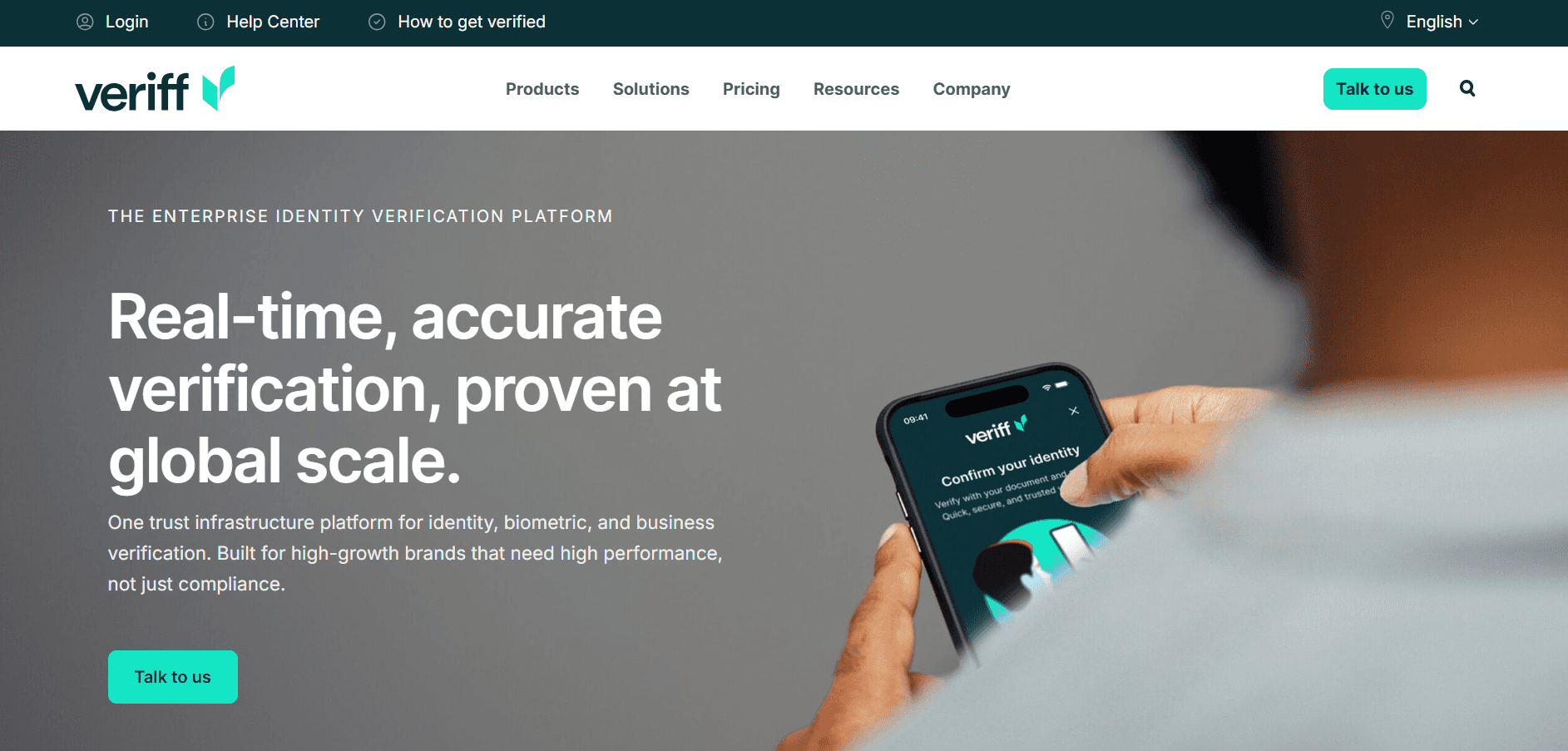
Veriff is a high-assurance identity verification platform focused on establishing whether an applicant’s identity evidence is genuine. The platform combines automated document and biometric verification with fraud signals to support remote onboarding.
How Veriff handles remote identity verification
Document verification: Veriff checks identity documents for authenticity during remote onboarding and reduces the need for manual checks.
Biometric verification: Face matching and liveness checks help confirm that the person applying matches the submitted identity document.
Fraud-resistant verification: Fraud indicators help identify manipulated documents and suspicious verification attempts before onboarding is complete.
Device and network signals: Device and network information adds context when assessing suspicious onboarding activity.
Configurable verification flows: Teams can adjust verification steps based on the product, market, or onboarding requirements.
Veriff emphasizes identity authenticity through document and biometric verification. The platform fits onboarding journeys where high-assurance remote verification is a priority over broader risk decisioning across the customer lifecycle.
Operational fit: Veriff supports configurable flows for adding document and biometric verification to digital onboarding journeys. Teams should assess how verification results will connect with their existing AML, fraud, and decisioning systems.
What to consider:
Veriff is primarily focused on identity verification. Businesses that need broader AML orchestration or risk decisioning across the customer lifecycle may need additional tools.
One reviewer noted verification errors can have financial and reputational consequences and called for more flexible subscription pricing options.
Best for: Banks, fintechs, marketplaces, and other digital businesses that prioritize document authenticity, remote biometric verification, and high-assurance identity checks during onboarding.
Pricing approach: Pricing depends on verification volumes, selected identity checks, deployment needs, and subscription requirements.
6. SEON

SEON is a fraud prevention platform focused on screening applicants before or alongside formal identity verification. It uses digital signals to help businesses identify suspicious activity early in the onboarding process.
How does SEON fit around KYC
Device intelligence: Device signals help identify suspicious environments, repeat usage, emulator activity, and other patterns linked to higher onboarding risk.
Email and phone intelligence: Checks around contact details add context when assessing whether an applicant’s information appears credible.
IP and network risk: IP analysis helps identify risky connections, proxies, location inconsistencies, and other network signals before further verification begins.
Bot and automation detection: Technical and behavioral signals help identify scripted signups, automated abuse, and non-human activity early in onboarding.
Fraud scoring: Combined signals produce configurable risk scores that help teams decide whether an applicant should proceed, face additional checks, move to review, or be blocked.
SEON brings fraud screening earlier in the onboarding process. Businesses can identify suspicious applicants before putting every customer through more costly or higher-friction verification.
Operational fit: SEON fits digital-first onboarding setups that already use KYC or identity verification providers and need an additional fraud layer. Teams can configure rules and scoring around their own risk strategy.
What to consider:
User feedback points to a learning curve around rule design and ongoing calibration, particularly for teams expecting a plug-and-play setup.
Document and biometric verification may also require additional technology, depending on how the wider onboarding process is designed.
Best for: Fintechs, marketplaces, e-commerce businesses, and other digital-first companies that need stronger fraud screening before or alongside formal KYC.
Pricing approach: Pricing varies by usage volume, selected fraud modules, data checks, and implementation requirements.
Related Read: 9 Best Identity Verification Solutions for Secure Digital Onboarding
How to Choose the Right Digital Onboarding Platform
A platform can look strong in a demo and still struggle with the cases that matter most once it meets real applications. The better way to evaluate one is to start with the fraud your team is dealing with, then work through how the platform would handle those cases.
Start with the fraud problem: Begin with the issue creating the most risk or manual work, such as synthetic identity fraud, stolen identities, application fraud, or false positives. The type of fraud you are trying to address should shape which capabilities you evaluate.
Map the onboarding journey: Trace an application from the first data capture through verification and account activation. See where checks happen, where information moves between systems, and where cases reach a manual review team.
Separate required checks from risk-based checks: Decide which checks every applicant needs to pass. Then identify where additional scrutiny applies when something looks unusual. This helps avoid putting every customer through the same process.
Decide how much of the stack you need: A point solution can work when the problem is narrow. A broader platform becomes useful when identity, fraud detection, and decisioning need to work together. Bureau fits teams that want these capabilities connected within the same onboarding flow.
Test with real fraud cases: Take cases your team has already seen and run them through the platform. Test genuine customers with unusual devices or locations too. This shows whether the technology can find the fraud without creating unnecessary false positives.
Measure what you expect to improve: Decide which outcomes matter before making a choice, and use those measures to compare how each option could affect the onboarding operation.
Consider where you may need the platform next: Check whether the technology can support risks that may emerge beyond onboarding, such as account takeover prevention, mule account activity, transaction fraud, or ongoing customer risk.
TheCityUK and PwC UK’s 2025 report, Reducing the Cost of Compliance, estimated that regulatory compliance directly accounts for 2.6% of operating costs. When costs across the full process are included, the figure rises above 13%. The finding highlights how work can accumulate across the wider onboarding process, beyond any individual compliance check.
Build an Onboarding Stack That Approves Good Users Faster
A new fraud pattern can change the rules a risk team needs to apply. A control that worked for one type of abuse may need to be adjusted when the attack moves to a different part of the onboarding flow.
Four areas can help the stack keep pace:
Review confirmed fraud cases and identify what the existing process missed.
Feed false-positive outcomes back into the rules so legitimate applications are not repeatedly flagged.
Keep a clear record of why an application was approved, reviewed, or rejected.
Give fraud and compliance teams clear ownership of policy changes and review decisions.
Bureau brings these capabilities together by connecting identity verification with device intelligence, behavioral biometrics, network intelligence, and risk-based decisioning. Teams can assess an application in one place and act on the result without maintaining separate rules across multiple tools.
Schedule a demo with Bureau to see how an existing onboarding stack can move toward a more adaptive risk-decisioning workflow.
FAQs
1. What is a digital onboarding solution?
A digital onboarding solution helps businesses verify and approve new customers remotely. It brings the checks needed before account activation into a digital process, including identity verification, compliance screening, and fraud assessment.
2. What are the five stages of the onboarding process?
The five stages are collecting customer information, verifying the applicant, completing compliance checks, assessing fraud risk, and completing onboarding. Each stage moves the application closer to an approval decision or additional review.
3. What is the best onboarding software?
The right choice depends on the type of onboarding a business needs to manage. Some platforms focus on identity verification and compliance, while others add fraud intelligence or more flexible workflow controls. Bureau, Entrust IDV, Jumio, Persona, Veriff, and SEON take different approaches.
4. What are the four Cs of successful onboarding?
The four Cs are Communication, Collaboration, Culture, and Connection. The framework is commonly used for employee onboarding rather than customer onboarding, so it is less relevant to digital customer onboarding software.
5. How does digital onboarding KYC work?
Digital onboarding KYC starts by collecting customer information and verifying their identity. The process then applies the required due diligence and screening before a decision is made. Additional verification or review can follow when an application requires further scrutiny.
6. How does biometric verification work in digital onboarding?
Biometric verification compares a customer's facial image with the photo on their identity document. Liveness checks confirm that the person is present during the verification process. Additional controls can detect spoofing or manipulated media.
Even when a customer submits valid identity documents before onboarding, the account is not necessarily safe to approve. A matching selfie can help confirm visual identity, but a device linked to previously mismatched accounts can still raise concern.
When identity checks and fraud signals sit in separate systems, teams have to piece together the application’s history before making a decision. Genuine customers can end up waiting while reviewers establish whether a concern needs further investigation or not.
A digital onboarding solution connects verification results with fraud and compliance checks, giving teams more context to decide how an application should proceed.
How a Digital Onboarding Solution Moves an Application Forward
A digital onboarding solution helps businesses verify a customer and decide whether an application is ready for approval. It brings the required checks into a connected process, reducing manual work and giving risk teams the information they need to handle applications consistently.
Think about what happens after a customer submits an application. The business still needs to establish who they are, complete the required compliance checks, look for fraud, and decide whether the account can be activated.
A digital onboarding solution brings those steps into one process:
Collect customer information: Capture accurate application data from the start. Optical Character Recognition (OCR) pulls information from identity documents, while prefilled fields reduce manual entry.
Verify the applicant: Check whether the submitted identity belongs to the person applying. Document checks look for tampering or forgery. Facial matching, liveness detection, and deepfake checks help verify the person behind the application.
Complete compliance checks: Apply Know Your Customer (KYC) and Anti-Money Laundering (AML) requirements before onboarding proceeds. Sanctions and Politically Exposed Person (PEP) screening can be added based on the business and market.
Assess fraud risk: Look for signs of fraud beyond the information submitted by the applicant. Synthetic identities and links to other accounts can reveal suspicious activity. Automated activity can also indicate that the application is not coming from a genuine user.
Complete onboarding: Bring the results together to make the final decision. The application can move forward, go through additional review, or fail to meet the approval requirements.
Capgemini’s 2025 World Retail Banking Report found that 47% of customers globally abandoned card applications midway because of a poor experience. This shows how quickly a difficult onboarding journey can turn into a lost customer before the account is even activated.
Bureau gives risk teams control over rules, review paths, and decision logic through configurable onboarding workflows. Teams can adjust the process as fraud patterns and business requirements change without rebuilding the entire journey.
Features to Look for in a Digital Onboarding Solution
A digital onboarding solution should give risk teams the information needed to verify an applicant and move an application through the required checks. It should also include capabilities to reduce unnecessary manual work and give teams control over how the onboarding process responds to different situations.
The core features to prioritize include:
Feature | What to Look For | Why It Matters |
Identity and compliance | Reliable identity verification with support for required regulatory checks | Helps teams verify customers and maintain compliance records |
Fraud prevention | Ability to identify suspicious patterns beyond the information provided during onboarding | Helps detect fraud attempts that appear legitimate at first review |
Risk decisioning | Clear decision logic that combines available signals into an outcome | Helps teams understand why an application was approved, reviewed, or rejected |
Workflow control | Flexible rules that teams can update as onboarding requirements change | Helps businesses adapt processes without rebuilding the entire flow |
Integration and lifecycle support | Connections with existing systems and support beyond initial onboarding | Helps extend risk controls as customer relationships continue |
The 6 Best Digital Onboarding Solutions in 2026
The six platforms in this list take different approaches to digital onboarding:
Bureau extends onboarding into broader fraud intelligence.
Entrust IDV, Jumio, and Veriff focus on high-assurance identity verification.
Persona emphasizes configurable onboarding workflows.
SEON focuses on fraud screening around KYC.
The table below shows where each platform puts its product focus and how it supports onboarding.
Platform | Core onboarding focus | Identity & document capabilities | Fraud & risk capabilities | Workflow/integration | Best suited to |
Bureau | Identity verification with broader fraud intelligence | Document verification, facial biometrics, liveness, and deepfake detection | Device, behavioral, network, and identity signals | Configurable rules and onboarding workflows | Businesses that want identity and fraud intelligence connected during onboarding |
Entrust IDV (formerly Onfido) | High-assurance identity verification | Document verification, facial biometrics, liveness, database checks, and proof of address | Passive fraud signals, device intelligence, repeat-face detection, and repeat-attempt detection | No-code Workflow Studio with conditional logic and SDKs | Enterprises that need configurable identity verification workflows |
Jumio | Identity verification and compliance | Government ID, selfie verification, liveness, supporting document checks, and digital ID verification | Risk signals combined with identity checks | APIs and digital onboarding verification flows | Regulated businesses focused on identity assurance and compliance |
Persona | Configurable identity workflows | Government ID, selfie, document, and database verification | Conditional verification and third-party data within workflows | No-code workflow builder, APIs, webhooks, and case management | Businesses that need flexible verification journeys |
Veriff | Remote identity verification | Automated document recognition, selfie verification, liveness, and broad document coverage | Device, network, and other fraud signals | Web and mobile SDKs, API, and configurable verification flows | Businesses prioritizing high-assurance remote verification |
SEON | Pre-KYC fraud screening | Identity verification available as part of its wider fraud stack | Digital footprint, device, behavioral, network, and real-time risk scoring | Modular APIs, rules, and automated decisioning | Digital businesses that want fraud screening before or alongside KYC |
Here’s a closer look at how each platform approaches digital onboarding, what it offers, and where it fits.
1. Bureau
Bureau helps businesses manage fraud and risk across the digital customer journey, with onboarding as a key part of the platform. Its approach moves beyond account-level defense to network-level intelligence by connecting activity across users, devices, accounts, and transactions.
Bureau’s onboarding solution brings these capabilities into the onboarding journey. Identity verification sits alongside device and behavioral signals, while compliance checks support the requirements of regulated businesses. The platform supports more than 2,000 document types, with a reported median onboarding time of under 10 seconds.
How Bureau supports onboarding decisions
Persistent device recognition: Device intelligence identifies repeat devices, emulators, and spoofed environments linked to multiple identities or applications.
Connected identity verification: Bureau combines document and biometric verification with liveness and deepfake checks to identify suspicious applications.
Behavioral context: Behavioral biometrics helps detect bots, scripted interactions, and unusual behavior during onboarding.
Risk-based decisioning: Teams can set different outcomes based on the risk signals linked to an application.
Network-level fraud intelligence: The Graph Identity Network connects users, devices, accounts, and relationships to identify mule activity, fraud rings, and coordinated abuse.
Case Study: How an Insurer Cut Fraud and Reduced Onboarding Time by 30%
Bureau connected identity, device, and behavioral signals to help an insurer flag suspicious applications at the source. Fraudulent applications were entering the onboarding flow through agents misusing real customer data or creating synthetic identities, while genuine applicants remained on a lower-friction path.
Within the first week, the insurer was able to:
Detect more than 100 fake applications and resubmit them with the correct details
Reduce customer complaints linked to unauthorized applications
Cut onboarding time by 30%, improving conversion and customer experience
Read the full case study: Insurer Cuts Fraud for 30% Faster Onboarding
The case shows how identity, device, and behavioral signals can help separate genuine applicants from fraud even when customer data appears valid.
Operational fit: Bureau gives fraud and risk teams control over onboarding rules and risk thresholds. No-code and low-code workflows let teams update the process as attack patterns change without relying on engineering for every policy update.
What to consider:
Define which onboarding and fraud decisions Bureau should influence and how confirmed fraud or false-positive feedback returns to the workflow.
Teams should also decide how confirmed fraud and false-positive feedback will feed back into the workflow.
Best for: Bureau is suited to banks, fintechs, lenders, insurers, marketplaces, and other high-risk digital businesses that need identity verification alongside fraud intelligence during onboarding.
Pricing approach: Pricing is customized based on the modules selected, onboarding volumes, supported journeys, and implementation requirements.
2. Entrust IDV (Formerly Onfido)
Entrust IDV (formerly Onfido) is an enterprise identity verification platform for digital onboarding. It helps businesses establish whether a customer is genuine and supports the compliance checks required during verification.
What Entrust IDV does for onboarding
Document verification: Entrust IDV checks government-issued identity documents for signs of tampering or fraud before onboarding continues.
Biometric verification: Facial matching and liveness checks help confirm that the person applying matches the submitted identity document.
Fraud checks: The platform adds fraud checks beyond document validity to identify suspicious applicants earlier in the process.
KYC and AML workflows: Entrust IDV supports customer verification and compliance screening within regulated onboarding processes.
Flexible implementation: Application Programming Interfaces (APIs) and Software Development Kits (SDKs) allow businesses to add identity verification to existing web and mobile onboarding journeys.
Entrust IDV brings identity and compliance checks into a single verification flow. Enterprises can manage these core identity controls without building each step separately.
Operational fit: Entrust IDV supports APIs and SDKs for existing digital journeys. Teams should assess document and geographic coverage against their customer base and consider how the platform will connect with existing fraud, compliance, and decisioning systems.
What to consider:
Entrust IDV focuses on identity verification. Businesses that need deeper intelligence on device, behavior, network, or transactions may need additional tools.
Some users report slower status updates and less convenient file naming during case handling.
Best for: Enterprises and regulated businesses that prioritize high-assurance identity verification, biometrics, liveness, and compliance checks during digital onboarding.
Pricing approach: Custom pricing based on verification requirements, onboarding volumes, markets, and selected identity and compliance capabilities.
3. Jumio
Jumio is a digital identity verification and compliance platform for regulated businesses. It helps businesses verify customers remotely and complete the identity and compliance checks required during digital onboarding.
How Jumio supports regulated onboarding
Identity and document verification: Jumio checks submitted identity documents for signs of manipulation or fraud.
Biometric verification: Facial biometrics and liveness checks help confirm that the person applying matches the submitted identity document.
KYC and AML compliance: Jumio supports customer verification and compliance checks within remote onboarding processes.
PEP and sanctions screening: The platform screens applicants for PEP exposure and sanctions risk before regulated accounts or services are activated.
Identity fraud controls: Jumio adds fraud signals to document and biometric checks to help identify suspicious applications before onboarding is complete.
Jumio brings identity verification and regulatory screening into the same digital onboarding process. Banks and fintechs can manage core verification and compliance requirements through a connected workflow.
Operational fit: Jumio fits regulated onboarding journeys where remote identity verification and compliance checks are important. Teams should assess whether its workflow supports their internal risk policies and whether existing fraud systems need to provide additional device or network intelligence.
What to consider:
Businesses dealing with advanced device, behavioral, or network fraud should assess whether they need additional fraud intelligence.
Customer feedback highlights retries in poor lighting or low image quality, while pricing can become more significant at higher volumes.
Best for: Banks, fintechs, and other regulated businesses that prioritize remote KYC, biometric verification, compliance screening, and identity assurance during onboarding.
Pricing approach: Pricing varies based on verification volumes, selected identity and compliance checks, markets, and implementation requirements.
4. Persona
Persona is an identity verification and compliance platform built around configurable onboarding workflows. It lets businesses adjust how customers move through verification based on their needs, with support for different customer types, products, and risk levels.
How Persona handles different onboarding journeys
Configurable identity verification: Persona adjusts document and biometric checks based on the customer or the verification outcome.
Conditional onboarding flows: Teams can set different verification paths based on factors such as risk, geography, product, or customer segment.
KYC and AML workflows: Persona brings identity verification and compliance screening into the same onboarding process.
Case and customer workflows: Operations teams can manage exceptions, reviews, and follow-up verification through structured case workflows.
Integration flexibility: APIs and configurable workflows allow Persona to connect with existing onboarding systems while giving teams control over how verification is handled.
Persona stands out for the flexibility of its onboarding workflows. Teams can tailor verification paths for different customer groups without using the same process for every applicant.
Operational fit: Persona fits businesses where product, risk, and compliance teams manage different onboarding requirements across customer segments. The flexibility also requires clear internal policies and ownership over how workflows are designed.
What to consider:
Several reviewers mention that photo submission controls can be permissive, which may require tighter internal rules around acceptable uploads.
Flexible workflows also require more internal policy design. Teams should assess whether Persona's built-in fraud intelligence covers the threats present in their onboarding process.
Best for: Fintechs, marketplaces, and regulated businesses that prioritize configurable identity verification, compliance workflows, and different onboarding journeys by customer segment.
Pricing approach: Custom or usage-based pricing depending on verification volumes, selected checks, workflow complexity, and deployment requirements.
5. Veriff
Veriff is a high-assurance identity verification platform focused on establishing whether an applicant’s identity evidence is genuine. The platform combines automated document and biometric verification with fraud signals to support remote onboarding.
How Veriff handles remote identity verification
Document verification: Veriff checks identity documents for authenticity during remote onboarding and reduces the need for manual checks.
Biometric verification: Face matching and liveness checks help confirm that the person applying matches the submitted identity document.
Fraud-resistant verification: Fraud indicators help identify manipulated documents and suspicious verification attempts before onboarding is complete.
Device and network signals: Device and network information adds context when assessing suspicious onboarding activity.
Configurable verification flows: Teams can adjust verification steps based on the product, market, or onboarding requirements.
Veriff emphasizes identity authenticity through document and biometric verification. The platform fits onboarding journeys where high-assurance remote verification is a priority over broader risk decisioning across the customer lifecycle.
Operational fit: Veriff supports configurable flows for adding document and biometric verification to digital onboarding journeys. Teams should assess how verification results will connect with their existing AML, fraud, and decisioning systems.
What to consider:
Veriff is primarily focused on identity verification. Businesses that need broader AML orchestration or risk decisioning across the customer lifecycle may need additional tools.
One reviewer noted verification errors can have financial and reputational consequences and called for more flexible subscription pricing options.
Best for: Banks, fintechs, marketplaces, and other digital businesses that prioritize document authenticity, remote biometric verification, and high-assurance identity checks during onboarding.
Pricing approach: Pricing depends on verification volumes, selected identity checks, deployment needs, and subscription requirements.
6. SEON
SEON is a fraud prevention platform focused on screening applicants before or alongside formal identity verification. It uses digital signals to help businesses identify suspicious activity early in the onboarding process.
How does SEON fit around KYC
Device intelligence: Device signals help identify suspicious environments, repeat usage, emulator activity, and other patterns linked to higher onboarding risk.
Email and phone intelligence: Checks around contact details add context when assessing whether an applicant’s information appears credible.
IP and network risk: IP analysis helps identify risky connections, proxies, location inconsistencies, and other network signals before further verification begins.
Bot and automation detection: Technical and behavioral signals help identify scripted signups, automated abuse, and non-human activity early in onboarding.
Fraud scoring: Combined signals produce configurable risk scores that help teams decide whether an applicant should proceed, face additional checks, move to review, or be blocked.
SEON brings fraud screening earlier in the onboarding process. Businesses can identify suspicious applicants before putting every customer through more costly or higher-friction verification.
Operational fit: SEON fits digital-first onboarding setups that already use KYC or identity verification providers and need an additional fraud layer. Teams can configure rules and scoring around their own risk strategy.
What to consider:
User feedback points to a learning curve around rule design and ongoing calibration, particularly for teams expecting a plug-and-play setup.
Document and biometric verification may also require additional technology, depending on how the wider onboarding process is designed.
Best for: Fintechs, marketplaces, e-commerce businesses, and other digital-first companies that need stronger fraud screening before or alongside formal KYC.
Pricing approach: Pricing varies by usage volume, selected fraud modules, data checks, and implementation requirements.
Related Read: 9 Best Identity Verification Solutions for Secure Digital Onboarding
How to Choose the Right Digital Onboarding Platform
A platform can look strong in a demo and still struggle with the cases that matter most once it meets real applications. The better way to evaluate one is to start with the fraud your team is dealing with, then work through how the platform would handle those cases.
Start with the fraud problem: Begin with the issue creating the most risk or manual work, such as synthetic identity fraud, stolen identities, application fraud, or false positives. The type of fraud you are trying to address should shape which capabilities you evaluate.
Map the onboarding journey: Trace an application from the first data capture through verification and account activation. See where checks happen, where information moves between systems, and where cases reach a manual review team.
Separate required checks from risk-based checks: Decide which checks every applicant needs to pass. Then identify where additional scrutiny applies when something looks unusual. This helps avoid putting every customer through the same process.
Decide how much of the stack you need: A point solution can work when the problem is narrow. A broader platform becomes useful when identity, fraud detection, and decisioning need to work together. Bureau fits teams that want these capabilities connected within the same onboarding flow.
Test with real fraud cases: Take cases your team has already seen and run them through the platform. Test genuine customers with unusual devices or locations too. This shows whether the technology can find the fraud without creating unnecessary false positives.
Measure what you expect to improve: Decide which outcomes matter before making a choice, and use those measures to compare how each option could affect the onboarding operation.
Consider where you may need the platform next: Check whether the technology can support risks that may emerge beyond onboarding, such as account takeover prevention, mule account activity, transaction fraud, or ongoing customer risk.
TheCityUK and PwC UK’s 2025 report, Reducing the Cost of Compliance, estimated that regulatory compliance directly accounts for 2.6% of operating costs. When costs across the full process are included, the figure rises above 13%. The finding highlights how work can accumulate across the wider onboarding process, beyond any individual compliance check.
Build an Onboarding Stack That Approves Good Users Faster
A new fraud pattern can change the rules a risk team needs to apply. A control that worked for one type of abuse may need to be adjusted when the attack moves to a different part of the onboarding flow.
Four areas can help the stack keep pace:
Review confirmed fraud cases and identify what the existing process missed.
Feed false-positive outcomes back into the rules so legitimate applications are not repeatedly flagged.
Keep a clear record of why an application was approved, reviewed, or rejected.
Give fraud and compliance teams clear ownership of policy changes and review decisions.
Bureau brings these capabilities together by connecting identity verification with device intelligence, behavioral biometrics, network intelligence, and risk-based decisioning. Teams can assess an application in one place and act on the result without maintaining separate rules across multiple tools.
Schedule a demo with Bureau to see how an existing onboarding stack can move toward a more adaptive risk-decisioning workflow.
FAQs
1. What is a digital onboarding solution?
A digital onboarding solution helps businesses verify and approve new customers remotely. It brings the checks needed before account activation into a digital process, including identity verification, compliance screening, and fraud assessment.
2. What are the five stages of the onboarding process?
The five stages are collecting customer information, verifying the applicant, completing compliance checks, assessing fraud risk, and completing onboarding. Each stage moves the application closer to an approval decision or additional review.
3. What is the best onboarding software?
The right choice depends on the type of onboarding a business needs to manage. Some platforms focus on identity verification and compliance, while others add fraud intelligence or more flexible workflow controls. Bureau, Entrust IDV, Jumio, Persona, Veriff, and SEON take different approaches.
4. What are the four Cs of successful onboarding?
The four Cs are Communication, Collaboration, Culture, and Connection. The framework is commonly used for employee onboarding rather than customer onboarding, so it is less relevant to digital customer onboarding software.
5. How does digital onboarding KYC work?
Digital onboarding KYC starts by collecting customer information and verifying their identity. The process then applies the required due diligence and screening before a decision is made. Additional verification or review can follow when an application requires further scrutiny.
6. How does biometric verification work in digital onboarding?
Biometric verification compares a customer's facial image with the photo on their identity document. Liveness checks confirm that the person is present during the verification process. Additional controls can detect spoofing or manipulated media.
TABLE OF CONTENTS
See More
Recommended Blogs


Landing Page.
Simple, bold.
Sign Up
Download

Products
Solutions


© 2026 Bureau . All rights reserved.
Solutions
Industries
Resources
Company
Solutions
Industries
Resources
Company
© 2026 Bureau . All rights reserved.
Follow Us
Leave behind fragmented tools. Stop fraud rings, cut false declines, and deliver secure digital journeys at scale
Our Presence








Leave behind fragmented tools. Stop fraud rings, cut false declines, and deliver secure digital journeys at scale
Our Presence
© 2026 Bureau . All rights reserved.