How Synthetic Identity Fraud Detection Finds Fraud Before Losses Grow
How Synthetic Identity Fraud Detection Finds Fraud Before Losses Grow
How Synthetic Identity Fraud Detection Finds Fraud Before Losses Grow
See how synthetic identity fraud detection uses identity, device, graph, and behavior signals to catch constructed profiles before losses grow.
Author
Team Bureau


See how Bureau has helped industry leaders defend against networked Industrial-scale frauds →
Schedule a Demo
TABLE OF CONTENTS
See Less
Synthetic identity fraud does not always look suspicious at onboarding.
A profile can pass KYC, make regular repayments, build credit, and behave like a genuine customer for months. The problem often surfaces only when the account defaults or disappears, by which point the loss may look more like bad credit than fraud.
This is why synthetic identity fraud detection needs to go beyond a one-time identity check. Risk teams need to verify whether identity attributes actually belong together, spot links across accounts and devices, and keep assessing risk after onboarding.
Bureau’s Stopping Synthetic Identity Fraud eBook reports that 89% of financial institutions rank synthetic identity creation as the top AI-enabled fraud threat. For risk teams, that means synthetic identities are becoming harder to distinguish from genuine applicants and can survive long enough to build trust before fraud surfaces.
The key is understanding what synthetic identity fraud detection actually tests when an applicant looks legitimate on the surface.
What Is Synthetic Identity Fraud Detection?
Synthetic identity fraud detection identifies personas built from a mix of real and fabricated information. It checks whether submitted identity attributes belong to the same genuine person by combining identity validation with document, biometric, device, behavioral, graph, and account-level signals.
A synthetic identity may still contain a valid government-issued identifier or other genuine identity data. The fraud appears in how that real data is combined with unrelated or fabricated details. Effective detection, therefore, looks beyond whether each field is valid and tests whether the full identity is coherent.
In practice, that involves several connected checks:
Confirm the core identity: Validate key details such as the name, date of birth, national identifier, phone, email, and address against trusted sources.
Check whether the data belongs together: Look for historical evidence that those attributes have been associated with the same person over time.
Verify the evidence: Assess whether documents are authentic, the face matches the ID, facial liveness is genuine, and submitted images have not been manipulated.
Review digital behavior: Examine the device, location, IP risk, application velocity, and session behavior for signs of repeat or coordinated fraud.
Find hidden connections: Identify shared devices, contact details, accounts, or beneficiaries that may link the applicant to other suspicious identities.
Keep monitoring after approval: Reassess risk when behavior changes, credit exposure increases, or higher-risk account actions occur.
Act on the combined risk: Use the full signal set to approve, monitor, step-up verification, review, restrict, or reject the applicant.
The goal is to determine whether the identity remains credible when multiple risk signals are assessed together across onboarding and ongoing account activity.
Synthetic Identity Fraud vs Traditional Identity Theft
The main difference between synthetic identity fraud and traditional identity theft is how the fraud develops and becomes visible. Traditional identity theft often produces unauthorized activity against a specific victim, while synthetic fraud can build credibility over time before losses surface.
Criteria | Synthetic Identity Fraud | Traditional Identity Theft |
Direct victim | May not be immediately identifiable | Usually a specific person |
Early behavior | May appear legitimate | Often conflicts with victim activity |
Typical lifecycle | Builds credibility before exploitation | Exploits an established identity |
Common outcome | Bust-out fraud, credit abuse, mule accounts | Unauthorized accounts or transactions |
Detection focus | Patterns that emerge across identity history, accounts, and activity | Activity that conflicts with the genuine person’s history |
For risk teams, this means synthetic fraud can remain harder to recognize early because seemingly legitimate activity may be part of the fraud lifecycle. Traditional identity theft is more likely to surface through unauthorized activity or deviations from an existing customer’s established behavior.
A fraudster may combine a genuine government-issued identifier or other real identity data with fabricated details, build a credible profile, and later default after accessing higher-value products. Traditional identity theft uses one real person’s information, so detection focuses on impersonation, while synthetic identity detection must establish whether the assembled persona exists at all.
What Are Common Risk Signals of Synthetic Identity Fraud?
Synthetic identity fraud risk signals are inconsistencies or unusual patterns that make an applicant’s identity history, credit activity, or account behavior difficult to explain as normal customer activity.
Cifas Fraudscape 2026 reported a 33% rise in loan-related false-application filings in the first half of 2026, particularly in cases involving altered or false documents. Cifas members also reported increasingly sophisticated application documents supported by AI.
For synthetic identity fraud detection, this makes document checks only one part of the decision. A profile may pass that checkpoint while inconsistencies appear across identity data, contact history, devices, account relationships, or application behavior.
The most useful red flags usually fall into six groups:
Identity data does not align: A valid government-issued identifier or other genuine identity attribute may have little credible connection to the submitted name or contact details. Historical records may also point to different people.
Credit history looks engineered: A thin or no-hit file becomes more suspicious when it quickly gains tradelines or shows unusual authorized-user activity. Repeated disputes followed by fresh credit applications can add to the risk.
Contact and address data looks newly assembled: Recently created emails or short-tenure phone numbers can weaken identity confidence. Reuse of the same address or contact point across unrelated applicants raises the risk further.
Devices and behavior repeat across applicants: One device may appear across several identities despite resets or other evasion attempts. Similar typing patterns or session flows can also indicate bots or fraud farms.
Identity evidence appears manipulated: AI-generated selfies, deepfakes, recaptured images, or altered documents can make fabricated personas look credible. Mismatches between the selfie and document photo add another layer of concern.
Linked accounts reveal coordinated activity: Shared beneficiaries or payout destinations can connect otherwise unrelated accounts. Sudden activity after a quiet period may also point to trust-building followed by planned exploitation.
For example, a thin credit file and a recently created phone number may be legitimate on their own. Risk becomes materially higher when the same device has submitted six applications under different names and three accounts share one payout beneficiary.
What Are the Methods to Detect Synthetic Identity Fraud?
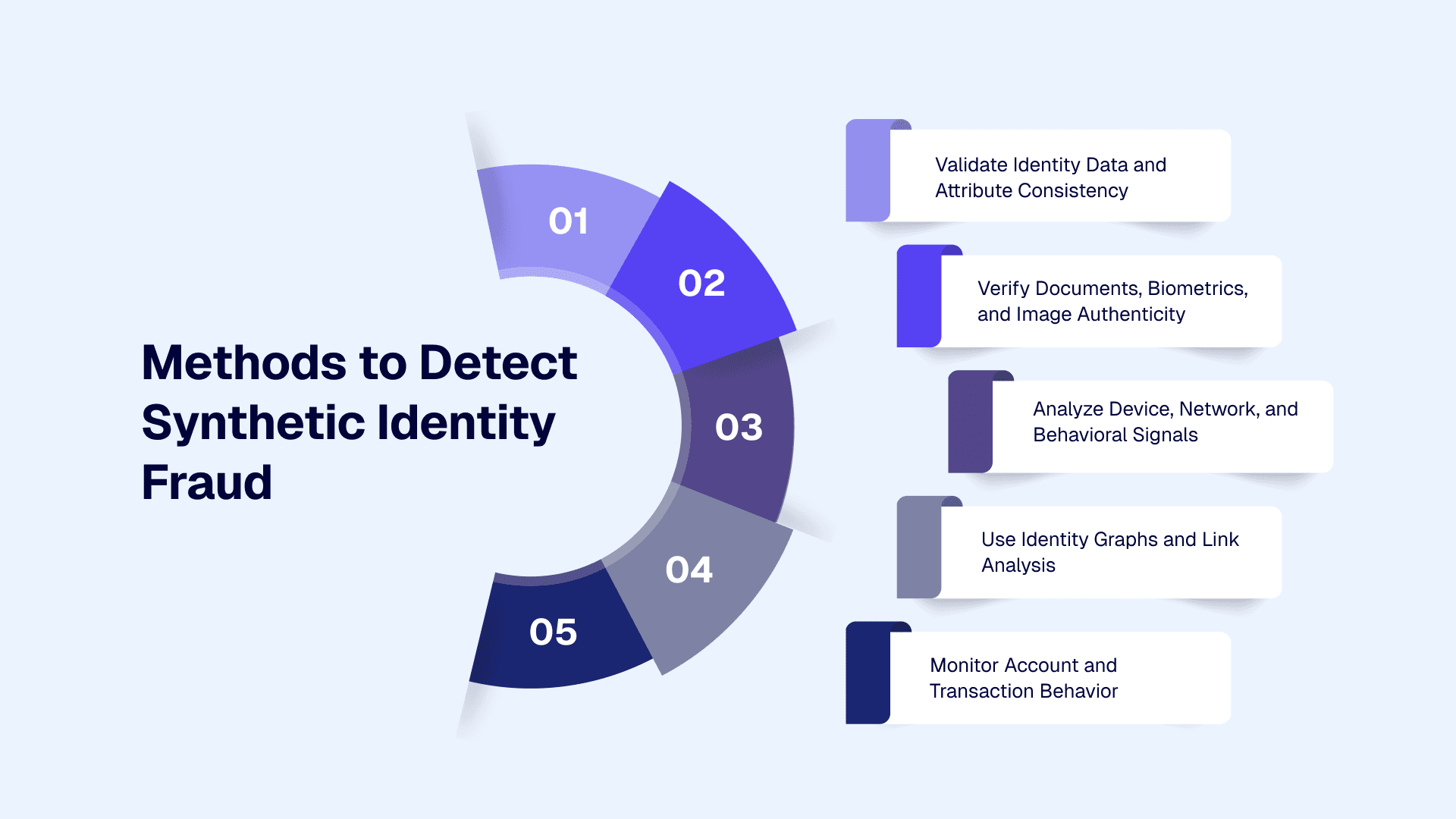
Synthetic identity fraud is best detected by combining identity validation, document and biometric checks, digital signals, graph analysis, and ongoing account monitoring. Each method tests a different part of the persona, which matters because synthetic identities are often built to pass isolated controls.
The strongest detection programs use these methods together to assess whether the identity is valid, coherent, and connected to genuine behavior over time.
1. Validate Identity Data and Attribute Consistency
Start by checking whether the submitted identity data is valid and whether those attributes form a credible profile. That means looking beyond individual matches across names, dates of birth, national identifiers, addresses, phone numbers, emails, and credit header data.
Entity resolution helps connect records that use different spellings, formats, or transliterations and determine whether they still refer to the same person.
Authoritative identity sources can strengthen that assessment across markets:
United States: SSA eCBSV can confirm whether submitted identity details match Social Security records, but it does not prove the applicant owns that identity.
India: RBI-regulated institutions can use Aadhaar-based verification, PAN checks, and other officially valid documents as part of KYC.
Philippines: BSP-regulated institutions verify customer identity using reliable identity documents and customer due diligence checks.
Saudi Arabia: SAMA-regulated banks can verify National ID or Iqama details through reliable government-backed sources as part of remote onboarding.
The principle stays the same across regions where a valid attribute is supporting evidence. Synthetic identity detection still needs to establish whether those attributes belong to the same genuine person.
2. Verify Documents, Biometrics, and Image Authenticity
Document checks should confirm more than whether an ID looks legitimate. They should assess document authenticity, OCR consistency, face-to-document matching, liveness, and proof of life.
Synthetic identity detection also needs to catch AI-generated, manipulated, replayed, injected, or recaptured images. Identity document verification can be paired with image forensics to assess whether the evidence presented actually supports a genuine person.
3. Analyze Device, Network, and Behavioral Signals
Digital signals can expose shared infrastructure behind applicants who appear unrelated. Look for repeat devices, unusual device-to-account ratios, emulator use, resets, VPNs, proxies, location mismatches, and high application velocity.
Behavioral patterns add another layer. Repeated typing rhythms, copy-paste activity, or near-identical session flows can indicate that multiple identities are being controlled by the same person, script, or fraud farm.
4. Use Identity Graphs and Link Analysis
Identity graphs reveal relationships that individual application reviews can miss. They connect identities with phones, emails, devices, addresses, accounts, beneficiaries, and transactions.
A 2026 Europol investigation shows how valuable those connections can become at scale. Investigators identified more than 6,000 KYC records linked to money mule accounts while tracing a crypto-laundering network. For synthetic identity detection, these connections can expose accounts that look legitimate in isolation but share infrastructure with a wider fraud network.
Link analysis can then surface reused contact details, shared payout destinations, mule relationships, and dense account clusters. These connections can expose coordinated synthetic identities even when each application looks plausible on its own.
5. Monitor Account and Transaction Behavior
Synthetic identity detection should continue after onboarding because many accounts behave normally while building trust. Sudden limit requests, new beneficiaries, shared payout accounts, abnormal withdrawals, or shifts in device and behavioral patterns can signal rising risk.
These events should feed back into the risk score and trigger the right response, from continued monitoring and step-up verification to review, restriction, or rejection.
Prevention Strategies Bureau Uses Against Synthetic Identities
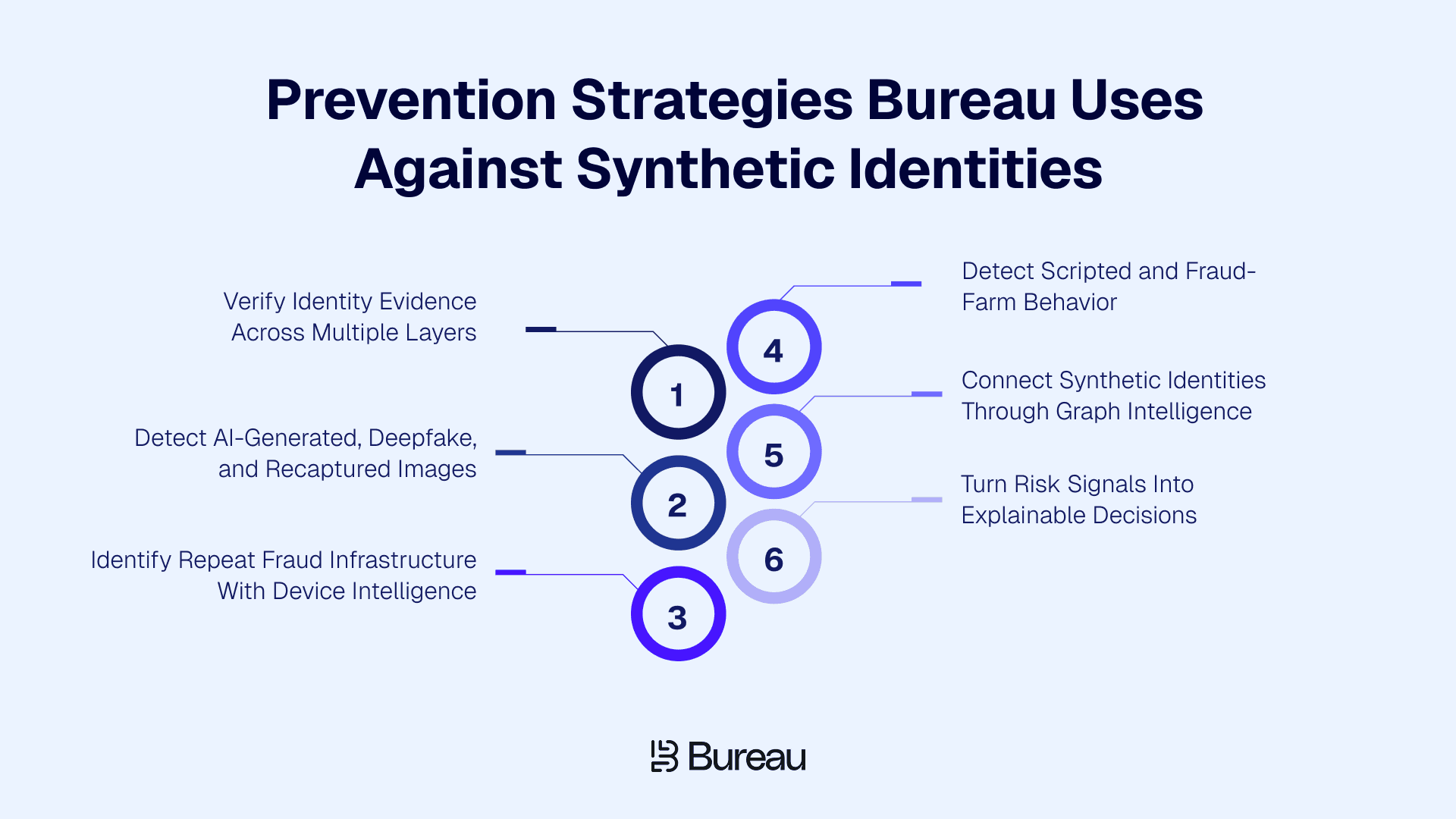
Synthetic identities are often designed to look clean at the account level. Bureau combines identity-level checks with device, behavioral, linkage, beneficiary, and fraud-network signals to expose patterns that only become visible across connected accounts.
This helps teams move beyond isolated account checks and identify the wider network behind suspicious activity.
1. Verifies Identity Evidence Across Multiple Layers
Bureau begins by checking whether the applicant’s identity evidence is internally consistent. It combines identity-data checks with facial matching, liveness, contact intelligence, digital-footprint signals, and device context to assess whether the profile holds together.
A valid government identifier or authentic-looking document is only one part of that assessment. Bureau can also evaluate whether the contact details have credible history, the submitted attributes belong together, and the applicant’s broader risk context supports the identity being presented.
2. Detects AI-Generated, Deepfake, and Recaptured Images
AI-generated fake IDs, deepfake selfies, and recaptured images can make a synthetic identity look credible during KYC. Bureau checks submitted identity evidence for signs of generation or manipulation before that evidence contributes to a trusted profile.
These image-level signals add context to document checks and liveness, but they should remain one part of the broader identity decision.
3. Identifies Shared Devices and Operating Patterns
Different identities can still leave behind the same digital footprint. Bureau’s Device ID can surface repeat devices across accounts, even after resets, incognito use, or emulator-based evasion.
Its behavioral biometrics can then identify repeated typing patterns, navigation flows, and scripted interactions. When those signals recur across supposedly unrelated applicants, the activity starts to look coordinated rather than isolated.
4. Expands the View With Graph Intelligence
An applicant can look clean in isolation and still belong to a coordinated fraud network. Bureau’s Graph Identity Network connects identities with devices, phone numbers, emails, addresses, accounts, transactions, and beneficiaries to surface shared infrastructure and hidden relationships.
That network context can expose fraud clusters, mule connections, and links to known bad actors. For example, a new applicant may have clean documents and no direct fraud history, but a shared device or beneficiary can connect the account to previously confirmed fraud.
5. Turns Network Context Into a Risk Decision
Connected signals make it possible to judge the applicant in context rather than relying on one successful check. Bureau can combine identity, image, device, behavioral, graph, and transaction signals into a single risk score with explainable reason codes.
Teams can then match the response to the level of risk:
Risk level | Example signals | Possible action |
Low | Coherent identity, trusted device, no adverse links | Approve |
Medium | Thin file, limited history, new contact details | Monitor or step up |
High | Shared device, suspicious behavior, identity inconsistencies | Enhanced verification or review |
Critical | Synthetic image, known fraud links, coordinated cluster | Restrict, reject, or escalate |
This helps avoid costly errors like approving a constructed identity because one check passed, or rejecting a genuine thin-file applicant because one signal was inconclusive.
Case Study: How Bureau Helped an Insurer Cut Fraud and Speed Up Onboarding by 30%
A leading insurer was dealing with agent-driven fake applications that created customer complaints, onboarding delays, and higher drop-offs. Internal field agents were submitting unauthorized or synthetic applications to inflate commissions, while genuine applicants faced extra verification and slower processing.
The insurer implemented Bureau’s identity verification, device intelligence, and behavioral risk signals to flag suspicious applications at the source. This helped separate genuine customers from agent-driven abuse without adding the same friction to every applicant.
By the end of the first week, the insurer was able to:
Detect and correct 100+ fake or inaccurate applications.
Reduce complaints linked to unauthorized applications.
Cut onboarding time by 30%, helping improve conversions and customer experience.
Replace a high-friction verification process with faster, risk-based onboarding.
Read the full case study here → Insurer Cuts Fraud for 30% Faster Onboarding
The takeaway is that stronger onboarding does not have to mean more verification for everyone. Combining identity, device, and behavioral signals can help stop suspicious applications earlier while allowing low-risk customers to move through onboarding with less friction.
Prevent Synthetic Identities From Gaining Trust
Synthetic identities become expensive when they survive long enough to build trust. That makes early detection of manipulated identity evidence critical before it influences onboarding and risk decisions.
Bureau helps risk teams evaluate synthetic identity risk across image evidence, device context, behavior, linked accounts, and transaction activity. This creates a clearer view of where an apparently credible applicant may still carry hidden risk.
A practical starting point is the image stack. Testing whether it can detect AI-generated and recaptured identity evidence can reveal gaps before those signals affect account approval.
If that gap exists today, schedule a demo with Bureau to see how those checks can fit into an existing risk workflow.
FAQs
1. What is synthetic identity fraud?
Synthetic identity fraud is the creation of a fabricated persona using a mix of real and false personal information. A genuine government-issued identifier or other real identity data may be combined with a fabricated name, date of birth, address, phone number, email, document, or image.
2. What is synthetic identity fraud detection?
Synthetic identity fraud detection identifies whether submitted identity attributes belong to a genuine person. It combines identity-data validation, document and biometric checks, image forensics, device intelligence, behavioral analysis, identity graphs, and ongoing monitoring across the account lifecycle.
3. What are the most common synthetic identity fraud risk signals?
Common signals include inconsistent personal information, newly created phone numbers or emails, thin or no-hit credit files, shared devices or addresses, high application velocity, manipulated images, unusual authorized-user histories, and links to previously confirmed fraudulent accounts.
4. How does synthetic image detection help identify synthetic identities?
Synthetic image detection can flag AI-generated applicant photos, deepfakes, manipulated evidence, and recaptured images. Bureau uses these signals alongside document checks, liveness, device context, behavioral patterns, and graph relationships to strengthen the overall identity decision.
5. How do identity graphs detect synthetic identity fraud?
Identity graphs connect devices, phone numbers, emails, addresses, accounts, beneficiaries, and transactions. Bureau uses these relationships to expose coordinated identities, reused fraud infrastructure, mule connections, and links that may remain hidden when individual applications are reviewed separately.
6. How can businesses prevent synthetic identity fraud?
Businesses can prevent synthetic identity fraud by validating identity relationships, verifying documents and biometrics, detecting manipulated images, analyzing device and behavioral signals, linking related accounts through graph analysis, applying risk-based decisions, and monitoring account activity after onboarding.
Synthetic identity fraud does not always look suspicious at onboarding.
A profile can pass KYC, make regular repayments, build credit, and behave like a genuine customer for months. The problem often surfaces only when the account defaults or disappears, by which point the loss may look more like bad credit than fraud.
This is why synthetic identity fraud detection needs to go beyond a one-time identity check. Risk teams need to verify whether identity attributes actually belong together, spot links across accounts and devices, and keep assessing risk after onboarding.
Bureau’s Stopping Synthetic Identity Fraud eBook reports that 89% of financial institutions rank synthetic identity creation as the top AI-enabled fraud threat. For risk teams, that means synthetic identities are becoming harder to distinguish from genuine applicants and can survive long enough to build trust before fraud surfaces.
The key is understanding what synthetic identity fraud detection actually tests when an applicant looks legitimate on the surface.
What Is Synthetic Identity Fraud Detection?
Synthetic identity fraud detection identifies personas built from a mix of real and fabricated information. It checks whether submitted identity attributes belong to the same genuine person by combining identity validation with document, biometric, device, behavioral, graph, and account-level signals.
A synthetic identity may still contain a valid government-issued identifier or other genuine identity data. The fraud appears in how that real data is combined with unrelated or fabricated details. Effective detection, therefore, looks beyond whether each field is valid and tests whether the full identity is coherent.
In practice, that involves several connected checks:
Confirm the core identity: Validate key details such as the name, date of birth, national identifier, phone, email, and address against trusted sources.
Check whether the data belongs together: Look for historical evidence that those attributes have been associated with the same person over time.
Verify the evidence: Assess whether documents are authentic, the face matches the ID, facial liveness is genuine, and submitted images have not been manipulated.
Review digital behavior: Examine the device, location, IP risk, application velocity, and session behavior for signs of repeat or coordinated fraud.
Find hidden connections: Identify shared devices, contact details, accounts, or beneficiaries that may link the applicant to other suspicious identities.
Keep monitoring after approval: Reassess risk when behavior changes, credit exposure increases, or higher-risk account actions occur.
Act on the combined risk: Use the full signal set to approve, monitor, step-up verification, review, restrict, or reject the applicant.
The goal is to determine whether the identity remains credible when multiple risk signals are assessed together across onboarding and ongoing account activity.
Synthetic Identity Fraud vs Traditional Identity Theft
The main difference between synthetic identity fraud and traditional identity theft is how the fraud develops and becomes visible. Traditional identity theft often produces unauthorized activity against a specific victim, while synthetic fraud can build credibility over time before losses surface.
Criteria | Synthetic Identity Fraud | Traditional Identity Theft |
Direct victim | May not be immediately identifiable | Usually a specific person |
Early behavior | May appear legitimate | Often conflicts with victim activity |
Typical lifecycle | Builds credibility before exploitation | Exploits an established identity |
Common outcome | Bust-out fraud, credit abuse, mule accounts | Unauthorized accounts or transactions |
Detection focus | Patterns that emerge across identity history, accounts, and activity | Activity that conflicts with the genuine person’s history |
For risk teams, this means synthetic fraud can remain harder to recognize early because seemingly legitimate activity may be part of the fraud lifecycle. Traditional identity theft is more likely to surface through unauthorized activity or deviations from an existing customer’s established behavior.
A fraudster may combine a genuine government-issued identifier or other real identity data with fabricated details, build a credible profile, and later default after accessing higher-value products. Traditional identity theft uses one real person’s information, so detection focuses on impersonation, while synthetic identity detection must establish whether the assembled persona exists at all.
What Are Common Risk Signals of Synthetic Identity Fraud?
Synthetic identity fraud risk signals are inconsistencies or unusual patterns that make an applicant’s identity history, credit activity, or account behavior difficult to explain as normal customer activity.
Cifas Fraudscape 2026 reported a 33% rise in loan-related false-application filings in the first half of 2026, particularly in cases involving altered or false documents. Cifas members also reported increasingly sophisticated application documents supported by AI.
For synthetic identity fraud detection, this makes document checks only one part of the decision. A profile may pass that checkpoint while inconsistencies appear across identity data, contact history, devices, account relationships, or application behavior.
The most useful red flags usually fall into six groups:
Identity data does not align: A valid government-issued identifier or other genuine identity attribute may have little credible connection to the submitted name or contact details. Historical records may also point to different people.
Credit history looks engineered: A thin or no-hit file becomes more suspicious when it quickly gains tradelines or shows unusual authorized-user activity. Repeated disputes followed by fresh credit applications can add to the risk.
Contact and address data looks newly assembled: Recently created emails or short-tenure phone numbers can weaken identity confidence. Reuse of the same address or contact point across unrelated applicants raises the risk further.
Devices and behavior repeat across applicants: One device may appear across several identities despite resets or other evasion attempts. Similar typing patterns or session flows can also indicate bots or fraud farms.
Identity evidence appears manipulated: AI-generated selfies, deepfakes, recaptured images, or altered documents can make fabricated personas look credible. Mismatches between the selfie and document photo add another layer of concern.
Linked accounts reveal coordinated activity: Shared beneficiaries or payout destinations can connect otherwise unrelated accounts. Sudden activity after a quiet period may also point to trust-building followed by planned exploitation.
For example, a thin credit file and a recently created phone number may be legitimate on their own. Risk becomes materially higher when the same device has submitted six applications under different names and three accounts share one payout beneficiary.
What Are the Methods to Detect Synthetic Identity Fraud?
Synthetic identity fraud is best detected by combining identity validation, document and biometric checks, digital signals, graph analysis, and ongoing account monitoring. Each method tests a different part of the persona, which matters because synthetic identities are often built to pass isolated controls.
The strongest detection programs use these methods together to assess whether the identity is valid, coherent, and connected to genuine behavior over time.
1. Validate Identity Data and Attribute Consistency
Start by checking whether the submitted identity data is valid and whether those attributes form a credible profile. That means looking beyond individual matches across names, dates of birth, national identifiers, addresses, phone numbers, emails, and credit header data.
Entity resolution helps connect records that use different spellings, formats, or transliterations and determine whether they still refer to the same person.
Authoritative identity sources can strengthen that assessment across markets:
United States: SSA eCBSV can confirm whether submitted identity details match Social Security records, but it does not prove the applicant owns that identity.
India: RBI-regulated institutions can use Aadhaar-based verification, PAN checks, and other officially valid documents as part of KYC.
Philippines: BSP-regulated institutions verify customer identity using reliable identity documents and customer due diligence checks.
Saudi Arabia: SAMA-regulated banks can verify National ID or Iqama details through reliable government-backed sources as part of remote onboarding.
The principle stays the same across regions where a valid attribute is supporting evidence. Synthetic identity detection still needs to establish whether those attributes belong to the same genuine person.
2. Verify Documents, Biometrics, and Image Authenticity
Document checks should confirm more than whether an ID looks legitimate. They should assess document authenticity, OCR consistency, face-to-document matching, liveness, and proof of life.
Synthetic identity detection also needs to catch AI-generated, manipulated, replayed, injected, or recaptured images. Identity document verification can be paired with image forensics to assess whether the evidence presented actually supports a genuine person.
3. Analyze Device, Network, and Behavioral Signals
Digital signals can expose shared infrastructure behind applicants who appear unrelated. Look for repeat devices, unusual device-to-account ratios, emulator use, resets, VPNs, proxies, location mismatches, and high application velocity.
Behavioral patterns add another layer. Repeated typing rhythms, copy-paste activity, or near-identical session flows can indicate that multiple identities are being controlled by the same person, script, or fraud farm.
4. Use Identity Graphs and Link Analysis
Identity graphs reveal relationships that individual application reviews can miss. They connect identities with phones, emails, devices, addresses, accounts, beneficiaries, and transactions.
A 2026 Europol investigation shows how valuable those connections can become at scale. Investigators identified more than 6,000 KYC records linked to money mule accounts while tracing a crypto-laundering network. For synthetic identity detection, these connections can expose accounts that look legitimate in isolation but share infrastructure with a wider fraud network.
Link analysis can then surface reused contact details, shared payout destinations, mule relationships, and dense account clusters. These connections can expose coordinated synthetic identities even when each application looks plausible on its own.
5. Monitor Account and Transaction Behavior
Synthetic identity detection should continue after onboarding because many accounts behave normally while building trust. Sudden limit requests, new beneficiaries, shared payout accounts, abnormal withdrawals, or shifts in device and behavioral patterns can signal rising risk.
These events should feed back into the risk score and trigger the right response, from continued monitoring and step-up verification to review, restriction, or rejection.
Prevention Strategies Bureau Uses Against Synthetic Identities
Synthetic identities are often designed to look clean at the account level. Bureau combines identity-level checks with device, behavioral, linkage, beneficiary, and fraud-network signals to expose patterns that only become visible across connected accounts.
This helps teams move beyond isolated account checks and identify the wider network behind suspicious activity.
1. Verifies Identity Evidence Across Multiple Layers
Bureau begins by checking whether the applicant’s identity evidence is internally consistent. It combines identity-data checks with facial matching, liveness, contact intelligence, digital-footprint signals, and device context to assess whether the profile holds together.
A valid government identifier or authentic-looking document is only one part of that assessment. Bureau can also evaluate whether the contact details have credible history, the submitted attributes belong together, and the applicant’s broader risk context supports the identity being presented.
2. Detects AI-Generated, Deepfake, and Recaptured Images
AI-generated fake IDs, deepfake selfies, and recaptured images can make a synthetic identity look credible during KYC. Bureau checks submitted identity evidence for signs of generation or manipulation before that evidence contributes to a trusted profile.
These image-level signals add context to document checks and liveness, but they should remain one part of the broader identity decision.
3. Identifies Shared Devices and Operating Patterns
Different identities can still leave behind the same digital footprint. Bureau’s Device ID can surface repeat devices across accounts, even after resets, incognito use, or emulator-based evasion.
Its behavioral biometrics can then identify repeated typing patterns, navigation flows, and scripted interactions. When those signals recur across supposedly unrelated applicants, the activity starts to look coordinated rather than isolated.
4. Expands the View With Graph Intelligence
An applicant can look clean in isolation and still belong to a coordinated fraud network. Bureau’s Graph Identity Network connects identities with devices, phone numbers, emails, addresses, accounts, transactions, and beneficiaries to surface shared infrastructure and hidden relationships.
That network context can expose fraud clusters, mule connections, and links to known bad actors. For example, a new applicant may have clean documents and no direct fraud history, but a shared device or beneficiary can connect the account to previously confirmed fraud.
5. Turns Network Context Into a Risk Decision
Connected signals make it possible to judge the applicant in context rather than relying on one successful check. Bureau can combine identity, image, device, behavioral, graph, and transaction signals into a single risk score with explainable reason codes.
Teams can then match the response to the level of risk:
Risk level | Example signals | Possible action |
Low | Coherent identity, trusted device, no adverse links | Approve |
Medium | Thin file, limited history, new contact details | Monitor or step up |
High | Shared device, suspicious behavior, identity inconsistencies | Enhanced verification or review |
Critical | Synthetic image, known fraud links, coordinated cluster | Restrict, reject, or escalate |
This helps avoid costly errors like approving a constructed identity because one check passed, or rejecting a genuine thin-file applicant because one signal was inconclusive.
Case Study: How Bureau Helped an Insurer Cut Fraud and Speed Up Onboarding by 30%
A leading insurer was dealing with agent-driven fake applications that created customer complaints, onboarding delays, and higher drop-offs. Internal field agents were submitting unauthorized or synthetic applications to inflate commissions, while genuine applicants faced extra verification and slower processing.
The insurer implemented Bureau’s identity verification, device intelligence, and behavioral risk signals to flag suspicious applications at the source. This helped separate genuine customers from agent-driven abuse without adding the same friction to every applicant.
By the end of the first week, the insurer was able to:
Detect and correct 100+ fake or inaccurate applications.
Reduce complaints linked to unauthorized applications.
Cut onboarding time by 30%, helping improve conversions and customer experience.
Replace a high-friction verification process with faster, risk-based onboarding.
Read the full case study here → Insurer Cuts Fraud for 30% Faster Onboarding
The takeaway is that stronger onboarding does not have to mean more verification for everyone. Combining identity, device, and behavioral signals can help stop suspicious applications earlier while allowing low-risk customers to move through onboarding with less friction.
Prevent Synthetic Identities From Gaining Trust
Synthetic identities become expensive when they survive long enough to build trust. That makes early detection of manipulated identity evidence critical before it influences onboarding and risk decisions.
Bureau helps risk teams evaluate synthetic identity risk across image evidence, device context, behavior, linked accounts, and transaction activity. This creates a clearer view of where an apparently credible applicant may still carry hidden risk.
A practical starting point is the image stack. Testing whether it can detect AI-generated and recaptured identity evidence can reveal gaps before those signals affect account approval.
If that gap exists today, schedule a demo with Bureau to see how those checks can fit into an existing risk workflow.
FAQs
1. What is synthetic identity fraud?
Synthetic identity fraud is the creation of a fabricated persona using a mix of real and false personal information. A genuine government-issued identifier or other real identity data may be combined with a fabricated name, date of birth, address, phone number, email, document, or image.
2. What is synthetic identity fraud detection?
Synthetic identity fraud detection identifies whether submitted identity attributes belong to a genuine person. It combines identity-data validation, document and biometric checks, image forensics, device intelligence, behavioral analysis, identity graphs, and ongoing monitoring across the account lifecycle.
3. What are the most common synthetic identity fraud risk signals?
Common signals include inconsistent personal information, newly created phone numbers or emails, thin or no-hit credit files, shared devices or addresses, high application velocity, manipulated images, unusual authorized-user histories, and links to previously confirmed fraudulent accounts.
4. How does synthetic image detection help identify synthetic identities?
Synthetic image detection can flag AI-generated applicant photos, deepfakes, manipulated evidence, and recaptured images. Bureau uses these signals alongside document checks, liveness, device context, behavioral patterns, and graph relationships to strengthen the overall identity decision.
5. How do identity graphs detect synthetic identity fraud?
Identity graphs connect devices, phone numbers, emails, addresses, accounts, beneficiaries, and transactions. Bureau uses these relationships to expose coordinated identities, reused fraud infrastructure, mule connections, and links that may remain hidden when individual applications are reviewed separately.
6. How can businesses prevent synthetic identity fraud?
Businesses can prevent synthetic identity fraud by validating identity relationships, verifying documents and biometrics, detecting manipulated images, analyzing device and behavioral signals, linking related accounts through graph analysis, applying risk-based decisions, and monitoring account activity after onboarding.
TABLE OF CONTENTS
See More
Recommended Blogs



Landing Page.
Simple, bold.
Sign Up
Download

Products
Solutions


© 2026 Bureau . All rights reserved.
Solutions
Industries
Resources
Company
Solutions
Industries
Resources
Company
© 2026 Bureau . All rights reserved.
Follow Us
Leave behind fragmented tools. Stop fraud rings, cut false declines, and deliver secure digital journeys at scale
Our Presence








Leave behind fragmented tools. Stop fraud rings, cut false declines, and deliver secure digital journeys at scale
Our Presence
© 2026 Bureau . All rights reserved.