6 Best Bot Detection Software Platforms to Compare in 2026
6 Best Bot Detection Software Platforms to Compare in 2026
6 Best Bot Detection Software Platforms to Compare in 2026
Compare bot detection software for login abuse, scraping, APIs, and fraud. See which platforms fit edge security, account risk, and bot control.
Author
Team Bureau


See how Bureau has helped industry leaders defend against networked Industrial-scale frauds →
Schedule a Demo
TABLE OF CONTENTS
See Less
Modern bots imitate real users, rotate devices and IPs, and automate account creation, login attempts, card testing, scraping, and promo abuse. Bot detection software helps businesses spot this activity early without slowing down genuine customers.
The strongest bot detection platforms combine behavioral, device, browser, network, and risk signals. This makes it easier to separate malicious automation from approved crawlers, partner integrations, and legitimate users.
This list compares 6 bot detection solutions across detection depth, false-positive control, integration fit, mitigation options, and the attack surfaces each platform is built to protect.
Bot Detection Software Comparison: Top Tools at a Glance
Bot detection software identifies and classifies automated traffic across websites, applications, APIs, and login flows. The main categories include fraud and risk decisioning platforms, WAF-native bot managers, dedicated bot mitigation software, adaptive challenge providers, and device or browser intelligence tools.
These platforms solve different parts of the problem. Some focus on stopping suspicious requests at the edge. Others assess the user, account, device, behavior, and transaction behind the request.
Tool | Core Detection Approach | Primary Coverage | Behavioral and Fraud Context | WAF Integration | Best For |
Bureau | Device, behavior, identity, network, graph, and account-risk signals | Web, mobile, and API journeys | High; connects automation to accounts, identities, devices, and transactions | Complements WAF and CDN controls through APIs and SDKs | Fraud and bot abuse detection across onboarding, login, recovery, and transactions |
Cloudflare | Edge machine learning, request scoring, browser, and network signals | Websites and web applications | Moderate; strongest at request and traffic analysis | Native Cloudflare integration | Businesses already using Cloudflare CDN and WAF |
Akamai | Behavioral analysis, fingerprinting, HTTP anomalies, and bot scoring | Web, mobile, and APIs | High behavioral depth with enterprise traffic context | Native Akamai integration | Large enterprises with high-volume digital traffic |
DataDome | Intent analysis, real-time classification, and adaptive mitigation | Web, mobile, APIs, cloud, and CDN environments | Strong bot behavior and intent analysis | Supports multi-infrastructure deployment | Dedicated bot protection across varied infrastructure |
HUMAN | Behavioral fingerprints, predictive detection, and device signals | Web, mobile, and APIs | Strong behavioral analysis with managed threat expertise | Supports varied infrastructure integrations | Enterprise teams seeking specialist support |
Imperva | Request analysis, bot models, policy controls, and reporting | Websites and APIs | Moderate; focused on application and request risk | Native Imperva integration | Organizations already using Imperva security products |
The shortlist should reflect where automation appears and how much context the decision requires. Login abuse often needs device, behavioral, and identity signals, while scraping and high-volume attacks may depend more on edge enforcement and WAF integration. Detection accuracy, false-positive control, coverage, and response flexibility provide a clearer basis for comparing the leading platforms.
How the Best Bot Detection Software Were Selected
Choosing the best bot detection software requires more than checking whether a platform uses AI or machine learning. Stronger products should detect evasive automation, separate malicious bots from legitimate traffic, and support proportionate responses without adding unnecessary friction.
Each platform was evaluated across six criteria:
Detection accuracy: Ability to identify headless browsers, automation frameworks, emulators, residential proxies, rotating IPs, distributed botnets, and low-and-slow attacks. This matters because modern bots often avoid obvious traffic spikes and simple signature-based controls.
Behavioral and device intelligence: Depth of analysis across navigation, typing, gestures, session timing, browser signals, device history, spoofing, and repeat-device activity. These signals help expose automation that is designed to resemble genuine user behavior.
False-positive control: Ability to distinguish genuine users, approved crawlers, partner bots, uncertain sessions, and confirmed malicious traffic. Strong false-positive control protects conversion and prevents legitimate activity from being blocked unnecessarily.
Coverage and integration fit: Support for web, mobile, login, registration, checkout, and APIs, along with compatibility across WAFs, CDNs, SDKs, SIEM platforms, authentication systems, and fraud tools. Broad coverage matters because bot attacks often move across several channels and workflows.
Mitigation flexibility: Range of actions available, including monitoring, rate limiting, step-up verification, challenges, restricted access, review, and blocking. Flexible responses allow teams to match the action to the level of risk instead of relying on block-only decisions.
Explainability and proof-of-concept performance: Clear reason codes, attack reporting, endpoint visibility, policy controls, detection rates, false-positive rates, latency, challenge frequency, conversion impact, and tuning effort. These measures show whether the platform performs well under real traffic and can be managed effectively after deployment.
Vendor-reported accuracy claims should not be compared directly unless they were tested under equivalent, independent conditions.
Verizon’s 2025 DBIR research found that credential stuffing accounted for a median 19% of daily authentication attempts. The rate reached 25% among enterprise organizations and peaked at 44% on the highest single day observed. This shows why credential stuffing should be treated as a persistent authentication risk, not just a short-lived traffic spike.
6 Best Bot Detection Software Platforms in 2026
These six platforms address bot attacks across different layers, from edge traffic and APIs to devices, accounts, and transactions. The profiles highlight where each tool fits best, how it integrates, and the types of attacks it is built to handle.
1. Bureau
Bureau is an AI-powered Unified Risk Decisioning Platform that places bot detection inside a broader fraud and risk workflow. It helps businesses assess whether an interaction, user, account, or transaction can be trusted, rather than treating automation as an isolated traffic event.
Its bot detection capabilities connect suspicious activity with device history, behavioral patterns, account relationships, identity signals, and transaction context, elevating fraud prevention from account-level defense to network-level intelligence. This is useful when bots are part of a wider fraud workflow involving account takeover, fake account creation, promo abuse, mule activity, or payment fraud.
Key strengths:
Decision-led bot detection: Bureau helps teams allow, monitor, challenge, review, restrict, or block activity instead of returning a standalone bot classification.
Persistent device recognition: Its Device ID helps identify repeat attackers even after cookie clearing, incognito use, account changes, or device resets.
Behavioral context: Behavioral biometrics can surface scripted navigation, unusual interaction patterns, and activity that resembles legitimate customer behavior.
Connected fraud intelligence: The Graph Identity Network links accounts, devices, identities, and behaviors that may appear low risk when reviewed separately.
Unified fraud workflows: Bot intelligence can feed onboarding, authentication, account recovery, transaction monitoring, and fraud-review decisions through the same orchestration layer.
Flexible response controls: Teams can apply different actions based on what the user is attempting and the level of risk involved.
Explainable decisions: Risk results can include the signals and relationships that influenced the outcome, supporting investigations and policy tuning.
These capabilities matter when automated traffic continues beyond the initial request. A fraudster may pass signup, rotate credentials, switch devices, and move into promo abuse or account takeover. Bureau helps teams connect those events and assess the broader intent behind them.
How Bureau helped an insurer cut fraud and speed up onboarding
A major private insurer was dealing with fake applications submitted by internal field agents. Some agents misused real customer data or created synthetic identities, while email- and SMS-based checks failed because those channels were often under the agents’ control.
Bureau combined real-time identity verification with device and behavioral analysis to flag agent-led abuse at the source. It also applied risk-based onboarding, allowing lower-risk applicants to move through the process with less friction.
Results achieved:
More than 100 fake applications flagged within the first week
Onboarding time reduced by 30%
Customer complaints linked to unauthorized applications declined
Conversion improved as genuine applicants moved through the process faster
37% of users benefited from a more seamless onboarding journey
Read the full case study here → A Leading Insurer Cuts Fraud to Drive 30% Faster Onboarding
WAF and integration fit:
A WAF or CDN can continue handling request filtering, known signatures, rate limits, and edge enforcement. Bureau adds application, device, session, account, identity, and transaction context through APIs and SDKs.
Bureau’s risk output can feed application logic, authentication services, fraud engines, or case-management workflows to trigger MFA, identity verification, transaction limits, account restrictions, review, or rejection.
What to consider:
Define where Bureau should influence the decision, which system owns the final action, and how confirmed fraud or false positives feed back into the workflow.
Map which existing bot, device, fraud, and decisioning tools Bureau will replace, retain, or orchestrate, then include the operational value of consolidated rules and investigations in the business case.
Pricing: Pricing is customized based on traffic volume, selected modules, supported journeys, and workflow requirements.
2. Cloudflare
Cloudflare is most relevant for organizations that already run traffic through Cloudflare and want bot controls managed inside the same application-security environment. It allows security teams to reuse existing routes, rules, dashboards, and ownership models while acting on suspicious requests before they reach the origin.
Key strengths:
Unified security operations: Bot rules can sit alongside CDN, WAF, DDoS, rate-limiting, and challenge policies within one operating environment.
Flexible policy logic: Bot classifications can be combined with route, geography, request rate, threat level, or authentication conditions.
Endpoint-specific controls: Teams can apply different responses to login pages, APIs, checkout flows, content pages, and crawler traffic.
Custom edge decisions: Bot scores can support custom logic instead of forcing every suspicious request into the same default action.
Infrastructure consolidation: Existing Cloudflare customers can often extend current controls without creating a separate traffic path or adding another operational owner.
These capabilities are useful when bot mitigation needs to happen early in the request flow. A team can treat a suspicious login differently from a scraper, approved crawler, or high-volume API client while keeping enforcement close to the edge.
WAF and integration fit:
Bot scores can feed WAF rules, rate-limiting logic, edge functions, or application headers. Teams should decide whether enforcement stays at the edge or whether the score also passes to origin systems.
Login and account decisions may still need internal user-risk data. Cloudflare events should therefore be mapped into authentication, fraud-monitoring, SIEM, and incident-response workflows.
What to consider:
Some users report that initial configuration and advanced policy tuning can be difficult without strong networking or application-security expertise. Troubleshooting specific rules may also require deeper platform knowledge.
Buyers should confirm whether the required bot-score granularity, logging mode, endpoint-level thresholds, and export options are included in the selected plan.
Cloudflare may be less suitable when bot decisions depend heavily on payment history, identity data, linked accounts, or device relationships. It may also be a weaker fit for organizations that need one provider-independent policy layer across several CDN or WAF environments.
3. Akamai
Akamai is built for organizations that need detailed control over different types of automated traffic. It allows teams to separate valuable bots, suspicious automation, and confirmed attacks, then apply different responses across business-critical journeys.
Key strengths:
Granular policy control: Teams can apply different actions to approved bots, unwanted automation, uncertain traffic, and known attacks.
Journey-specific protection: Policies can be tuned separately for login, search, checkout, inventory, and API endpoints.
Flexible responses: Secondary actions help manage uncertain traffic without defaulting immediately to a hard block.
Centralized governance: Bot rules can be managed across several digital properties within a wider application-security program.
Business-impact visibility: Security teams can assess how policy changes affect traffic, customer experience, and high-value routes.
These capabilities are useful when bot activity affects more than security alone. Ecommerce, fraud, inventory, customer experience, and application teams may all depend on the same policies, which makes ownership and governance especially important.
WAF and integration fit:
Request-level scores can feed application-protection rules at the edge or be passed to origin systems. Teams should define how those scores combine with customer, payment, or account-risk data.
Browser, mobile, and API traffic may require different instrumentation. Security events should also flow into SIEM and fraud-investigation systems, with clear controls for policy approvals, rollback, and exceptions.
What to consider:
Users have flagged that the interface can take several weeks to become familiar with, especially for first-time users navigating detailed policy controls.
Pricing can be relatively high, so smaller organizations or businesses with lower traffic volumes should confirm that the operational depth justifies the investment.
Akamai is best suited to teams that can support detailed policy governance across security, engineering, fraud, and digital operations. Buyers should also test conversion impact on high-value journeys and confirm how quickly policies can be adjusted when new attack patterns appear.
4. DataDome
DataDome is a strong fit for organizations that want specialist bot protection without changing their existing CDN, WAF, or cloud stack. It helps centralize bot policies across brands, applications, and infrastructure providers while keeping automated abuse separate from broader application-security controls.
Key strengths:
Consistent policy layer: Teams can apply bot controls across different markets, brands, applications, and infrastructure environments.
Specialist bot focus: DataDome’s product and threat research are centered on automated abuse rather than a wider security portfolio.
Independent detection: Suspicious automation can be evaluated separately from the organization’s primary WAF or CDN vendor.
Cross-environment governance: Businesses can avoid rebuilding similar bot policies across several infrastructure tools.
Agent-aware controls: Policies can distinguish between approved crawlers, AI agents, commercial scrapers, and malicious automation.
These capabilities matter when the same organization operates across several technology stacks. Buyers should still test whether policies behave consistently across browser, mobile, and API traffic, and whether the evidence behind each classification is detailed enough for fraud and security teams.
WAF and integration fit:
DataDome can be deployed through connectors, edge integrations, server-side calls, or client-side instrumentation. Teams should define where decisions occur and whether mitigation is enforced by DataDome or the existing WAF.
Request context and bot events should flow into SIEM, data warehouse, and fraud systems. Policy ownership also needs to prevent duplicate challenges, rate limits, or conflicting actions across tools.
What to consider:
Customer feedback highlights that managing many tenants can become cumbersome because tenant switching and role-based access controls are handled separately. A centralized administration layer may therefore be important for large, multi-brand environments.
Dashboard exports can be limited for very large attack datasets, which may require vendor support when teams need a full extract for investigation or analysis.
A proof of concept should include every major environment, not only the primary website. Buyers should also clarify which controls are self-managed, which depend on DataDome support, and how policy changes propagate across tenants and infrastructure providers.
5. HUMAN
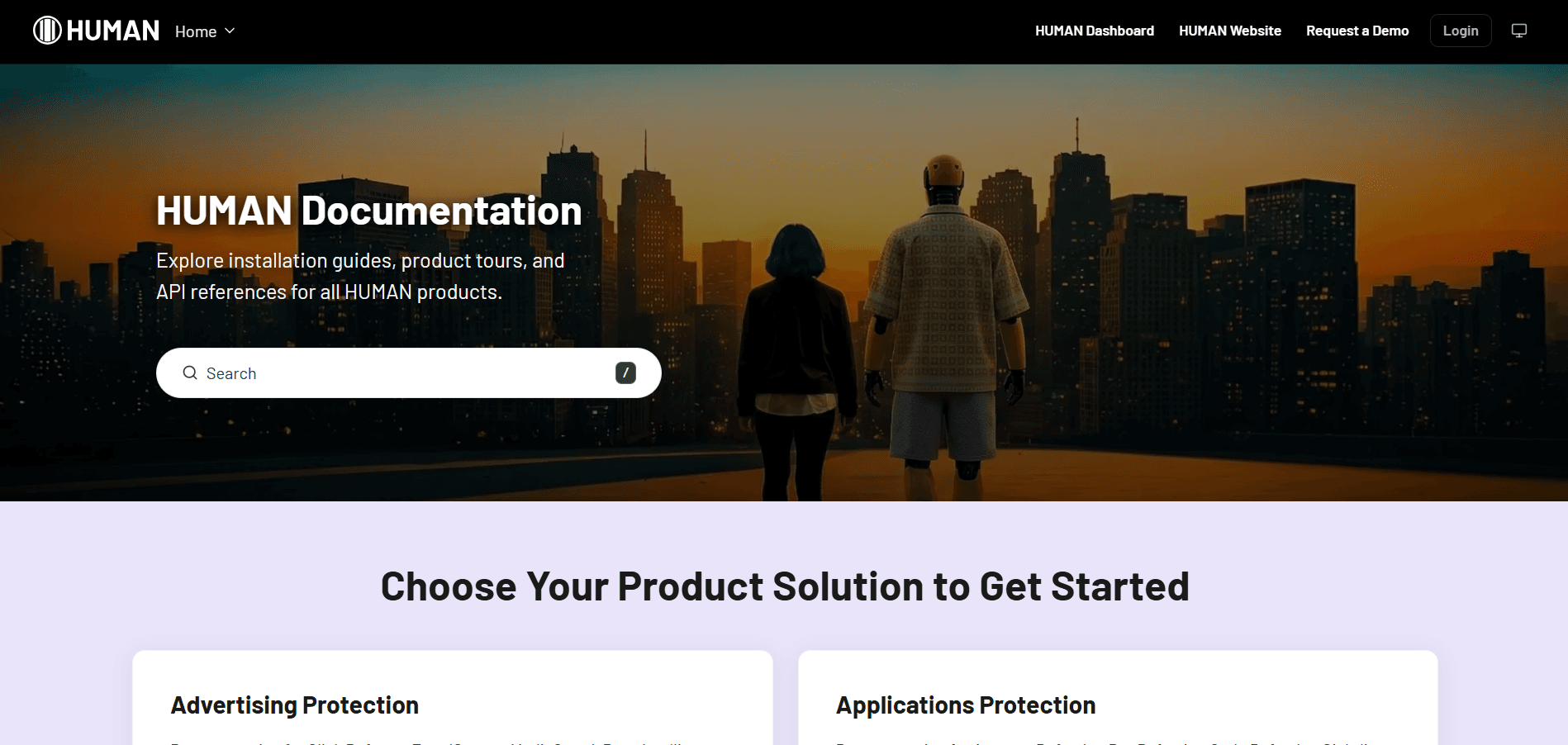
HUMAN is best evaluated as both a technology platform and an ongoing security partnership. It can suit organizations that want specialist threat research and active support alongside bot detection, especially when internal teams do not have the capacity to investigate and tune complex attacks alone.
Key strengths:
Specialist involvement: Managed analysis can reduce the burden on internal teams during sophisticated or fast-changing attacks.
Threat-research support: HUMAN’s researchers can help interpret shifts in attacker behavior and recommend policy changes.
Clear escalation path: Security teams gain access to specialist support when an active campaign requires deeper investigation.
Support for lean teams: The operating model can help organizations that lack a large, dedicated bot-management function.
Cross-team visibility: Centralized findings can help application owners, fraud teams, and security analysts work from the same attack context.
This model can be valuable when bots avoid obvious signatures or traffic spikes. Its effectiveness, however, depends on how clearly responsibilities are divided between HUMAN and the internal team.
WAF and integration fit:
Buyers should map where HUMAN’s sensors, detection logic, and enforcement controls sit across the CDN, WAF, load balancer, application server, browser, mobile app, and API stack.
HUMAN classifications should feed SIEM, fraud, authentication, and incident-response workflows. Teams also need clear processes for policy requests, emergency changes, false-positive reviews, and internal overrides.
What to consider:
Several reviewers mention that dashboard data may not always appear in real time during an attack, which can leave teams dependent on support for immediate detail. Occasional loading issues and slower access-log exports may also affect investigations.
Dashboard retention is limited to 14 days, so organizations that need longer forensic or compliance records should plan an external storage and export process.
HUMAN is a stronger fit when the managed-service element aligns with the organization’s incident process. Buyers should confirm who owns daily tuning, how quickly policy changes are deployed, whether emergency controls can be applied internally, and how traffic-based licensing behaves during attack spikes.
6. Imperva

Imperva is often shortlisted by organizations that want to extend an existing application-security operating model rather than add another independent control layer. Shared policies, reporting, support, and procurement can simplify ownership when bot activity is investigated alongside other application threats.
Key strengths:
Familiar operating model: Existing Imperva administrators can manage bot policies through established security processes.
Connected investigations: Application and bot events can be reviewed together, reducing the need to reconcile separate systems.
Reusable enforcement controls: Teams may be able to use current traffic routing, WAF rules, and response mechanisms.
Consolidated vendor management: WAF, API, and bot protection can remain under one commercial and support relationship.
Policy testing: Observation and testing modes can help teams assess business impact before applying stronger enforcement.
These capabilities are useful when security teams want one place to manage bot rules and application-risk events. Buyers should still examine whether fraud teams can access enough detail without depending on application-security specialists.
WAF and integration fit:
Imperva can combine bot classifications with application, API, geography, rate, and request conditions. Teams should decide whether enforcement remains inside Imperva or whether classifications are forwarded to origin systems and internal fraud workflows.
Bot decisions should be logged and exported to SIEM platforms, with clear ownership for policy exceptions, observation-mode testing, and rule changes. Buyers should also confirm whether identity, payment, or account-risk data can influence the final response.
What to consider:
Reviewers indicate that user friendliness could improve, particularly for teams that want a simpler way to interpret detections and interact with the platform.
Imperva may be less suitable when fraud decisions depend on device-account relationships, transaction history, or a provider-independent policy layer across several unrelated WAF and CDN environments.
Imperva is a stronger fit when infrastructure consolidation matters more than specialist bot research or narrowly scoped developer signals. Buyers should test how quickly new automation patterns can be addressed and whether browser and API traffic receive comparable decision context.
Related Read: Best Fraud Detection Software in 2026 for Unified Risk Decisions
How to Choose the Right Bot Detection Solution
The best-fit platform depends on where the attack appears and what the bot is trying to achieve. Edge-focused tools are often better for scraping and high-volume request filtering. Fraud-focused platforms are more useful when automation is tied to accounts, identities, or transactions.
The table below maps common attack types to the capabilities and vendors most relevant to each use case.
Primary Use Case | Capabilities to Prioritize | Platforms to Shortlist |
Credential stuffing and account takeover | Device recognition, behavioral analysis, login history, step-up authentication | Bureau, Cloudflare |
Fake account and promo abuse | Persistent device intelligence, identity context, account linking | Bureau, DataDome |
Web scraping and inventory hoarding | Request analysis, browser fingerprinting, rate limiting, edge enforcement | Cloudflare, DataDome |
API abuse | Server-side analysis, endpoint controls, token monitoring, rate limiting | Akamai, Imperva |
Card testing and transaction abuse | Device, velocity, behavioral, account, and payment signals | Bureau, HUMAN |
AI-agent traffic | Agent classification, verified-bot policies, page-level controls | Cloudflare, DataDome |
After narrowing the shortlist, assess how each platform handles uncertain traffic without blocking legitimate users. This matters for AI-agent and scraping activity, where robots.txt may offer limited protection.
A 2025 ACM Internet Measurement Conference study found that 20 of 23 tested AI assistant crawlers never fetched the file, while only one fetched and followed it consistently. This supports testing active agent classification, behavioral analysis, and page-level enforcement.
A proof of concept should test latency, conversion impact, tuning effort, and decision quality under real traffic. Total cost should also include deployment, investigation, and ongoing policy management.
Related Read: Session Hijacking Prevention: Detection & Controls
Stop Bot Attacks Without Hurting Conversion
Effective bot detection means allowing legitimate traffic while monitoring, challenging, rate-limiting, or blocking higher-risk activity. WAF- and CDN-native tools handle edge-level filtering well, but account takeover, fake registrations, promo abuse, and payment fraud often require deeper device, behavioral, identity, account, transaction, and network context.
Bureau brings these signals together in a unified risk decisioning layer. This helps teams detect automated and coordinated fraud, reduce false positives, and apply friction only where risk is higher. It also gives fraud and security teams one place to manage decisions across high-risk customer journeys instead of relying on fragmented point tools.
For teams facing account takeover, fake registrations, promo abuse, or transaction fraud, a quick demo with Bureau can strengthen detection without adding unnecessary friction for genuine users.
FAQs
1. What is bot detection software?
Bot detection software identifies automated traffic across websites, applications, APIs, and login flows. It evaluates network, browser, device, behavioral, and request signals to classify activity. Based on the risk level, the platform can allow the interaction, monitor it, apply rate limits, trigger a challenge or step-up check, restrict an action, or block the request.
2. What is the best bot detection software?
The best bot detection software depends on the attack type and existing infrastructure. Bureau fits bot-driven fraud across accounts and transactions, Cloudflare and Akamai suit edge protection, DataDome and HUMAN specialize in bot management, and Imperva fits teams already using its application-security stack.
3. How does bot detection software work?
Bot detection software collects signals from IP addresses, requests, browsers, devices, sessions, user behavior, accounts, and transactions. Rules and machine-learning models assess whether the activity is legitimate, uncertain, or malicious. The system can then allow, monitor, challenge, slow, restrict, or block the interaction based on the risk and the action being attempted.
4. Can a WAF detect bot traffic?
Yes, modern WAFs can detect many forms of automated traffic at the request and network layers. However, a standalone WAF may lack the device, behavioral, identity, account, or transaction context needed for fraud-focused bots. Bureau can add this deeper context when automation uses valid credentials, linked accounts, or human-like behavior to avoid edge-level detection.
5. How does Bureau detect bot-driven fraud?
Bureau detects bot-driven fraud by combining device intelligence, behavioral biometrics, identity signals, account relationships, and transaction context in one decisioning layer. This helps teams identify automation linked to account takeover, fake registrations, promo abuse, and payment fraud, then apply actions such as monitoring, step-up verification, restriction, review, or blocking based on risk.
6. Can bot detection software prevent credential stuffing?
Bot detection software can reduce credential stuffing by identifying abnormal login velocity, repeated device use, browser automation, residential proxies, rotating IPs, and unusual session behavior. Stronger protection combines these signals with adaptive authentication and continuous account monitoring. This helps detect attacks even when fraudsters use valid username and password combinations.
Modern bots imitate real users, rotate devices and IPs, and automate account creation, login attempts, card testing, scraping, and promo abuse. Bot detection software helps businesses spot this activity early without slowing down genuine customers.
The strongest bot detection platforms combine behavioral, device, browser, network, and risk signals. This makes it easier to separate malicious automation from approved crawlers, partner integrations, and legitimate users.
This list compares 6 bot detection solutions across detection depth, false-positive control, integration fit, mitigation options, and the attack surfaces each platform is built to protect.
Bot Detection Software Comparison: Top Tools at a Glance
Bot detection software identifies and classifies automated traffic across websites, applications, APIs, and login flows. The main categories include fraud and risk decisioning platforms, WAF-native bot managers, dedicated bot mitigation software, adaptive challenge providers, and device or browser intelligence tools.
These platforms solve different parts of the problem. Some focus on stopping suspicious requests at the edge. Others assess the user, account, device, behavior, and transaction behind the request.
Tool | Core Detection Approach | Primary Coverage | Behavioral and Fraud Context | WAF Integration | Best For |
Bureau | Device, behavior, identity, network, graph, and account-risk signals | Web, mobile, and API journeys | High; connects automation to accounts, identities, devices, and transactions | Complements WAF and CDN controls through APIs and SDKs | Fraud and bot abuse detection across onboarding, login, recovery, and transactions |
Cloudflare | Edge machine learning, request scoring, browser, and network signals | Websites and web applications | Moderate; strongest at request and traffic analysis | Native Cloudflare integration | Businesses already using Cloudflare CDN and WAF |
Akamai | Behavioral analysis, fingerprinting, HTTP anomalies, and bot scoring | Web, mobile, and APIs | High behavioral depth with enterprise traffic context | Native Akamai integration | Large enterprises with high-volume digital traffic |
DataDome | Intent analysis, real-time classification, and adaptive mitigation | Web, mobile, APIs, cloud, and CDN environments | Strong bot behavior and intent analysis | Supports multi-infrastructure deployment | Dedicated bot protection across varied infrastructure |
HUMAN | Behavioral fingerprints, predictive detection, and device signals | Web, mobile, and APIs | Strong behavioral analysis with managed threat expertise | Supports varied infrastructure integrations | Enterprise teams seeking specialist support |
Imperva | Request analysis, bot models, policy controls, and reporting | Websites and APIs | Moderate; focused on application and request risk | Native Imperva integration | Organizations already using Imperva security products |
The shortlist should reflect where automation appears and how much context the decision requires. Login abuse often needs device, behavioral, and identity signals, while scraping and high-volume attacks may depend more on edge enforcement and WAF integration. Detection accuracy, false-positive control, coverage, and response flexibility provide a clearer basis for comparing the leading platforms.
How the Best Bot Detection Software Were Selected
Choosing the best bot detection software requires more than checking whether a platform uses AI or machine learning. Stronger products should detect evasive automation, separate malicious bots from legitimate traffic, and support proportionate responses without adding unnecessary friction.
Each platform was evaluated across six criteria:
Detection accuracy: Ability to identify headless browsers, automation frameworks, emulators, residential proxies, rotating IPs, distributed botnets, and low-and-slow attacks. This matters because modern bots often avoid obvious traffic spikes and simple signature-based controls.
Behavioral and device intelligence: Depth of analysis across navigation, typing, gestures, session timing, browser signals, device history, spoofing, and repeat-device activity. These signals help expose automation that is designed to resemble genuine user behavior.
False-positive control: Ability to distinguish genuine users, approved crawlers, partner bots, uncertain sessions, and confirmed malicious traffic. Strong false-positive control protects conversion and prevents legitimate activity from being blocked unnecessarily.
Coverage and integration fit: Support for web, mobile, login, registration, checkout, and APIs, along with compatibility across WAFs, CDNs, SDKs, SIEM platforms, authentication systems, and fraud tools. Broad coverage matters because bot attacks often move across several channels and workflows.
Mitigation flexibility: Range of actions available, including monitoring, rate limiting, step-up verification, challenges, restricted access, review, and blocking. Flexible responses allow teams to match the action to the level of risk instead of relying on block-only decisions.
Explainability and proof-of-concept performance: Clear reason codes, attack reporting, endpoint visibility, policy controls, detection rates, false-positive rates, latency, challenge frequency, conversion impact, and tuning effort. These measures show whether the platform performs well under real traffic and can be managed effectively after deployment.
Vendor-reported accuracy claims should not be compared directly unless they were tested under equivalent, independent conditions.
Verizon’s 2025 DBIR research found that credential stuffing accounted for a median 19% of daily authentication attempts. The rate reached 25% among enterprise organizations and peaked at 44% on the highest single day observed. This shows why credential stuffing should be treated as a persistent authentication risk, not just a short-lived traffic spike.
6 Best Bot Detection Software Platforms in 2026
These six platforms address bot attacks across different layers, from edge traffic and APIs to devices, accounts, and transactions. The profiles highlight where each tool fits best, how it integrates, and the types of attacks it is built to handle.
1. Bureau
Bureau is an AI-powered Unified Risk Decisioning Platform that places bot detection inside a broader fraud and risk workflow. It helps businesses assess whether an interaction, user, account, or transaction can be trusted, rather than treating automation as an isolated traffic event.
Its bot detection capabilities connect suspicious activity with device history, behavioral patterns, account relationships, identity signals, and transaction context, elevating fraud prevention from account-level defense to network-level intelligence. This is useful when bots are part of a wider fraud workflow involving account takeover, fake account creation, promo abuse, mule activity, or payment fraud.
Key strengths:
Decision-led bot detection: Bureau helps teams allow, monitor, challenge, review, restrict, or block activity instead of returning a standalone bot classification.
Persistent device recognition: Its Device ID helps identify repeat attackers even after cookie clearing, incognito use, account changes, or device resets.
Behavioral context: Behavioral biometrics can surface scripted navigation, unusual interaction patterns, and activity that resembles legitimate customer behavior.
Connected fraud intelligence: The Graph Identity Network links accounts, devices, identities, and behaviors that may appear low risk when reviewed separately.
Unified fraud workflows: Bot intelligence can feed onboarding, authentication, account recovery, transaction monitoring, and fraud-review decisions through the same orchestration layer.
Flexible response controls: Teams can apply different actions based on what the user is attempting and the level of risk involved.
Explainable decisions: Risk results can include the signals and relationships that influenced the outcome, supporting investigations and policy tuning.
These capabilities matter when automated traffic continues beyond the initial request. A fraudster may pass signup, rotate credentials, switch devices, and move into promo abuse or account takeover. Bureau helps teams connect those events and assess the broader intent behind them.
How Bureau helped an insurer cut fraud and speed up onboarding
A major private insurer was dealing with fake applications submitted by internal field agents. Some agents misused real customer data or created synthetic identities, while email- and SMS-based checks failed because those channels were often under the agents’ control.
Bureau combined real-time identity verification with device and behavioral analysis to flag agent-led abuse at the source. It also applied risk-based onboarding, allowing lower-risk applicants to move through the process with less friction.
Results achieved:
More than 100 fake applications flagged within the first week
Onboarding time reduced by 30%
Customer complaints linked to unauthorized applications declined
Conversion improved as genuine applicants moved through the process faster
37% of users benefited from a more seamless onboarding journey
Read the full case study here → A Leading Insurer Cuts Fraud to Drive 30% Faster Onboarding
WAF and integration fit:
A WAF or CDN can continue handling request filtering, known signatures, rate limits, and edge enforcement. Bureau adds application, device, session, account, identity, and transaction context through APIs and SDKs.
Bureau’s risk output can feed application logic, authentication services, fraud engines, or case-management workflows to trigger MFA, identity verification, transaction limits, account restrictions, review, or rejection.
What to consider:
Define where Bureau should influence the decision, which system owns the final action, and how confirmed fraud or false positives feed back into the workflow.
Map which existing bot, device, fraud, and decisioning tools Bureau will replace, retain, or orchestrate, then include the operational value of consolidated rules and investigations in the business case.
Pricing: Pricing is customized based on traffic volume, selected modules, supported journeys, and workflow requirements.
2. Cloudflare
Cloudflare is most relevant for organizations that already run traffic through Cloudflare and want bot controls managed inside the same application-security environment. It allows security teams to reuse existing routes, rules, dashboards, and ownership models while acting on suspicious requests before they reach the origin.
Key strengths:
Unified security operations: Bot rules can sit alongside CDN, WAF, DDoS, rate-limiting, and challenge policies within one operating environment.
Flexible policy logic: Bot classifications can be combined with route, geography, request rate, threat level, or authentication conditions.
Endpoint-specific controls: Teams can apply different responses to login pages, APIs, checkout flows, content pages, and crawler traffic.
Custom edge decisions: Bot scores can support custom logic instead of forcing every suspicious request into the same default action.
Infrastructure consolidation: Existing Cloudflare customers can often extend current controls without creating a separate traffic path or adding another operational owner.
These capabilities are useful when bot mitigation needs to happen early in the request flow. A team can treat a suspicious login differently from a scraper, approved crawler, or high-volume API client while keeping enforcement close to the edge.
WAF and integration fit:
Bot scores can feed WAF rules, rate-limiting logic, edge functions, or application headers. Teams should decide whether enforcement stays at the edge or whether the score also passes to origin systems.
Login and account decisions may still need internal user-risk data. Cloudflare events should therefore be mapped into authentication, fraud-monitoring, SIEM, and incident-response workflows.
What to consider:
Some users report that initial configuration and advanced policy tuning can be difficult without strong networking or application-security expertise. Troubleshooting specific rules may also require deeper platform knowledge.
Buyers should confirm whether the required bot-score granularity, logging mode, endpoint-level thresholds, and export options are included in the selected plan.
Cloudflare may be less suitable when bot decisions depend heavily on payment history, identity data, linked accounts, or device relationships. It may also be a weaker fit for organizations that need one provider-independent policy layer across several CDN or WAF environments.
3. Akamai
Akamai is built for organizations that need detailed control over different types of automated traffic. It allows teams to separate valuable bots, suspicious automation, and confirmed attacks, then apply different responses across business-critical journeys.
Key strengths:
Granular policy control: Teams can apply different actions to approved bots, unwanted automation, uncertain traffic, and known attacks.
Journey-specific protection: Policies can be tuned separately for login, search, checkout, inventory, and API endpoints.
Flexible responses: Secondary actions help manage uncertain traffic without defaulting immediately to a hard block.
Centralized governance: Bot rules can be managed across several digital properties within a wider application-security program.
Business-impact visibility: Security teams can assess how policy changes affect traffic, customer experience, and high-value routes.
These capabilities are useful when bot activity affects more than security alone. Ecommerce, fraud, inventory, customer experience, and application teams may all depend on the same policies, which makes ownership and governance especially important.
WAF and integration fit:
Request-level scores can feed application-protection rules at the edge or be passed to origin systems. Teams should define how those scores combine with customer, payment, or account-risk data.
Browser, mobile, and API traffic may require different instrumentation. Security events should also flow into SIEM and fraud-investigation systems, with clear controls for policy approvals, rollback, and exceptions.
What to consider:
Users have flagged that the interface can take several weeks to become familiar with, especially for first-time users navigating detailed policy controls.
Pricing can be relatively high, so smaller organizations or businesses with lower traffic volumes should confirm that the operational depth justifies the investment.
Akamai is best suited to teams that can support detailed policy governance across security, engineering, fraud, and digital operations. Buyers should also test conversion impact on high-value journeys and confirm how quickly policies can be adjusted when new attack patterns appear.
4. DataDome
DataDome is a strong fit for organizations that want specialist bot protection without changing their existing CDN, WAF, or cloud stack. It helps centralize bot policies across brands, applications, and infrastructure providers while keeping automated abuse separate from broader application-security controls.
Key strengths:
Consistent policy layer: Teams can apply bot controls across different markets, brands, applications, and infrastructure environments.
Specialist bot focus: DataDome’s product and threat research are centered on automated abuse rather than a wider security portfolio.
Independent detection: Suspicious automation can be evaluated separately from the organization’s primary WAF or CDN vendor.
Cross-environment governance: Businesses can avoid rebuilding similar bot policies across several infrastructure tools.
Agent-aware controls: Policies can distinguish between approved crawlers, AI agents, commercial scrapers, and malicious automation.
These capabilities matter when the same organization operates across several technology stacks. Buyers should still test whether policies behave consistently across browser, mobile, and API traffic, and whether the evidence behind each classification is detailed enough for fraud and security teams.
WAF and integration fit:
DataDome can be deployed through connectors, edge integrations, server-side calls, or client-side instrumentation. Teams should define where decisions occur and whether mitigation is enforced by DataDome or the existing WAF.
Request context and bot events should flow into SIEM, data warehouse, and fraud systems. Policy ownership also needs to prevent duplicate challenges, rate limits, or conflicting actions across tools.
What to consider:
Customer feedback highlights that managing many tenants can become cumbersome because tenant switching and role-based access controls are handled separately. A centralized administration layer may therefore be important for large, multi-brand environments.
Dashboard exports can be limited for very large attack datasets, which may require vendor support when teams need a full extract for investigation or analysis.
A proof of concept should include every major environment, not only the primary website. Buyers should also clarify which controls are self-managed, which depend on DataDome support, and how policy changes propagate across tenants and infrastructure providers.
5. HUMAN
HUMAN is best evaluated as both a technology platform and an ongoing security partnership. It can suit organizations that want specialist threat research and active support alongside bot detection, especially when internal teams do not have the capacity to investigate and tune complex attacks alone.
Key strengths:
Specialist involvement: Managed analysis can reduce the burden on internal teams during sophisticated or fast-changing attacks.
Threat-research support: HUMAN’s researchers can help interpret shifts in attacker behavior and recommend policy changes.
Clear escalation path: Security teams gain access to specialist support when an active campaign requires deeper investigation.
Support for lean teams: The operating model can help organizations that lack a large, dedicated bot-management function.
Cross-team visibility: Centralized findings can help application owners, fraud teams, and security analysts work from the same attack context.
This model can be valuable when bots avoid obvious signatures or traffic spikes. Its effectiveness, however, depends on how clearly responsibilities are divided between HUMAN and the internal team.
WAF and integration fit:
Buyers should map where HUMAN’s sensors, detection logic, and enforcement controls sit across the CDN, WAF, load balancer, application server, browser, mobile app, and API stack.
HUMAN classifications should feed SIEM, fraud, authentication, and incident-response workflows. Teams also need clear processes for policy requests, emergency changes, false-positive reviews, and internal overrides.
What to consider:
Several reviewers mention that dashboard data may not always appear in real time during an attack, which can leave teams dependent on support for immediate detail. Occasional loading issues and slower access-log exports may also affect investigations.
Dashboard retention is limited to 14 days, so organizations that need longer forensic or compliance records should plan an external storage and export process.
HUMAN is a stronger fit when the managed-service element aligns with the organization’s incident process. Buyers should confirm who owns daily tuning, how quickly policy changes are deployed, whether emergency controls can be applied internally, and how traffic-based licensing behaves during attack spikes.
6. Imperva
Imperva is often shortlisted by organizations that want to extend an existing application-security operating model rather than add another independent control layer. Shared policies, reporting, support, and procurement can simplify ownership when bot activity is investigated alongside other application threats.
Key strengths:
Familiar operating model: Existing Imperva administrators can manage bot policies through established security processes.
Connected investigations: Application and bot events can be reviewed together, reducing the need to reconcile separate systems.
Reusable enforcement controls: Teams may be able to use current traffic routing, WAF rules, and response mechanisms.
Consolidated vendor management: WAF, API, and bot protection can remain under one commercial and support relationship.
Policy testing: Observation and testing modes can help teams assess business impact before applying stronger enforcement.
These capabilities are useful when security teams want one place to manage bot rules and application-risk events. Buyers should still examine whether fraud teams can access enough detail without depending on application-security specialists.
WAF and integration fit:
Imperva can combine bot classifications with application, API, geography, rate, and request conditions. Teams should decide whether enforcement remains inside Imperva or whether classifications are forwarded to origin systems and internal fraud workflows.
Bot decisions should be logged and exported to SIEM platforms, with clear ownership for policy exceptions, observation-mode testing, and rule changes. Buyers should also confirm whether identity, payment, or account-risk data can influence the final response.
What to consider:
Reviewers indicate that user friendliness could improve, particularly for teams that want a simpler way to interpret detections and interact with the platform.
Imperva may be less suitable when fraud decisions depend on device-account relationships, transaction history, or a provider-independent policy layer across several unrelated WAF and CDN environments.
Imperva is a stronger fit when infrastructure consolidation matters more than specialist bot research or narrowly scoped developer signals. Buyers should test how quickly new automation patterns can be addressed and whether browser and API traffic receive comparable decision context.
Related Read: Best Fraud Detection Software in 2026 for Unified Risk Decisions
How to Choose the Right Bot Detection Solution
The best-fit platform depends on where the attack appears and what the bot is trying to achieve. Edge-focused tools are often better for scraping and high-volume request filtering. Fraud-focused platforms are more useful when automation is tied to accounts, identities, or transactions.
The table below maps common attack types to the capabilities and vendors most relevant to each use case.
Primary Use Case | Capabilities to Prioritize | Platforms to Shortlist |
Credential stuffing and account takeover | Device recognition, behavioral analysis, login history, step-up authentication | Bureau, Cloudflare |
Fake account and promo abuse | Persistent device intelligence, identity context, account linking | Bureau, DataDome |
Web scraping and inventory hoarding | Request analysis, browser fingerprinting, rate limiting, edge enforcement | Cloudflare, DataDome |
API abuse | Server-side analysis, endpoint controls, token monitoring, rate limiting | Akamai, Imperva |
Card testing and transaction abuse | Device, velocity, behavioral, account, and payment signals | Bureau, HUMAN |
AI-agent traffic | Agent classification, verified-bot policies, page-level controls | Cloudflare, DataDome |
After narrowing the shortlist, assess how each platform handles uncertain traffic without blocking legitimate users. This matters for AI-agent and scraping activity, where robots.txt may offer limited protection.
A 2025 ACM Internet Measurement Conference study found that 20 of 23 tested AI assistant crawlers never fetched the file, while only one fetched and followed it consistently. This supports testing active agent classification, behavioral analysis, and page-level enforcement.
A proof of concept should test latency, conversion impact, tuning effort, and decision quality under real traffic. Total cost should also include deployment, investigation, and ongoing policy management.
Related Read: Session Hijacking Prevention: Detection & Controls
Stop Bot Attacks Without Hurting Conversion
Effective bot detection means allowing legitimate traffic while monitoring, challenging, rate-limiting, or blocking higher-risk activity. WAF- and CDN-native tools handle edge-level filtering well, but account takeover, fake registrations, promo abuse, and payment fraud often require deeper device, behavioral, identity, account, transaction, and network context.
Bureau brings these signals together in a unified risk decisioning layer. This helps teams detect automated and coordinated fraud, reduce false positives, and apply friction only where risk is higher. It also gives fraud and security teams one place to manage decisions across high-risk customer journeys instead of relying on fragmented point tools.
For teams facing account takeover, fake registrations, promo abuse, or transaction fraud, a quick demo with Bureau can strengthen detection without adding unnecessary friction for genuine users.
FAQs
1. What is bot detection software?
Bot detection software identifies automated traffic across websites, applications, APIs, and login flows. It evaluates network, browser, device, behavioral, and request signals to classify activity. Based on the risk level, the platform can allow the interaction, monitor it, apply rate limits, trigger a challenge or step-up check, restrict an action, or block the request.
2. What is the best bot detection software?
The best bot detection software depends on the attack type and existing infrastructure. Bureau fits bot-driven fraud across accounts and transactions, Cloudflare and Akamai suit edge protection, DataDome and HUMAN specialize in bot management, and Imperva fits teams already using its application-security stack.
3. How does bot detection software work?
Bot detection software collects signals from IP addresses, requests, browsers, devices, sessions, user behavior, accounts, and transactions. Rules and machine-learning models assess whether the activity is legitimate, uncertain, or malicious. The system can then allow, monitor, challenge, slow, restrict, or block the interaction based on the risk and the action being attempted.
4. Can a WAF detect bot traffic?
Yes, modern WAFs can detect many forms of automated traffic at the request and network layers. However, a standalone WAF may lack the device, behavioral, identity, account, or transaction context needed for fraud-focused bots. Bureau can add this deeper context when automation uses valid credentials, linked accounts, or human-like behavior to avoid edge-level detection.
5. How does Bureau detect bot-driven fraud?
Bureau detects bot-driven fraud by combining device intelligence, behavioral biometrics, identity signals, account relationships, and transaction context in one decisioning layer. This helps teams identify automation linked to account takeover, fake registrations, promo abuse, and payment fraud, then apply actions such as monitoring, step-up verification, restriction, review, or blocking based on risk.
6. Can bot detection software prevent credential stuffing?
Bot detection software can reduce credential stuffing by identifying abnormal login velocity, repeated device use, browser automation, residential proxies, rotating IPs, and unusual session behavior. Stronger protection combines these signals with adaptive authentication and continuous account monitoring. This helps detect attacks even when fraudsters use valid username and password combinations.
TABLE OF CONTENTS
See More
Recommended Blogs



Landing Page.
Simple, bold.
Sign Up
Download

Products
Solutions


© 2026 Bureau . All rights reserved.
Solutions
Industries
Resources
Company
Solutions
Industries
Resources
Company
© 2026 Bureau . All rights reserved.
Follow Us
Leave behind fragmented tools. Stop fraud rings, cut false declines, and deliver secure digital journeys at scale
Our Presence








Leave behind fragmented tools. Stop fraud rings, cut false declines, and deliver secure digital journeys at scale
Our Presence
© 2026 Bureau . All rights reserved.