Proven Strategies to Increase D2C Cart Conversions and Reduce Abandoned Checkouts
Proven Strategies to Increase D2C Cart Conversions and Reduce Abandoned Checkouts
Proven Strategies to Increase D2C Cart Conversions and Reduce Abandoned Checkouts
Reducing cart abandonment via a friction-free checkout and payment funnel is not only fundamental but also very important for user experience. Read our.
Author
Team Bureau


See how Bureau has helped industry leaders defend against networked Industrial-scale frauds →
Schedule a Demo
TABLE OF CONTENTS
See Less
This is the final part of our Supercharging Conversions for D2C brands series. Read Part 1 and Part 2.
Increasing Add-to-cart via a Conversion Optimised Product Page
So, you have run campaigns to acquire relevant users with affinity to your offerings, high willingness and capacity to pay, decreased page load times to avoid drop offs, and optimised product search to land more users on the product page.
But then, having an under-optimised product page can undo a lot of the good work of you and your team. Here are a few pointers to consider on how to go about creating a conversion optimised product page:
Product Information
- Give a crisp product overview without causing cognitive overload.
- Focus and amplify benefits of your product
- Use power words
- Add product details and size chart wherever relevant
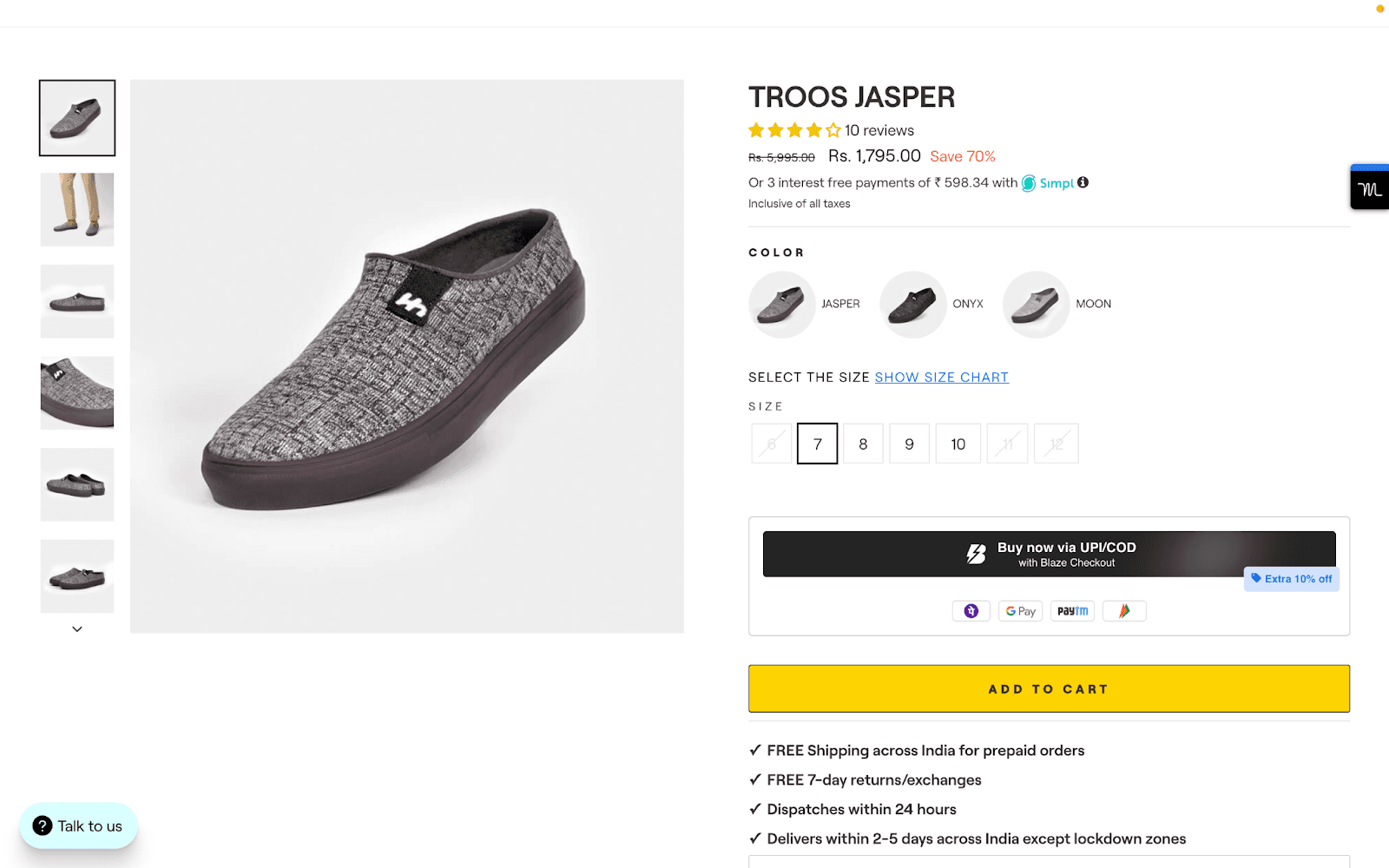
Have a clear Call-to-action (CTA) above the fold for making it easy for consumers to add-to-cart
?Ensure there is no other CTA that takes away from the page like social media links
?Give visitors the option to reach out and chat instantly for query.
?Run seasonal or periodic discounts
- EMI offers: Give customer the option to split payment
- Flat discount offers: Give flat discount on certain products
- Bundled discount offers: Offer extra discount on buying more items or for a certain cart value.
- Product collaboration: Collaborate with another D2C brand for exclusive offers when purchasing together. Eg: if you make jams and marmalade, collaborate with another D2C brand into the baked goods category to offer discounts when bought together.
Collaborate with partners like Blaze or banks to run additional discount offers
?Use social proofing for building trust
- Product reviews or testimonials
- Showcase purchase or other impact numbers
Reducing Cart Abandonment via a Friction-free Checkout and Payment Funnel
Once the customer has made the decision to add the product(s) to the cart, they can still drop-off before completing the transaction.
7 of the common friction points for Cart Abandonment:
No guest login or cumbersome login process with OTP delays
?Unexpected product, shipping, or additional fees
?Limited shipping or payment options that are not inclusive to the requirement
?Cumbersome performance and speed of the process including:
- Long, complex checkout process
- Many form fields to input
Inadequate security or fraud protection seems inadequate
- Credit card and security badges
- Unsafe payment processing tools
Website crashes, errors, and bugs
?Declined credit card or payment
7 Points to optimise for more conversion post-cart addition:
Educate about additional charges on product page and remove any unexpected or additional charges at the time of checkout
?Do not force account creation or registration at checkout. Provide a guest checkout option for first-time users.
?Reduce checkout time by using tools like Blaze that help reduce checkout time by 70%
?Integrate with popular payment methods.
?Offer Cash-on-delivery (COD) which can constitute as high as 60% of the payment method of choice for your consumers. You can always intelligently enable or disable Cash-on-delivery (COD) options via Blaze Checkout to incentivise COD customers to convert into prepaid or assess RTO. Learn more here.
?Provide 2-day shipping in Tier 1 cities in India.
?Ensure there are no other distractions
Conclusion
There you have it, 3 steps to fine tune and optimise your e-commerce store to drive better conversion rates:
Acquisition campaigns premised on industry and category insights
?Conversion Optimised Product Pages
?A Friction-free checkout and payment funnel
With a checkout partner like Blaze, step 3 is taken care off for you.Not only does Blaze offer a unique, friction free checkout experience, we optimise for speed, security and ROI through our built-in Return to Origin (RTO) guarantee.
This is the final part of our Supercharging Conversions for D2C brands series. Read Part 1 and Part 2.
Increasing Add-to-cart via a Conversion Optimised Product Page
So, you have run campaigns to acquire relevant users with affinity to your offerings, high willingness and capacity to pay, decreased page load times to avoid drop offs, and optimised product search to land more users on the product page.
But then, having an under-optimised product page can undo a lot of the good work of you and your team. Here are a few pointers to consider on how to go about creating a conversion optimised product page:
Product Information
- Give a crisp product overview without causing cognitive overload.
- Focus and amplify benefits of your product
- Use power words
- Add product details and size chart wherever relevant
Have a clear Call-to-action (CTA) above the fold for making it easy for consumers to add-to-cart
?Ensure there is no other CTA that takes away from the page like social media links
?Give visitors the option to reach out and chat instantly for query.
?Run seasonal or periodic discounts
- EMI offers: Give customer the option to split payment
- Flat discount offers: Give flat discount on certain products
- Bundled discount offers: Offer extra discount on buying more items or for a certain cart value.
- Product collaboration: Collaborate with another D2C brand for exclusive offers when purchasing together. Eg: if you make jams and marmalade, collaborate with another D2C brand into the baked goods category to offer discounts when bought together.
Collaborate with partners like Blaze or banks to run additional discount offers
?Use social proofing for building trust
- Product reviews or testimonials
- Showcase purchase or other impact numbers
Reducing Cart Abandonment via a Friction-free Checkout and Payment Funnel
Once the customer has made the decision to add the product(s) to the cart, they can still drop-off before completing the transaction.
7 of the common friction points for Cart Abandonment:
No guest login or cumbersome login process with OTP delays
?Unexpected product, shipping, or additional fees
?Limited shipping or payment options that are not inclusive to the requirement
?Cumbersome performance and speed of the process including:
- Long, complex checkout process
- Many form fields to input
Inadequate security or fraud protection seems inadequate
- Credit card and security badges
- Unsafe payment processing tools
Website crashes, errors, and bugs
?Declined credit card or payment
7 Points to optimise for more conversion post-cart addition:
Educate about additional charges on product page and remove any unexpected or additional charges at the time of checkout
?Do not force account creation or registration at checkout. Provide a guest checkout option for first-time users.
?Reduce checkout time by using tools like Blaze that help reduce checkout time by 70%
?Integrate with popular payment methods.
?Offer Cash-on-delivery (COD) which can constitute as high as 60% of the payment method of choice for your consumers. You can always intelligently enable or disable Cash-on-delivery (COD) options via Blaze Checkout to incentivise COD customers to convert into prepaid or assess RTO. Learn more here.
?Provide 2-day shipping in Tier 1 cities in India.
?Ensure there are no other distractions
Conclusion
There you have it, 3 steps to fine tune and optimise your e-commerce store to drive better conversion rates:
Acquisition campaigns premised on industry and category insights
?Conversion Optimised Product Pages
?A Friction-free checkout and payment funnel
With a checkout partner like Blaze, step 3 is taken care off for you.Not only does Blaze offer a unique, friction free checkout experience, we optimise for speed, security and ROI through our built-in Return to Origin (RTO) guarantee.
TABLE OF CONTENTS
See More
Recommended Blogs



Landing Page.
Simple, bold.
Sign Up
Download

Products
Solutions


© 2026 Bureau . All rights reserved.
Solutions
Industries
Resources
Company
Solutions
Industries
Resources
Company
© 2026 Bureau . All rights reserved.
Follow Us
Leave behind fragmented tools. Stop fraud rings, cut false declines, and deliver secure digital journeys at scale
Our Presence








Leave behind fragmented tools. Stop fraud rings, cut false declines, and deliver secure digital journeys at scale
Our Presence
© 2026 Bureau . All rights reserved.