Identifying and Stopping Money Mules Before They Damage Your Business
Identifying and Stopping Money Mules Before They Damage Your Business
Identifying and Stopping Money Mules Before They Damage Your Business
Detecting mule accounts is a complex process as criminals employ various methods to launder stolen funds. Learn effective prevention strategies.
Author
Maruthi Kumar


See how Bureau has helped industry leaders defend against networked Industrial-scale frauds →
Schedule a Demo
TABLE OF CONTENTS
See Less
Since time immemorial, mules have been used as a preferred mode of transport for goods. While their utility, over the years, has dwindled, the term is now used to refer to criminals who use humans to move stolen money across different accounts to cash out of fraudulent transactions. Mules have been known to cause damages worth
?
Who are Money Mules?
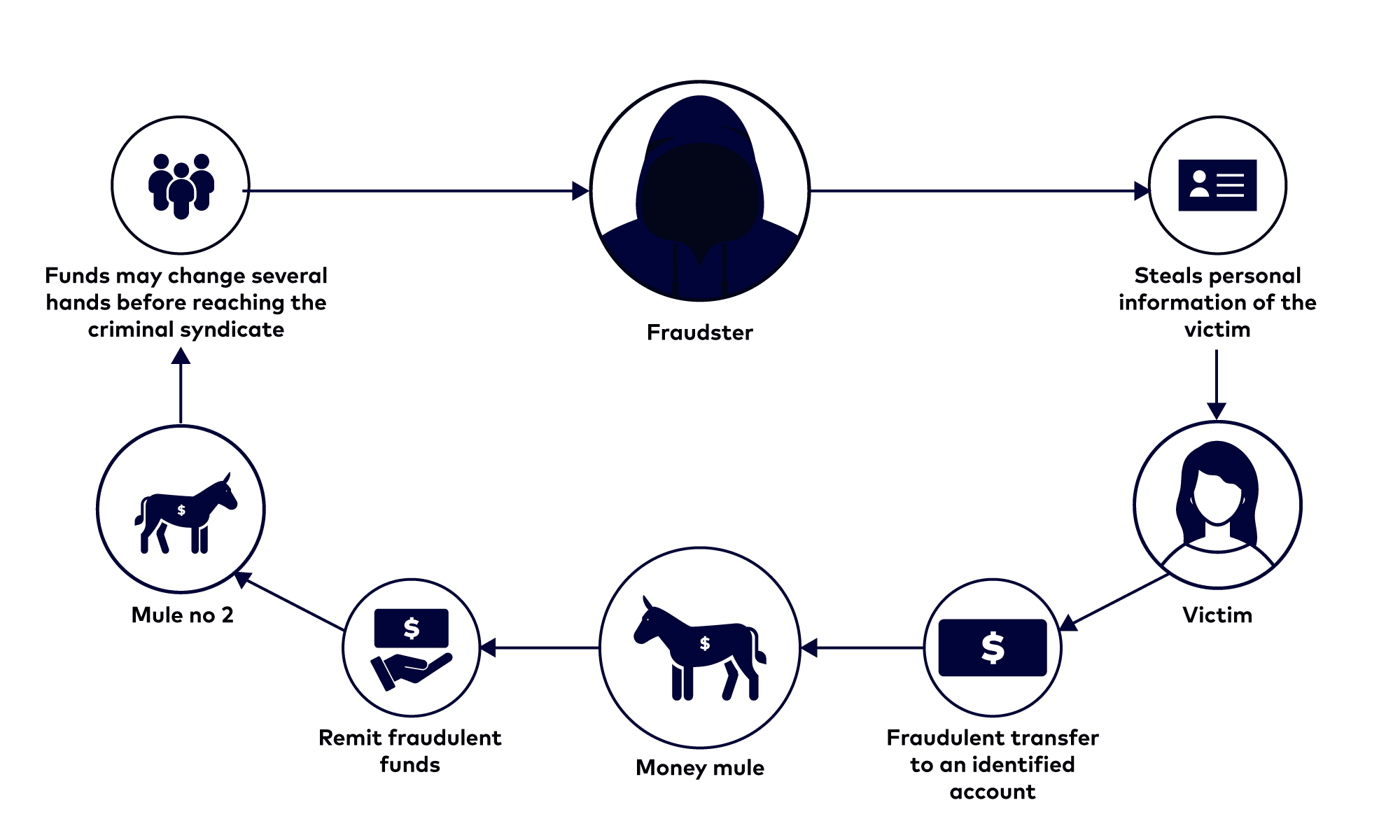
A money mule is someone who illegally transfers money on behalf of someone else. These accounts play a critical role in the fraud supply chain and the money laundering process. Syndicated crime rings usually pay mules a percentage of successfully transferred/laundered funds. Such funds are typically accrued via financial fraud or any other illicit activity.
Types of Mules
?
Unwitting money mule: Individuals that are unaware they are involved in criminal activity
Witting money mule: Individuals that should be aware they are involved in suspicious activity but engage in it anyway, mostly for monetary benefits
Complicit money mule: Fully understand their role, working closely with criminal networks to plan and execute fraud
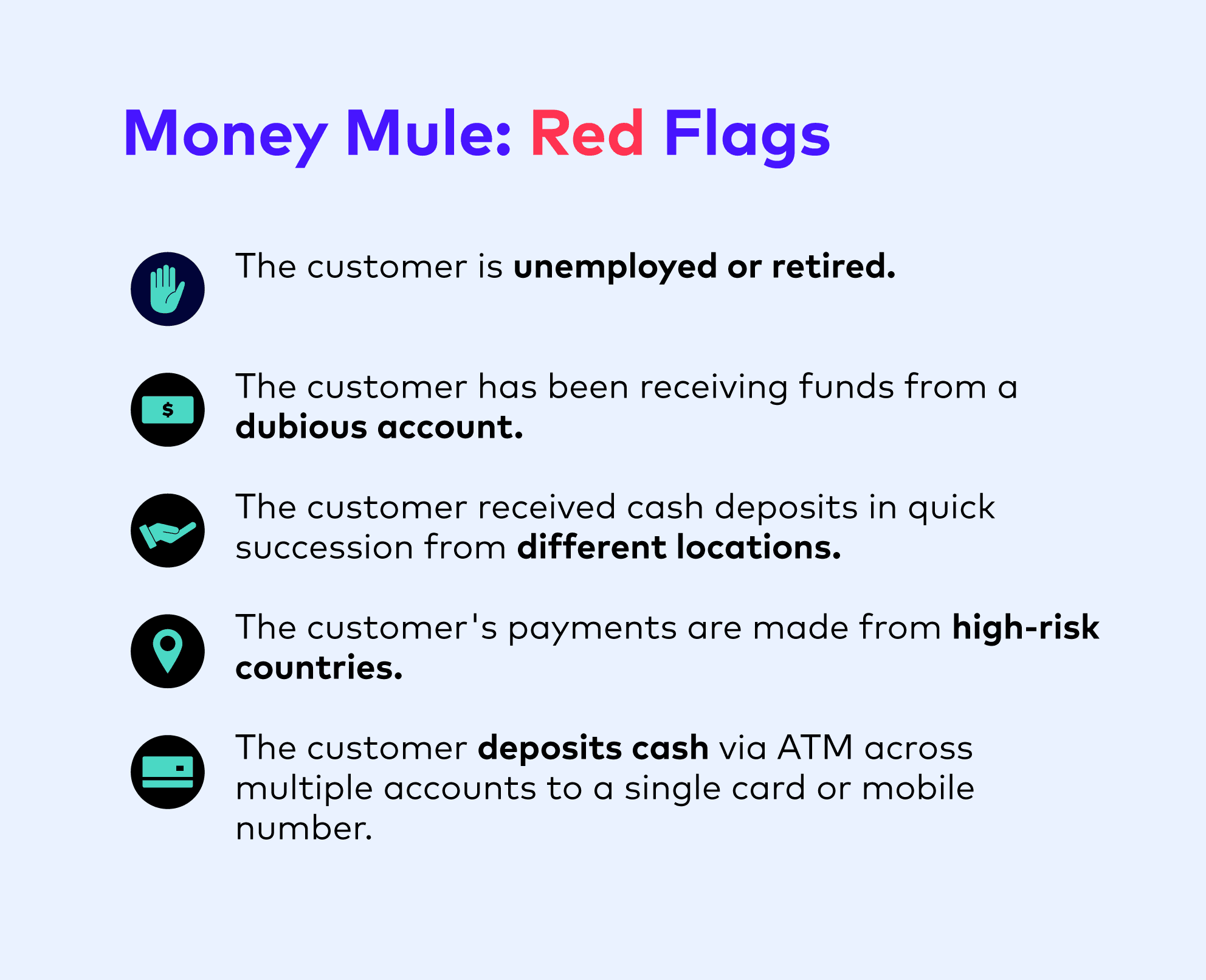
Irrespective of the actual MO, it is challenging to identify money mules during onboarding. It involves a genuine account and legitimate actions from account holders. Hence simple KYC checks are often ineffective and inadequate.
How do Money Mules Impact Your Business
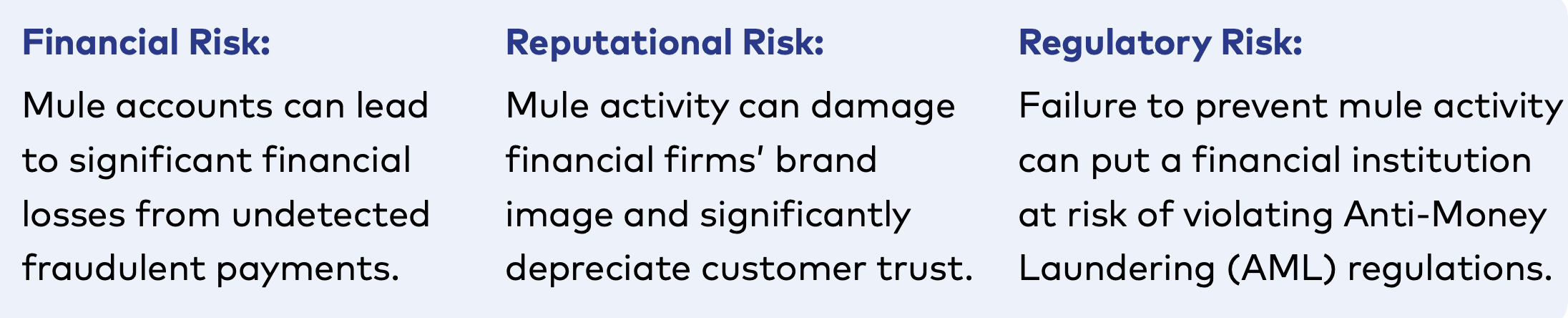
Money Mule accounts can lead to a variety of adverse outcomes for financial organisations:
?
Identifying mules has become challenging, with the pandemic providing a solid impetus to digital banking. Crime rings have been employing the services of displaced workers while also abusing economic relief programs from a fraud perspective. All of this has led to steady growth in money mules’ activity since the beginning of the pandemic.
Related read: Social Engineering Tactics: Exploring the ‘Human’ Angle in Fraud
Recent cases of significant damages caused by Money Mules
Authorities in Bengaluru, India, arrested individuals operating 126 mule accounts linked to various cybercrimes across India. Preliminary analysis revealed that fraudsters used a single device shared among multiple reported mule accounts, indicating a sophisticated network. At least $220,000 is known to have passed through these accounts. ?
Operation Jackal III, coordinated by Interpol, this operation targeted West African organized crime groups, including the notorious Black Axe syndicate. Conducted from April to July 2024 across 21 countries, the operation led to approximately 300 arrests and the freezing of over 720 bank accounts linked to online financial fraud. Money mules played a crucial role in these schemes, facilitating the laundering of funds obtained from victims worldwide.
The Indian government froze approximately 450,000 mule bank accounts over the past year, many associated with public sector banks. The State Bank of India (SBI) alone reported nearly 40,000 detected cases, highlighting its vulnerability. This large-scale operation aimed to curb the misuse of legitimate accounts for laundering proceeds from cybercrimes.
?
What are the Regulators doing about it?
RBI has directed banks to adopt a risk-based approach for KYC to minimise mule account frauds.
"Banks shall undertake diligence measures and meticulous monitoring to identify accounts, which are operated as Money Mules and take appropriate action, including reporting of suspicious transactions to FIU-IND," according to the amended Master Direction.
We discuss these requirements in our coverage of the RBI Master Directions here.
Tackling Money Mules with Bureau
Having the right checks in place enables businesses to combat money laundering and upgrade their anti-money laundering (AML) compliance efforts. Bureau’s end-to-end user onboarding and fraud prevention platform accurately and seamlessly verifies identities, reduces risk, and stops fraud while promoting compliance and growth, all in real-time.
With the help of pre-integrated APIs that intelligently combine insights from hundreds of data sources, including device, identity, email, and biometrics, fraud detection becomes more manageable and accurate. Here's how Bureau tackles money mules:
?
Predicts, not just reacts: We identify suspicious patterns in user behaviour, device usage, and network connections, with a comprehensive fraud graph that helps pinpointing potential money mule activity in real-time before it escalates.
Paints a holistic picture of the customer journey - A rich tapestry of enriched insights, encompassing alternative data insights, device forensics & behavioural biometrics.
Protects your entire ecosystem: From onboarding to transaction, Bureau shields your institution at every juncture, ensuring robust security throughout the customer journey.
?
Stop Mulling Over Mules
Money Mule has become a sophisticated crime ring with the advancement in technology. As a result, now it’s harder to track such illegal money transfers involving individuals, especially those who have verified payment accounts. They are classified as low-risk and aren't closely monitored which increases the chance of fraudulent transactions going undetected.
Detecting mule accounts is a complex process as criminals employ various methods to launder stolen funds. However, bespoke solutions can enable financial organisations to:
Disrupt criminal strategies with the effect that syndicated crime rings will learn to steer away quickly.
Protect unwitting money mules’ accounts from financial/legal impact.
Work with law enforcement to return stolen funds to fraud victims rather than allowing criminal profiteering to persist.
To know more about our solutions, reach out to us

Since time immemorial, mules have been used as a preferred mode of transport for goods. While their utility, over the years, has dwindled, the term is now used to refer to criminals who use humans to move stolen money across different accounts to cash out of fraudulent transactions. Mules have been known to cause damages worth
?
Who are Money Mules?
A money mule is someone who illegally transfers money on behalf of someone else. These accounts play a critical role in the fraud supply chain and the money laundering process. Syndicated crime rings usually pay mules a percentage of successfully transferred/laundered funds. Such funds are typically accrued via financial fraud or any other illicit activity.
Types of Mules
?
Unwitting money mule: Individuals that are unaware they are involved in criminal activity
Witting money mule: Individuals that should be aware they are involved in suspicious activity but engage in it anyway, mostly for monetary benefits
Complicit money mule: Fully understand their role, working closely with criminal networks to plan and execute fraud
Irrespective of the actual MO, it is challenging to identify money mules during onboarding. It involves a genuine account and legitimate actions from account holders. Hence simple KYC checks are often ineffective and inadequate.
How do Money Mules Impact Your Business
Money Mule accounts can lead to a variety of adverse outcomes for financial organisations:
?
Identifying mules has become challenging, with the pandemic providing a solid impetus to digital banking. Crime rings have been employing the services of displaced workers while also abusing economic relief programs from a fraud perspective. All of this has led to steady growth in money mules’ activity since the beginning of the pandemic.
Related read: Social Engineering Tactics: Exploring the ‘Human’ Angle in Fraud
Recent cases of significant damages caused by Money Mules
Authorities in Bengaluru, India, arrested individuals operating 126 mule accounts linked to various cybercrimes across India. Preliminary analysis revealed that fraudsters used a single device shared among multiple reported mule accounts, indicating a sophisticated network. At least $220,000 is known to have passed through these accounts. ?
Operation Jackal III, coordinated by Interpol, this operation targeted West African organized crime groups, including the notorious Black Axe syndicate. Conducted from April to July 2024 across 21 countries, the operation led to approximately 300 arrests and the freezing of over 720 bank accounts linked to online financial fraud. Money mules played a crucial role in these schemes, facilitating the laundering of funds obtained from victims worldwide.
The Indian government froze approximately 450,000 mule bank accounts over the past year, many associated with public sector banks. The State Bank of India (SBI) alone reported nearly 40,000 detected cases, highlighting its vulnerability. This large-scale operation aimed to curb the misuse of legitimate accounts for laundering proceeds from cybercrimes.
?
What are the Regulators doing about it?
RBI has directed banks to adopt a risk-based approach for KYC to minimise mule account frauds.
"Banks shall undertake diligence measures and meticulous monitoring to identify accounts, which are operated as Money Mules and take appropriate action, including reporting of suspicious transactions to FIU-IND," according to the amended Master Direction.
We discuss these requirements in our coverage of the RBI Master Directions here.
Tackling Money Mules with Bureau
Having the right checks in place enables businesses to combat money laundering and upgrade their anti-money laundering (AML) compliance efforts. Bureau’s end-to-end user onboarding and fraud prevention platform accurately and seamlessly verifies identities, reduces risk, and stops fraud while promoting compliance and growth, all in real-time.
With the help of pre-integrated APIs that intelligently combine insights from hundreds of data sources, including device, identity, email, and biometrics, fraud detection becomes more manageable and accurate. Here's how Bureau tackles money mules:
?
Predicts, not just reacts: We identify suspicious patterns in user behaviour, device usage, and network connections, with a comprehensive fraud graph that helps pinpointing potential money mule activity in real-time before it escalates.
Paints a holistic picture of the customer journey - A rich tapestry of enriched insights, encompassing alternative data insights, device forensics & behavioural biometrics.
Protects your entire ecosystem: From onboarding to transaction, Bureau shields your institution at every juncture, ensuring robust security throughout the customer journey.
?
Stop Mulling Over Mules
Money Mule has become a sophisticated crime ring with the advancement in technology. As a result, now it’s harder to track such illegal money transfers involving individuals, especially those who have verified payment accounts. They are classified as low-risk and aren't closely monitored which increases the chance of fraudulent transactions going undetected.
Detecting mule accounts is a complex process as criminals employ various methods to launder stolen funds. However, bespoke solutions can enable financial organisations to:
Disrupt criminal strategies with the effect that syndicated crime rings will learn to steer away quickly.
Protect unwitting money mules’ accounts from financial/legal impact.
Work with law enforcement to return stolen funds to fraud victims rather than allowing criminal profiteering to persist.
To know more about our solutions, reach out to us
TABLE OF CONTENTS
See More
Recommended Blogs



Landing Page.
Simple, bold.
Sign Up
Download

Products
Solutions


© 2026 Bureau . All rights reserved.
Solutions
Industries
Resources
Company
Solutions
Industries
Resources
Company
© 2026 Bureau . All rights reserved.
Follow Us
Leave behind fragmented tools. Stop fraud rings, cut false declines, and deliver secure digital journeys at scale
Our Presence








Leave behind fragmented tools. Stop fraud rings, cut false declines, and deliver secure digital journeys at scale
Our Presence
© 2026 Bureau . All rights reserved.