10 Best Identity Verification API Platforms to Compare in 2026
10 Best Identity Verification API Platforms to Compare in 2026
10 Best Identity Verification API Platforms to Compare in 2026
Compare identity verification API platforms for KYC, document checks, liveness, SDKs, and onboarding. Find the right fit for your workflow.
Author
Team Bureau


See how Bureau has helped industry leaders defend against networked Industrial-scale frauds →
Schedule a Demo
TABLE OF CONTENTS
See Less
An identity verification API can look strong in a demo and still underperform once it meets real users, real documents, and real network conditions. A flow that works well in one market may struggle with another document type, naming format, or liveness scenario. Developers need reliable APIs and SDKs, while product teams need fast checks that do not push genuine users out of onboarding.
This list compares 10 identity verification APIs across API quality, verification speed, document coverage, liveness, integration models, and buyer fit, making it easier to evaluate the right provider for different product requirements.
Before comparing providers, it helps to understand the core methods and features that shape identity verification performance.
Common Methods and Features Used for Identity Verification
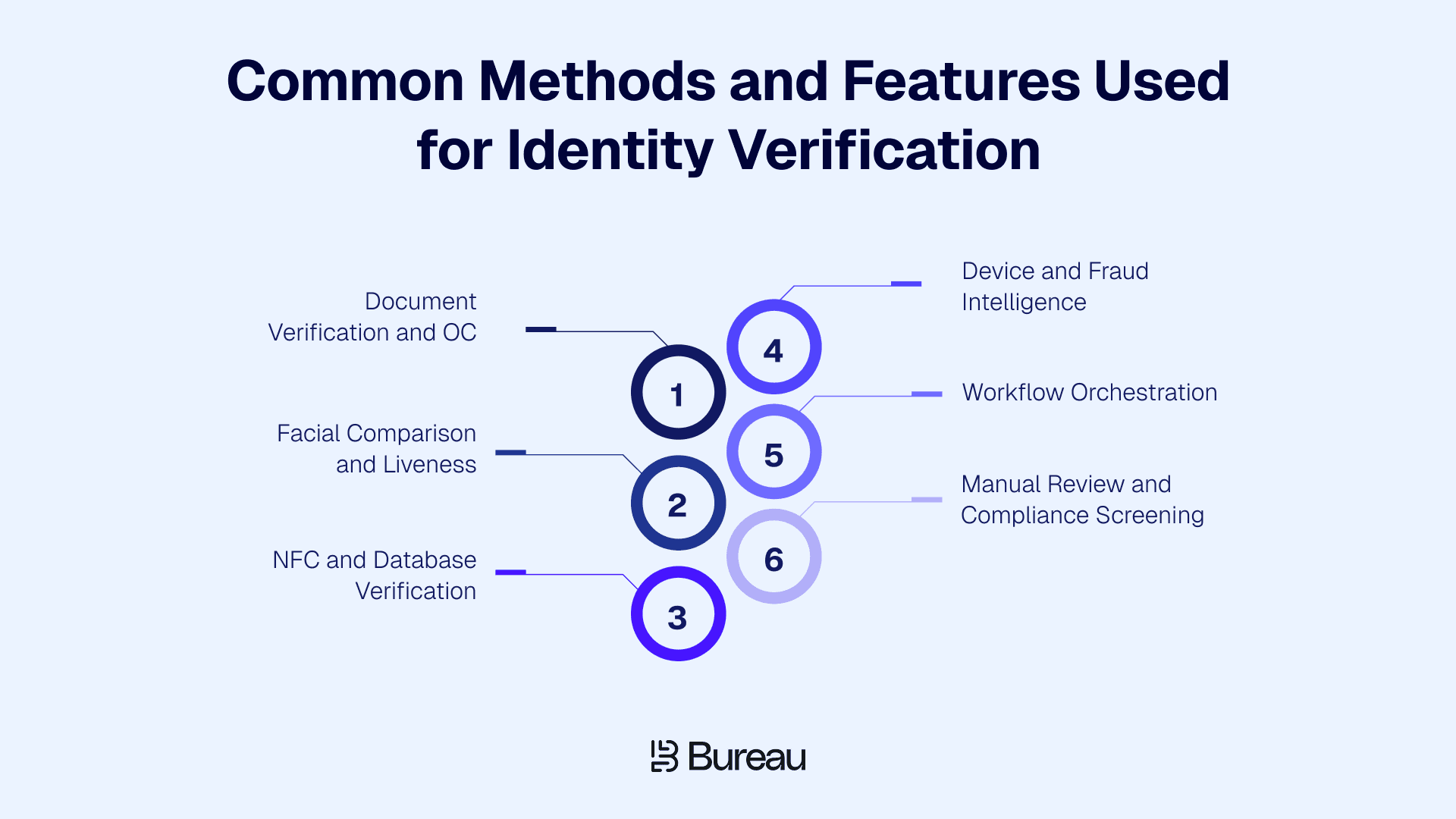
Two identity verification APIs can support the same document types yet deliver very different onboarding outcomes. The difference often comes from how they combine document verification with biometrics, fraud signals, workflow controls, and compliance checks.
Buyers typically compare six core capabilities:
Document verification and OCR: Checks passports, driving licences, and national IDs for authenticity, expiry, tampering, and data consistency. It also extracts key fields to reduce manual entry and improve onboarding speed.
Facial comparison and liveness: Matches a selfie with the document photo and confirms that a real person is present. This helps reduce impersonation, replay attacks, deepfakes, and injection-based fraud.
NFC and database verification: Reads chips in supported identity documents and compares submitted details against trusted or authoritative sources. These checks can increase assurance when image-based verification alone is not enough.
Device and fraud intelligence: Flags spoofed devices, emulators, VPN use, repeat fraudsters, and suspicious links between accounts. This helps teams identify risky applicants whose documents may still appear valid.
Workflow orchestration: Applies different checks based on country, customer type, product, or risk level. It also supports retries, fallbacks, and step-up verification so higher-friction checks are reserved for riskier cases.
Manual review and compliance screening: Handles inconclusive cases and supports sanctions checks, PEP screening, and regulated KYC workflows. This gives operations teams a clear path for exceptions without blocking every uncertain application.
Fraud has also become a larger operational concern for financial institutions. In the EBA’s Spring 2025 Risk Assessment Report, 52% of banks identified fraud as a significant operational risk, showing that fraud is becoming a core resilience concern rather than a problem confined to transaction losses.
When comparing providers, look beyond feature availability. Test accuracy, response times, reason codes, document coverage, liveness performance, retry flows, and completion rates in priority markets. These factors show how well an API will perform in production.
Identity Verification APIs: Top 10 Solutions Compared
Identity verification APIs differ in depth of verification, integration flexibility, geographic coverage, and buyer fit. Some are built for enterprise KYC programs, while others focus on mobile onboarding, configurable workflows, or broader fraud-risk decisioning.
The table below compares each provider by standout strength, integration model, verification coverage, and best-fit use case.
Provider | Standout Strength | Integration Model | Verification Coverage | Best For |
Bureau | Connected identity and fraud-risk signals | APIs, SDKs, Quick Links | Documents, biometrics, KYC, contextual risk | Identity verification with broader risk decisioning elevating protection from account-level defense to network-level intelligence |
Entrust | Document and biometric verification | REST API, web SDK, mobile SDKs | Global document and biometric checks | Enterprise identity workflows |
Jumio | Verification and compliance workflows | APIs, web and mobile SDKs | Global document, biometric, and KYC checks | Regulated enterprise onboarding |
Shufti | Localized checks within one verification stack | REST API, SDKs, hosted and on-premises flows | Documents, OCR, biometrics, NFC, eIDV, KYC, AML | Global identity verification |
HyperVerge | OCR, face matching, and passive liveness | APIs and mobile SDKs | Document, biometric, and eKYC checks | Mobile-first KYC |
Veriff | Session-based verification and developer tooling | REST API, web SDK, native SDKs | Documents, selfies, and biometric checks | Structured verification workflows |
Sumsub | Broad verification and compliance suite | APIs, SDKs, workflow tools | KYC, KYB, AML, and monitoring | Consolidated compliance workflows |
Persona | Configurable workflow builder | API, SDKs, hosted flows | Modular identity and business checks | Custom verification journeys |
Stripe Identity | Familiar Stripe developer environment | API and hosted verification | Document and selfie checks | Stripe-native identity checks |
iDenfy | Modular verification and screening | API, SDKs, plugins | Identity, biometrics, NFC, KYB, and AML | Modular verification workflows |
Provider fit depends on the business model, target regions, risk level, and compliance scope. Engineering resources also matter, especially when teams need control over capture flows, workflow logic, webhooks, retries, and result handling.
10 Best Identity Verification APIs in 2026
Each provider in this list is evaluated through the lens that best reflects how buyers use it. Here’s how they all stand out, what to consider, and their respective pricing approach.
1. Bureau
Bureau is an AI-powered unified risk decisioning platform that places identity verification inside a broader onboarding and fraud-risk workflow. It helps businesses assess whether an applicant, identity, device, account, or interaction can be trusted, rather than treating document verification as an isolated checkpoint.
Its identity verification capabilities connect document and biometric checks with device history, behavioral patterns, account relationships, alternate data, and network context. This is useful when applicants submit valid-looking documents but still show signs of synthetic identity fraud, device spoofing, app cloning, repeated account creation, or coordinated abuse.
Key strengths:
Connected identity verification: Bureau combines identity document verification, biometric matching, and liveness checks with wider fraud signals to assess the full onboarding attempt.
Persistent device recognition: Device ID can identify cloned apps, rooted devices, emulators, spoofed environments, and repeat devices linked to multiple applications.
Behavioral context: Behavioral biometrics can flag scripted interactions, impersonation, session anomalies, and activity that does not match genuine onboarding behavior.
Identity and data matching: Alternate data signals can cross-check names, phone numbers, emails, and digital attributes to surface synthetic or mismatched identities.
Connected fraud intelligence: The Graph Identity Network links users, devices, IPs, and account relationships that may look low risk when reviewed separately.
Risk-based decisioning: Teams can approve trusted users, trigger additional verification, escalate cases, or block applicants through configurable workflows and explainable risk signals.
These capabilities matter because a document can pass authenticity checks while the wider application remains risky. The applicant may be using a stolen identity, a cloned app, or a device already linked to several fraudulent accounts. Bureau helps teams connect those signals before the account is activated or funds are made available.
How Bureau helped an insurer cut fraud and speed up onboarding
A major private insurer was dealing with fake applications submitted by internal field agents. Some agents misused real customer details or created synthetic identities to inflate commissions, while SMS and email checks did little to stop the abuse because the same agents often controlled those channels. Genuine applicants faced extra friction, yet fraudulent applications could still get through.
Bureau addressed this by verifying applicant details in real time and combining identity, device, and behavioral signals into one risk profile. Suspicious applications were flagged at the source, while lower-risk users moved through a lighter onboarding flow with fewer unnecessary checks.
Within the first week, Bureau was able to:
Flag more than 100 fake applications
Reduce onboarding time by 30%
Lower customer complaints linked to unauthorized applications
Increase conversions as genuine applicants moved through onboarding faster
Read the full case study here → Insurer Cuts Fraud for 30% Faster Onboarding
Behind these outcomes is a flexible integration model that lets teams apply risk decisions directly within their onboarding flow.
Integration fit: Bureau can sit within digital onboarding and KYC workflows through APIs, SDKs, and configurable decisioning rules. Developers can use Bureau’s documentation to build custom flows, while risk teams can adjust thresholds and actions without rebuilding the full integration.
What to consider:
Define which onboarding and fraud decisions Bureau should influence, which system owns the final action, and how confirmed fraud or false-positive feedback returns to the workflow.
Map the identity, device, fraud, and decisioning tools Bureau will replace, retain, or orchestrate, then compare the value of the broader platform with a narrower document-verification API.
Pricing approach: Custom pricing based on modules, regions, onboarding volumes, supported journeys, and workflow requirements.
2. Entrust
Entrust, formerly known as Onfido, is an enterprise identity-verification platform for organizations that need document analysis, facial biometrics, liveness detection, configurable workflows, and global onboarding support. It is commonly used for remote customer onboarding, reverification, enterprise KYC flows, and identity checks that include fraud signals within the verification journey.
Key strengths:
Document and biometric verification: Entrust combines document checks, facial comparison, and liveness detection within one identity-verification flow.
Enterprise onboarding support: The platform supports regulated organizations operating across multiple markets, customer segments, and onboarding journeys.
Configurable workflows: Teams can adjust verification steps by geography, product, customer type, or risk level.
SDK-based capture: Mobile and web SDKs guide users through document and selfie capture inside the application.
Established infrastructure: Entrust provides mature verification workflows, structured decisions, and implementation support for enterprise deployments.
Integration fit: Entrust supports REST APIs, mobile SDKs, and a web SDK. Developers typically create an applicant or workflow run, generate SDK tokens, collect identity evidence, and retrieve results through webhooks or API responses.
What to consider:
Customer reviews indicate watchlist results can sometimes surface broad same-name matches with limited operational value. Test match precision, filtering, and review workflows using realistic customer data.
Confirm which document, biometric, fraud, and compliance modules are included. Broader device, network, or transaction-risk decisioning may require additional products or integrations.
Pricing approach: Typically sales-led or tiered according to verification volume and selected products. Confirm directly with Entrust.
3. Jumio

Jumio is an enterprise identity-verification and KYC provider for banks, fintechs, and other regulated organizations. It combines document checks, facial comparison, liveness detection, and compliance workflows for remote onboarding across multiple markets.
Key strengths:
Document verification: Jumio checks identity documents for tampering, expiry, and inconsistencies in the submitted information.
Biometric checks: Its facial comparison and liveness capabilities help confirm that the applicant is present and matches the document.
Global onboarding: The platform supports document and KYC workflows across multiple countries, document types, and customer segments.
Structured decisions: Verification outcomes can route applicants into approval, retry, manual review, or rejection based on the result.
Compliance coverage: Teams can add related identity and compliance checks within the same onboarding workflow as requirements expand.
Integration fit: Jumio supports API- and SDK-based onboarding flows for document capture, biometric verification, and result retrieval. It is best suited to teams that need enterprise implementation support, structured governance, and one workflow for identity and compliance checks.
What to consider:
Teams using the platform have noted that OCR output can be less accurate for names containing special characters. Test extraction quality across representative documents, languages, and naming formats.
Confirm automation rates, manual-review pricing, median and P95 response times, country-level document support, workflow flexibility, and separately priced compliance modules.
Pricing approach: Custom enterprise pricing based on verification volume, markets, workflow scope, and selected compliance capabilities.
4. Shufti
Shufti is a global identity-verification and compliance platform for businesses that need document, biometric, and electronic identity checks across multiple markets. It supports embedded onboarding flows, hosted journeys, and on-premises deployment.
Key strengths:
Broad verification coverage: Shufti combines document checks, OCR, facial comparison, liveness, NFC, eIDV, age, and address verification within one platform.
Compliance extensions: Teams can add KYC, AML, KYB, reverification, and ongoing monitoring as their compliance requirements expand.
Flexible deployment: The platform supports REST APIs, native and cross-platform SDKs, hosted journeys, and on-premises deployment options.
Developer tooling: Developers get sandbox access, webhooks, structured responses, and implementation documentation to support testing and integration.
Cross-border onboarding: Shufti supports multilingual journeys across a range of document types and markets, making it relevant for businesses operating internationally.
Integration fit: Shufti supports server-to-server APIs, SDK-based capture, hosted verification journeys, and on-premises deployment. It fits teams that want one integration for several identity and compliance checks, with the option to choose between deeper customization and faster deployment.
What to consider:
Reviewers mention limited control over some hosted-flow behaviors. Test cancellation settings, decline logic, retry handling, and journey configuration before deployment.
Confirm country-level document support, automation rates, manual-review turnaround, response times, data residency, and retry or inconclusive-case billing.
Pricing approach: Custom, usage-based, or package-based pricing based on verification methods, compliance modules, markets, deployment model, and volume.
5. HyperVerge
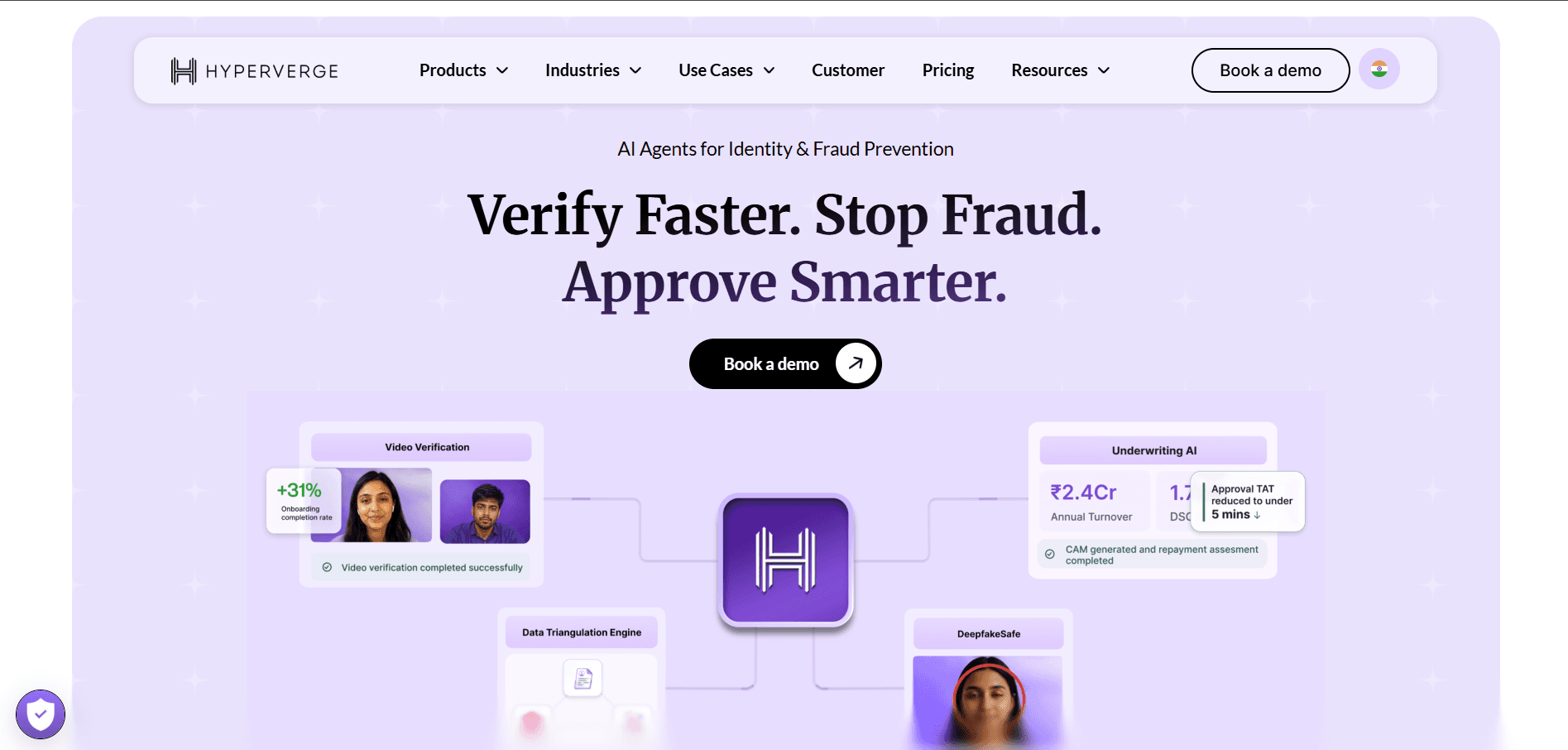
HyperVerge is a mobile-first identity-verification and eKYC provider known for document OCR, face matching, passive liveness, and digital onboarding workflows. It is often considered by fintech and financial-services teams that need fast mobile capture and region-specific KYC flows.
Key strengths:
Mobile document capture: HyperVerge guides users through document capture on mobile devices, helping improve image quality and reduce avoidable retries.
OCR and extraction: Its OCR pulls identity data from submitted documents, reducing manual entry and helping teams populate onboarding fields faster.
Face and liveness checks: The platform combines facial comparison with passive liveness to confirm the applicant while keeping the verification flow relatively light.
Digital KYC workflows: Teams can support remote onboarding, document checks, biometric verification, and video KYC where required.
Mobile-first performance: HyperVerge is built for smartphone-heavy journeys and lower-bandwidth conditions, making it relevant for mobile-led onboarding programs.
Integration fit: HyperVerge supports API- and SDK-based onboarding flows for document capture, biometric checks, and result handling. It fits teams that prioritize mobile conversion, fast OCR, passive liveness, and regional eKYC requirements.
What to consider:
Operational feedback suggests the documentation could explain SDK switch-case simulation and manual-review behavior more clearly. Test both during implementation.
Confirm global document depth, workflow flexibility, manual-review operations, and whether device, behavioral, or network intelligence requires additional tools.
Pricing approach: Custom or volume-based pricing based on verification scope, markets, workflow requirements, and usage.
Related Read: HyperVerge Competitors & Alternatives in 2026
6. Veriff
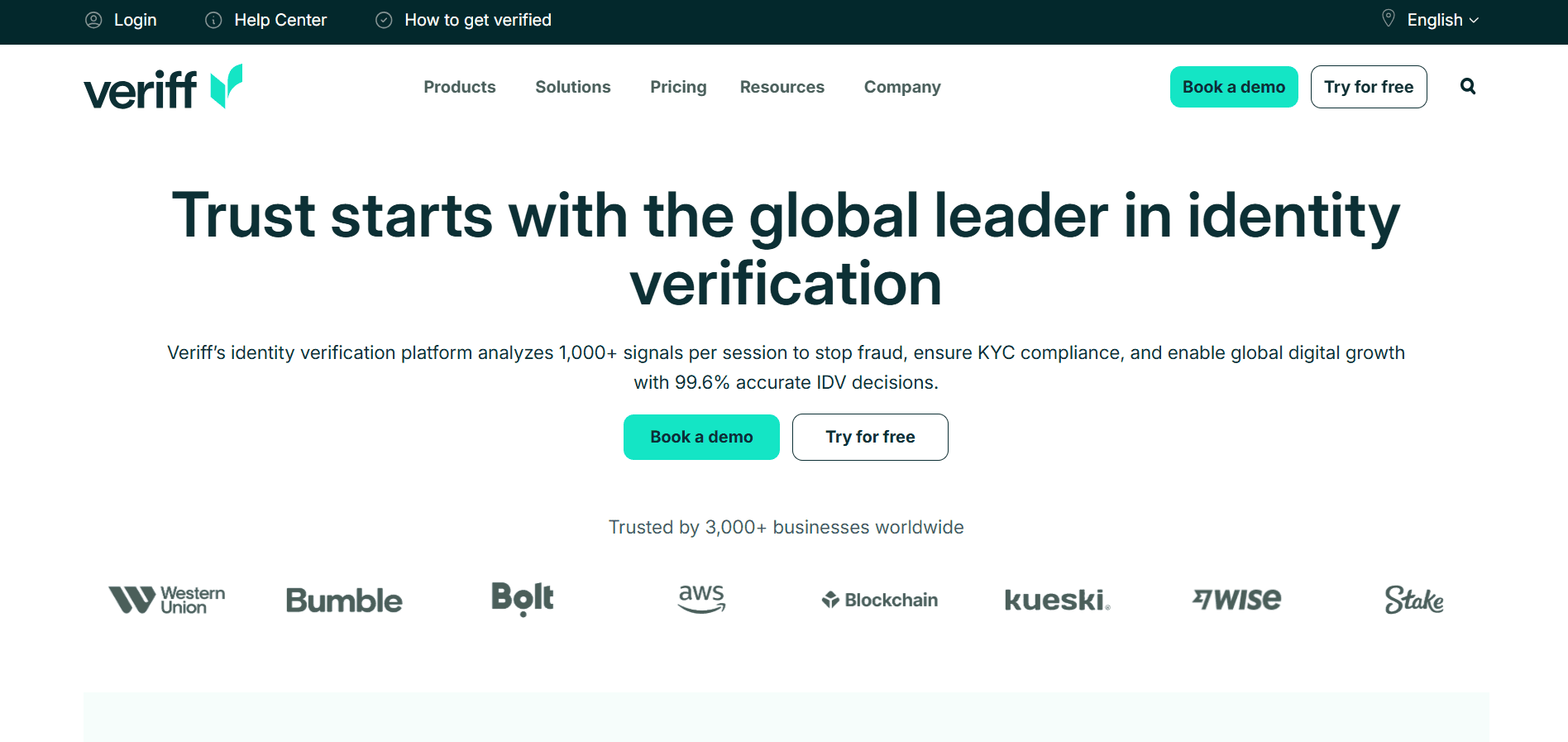
Veriff is an identity-verification platform built around structured, session-based workflows. It supports document and selfie checks, web and mobile SDKs, automated decisions, and hybrid review options for global onboarding.
Key strengths:
Session-based flow: Veriff gives developers a defined path from creating a verification session to collecting evidence and retrieving the final decision.
Document and selfie checks: The platform combines identity-document verification with selfie comparison to confirm that the applicant matches the submitted document.
SDK-supported capture: Web and mobile SDKs guide users through document and selfie capture, helping teams build a more consistent verification experience.
Structured decisions: Results are returned through APIs or webhooks, allowing teams to route users into approval, retry, manual review, or rejection.
Fraud context: Where supported, Veriff can add device and fraud signals to provide more context around the verification outcome.
Integration fit: Teams typically create a verification session, collect document and biometric evidence, receive the result through an API or webhook, and apply the outcome to the onboarding workflow. During implementation, review authentication, webhook signing, idempotency, status handling, error responses, sandbox coverage, SDK customization, and retry behavior.
What to consider:
User feedback indicates slower processing during peak periods and limited flexibility for unusual documents or manual edge cases. Test exception handling, customization, and review flows before deployment.
Confirm regional document performance, automated versus hybrid-review coverage, manual-review turnaround, and which fraud or database checks are priced separately.
Pricing approach: Custom or per-verification pricing based on product configuration, markets, review model, and verification volume.
7. Sumsub
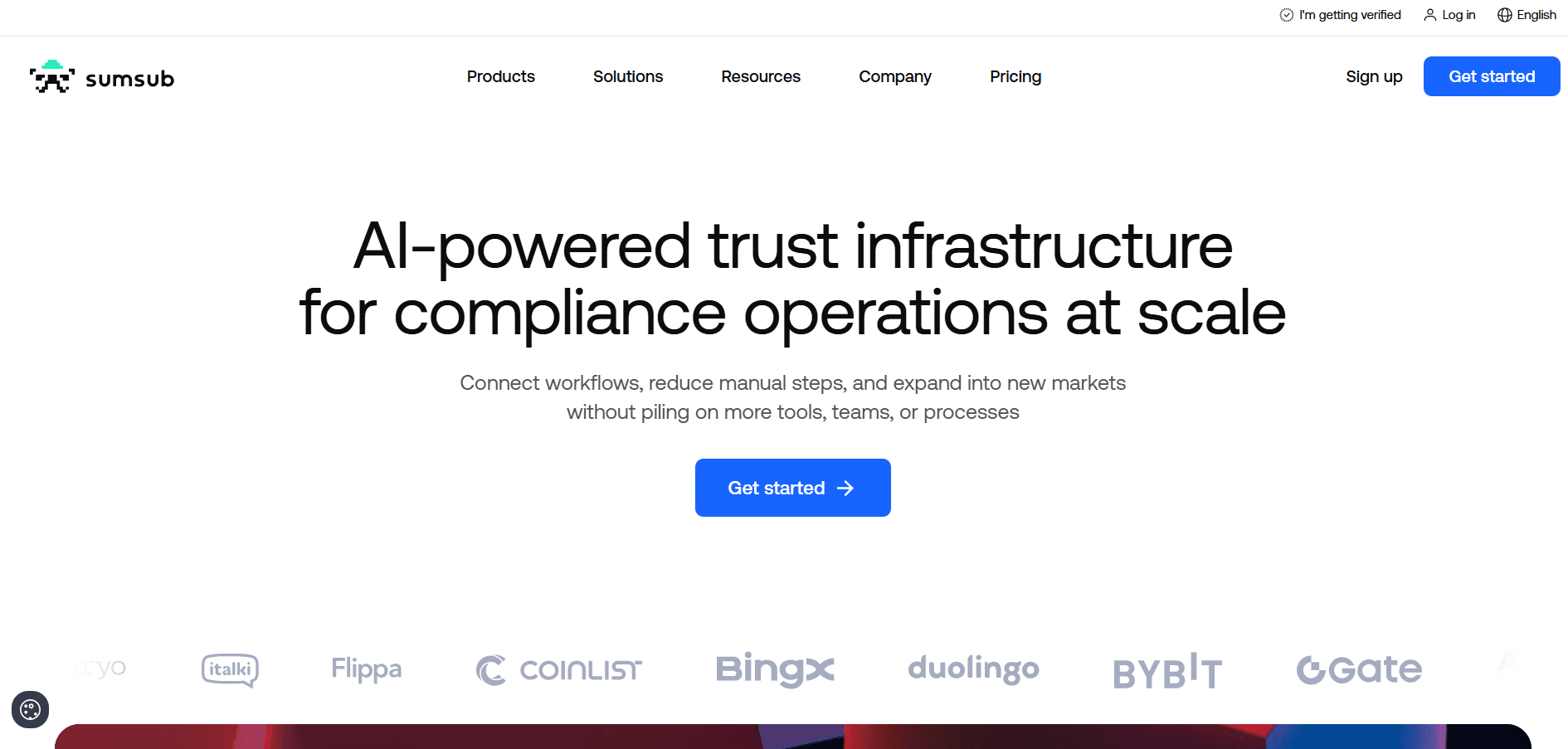
Sumsub is a broad verification and compliance platform that brings identity verification, business verification, AML screening, transaction monitoring, and related fraud workflows into one environment. It is often considered by regulated businesses that expect KYC, KYB, monitoring, and case-review requirements to grow together.
Key strengths:
KYC and KYB coverage: Sumsub supports both consumer and business verification, allowing teams to manage individual onboarding and company checks within one platform.
Document and biometric checks: The platform combines identity-document verification with facial comparison and liveness detection to confirm both the evidence and the applicant.
AML and monitoring: Teams can extend onboarding checks with sanctions screening, ongoing monitoring, and transaction-risk controls as compliance requirements expand.
Configurable workflows: Verification steps can be adjusted by product, market, customer type, or risk level, giving teams more control over how each journey is handled.
API and SDK integrations: Developers can embed verification into web and mobile journeys, while product teams configure how users move through different checks and outcomes.
Integration fit: Sumsub suits teams that want to consolidate identity, compliance, and monitoring workflows under one provider. It can reduce vendor fragmentation, but teams still need to define internal policies, escalation rules, review ownership, and which modules belong in each customer journey.
What to consider:
Customer reviews suggest onboarding can take longer than expected because of agreements, approvals, and production sign-offs.
Reviews also point to uneven first-line support depth. Confirm escalation paths, implementation ownership, regional data processing, retention controls, and which modules are priced separately.
Pricing approach: Usage-based or custom pricing based on verification levels, selected modules, markets, monitoring scope, and volume.
8. Persona

Persona is a configurable identity platform for teams that need different verification journeys by product, market, risk level, or customer segment. It supports modular identity checks, hosted and embedded experiences, KYC and KYB workflows, reverification, and case review.
Key strengths:
Workflow builder: Persona lets teams configure rules, branching logic, retries, and escalation paths so different applicants can move through different verification journeys.
Modular checks: Product teams can apply document, database, biometric, or business-verification checks based on market, use case, or risk level.
Hosted and embedded flows: Teams can use hosted journeys for faster deployment or embedded experiences when they need greater control over the front end.
Segment-specific journeys: Persona supports separate flows for individuals, businesses, and higher-risk users, helping teams tailor verification without duplicating the full workflow.
Reverification and review: The platform supports account recovery, repeat verification, and case review for inconclusive or higher-risk applications.
Integration fit: Persona suits product teams building multiple onboarding journeys in one platform. Checks can vary by market, product, customer type, or risk level, with uncertain cases routed to review. Teams should still define branching logic, escalation rules, and ownership before adding workflow complexity.
What to consider:
Several reviewers mention that dashboard terminology can be confusing, particularly the distinction between a verification and an inquiry. Validate nomenclature, reporting logic, and team training during implementation.
Confirm how pricing applies across inquiries, checks, workflows, and modules. Also assess whether separate device or fraud-intelligence tools are required.
Pricing approach: Usage-based or custom pricing depending on modules, workflow complexity, markets, and volume.
9. Stripe Identity
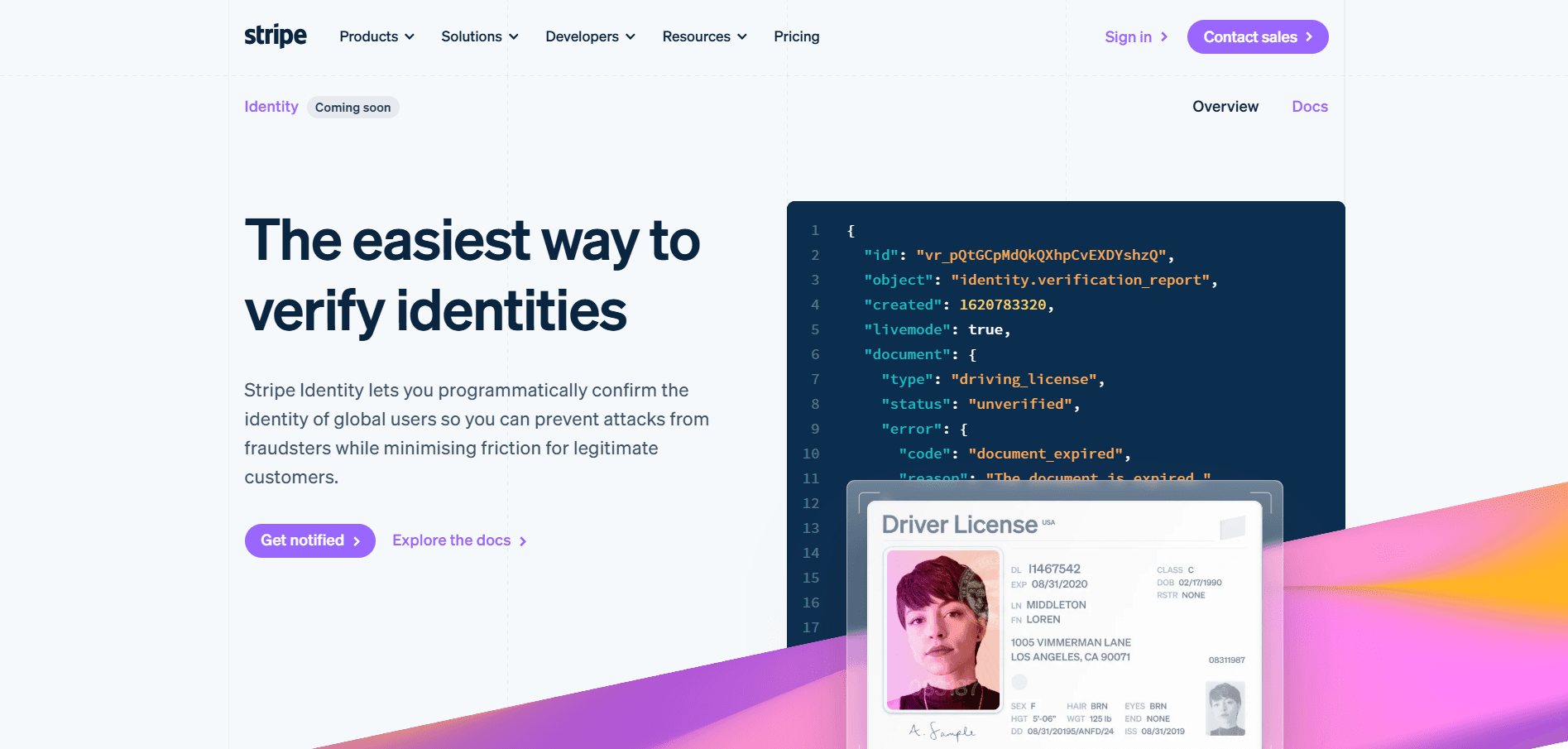
Stripe Identity is a practical identity-verification option for teams already using Stripe’s payments and developer infrastructure. It supports document checks, selfie comparison, hosted verification flows, webhooks, and dashboard-based result visibility through a familiar Stripe integration model.
Key strengths:
Familiar API model: Stripe Identity uses the same session-based patterns, webhooks, and dashboard workflows that many Stripe developers already know.
Hosted verification: Teams can use a hosted flow for document and selfie capture, reducing the amount of front-end verification logic they need to build.
Document and selfie checks: The product supports a focused identity-verification journey that combines document checks with selfie comparison.
Low integration overhead: Stripe Identity fits naturally into products already using Stripe, which can simplify implementation and reduce architectural complexity.
Dashboard visibility: Teams can review verification activity, outcomes, and supporting details from the Stripe Dashboard.
Integration fit: Stripe Identity suits startups and digital platforms that want to add document and selfie verification without introducing a separate developer ecosystem. Teams can create a verification session, direct the user into a hosted flow, receive the result through webhooks, and connect the outcome with the wider Stripe stack.
What to consider:
Users have flagged that finding the right support content can be difficult and reaching a representative may take more effort than expected. Test documentation search, escalation paths, and support responsiveness before rollout.
Confirm business and user-market availability, document coverage, data-access settings, retention controls, and whether separate KYC, AML, or fraud-decisioning tools are required.
Pricing approach: Usage-based where publicly available, subject to region, verification type, and current product terms.
10. iDenfy
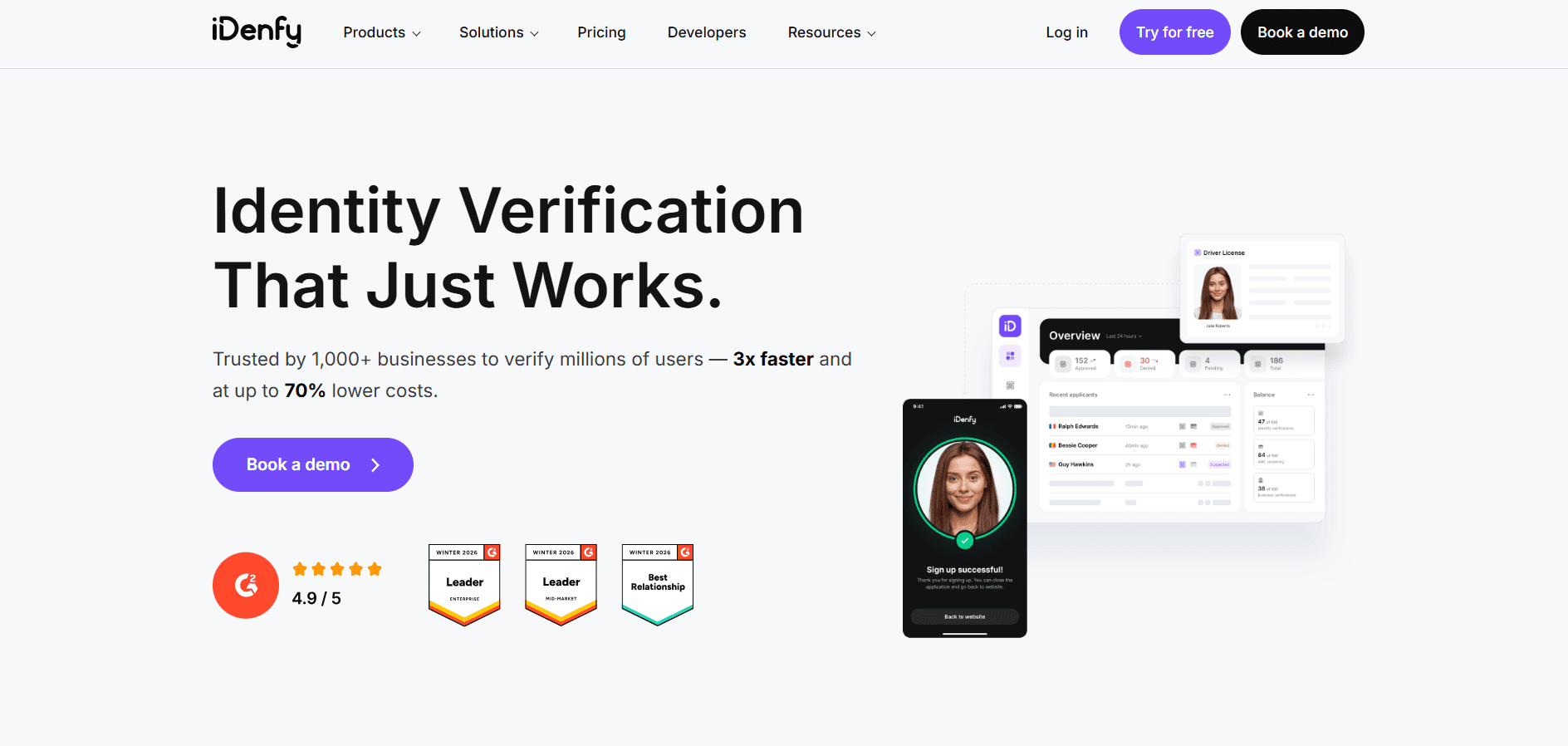
iDenfy is a modular identity-verification provider offering document checks, OCR, facial comparison, liveness detection, NFC verification, address and phone checks, KYB, and AML screening. It is suited to teams that want several verification and compliance modules from one vendor.
Key strengths:
Document verification: iDenfy supports identity-document checks and OCR-based extraction to validate submitted evidence and reduce manual data entry.
Biometric coverage: The platform combines facial comparison with liveness detection to confirm that the applicant matches the document and is present during verification.
NFC capability: Teams can read chips in compatible identity documents to add a higher-assurance verification step where supported.
Modular compliance checks: iDenfy extends beyond identity checks with KYB, AML, address, and phone verification modules that can be added as requirements grow.
Flexible integration: Developers can use APIs, SDKs, or plugins depending on how much control they need over the verification experience and implementation effort.
Integration fit: iDenfy fits businesses that want a configurable package rather than a single narrow verification method. Teams can combine document, biometric, NFC, business-verification, and screening modules based on market, customer type, and risk level.
What to consider:
Customer feedback indicates that some automated decisions lack enough explanation. Test reason codes, review outputs, and how quickly manual review resolves unclear cases.
Confirm supported document versions, automated and manual-review handling, response-time SLAs, maintained SDKs, implementation support, and billing for retries or failed attempts.
Pricing approach: Custom or usage-based pricing depending on selected checks, markets, verification volume, and compliance modules.
Related Read: Top 9 Identity Verification Solution Providers
Choose Identity Verification APIs by Use Case
The best identity verification API depends on target markets, fraud exposure, compliance requirements, existing technology stack, and desired level of workflow control. The table below maps common buying needs to the providers most likely to fit them.
Use Case | Best-Fit Tools |
Broader identity and fraud-risk decisioning | Bureau |
Global enterprise verification | Entrust, Jumio |
Broad global document and biometric verification | Shufti, Bureau |
Mobile-first KYC and eKYC | HyperVerge |
Document, biometric, and liveness verification | Veriff, Entrust |
KYC, KYB, AML, and monitoring | Sumsub |
Configurable verification workflows | Persona, Bureau |
Stripe-native identity checks | Stripe Identity |
Modular document, NFC, and screening checks | iDenfy |
Low-friction, risk-based onboarding | Bureau, HyperVerge |
User expectations also make it important to test security and conversion together. In the UK government’s 2025 Digital Identity Sectoral Analysis, 75% of surveyed consumers reported faster transactions when using digital identity, while 79% rated privacy and security as important. Provider testing should therefore measure onboarding speed without weakening user trust or risk controls.
Shortlist two to four providers and test them with real documents, devices, and network conditions in priority markets. Compare completion rates, verification speed, automated decisions, false rejections, SDK reliability, abandonment, and fraud detection. The right provider should protect conversion without weakening risk controls.
Related Read: How to Prevent AI Identity Fraud at Scale?
Improve Verification Accuracy with Bureau
The best identity verification API is the one that performs reliably for users, documents, devices, risk levels, and onboarding journey.
Before making a decision, teams should:
Test the exact countries, document types, and user conditions they expect in production.
Compare developer experience, reason codes, review workflows, and operational usability alongside verification accuracy.
Measure genuine-user conversion and fraud detection together.
Apply stronger checks based on risk instead of adding the same friction to every applicant.
Bureau helps teams connect identity verification with configurable risk-based onboarding, device intelligence, behavioral biometrics, fraud-network detection, and explainable decisions.
This gives product and risk teams more context when deciding whether to approve, challenge, review, or reject an application. It can also reduce the need to manage separate tools and disconnected decision rules across the onboarding flow.
Schedule a demo with Bureau today and explore how identity verification can fit into a broader onboarding and fraud-decisioning workflow.
FAQs
1. What is an identity verification API?
An identity verification API lets businesses verify users inside a digital onboarding or KYC flow. It can check identity documents, compare facial biometrics, perform liveness detection, extract applicant data, and return structured decisions that product and risk teams can use to approve, retry, review, or reject an application.
2. Which is the best identity verification API?
There is no universally best identity verification API. Some leading ones include Bureau, Entrust, Jumio, Shufti, HyperVerge, Veriff, Sumsub, Persona, Stripe Identity, and iDenfy. The right choice depends on market coverage, SDK quality, liveness, workflow control, fraud-risk depth, data residency, and total cost.
3. How do I integrate an identity verification API?
Most integrations start by creating a verification session and initializing a web or mobile SDK. The user then submits document and biometric evidence. Results are returned through an API response or webhook, after which the onboarding workflow can approve, request a retry, escalate to review, or reject the application.
4. What should an identity verification API return?
A useful identity verification API should return an overall decision, individual check results, reason codes, extracted identity data, timestamps, retry instructions, and manual-review status. Clear payloads help developers handle edge cases while giving risk teams enough context to investigate failures, tune workflows, and explain decisions.
5. Can identity verification APIs detect synthetic identity fraud?
Document and biometric checks can detect some synthetic identity attempts, but they may not be enough alone. Stronger detection often requires phone, email, device, behavioral, network, and identity-relationship signals. These additional signals help identify coordinated applications that appear valid when each document is reviewed in isolation.
6. How does Bureau improve identity verification?
Bureau connects identity verification with device, behavioral, network, and transaction intelligence. This helps teams assess the full onboarding attempt, not just the submitted document. Risk teams can use explainable signals and configurable workflows to approve trusted users, trigger step-up checks, or block suspicious applications earlier.
An identity verification API can look strong in a demo and still underperform once it meets real users, real documents, and real network conditions. A flow that works well in one market may struggle with another document type, naming format, or liveness scenario. Developers need reliable APIs and SDKs, while product teams need fast checks that do not push genuine users out of onboarding.
This list compares 10 identity verification APIs across API quality, verification speed, document coverage, liveness, integration models, and buyer fit, making it easier to evaluate the right provider for different product requirements.
Before comparing providers, it helps to understand the core methods and features that shape identity verification performance.
Common Methods and Features Used for Identity Verification
Two identity verification APIs can support the same document types yet deliver very different onboarding outcomes. The difference often comes from how they combine document verification with biometrics, fraud signals, workflow controls, and compliance checks.
Buyers typically compare six core capabilities:
Document verification and OCR: Checks passports, driving licences, and national IDs for authenticity, expiry, tampering, and data consistency. It also extracts key fields to reduce manual entry and improve onboarding speed.
Facial comparison and liveness: Matches a selfie with the document photo and confirms that a real person is present. This helps reduce impersonation, replay attacks, deepfakes, and injection-based fraud.
NFC and database verification: Reads chips in supported identity documents and compares submitted details against trusted or authoritative sources. These checks can increase assurance when image-based verification alone is not enough.
Device and fraud intelligence: Flags spoofed devices, emulators, VPN use, repeat fraudsters, and suspicious links between accounts. This helps teams identify risky applicants whose documents may still appear valid.
Workflow orchestration: Applies different checks based on country, customer type, product, or risk level. It also supports retries, fallbacks, and step-up verification so higher-friction checks are reserved for riskier cases.
Manual review and compliance screening: Handles inconclusive cases and supports sanctions checks, PEP screening, and regulated KYC workflows. This gives operations teams a clear path for exceptions without blocking every uncertain application.
Fraud has also become a larger operational concern for financial institutions. In the EBA’s Spring 2025 Risk Assessment Report, 52% of banks identified fraud as a significant operational risk, showing that fraud is becoming a core resilience concern rather than a problem confined to transaction losses.
When comparing providers, look beyond feature availability. Test accuracy, response times, reason codes, document coverage, liveness performance, retry flows, and completion rates in priority markets. These factors show how well an API will perform in production.
Identity Verification APIs: Top 10 Solutions Compared
Identity verification APIs differ in depth of verification, integration flexibility, geographic coverage, and buyer fit. Some are built for enterprise KYC programs, while others focus on mobile onboarding, configurable workflows, or broader fraud-risk decisioning.
The table below compares each provider by standout strength, integration model, verification coverage, and best-fit use case.
Provider | Standout Strength | Integration Model | Verification Coverage | Best For |
Bureau | Connected identity and fraud-risk signals | APIs, SDKs, Quick Links | Documents, biometrics, KYC, contextual risk | Identity verification with broader risk decisioning elevating protection from account-level defense to network-level intelligence |
Entrust | Document and biometric verification | REST API, web SDK, mobile SDKs | Global document and biometric checks | Enterprise identity workflows |
Jumio | Verification and compliance workflows | APIs, web and mobile SDKs | Global document, biometric, and KYC checks | Regulated enterprise onboarding |
Shufti | Localized checks within one verification stack | REST API, SDKs, hosted and on-premises flows | Documents, OCR, biometrics, NFC, eIDV, KYC, AML | Global identity verification |
HyperVerge | OCR, face matching, and passive liveness | APIs and mobile SDKs | Document, biometric, and eKYC checks | Mobile-first KYC |
Veriff | Session-based verification and developer tooling | REST API, web SDK, native SDKs | Documents, selfies, and biometric checks | Structured verification workflows |
Sumsub | Broad verification and compliance suite | APIs, SDKs, workflow tools | KYC, KYB, AML, and monitoring | Consolidated compliance workflows |
Persona | Configurable workflow builder | API, SDKs, hosted flows | Modular identity and business checks | Custom verification journeys |
Stripe Identity | Familiar Stripe developer environment | API and hosted verification | Document and selfie checks | Stripe-native identity checks |
iDenfy | Modular verification and screening | API, SDKs, plugins | Identity, biometrics, NFC, KYB, and AML | Modular verification workflows |
Provider fit depends on the business model, target regions, risk level, and compliance scope. Engineering resources also matter, especially when teams need control over capture flows, workflow logic, webhooks, retries, and result handling.
10 Best Identity Verification APIs in 2026
Each provider in this list is evaluated through the lens that best reflects how buyers use it. Here’s how they all stand out, what to consider, and their respective pricing approach.
1. Bureau
Bureau is an AI-powered unified risk decisioning platform that places identity verification inside a broader onboarding and fraud-risk workflow. It helps businesses assess whether an applicant, identity, device, account, or interaction can be trusted, rather than treating document verification as an isolated checkpoint.
Its identity verification capabilities connect document and biometric checks with device history, behavioral patterns, account relationships, alternate data, and network context. This is useful when applicants submit valid-looking documents but still show signs of synthetic identity fraud, device spoofing, app cloning, repeated account creation, or coordinated abuse.
Key strengths:
Connected identity verification: Bureau combines identity document verification, biometric matching, and liveness checks with wider fraud signals to assess the full onboarding attempt.
Persistent device recognition: Device ID can identify cloned apps, rooted devices, emulators, spoofed environments, and repeat devices linked to multiple applications.
Behavioral context: Behavioral biometrics can flag scripted interactions, impersonation, session anomalies, and activity that does not match genuine onboarding behavior.
Identity and data matching: Alternate data signals can cross-check names, phone numbers, emails, and digital attributes to surface synthetic or mismatched identities.
Connected fraud intelligence: The Graph Identity Network links users, devices, IPs, and account relationships that may look low risk when reviewed separately.
Risk-based decisioning: Teams can approve trusted users, trigger additional verification, escalate cases, or block applicants through configurable workflows and explainable risk signals.
These capabilities matter because a document can pass authenticity checks while the wider application remains risky. The applicant may be using a stolen identity, a cloned app, or a device already linked to several fraudulent accounts. Bureau helps teams connect those signals before the account is activated or funds are made available.
How Bureau helped an insurer cut fraud and speed up onboarding
A major private insurer was dealing with fake applications submitted by internal field agents. Some agents misused real customer details or created synthetic identities to inflate commissions, while SMS and email checks did little to stop the abuse because the same agents often controlled those channels. Genuine applicants faced extra friction, yet fraudulent applications could still get through.
Bureau addressed this by verifying applicant details in real time and combining identity, device, and behavioral signals into one risk profile. Suspicious applications were flagged at the source, while lower-risk users moved through a lighter onboarding flow with fewer unnecessary checks.
Within the first week, Bureau was able to:
Flag more than 100 fake applications
Reduce onboarding time by 30%
Lower customer complaints linked to unauthorized applications
Increase conversions as genuine applicants moved through onboarding faster
Read the full case study here → Insurer Cuts Fraud for 30% Faster Onboarding
Behind these outcomes is a flexible integration model that lets teams apply risk decisions directly within their onboarding flow.
Integration fit: Bureau can sit within digital onboarding and KYC workflows through APIs, SDKs, and configurable decisioning rules. Developers can use Bureau’s documentation to build custom flows, while risk teams can adjust thresholds and actions without rebuilding the full integration.
What to consider:
Define which onboarding and fraud decisions Bureau should influence, which system owns the final action, and how confirmed fraud or false-positive feedback returns to the workflow.
Map the identity, device, fraud, and decisioning tools Bureau will replace, retain, or orchestrate, then compare the value of the broader platform with a narrower document-verification API.
Pricing approach: Custom pricing based on modules, regions, onboarding volumes, supported journeys, and workflow requirements.
2. Entrust
Entrust, formerly known as Onfido, is an enterprise identity-verification platform for organizations that need document analysis, facial biometrics, liveness detection, configurable workflows, and global onboarding support. It is commonly used for remote customer onboarding, reverification, enterprise KYC flows, and identity checks that include fraud signals within the verification journey.
Key strengths:
Document and biometric verification: Entrust combines document checks, facial comparison, and liveness detection within one identity-verification flow.
Enterprise onboarding support: The platform supports regulated organizations operating across multiple markets, customer segments, and onboarding journeys.
Configurable workflows: Teams can adjust verification steps by geography, product, customer type, or risk level.
SDK-based capture: Mobile and web SDKs guide users through document and selfie capture inside the application.
Established infrastructure: Entrust provides mature verification workflows, structured decisions, and implementation support for enterprise deployments.
Integration fit: Entrust supports REST APIs, mobile SDKs, and a web SDK. Developers typically create an applicant or workflow run, generate SDK tokens, collect identity evidence, and retrieve results through webhooks or API responses.
What to consider:
Customer reviews indicate watchlist results can sometimes surface broad same-name matches with limited operational value. Test match precision, filtering, and review workflows using realistic customer data.
Confirm which document, biometric, fraud, and compliance modules are included. Broader device, network, or transaction-risk decisioning may require additional products or integrations.
Pricing approach: Typically sales-led or tiered according to verification volume and selected products. Confirm directly with Entrust.
3. Jumio
Jumio is an enterprise identity-verification and KYC provider for banks, fintechs, and other regulated organizations. It combines document checks, facial comparison, liveness detection, and compliance workflows for remote onboarding across multiple markets.
Key strengths:
Document verification: Jumio checks identity documents for tampering, expiry, and inconsistencies in the submitted information.
Biometric checks: Its facial comparison and liveness capabilities help confirm that the applicant is present and matches the document.
Global onboarding: The platform supports document and KYC workflows across multiple countries, document types, and customer segments.
Structured decisions: Verification outcomes can route applicants into approval, retry, manual review, or rejection based on the result.
Compliance coverage: Teams can add related identity and compliance checks within the same onboarding workflow as requirements expand.
Integration fit: Jumio supports API- and SDK-based onboarding flows for document capture, biometric verification, and result retrieval. It is best suited to teams that need enterprise implementation support, structured governance, and one workflow for identity and compliance checks.
What to consider:
Teams using the platform have noted that OCR output can be less accurate for names containing special characters. Test extraction quality across representative documents, languages, and naming formats.
Confirm automation rates, manual-review pricing, median and P95 response times, country-level document support, workflow flexibility, and separately priced compliance modules.
Pricing approach: Custom enterprise pricing based on verification volume, markets, workflow scope, and selected compliance capabilities.
4. Shufti
Shufti is a global identity-verification and compliance platform for businesses that need document, biometric, and electronic identity checks across multiple markets. It supports embedded onboarding flows, hosted journeys, and on-premises deployment.
Key strengths:
Broad verification coverage: Shufti combines document checks, OCR, facial comparison, liveness, NFC, eIDV, age, and address verification within one platform.
Compliance extensions: Teams can add KYC, AML, KYB, reverification, and ongoing monitoring as their compliance requirements expand.
Flexible deployment: The platform supports REST APIs, native and cross-platform SDKs, hosted journeys, and on-premises deployment options.
Developer tooling: Developers get sandbox access, webhooks, structured responses, and implementation documentation to support testing and integration.
Cross-border onboarding: Shufti supports multilingual journeys across a range of document types and markets, making it relevant for businesses operating internationally.
Integration fit: Shufti supports server-to-server APIs, SDK-based capture, hosted verification journeys, and on-premises deployment. It fits teams that want one integration for several identity and compliance checks, with the option to choose between deeper customization and faster deployment.
What to consider:
Reviewers mention limited control over some hosted-flow behaviors. Test cancellation settings, decline logic, retry handling, and journey configuration before deployment.
Confirm country-level document support, automation rates, manual-review turnaround, response times, data residency, and retry or inconclusive-case billing.
Pricing approach: Custom, usage-based, or package-based pricing based on verification methods, compliance modules, markets, deployment model, and volume.
5. HyperVerge
HyperVerge is a mobile-first identity-verification and eKYC provider known for document OCR, face matching, passive liveness, and digital onboarding workflows. It is often considered by fintech and financial-services teams that need fast mobile capture and region-specific KYC flows.
Key strengths:
Mobile document capture: HyperVerge guides users through document capture on mobile devices, helping improve image quality and reduce avoidable retries.
OCR and extraction: Its OCR pulls identity data from submitted documents, reducing manual entry and helping teams populate onboarding fields faster.
Face and liveness checks: The platform combines facial comparison with passive liveness to confirm the applicant while keeping the verification flow relatively light.
Digital KYC workflows: Teams can support remote onboarding, document checks, biometric verification, and video KYC where required.
Mobile-first performance: HyperVerge is built for smartphone-heavy journeys and lower-bandwidth conditions, making it relevant for mobile-led onboarding programs.
Integration fit: HyperVerge supports API- and SDK-based onboarding flows for document capture, biometric checks, and result handling. It fits teams that prioritize mobile conversion, fast OCR, passive liveness, and regional eKYC requirements.
What to consider:
Operational feedback suggests the documentation could explain SDK switch-case simulation and manual-review behavior more clearly. Test both during implementation.
Confirm global document depth, workflow flexibility, manual-review operations, and whether device, behavioral, or network intelligence requires additional tools.
Pricing approach: Custom or volume-based pricing based on verification scope, markets, workflow requirements, and usage.
Related Read: HyperVerge Competitors & Alternatives in 2026
6. Veriff
Veriff is an identity-verification platform built around structured, session-based workflows. It supports document and selfie checks, web and mobile SDKs, automated decisions, and hybrid review options for global onboarding.
Key strengths:
Session-based flow: Veriff gives developers a defined path from creating a verification session to collecting evidence and retrieving the final decision.
Document and selfie checks: The platform combines identity-document verification with selfie comparison to confirm that the applicant matches the submitted document.
SDK-supported capture: Web and mobile SDKs guide users through document and selfie capture, helping teams build a more consistent verification experience.
Structured decisions: Results are returned through APIs or webhooks, allowing teams to route users into approval, retry, manual review, or rejection.
Fraud context: Where supported, Veriff can add device and fraud signals to provide more context around the verification outcome.
Integration fit: Teams typically create a verification session, collect document and biometric evidence, receive the result through an API or webhook, and apply the outcome to the onboarding workflow. During implementation, review authentication, webhook signing, idempotency, status handling, error responses, sandbox coverage, SDK customization, and retry behavior.
What to consider:
User feedback indicates slower processing during peak periods and limited flexibility for unusual documents or manual edge cases. Test exception handling, customization, and review flows before deployment.
Confirm regional document performance, automated versus hybrid-review coverage, manual-review turnaround, and which fraud or database checks are priced separately.
Pricing approach: Custom or per-verification pricing based on product configuration, markets, review model, and verification volume.
7. Sumsub
Sumsub is a broad verification and compliance platform that brings identity verification, business verification, AML screening, transaction monitoring, and related fraud workflows into one environment. It is often considered by regulated businesses that expect KYC, KYB, monitoring, and case-review requirements to grow together.
Key strengths:
KYC and KYB coverage: Sumsub supports both consumer and business verification, allowing teams to manage individual onboarding and company checks within one platform.
Document and biometric checks: The platform combines identity-document verification with facial comparison and liveness detection to confirm both the evidence and the applicant.
AML and monitoring: Teams can extend onboarding checks with sanctions screening, ongoing monitoring, and transaction-risk controls as compliance requirements expand.
Configurable workflows: Verification steps can be adjusted by product, market, customer type, or risk level, giving teams more control over how each journey is handled.
API and SDK integrations: Developers can embed verification into web and mobile journeys, while product teams configure how users move through different checks and outcomes.
Integration fit: Sumsub suits teams that want to consolidate identity, compliance, and monitoring workflows under one provider. It can reduce vendor fragmentation, but teams still need to define internal policies, escalation rules, review ownership, and which modules belong in each customer journey.
What to consider:
Customer reviews suggest onboarding can take longer than expected because of agreements, approvals, and production sign-offs.
Reviews also point to uneven first-line support depth. Confirm escalation paths, implementation ownership, regional data processing, retention controls, and which modules are priced separately.
Pricing approach: Usage-based or custom pricing based on verification levels, selected modules, markets, monitoring scope, and volume.
8. Persona
Persona is a configurable identity platform for teams that need different verification journeys by product, market, risk level, or customer segment. It supports modular identity checks, hosted and embedded experiences, KYC and KYB workflows, reverification, and case review.
Key strengths:
Workflow builder: Persona lets teams configure rules, branching logic, retries, and escalation paths so different applicants can move through different verification journeys.
Modular checks: Product teams can apply document, database, biometric, or business-verification checks based on market, use case, or risk level.
Hosted and embedded flows: Teams can use hosted journeys for faster deployment or embedded experiences when they need greater control over the front end.
Segment-specific journeys: Persona supports separate flows for individuals, businesses, and higher-risk users, helping teams tailor verification without duplicating the full workflow.
Reverification and review: The platform supports account recovery, repeat verification, and case review for inconclusive or higher-risk applications.
Integration fit: Persona suits product teams building multiple onboarding journeys in one platform. Checks can vary by market, product, customer type, or risk level, with uncertain cases routed to review. Teams should still define branching logic, escalation rules, and ownership before adding workflow complexity.
What to consider:
Several reviewers mention that dashboard terminology can be confusing, particularly the distinction between a verification and an inquiry. Validate nomenclature, reporting logic, and team training during implementation.
Confirm how pricing applies across inquiries, checks, workflows, and modules. Also assess whether separate device or fraud-intelligence tools are required.
Pricing approach: Usage-based or custom pricing depending on modules, workflow complexity, markets, and volume.
9. Stripe Identity
Stripe Identity is a practical identity-verification option for teams already using Stripe’s payments and developer infrastructure. It supports document checks, selfie comparison, hosted verification flows, webhooks, and dashboard-based result visibility through a familiar Stripe integration model.
Key strengths:
Familiar API model: Stripe Identity uses the same session-based patterns, webhooks, and dashboard workflows that many Stripe developers already know.
Hosted verification: Teams can use a hosted flow for document and selfie capture, reducing the amount of front-end verification logic they need to build.
Document and selfie checks: The product supports a focused identity-verification journey that combines document checks with selfie comparison.
Low integration overhead: Stripe Identity fits naturally into products already using Stripe, which can simplify implementation and reduce architectural complexity.
Dashboard visibility: Teams can review verification activity, outcomes, and supporting details from the Stripe Dashboard.
Integration fit: Stripe Identity suits startups and digital platforms that want to add document and selfie verification without introducing a separate developer ecosystem. Teams can create a verification session, direct the user into a hosted flow, receive the result through webhooks, and connect the outcome with the wider Stripe stack.
What to consider:
Users have flagged that finding the right support content can be difficult and reaching a representative may take more effort than expected. Test documentation search, escalation paths, and support responsiveness before rollout.
Confirm business and user-market availability, document coverage, data-access settings, retention controls, and whether separate KYC, AML, or fraud-decisioning tools are required.
Pricing approach: Usage-based where publicly available, subject to region, verification type, and current product terms.
10. iDenfy
iDenfy is a modular identity-verification provider offering document checks, OCR, facial comparison, liveness detection, NFC verification, address and phone checks, KYB, and AML screening. It is suited to teams that want several verification and compliance modules from one vendor.
Key strengths:
Document verification: iDenfy supports identity-document checks and OCR-based extraction to validate submitted evidence and reduce manual data entry.
Biometric coverage: The platform combines facial comparison with liveness detection to confirm that the applicant matches the document and is present during verification.
NFC capability: Teams can read chips in compatible identity documents to add a higher-assurance verification step where supported.
Modular compliance checks: iDenfy extends beyond identity checks with KYB, AML, address, and phone verification modules that can be added as requirements grow.
Flexible integration: Developers can use APIs, SDKs, or plugins depending on how much control they need over the verification experience and implementation effort.
Integration fit: iDenfy fits businesses that want a configurable package rather than a single narrow verification method. Teams can combine document, biometric, NFC, business-verification, and screening modules based on market, customer type, and risk level.
What to consider:
Customer feedback indicates that some automated decisions lack enough explanation. Test reason codes, review outputs, and how quickly manual review resolves unclear cases.
Confirm supported document versions, automated and manual-review handling, response-time SLAs, maintained SDKs, implementation support, and billing for retries or failed attempts.
Pricing approach: Custom or usage-based pricing depending on selected checks, markets, verification volume, and compliance modules.
Related Read: Top 9 Identity Verification Solution Providers
Choose Identity Verification APIs by Use Case
The best identity verification API depends on target markets, fraud exposure, compliance requirements, existing technology stack, and desired level of workflow control. The table below maps common buying needs to the providers most likely to fit them.
Use Case | Best-Fit Tools |
Broader identity and fraud-risk decisioning | Bureau |
Global enterprise verification | Entrust, Jumio |
Broad global document and biometric verification | Shufti, Bureau |
Mobile-first KYC and eKYC | HyperVerge |
Document, biometric, and liveness verification | Veriff, Entrust |
KYC, KYB, AML, and monitoring | Sumsub |
Configurable verification workflows | Persona, Bureau |
Stripe-native identity checks | Stripe Identity |
Modular document, NFC, and screening checks | iDenfy |
Low-friction, risk-based onboarding | Bureau, HyperVerge |
User expectations also make it important to test security and conversion together. In the UK government’s 2025 Digital Identity Sectoral Analysis, 75% of surveyed consumers reported faster transactions when using digital identity, while 79% rated privacy and security as important. Provider testing should therefore measure onboarding speed without weakening user trust or risk controls.
Shortlist two to four providers and test them with real documents, devices, and network conditions in priority markets. Compare completion rates, verification speed, automated decisions, false rejections, SDK reliability, abandonment, and fraud detection. The right provider should protect conversion without weakening risk controls.
Related Read: How to Prevent AI Identity Fraud at Scale?
Improve Verification Accuracy with Bureau
The best identity verification API is the one that performs reliably for users, documents, devices, risk levels, and onboarding journey.
Before making a decision, teams should:
Test the exact countries, document types, and user conditions they expect in production.
Compare developer experience, reason codes, review workflows, and operational usability alongside verification accuracy.
Measure genuine-user conversion and fraud detection together.
Apply stronger checks based on risk instead of adding the same friction to every applicant.
Bureau helps teams connect identity verification with configurable risk-based onboarding, device intelligence, behavioral biometrics, fraud-network detection, and explainable decisions.
This gives product and risk teams more context when deciding whether to approve, challenge, review, or reject an application. It can also reduce the need to manage separate tools and disconnected decision rules across the onboarding flow.
Schedule a demo with Bureau today and explore how identity verification can fit into a broader onboarding and fraud-decisioning workflow.
FAQs
1. What is an identity verification API?
An identity verification API lets businesses verify users inside a digital onboarding or KYC flow. It can check identity documents, compare facial biometrics, perform liveness detection, extract applicant data, and return structured decisions that product and risk teams can use to approve, retry, review, or reject an application.
2. Which is the best identity verification API?
There is no universally best identity verification API. Some leading ones include Bureau, Entrust, Jumio, Shufti, HyperVerge, Veriff, Sumsub, Persona, Stripe Identity, and iDenfy. The right choice depends on market coverage, SDK quality, liveness, workflow control, fraud-risk depth, data residency, and total cost.
3. How do I integrate an identity verification API?
Most integrations start by creating a verification session and initializing a web or mobile SDK. The user then submits document and biometric evidence. Results are returned through an API response or webhook, after which the onboarding workflow can approve, request a retry, escalate to review, or reject the application.
4. What should an identity verification API return?
A useful identity verification API should return an overall decision, individual check results, reason codes, extracted identity data, timestamps, retry instructions, and manual-review status. Clear payloads help developers handle edge cases while giving risk teams enough context to investigate failures, tune workflows, and explain decisions.
5. Can identity verification APIs detect synthetic identity fraud?
Document and biometric checks can detect some synthetic identity attempts, but they may not be enough alone. Stronger detection often requires phone, email, device, behavioral, network, and identity-relationship signals. These additional signals help identify coordinated applications that appear valid when each document is reviewed in isolation.
6. How does Bureau improve identity verification?
Bureau connects identity verification with device, behavioral, network, and transaction intelligence. This helps teams assess the full onboarding attempt, not just the submitted document. Risk teams can use explainable signals and configurable workflows to approve trusted users, trigger step-up checks, or block suspicious applications earlier.
TABLE OF CONTENTS
See More
Recommended Blogs


Landing Page.
Simple, bold.
Sign Up
Download

Products
Solutions


© 2026 Bureau . All rights reserved.
Solutions
Industries
Resources
Company
Solutions
Industries
Resources
Company
© 2026 Bureau . All rights reserved.
Follow Us
Leave behind fragmented tools. Stop fraud rings, cut false declines, and deliver secure digital journeys at scale
Our Presence








Leave behind fragmented tools. Stop fraud rings, cut false declines, and deliver secure digital journeys at scale
Our Presence
© 2026 Bureau . All rights reserved.