Graph Identity Network

The Fraud Ring in Your Data Looks Like a Hundred Unrelated Customers

Bureau links users across devices, emails, phone numbers, and IPs, inside your own data and across every institution in the network. The cluster that looks like a hundred good customers to you has usually been flagged somewhere else already.

62%

less collusion-based fraud

62%

less collusion-based fraud

62%

less collusion-based fraud

93%

less promo abuse

93%

less promo abuse

93%

less promo abuse

40%

fewer account takeoversrofiled

40%

fewer account takeoversrofiled

40%

fewer account takeoversrofiled

WHAT ONE COMPANY CANNOT SEE

Every account in the ring looks clean from where you are standing.

A ring running two hundred accounts through your signup flow does not look like a ring. It looks like two hundred customers, each one passing every check. The links that expose it sit outside your data: the device shared with an account at another bank, the phone number recycled from a profile you already blocked, the fund flow that only makes sense when you can see both ends.

00
01

See the cluster, not the account

Bureau resolves users across devices, emails, phone numbers, and IPs, then shows you the cluster that account belongs to. One investigation becomes a ring you can act on in a single decision. A recent case mapped a 2,700 user ring operating through 150 devices. Another traced 1,750 accounts back to three devices. Segmentation runs the other way too, separating genuine users who happen to share a household device from users who share an operator.

  • Entity resolution across devices, emails, phone numbers, and IPs

  • Clusters you can block, step up, or investigate as one unit

  • Good users separated from rings, so shared households are not punished

Intelligence that acts, not a list you look up

Most identity networks are a service you query and a report you read. Bureau's network feeds the same engine that runs your onboarding checks, your login decisions, your transaction scoring, and your investigations. Network risk arrives in the same call as device and behavior signals, so a link found at another institution changes what happens to this session, not what you learn about it next quarter. A device flagged at another bank this morning is already scored on your platform this afternoon.

  • Network risk delivered inside your existing decision call

  • Same intelligence applied at onboarding, login, payment, and investigation

  • Updated in real time as new links form across the network

Mules found before the first transaction

A mule account is opened to look ordinary and it succeeds. What it cannot hide is the network it belongs to. Bureau scores mule risk at onboarding, watches the account as it behaves, and raises cross-ecosystem alerts when the cluster around it moves. 85% of mules are caught before the first login, with half the false positives, which is the difference between a compliance programme that scales and one that drowns in review queues.

  • 85% of mules caught pre-login, 50% fewer false positives

  • Tiered scoring from onboarding through live cross-ecosystem alerts

  • Fund flow and account cluster views for AML reporting

99.9% Persistent Device Identification

Bureau uses unique hardware and software signals, smart weighting, and collision control to ensure highest device fingerprint persistence.

  • Combines hardware & software signals into a single, resilient device identifier

  • Built to withstand resets, reinstalls, and spoofing attempts

  • Industry’s lowest collision & division rates

00
01

See the cluster, not the account

Bureau resolves users across devices, emails, phone numbers, and IPs, then shows you the cluster that account belongs to. One investigation becomes a ring you can act on in a single decision. A recent case mapped a 2,700 user ring operating through 150 devices. Another traced 1,750 accounts back to three devices. Segmentation runs the other way too, separating genuine users who happen to share a household device from users who share an operator.

  • Entity resolution across devices, emails, phone numbers, and IPs

  • Clusters you can block, step up, or investigate as one unit

  • Good users separated from rings, so shared households are not punished

Intelligence that acts, not a list you look up

Most identity networks are a service you query and a report you read. Bureau's network feeds the same engine that runs your onboarding checks, your login decisions, your transaction scoring, and your investigations. Network risk arrives in the same call as device and behavior signals, so a link found at another institution changes what happens to this session, not what you learn about it next quarter. A device flagged at another bank this morning is already scored on your platform this afternoon.

  • Network risk delivered inside your existing decision call

  • Same intelligence applied at onboarding, login, payment, and investigation

  • Updated in real time as new links form across the network

Mules found before the first transaction

A mule account is opened to look ordinary and it succeeds. What it cannot hide is the network it belongs to. Bureau scores mule risk at onboarding, watches the account as it behaves, and raises cross-ecosystem alerts when the cluster around it moves. 85% of mules are caught before the first login, with half the false positives, which is the difference between a compliance programme that scales and one that drowns in review queues.

  • 85% of mules caught pre-login, 50% fewer false positives

  • Tiered scoring from onboarding through live cross-ecosystem alerts

  • Fund flow and account cluster views for AML reporting

99.9% Persistent Device Identification

Bureau uses unique hardware and software signals, smart weighting, and collision control to ensure highest device fingerprint persistence.

  • Combines hardware & software signals into a single, resilient device identifier

  • Built to withstand resets, reinstalls, and spoofing attempts

  • Industry’s lowest collision & division rates

WHY THIS NETWORK

The question is not how big the network is. It is how much of your market is inside it.

Every fraud network claims a large number. The number that decides whether it catches your fraud is how many of the institutions your fraudsters also target are contributing to it. Bureau's density sits with banks, lenders, marketplaces, and payment companies across India and Southeast Asia, which is where the rings targeting those markets actually operate. A ring working Indian banks leaves its evidence with Bureau's customers, not in a network built mostly on North American traffic.

How it works

Connect. Link.
Score. Act.
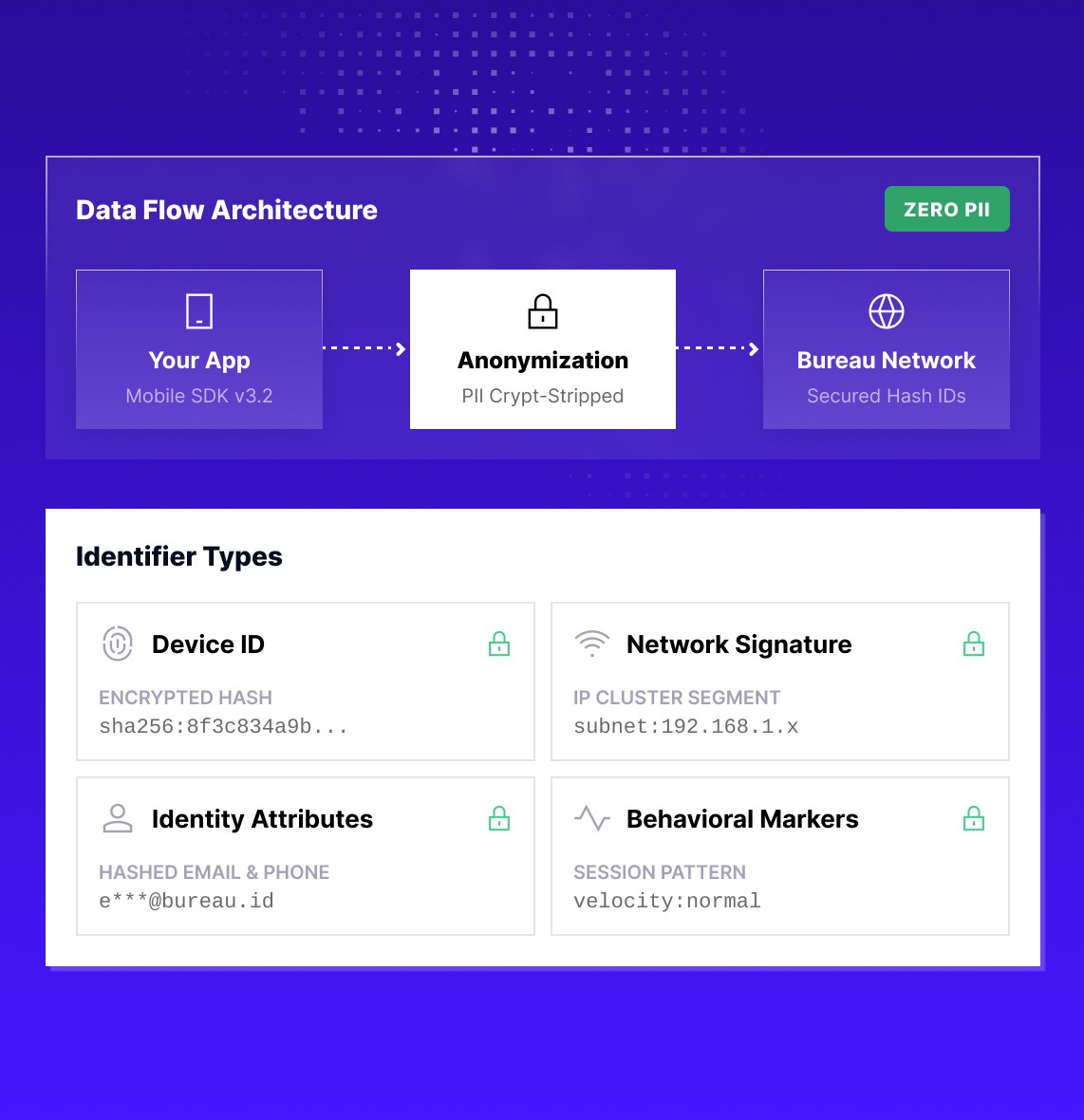
Connect - Your signals join the network as identifiers, not records.

Bureau's SDK or API already collects device, network, and identity signals on the journeys you protect. Those signals enter the network as anonymized, encrypted identifiers. No customer PII moves between institutions and no member sees another member's data. What is shared is risk intelligence about devices, identities, and infrastructure, which is the part that catches rings and the part that carries no personal data with it.

Anonymized and encrypted identifiers, never raw PII

No member can see another member's customers or data

Works through the SDK or API you already have live

Connect - Your signals join the network as identifiers, not records.

Bureau's SDK or API already collects device, network, and identity signals on the journeys you protect. Those signals enter the network as anonymized, encrypted identifiers. No customer PII moves between institutions and no member sees another member's data. What is shared is risk intelligence about devices, identities, and infrastructure, which is the part that catches rings and the part that carries no personal data with it.

Anonymized and encrypted identifiers, never raw PII

No member can see another member's customers or data

Works through the SDK or API you already have live

use cases

One graph infrastructure. Every risk scenario.

GIN powers risk decisions across onboarding, credit, transaction monitoring, and trust & safety - for any institution processing identity or money movement at scale.

Stay updated with Our resources

Stay updated with Our resources

See the Network. Stop the Fraud.

See the Network. Stop the Fraud.

frequently asked question

Got questions? We’ve got answers

What is Bureau’s Graph Identity Network?

Bureau’s Graph Identity Network (GIN) is a dynamic knowledge graph that leverages insights from interconnected data to establish a global trust network.

How does Bureau’s GIN improve detection of money mules and fraud rings?

Bureau GIN intelligently links and correlates data points aggregated from various sources to uncover hidden relationships and patterns for deeper insights into user identity and potential risks, thereby enabling businesses to dismantle financial crime networks.

Why choose Bureau’s GIN?

Bureau’s GIN accurately correlates users, devices, emails, and IPs to detect hidden fraud rings. By decoding contextual linkages between identity signals, it helps understand true user intent, proactively mitigate fraud risks, and ensure compliance with anti money laundering regulations.